Did War Cut the World's Emissions?
November 13, 2026
On the morning of Tuesday, 10 November 2026, in a conference hall in Antalya on Turkey's Mediterranean coast, a team of climate scientists stood up at the COP31 talks to present the one number every delegation had been waiting for.1 The Global Carbon Budget, now in its 21st edition and compiled by more than 140 scientists from the University of Exeter, the University of East Anglia, CICERO in Oslo, LMU Munich, the Alfred Wegener Institute and more than 90 other institutions, projected that fossil carbon dioxide emissions in 2026 would come to 38.2 billion tonnes. That was 0.4 percent less than in 2025.2 It was the first annual fall since 2020, and only the third of the 21st century, after the financial crisis of 2009 and the pandemic year of 2020.3
Emissions from oil were projected to drop 1.9 percent, about 243 million tonnes of CO2, one of the largest annual falls in the record, matched or exceeded only by 2020 and comparable to the declines of 2009 and of 1992, the year after the Soviet Union dissolved. Oil emissions fell in every major region. Gas was down 0.3 percent, "effectively flat." Coal was up 0.6 percent.4 The headline figure carried a range from minus 1.5 percent to plus 0.6 percent, and the authors wrote plainly that "a small increase in emissions can not be ruled out."4
The press release named two causes in a single phrase: the decrease was "driven by expansion of solar and wind power and the Iran conflict." The fall in oil, it added, was "likely a short-term response to the energy shock triggered by the Iran conflict."2 The team's own accounting showed how the two halves fit together. Rising demand for energy alone would have added about 0.78 billion tonnes of CO2 in 2026; solar, wind and electric vehicles offset roughly 0.54 billion tonnes of that, about 69 percent. The rest of the swing from rise to fall came "mostly" from high energy prices and supply constraints.4 In February 2026, before the first missile was fired, the International Energy Agency had forecast that world oil demand would grow by 850,000 barrels a day that year and that the market would sit on a 3.7-million-barrel-a-day surplus. By June it had revised the growth figure to a contraction of 1.1 million barrels a day.5 Fossil emissions had risen 1.2 percent in 2025, to a record.6 Pep Canadell, executive director of the Global Carbon Project, was quoted at a briefing in Spain the same day: "Had it not been for the war in Iran, emissions would surely have risen very little or perhaps hardly at all, but they would not have fallen."7
Glen Peters, a research professor at CICERO, put it in one sentence in the official release: "A drop in emissions in one year is not a peak unless it is driven by structural change."2 To Seth Borenstein of the Associated Press he was blunter. "It's downwards which sounds good, but this is largely driven by the war in Iran, what's happened in the Strait of Hormuz," he said. "So in a way, a little bit of good news, but for the wrong reasons." Oil emissions, he said, should have climbed slowly to a peak and slowly declined, "whereas what we see this year is oil emissions are going up and then suddenly BANG, down 2%." He remembered the hopes after 2009 and 2020 that recoveries would be built on clean energy, "but at the end of the day, we seem to go back to where we were before."3
Pierre Friedlingstein of the University of Exeter, who led the study, chose his words for the cameras: "A decline in fossil CO2 emissions is encouraging, but a reduction driven partly by geopolitical shocks is not a sustainable climate solution." Corinne Le Quéré of the University of East Anglia pointed to the other half of the ledger: "Countries on every continent are decreasing their emissions while growing their economies. A further acceleration could turn the tide on global emissions within a few years."2
Fossil fuels are not the whole account. Adding the carbon released by cutting and burning land, total CO2 emissions in 2026 were projected at 43.3 billion tonnes, up from 42.8 billion in 2025 and a new record. Land-use emissions rose from 4.4 billion to 5.1 billion tonnes, driven by peat fires "almost entirely ignited by human activities" and forest degradation in Southeast Asia as an El Niño dried the region out. The carbon budget left for a 50 percent chance of holding warming to 1.5°C stood at 150 billion tonnes from the start of 2027, "less than four years of emissions at the current rate."4
The day before, at the opening plenary, Simon Stiell, the UN's climate chief, had told delegates from almost 200 countries that "fossil fuel cost chaos" had "delivered a global shock wave, hitting households hard and spreading inflation like a cancer." Outside, activists staged a "fossil of the day" demonstration, one of them in a dinosaur costume.8 The 38.2 billion tonnes, the AP worked out, came to about 1,211 metric tonnes of carbon dioxide every second. "It's very abstract to think about the magnitude of stuff we throw in the atmosphere every year, but it's a ginormous number," Peters said. "If it was black and not transparent, the sky would be dark."3
1. The Strait
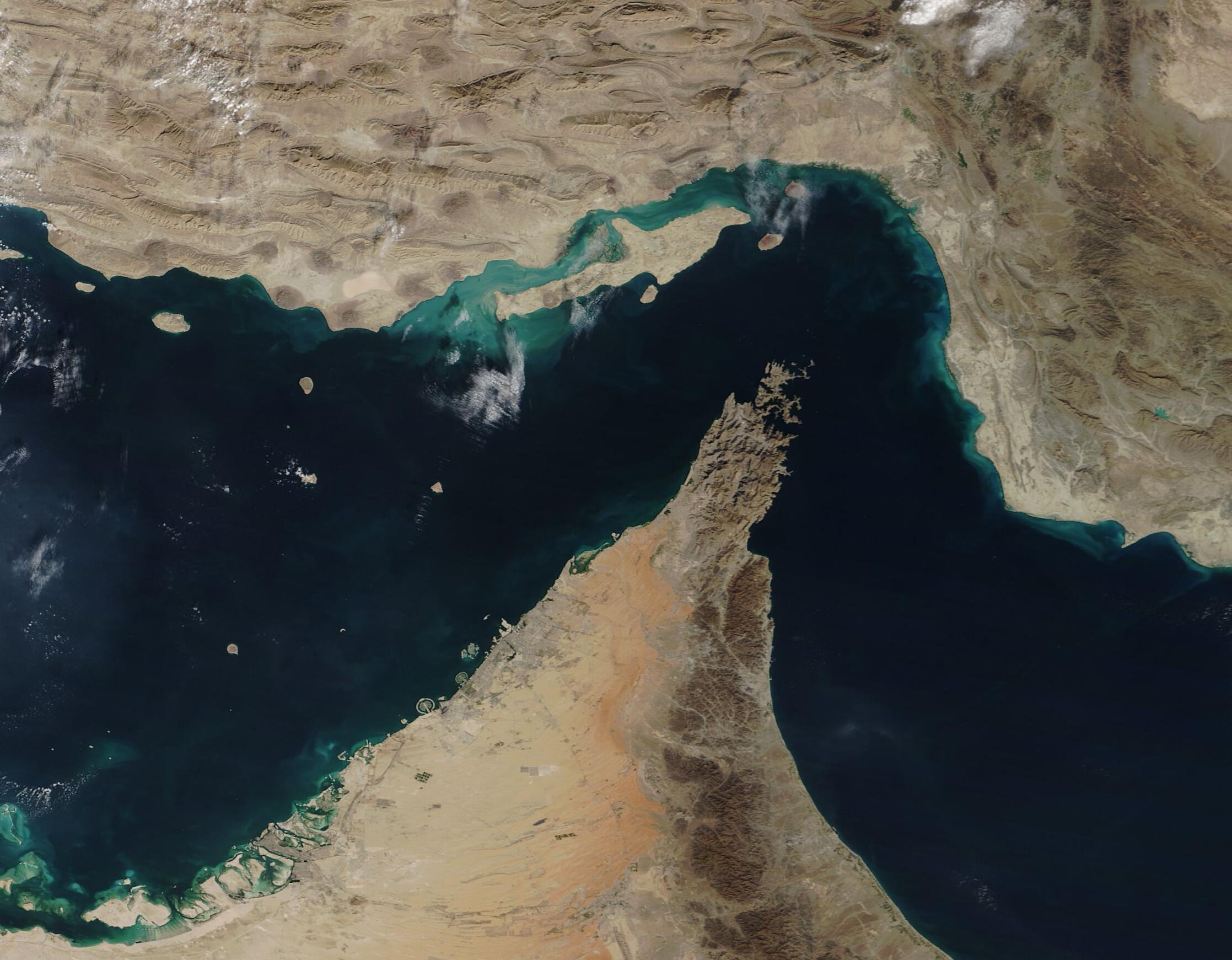
On 28 February 2026 the United States and Israel launched joint large-scale strikes on Iran. Supreme Leader Ali Khamenei was reportedly killed in the opening wave, along with other senior officials, and the Revolutionary Guards answered with missiles and drones aimed at US bases and at Israel.910 Within days the Strait of Hormuz was closed in all but name. Iraq, Saudi Arabia and the United Arab Emirates shut in oil production they could no longer ship.11 According to one tally of satellite ship-tracking data, 57 vessels transited the strait on 28 February and none on 4 March.12 Before the war roughly a quarter of the world's seaborne oil trade and a fifth of its liquefied natural gas passed through it, by one widely cited count.13
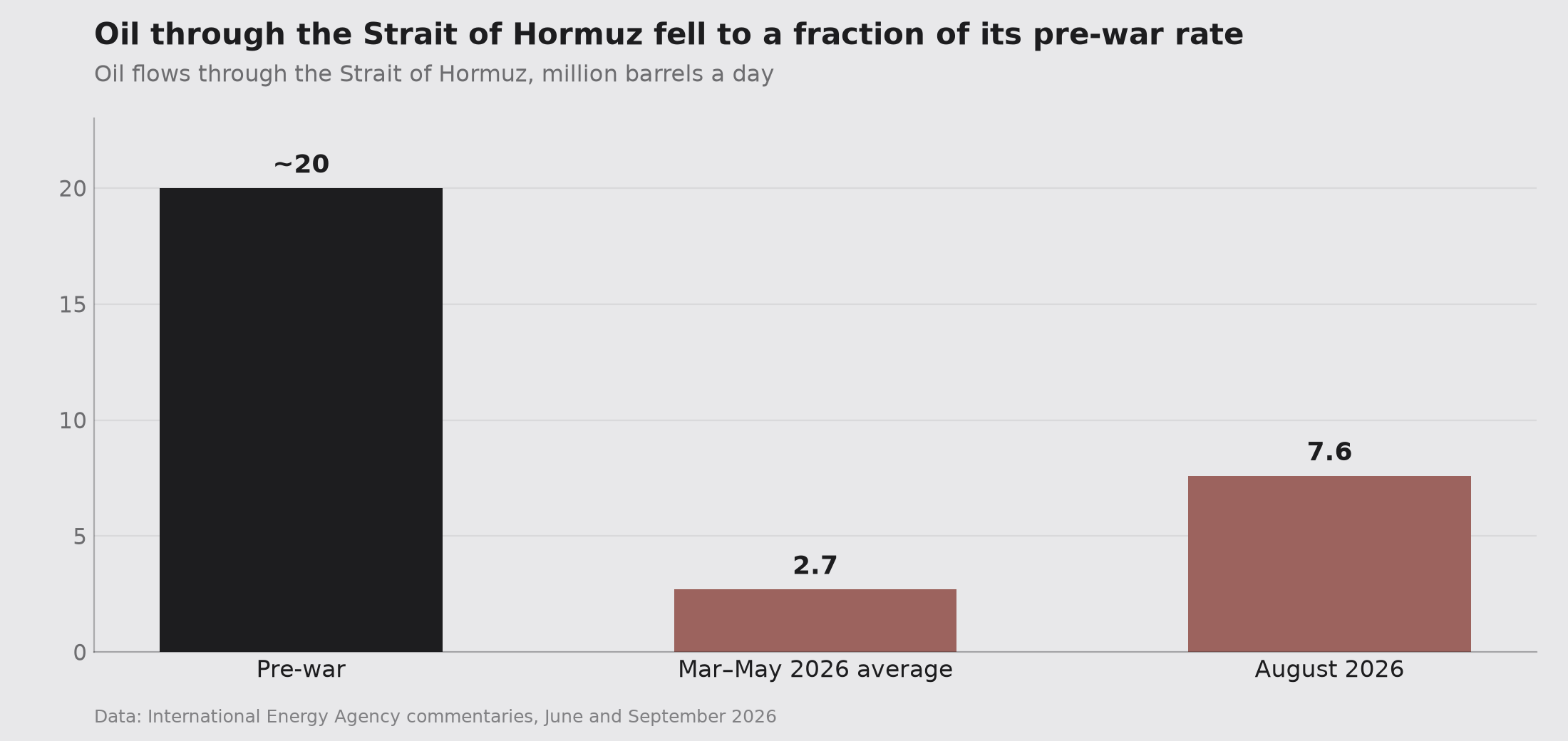
Through the strait had flowed about 20 million barrels of oil a day. Between March and May the average fell to 2.7 million. By 22 June cumulative supply losses from the Middle East had passed 1.3 billion barrels, and the IEA called it the "largest supply disruption in history."5 Between 28 February and 19 March only about 90 vessels made the crossing, most of them flagged in India, Pakistan or China.14 By April the International Maritime Organization reportedly counted some 20,000 seafarers and 2,000 ships stranded in the Gulf.13 On 12 March Mojtaba Khamenei, in his first public remarks, reportedly called for the strait to stay closed.10
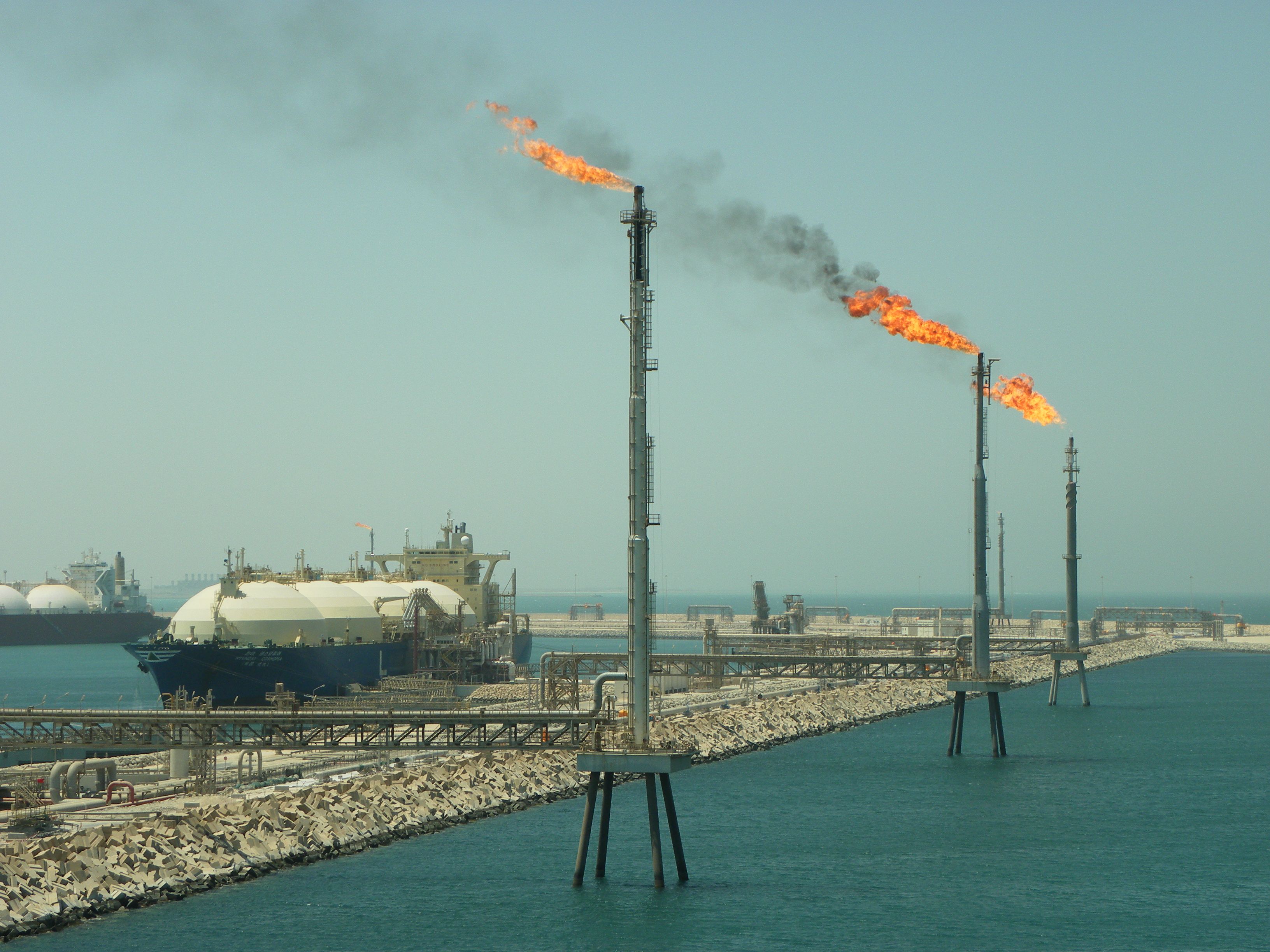
Gas was hit almost as fast as oil. On 2 March Iranian drones targeted QatarEnergy's complex at Ras Laffan and LNG production there halted.15 On 18 and 19 March missiles struck again and damaged LNG Trains 4 and 6, which together hold 12.8 million tonnes a year of capacity, about 17 percent of Qatar's exports. Repairs were put at three to five years and the lost revenue at about $20 billion a year; the Pearl gas-to-liquids train would be offline for at least a year. Saad Sherida Al-Kaabi, Qatar's minister of state for energy and chief executive of QatarEnergy, said the strikes "weren't just an attack on the State of Qatar but attacks on global energy security and stability." He named the buyers: "The impact is on China, South Korea, Italy and Belgium. This means that we will be compelled to declare force majeure for up to five years on some long-term LNG contracts."16
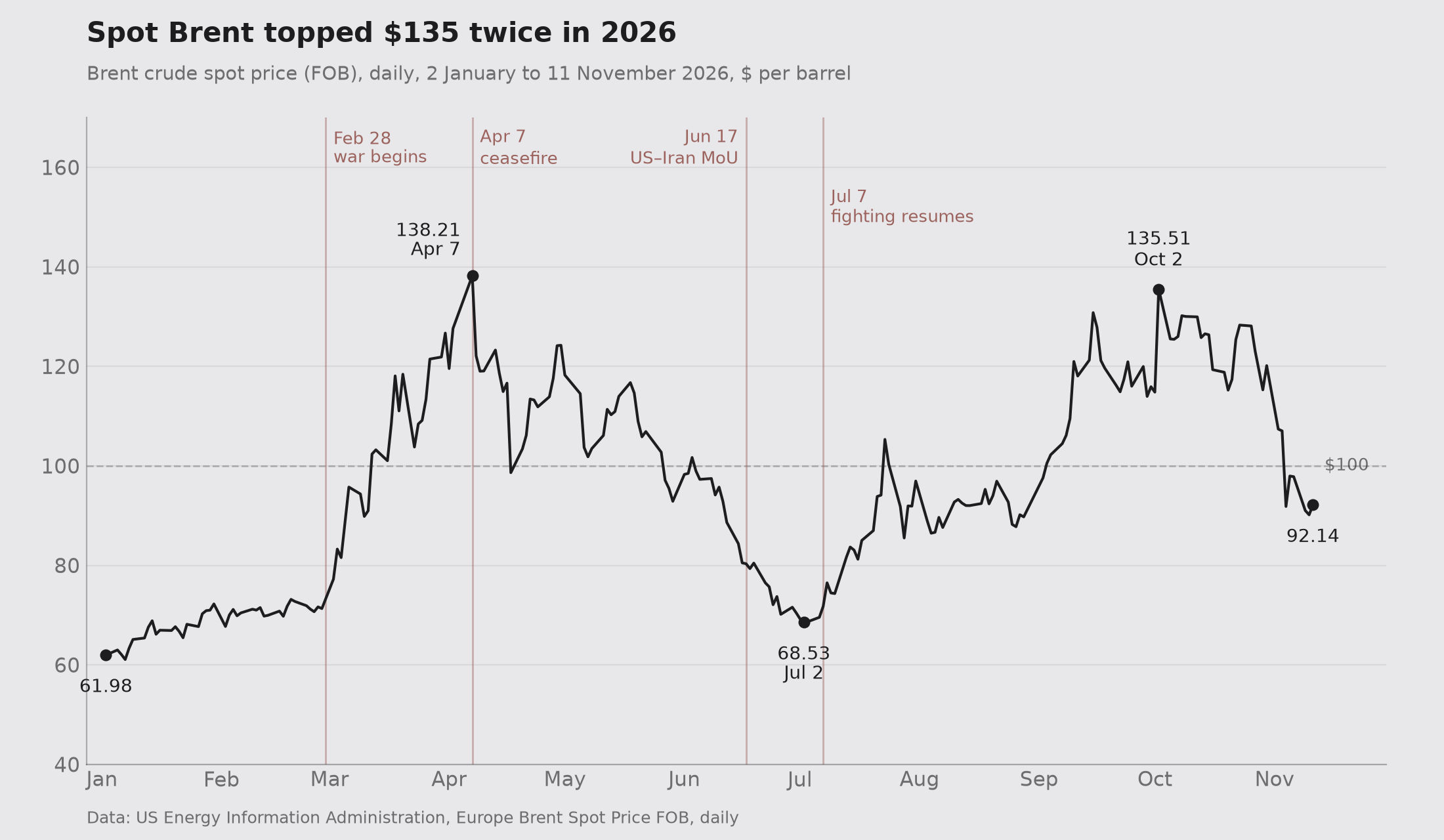
Brent front-month futures, at $72 a barrel at the end of February, passed $100 on 12 March and finished the first quarter at $118, the largest quarterly increase on an inflation-adjusted basis in data going back to 1988.11 The physical market ran further ahead of the paper one. On 19 March Dubai crude, the Asian marker, reportedly hit a record $166.80,17 and in early April North Sea Dated Brent, the price for actual cargoes, reached an all-time high of $144, more than double its pre-war level.5 In the United States, retail gasoline reached $3.99 a gallon on 30 March.11 On 11 March the IEA's members had unanimously agreed the largest emergency stock release in the agency's history, 400 million barrels, more than double the previous record, set in 2022.5
Donald Trump announced a two-week ceasefire on 7 April, and Brent fell as much as 16 percent the next morning; by 30 April futures were back at a four-year high of $126.41.15 From 13 April to 29 May the US Navy blockaded Iranian ports, by one account.13 On 17 June Washington and Tehran signed a memorandum of understanding; the IEA called it "a crucial breakthrough." Brent futures began the third quarter at $72 on 1 July, their lowest since 26 February.185 On 7 July the strikes resumed. Futures passed $100 again on 23 July and once more on 9 September, after attacks on tankers, a US blockade of Iranian oil exports, strikes on pumping stations of Saudi Arabia's East-West pipeline, tanker attacks in the Bab el-Mandeb and Ukrainian drones over the Russian port of Novorossiysk. On 15 September futures peaked at $109 while spot cargoes changed hands as high as $132.18 On 23 October, after Houthi attacks inside Saudi Arabia, Brent settled at $116.72.15
In August only 7.6 million barrels a day were getting through Hormuz, 13.1 million below the pre-war rate, and lost exports through the strait were approaching 2.8 billion barrels.19
On 18 September Toril Bosoni, head of the IEA's oil industry and markets division, set out what those prices had done to consumption: "global oil demand over the past six months has averaged 5.8 mb/d less than in February, which equates to a cumulative demand reduction of more than 1 billion barrels." In the second quarter demand fell below the year before for the first time since Covid, and the Middle East and Asia accounted for 80 percent of the year's drop.19 China cut its crude imports by 40 percent between February and May, and its refiners drew down their own tanks.519 "Some governments, notably in Asia," the IEA noted, "have implemented fuel rationing and emergency conservation policies."19
On Sunday, 15 March, Sri Lanka brought back fuel rationing. "In scenes reminiscent of Sri Lanka's economic crisis four years ago," the Guardian reported, long lines formed outside petrol stations; motorists were limited to 15 liters of petrol or diesel a week, public transport to 200 liters.20 One later report put the weekly National Fuel Pass at 25 liters for cars and 20 for tuk-tuks, so the limits likely moved.21 The QR-code system built during the 2022 crisis was revived, and administered fuel prices were reportedly raised four times by a cumulative 38 to 46 percent.22 From Wednesday, 18 March, schools, universities and state institutions worked four days a week. After an emergency meeting chaired by President Anura Kumara Dissanayake, Prabath Chandrakeerthi, commissioner general of essential services, said: "We are also asking the private sector to follow suit and declare every Wednesday a holiday from now on." Dissanayake reportedly told senior officials: "We must prepare for the worst, but hope for the best."20
Pakistan, which gets 85 percent of its energy through Hormuz, shut its schools for two weeks, moved university teaching online and raised fuel prices to discourage hoarding.2023 Free fuel for government vehicles was cut by half for two months, and the Pakistan Day parade was cancelled and replaced by a flag-hoisting ceremony.14 On 17 September Islamabad reportedly announced a second round of austerity: no new state vehicles, no official foreign visits or dinners, meetings by teleconference.24 Bangladesh, which imports about 95 percent of its energy, brought forward the Ramadan holidays for universities and scheduled blackouts for fear its garment factories would run dry; on 10 March motorbikes queued around a gas station in Dhaka.2025
In Manila the government paid $83 each to about 139,000 tricycle-taxi drivers and put its offices on a four-day week.14 President Ferdinand Marcos Jr signed an executive order on 25 March citing "imminent danger" to the energy supply; diesel reportedly neared 150 pesos a liter, and government agencies were ordered to cut power and fuel use by 10 to 20 percent.26 India, which draws 60 percent of its LPG from the Gulf, saw long queues for cooking-gas cylinders; restaurants closed or dropped slow-cooked dishes from their menus, and Prime Minister Narendra Modi said there was "no need to panic."20 On 19 March an elderly man in New Delhi was photographed tying a gas cylinder to his scooter at a depot.14 By late May about a fifth of India's trucks had reportedly gone off the roads, with "serpentine queues" at highway fuel stations.27
Japan, which relies on Hormuz for about 93 percent of its oil imports, released 15 days of private stocks and then a month of national reserves; regular gasoline rose from about $0.91 a liter to $1.09 in a month.14 South Korea, which takes 70 percent of its oil from the Middle East, saw drivers queue at the cheaper stations.14 In Hanoi "sold out" signs reportedly went up at 15 to 20 stations, and the Vietnamese government urged people to "ride bicycles, carpool, use public transport."2829 Nepal Oil Corporation filled cooking-gas cylinders only halfway, to about 15 pounds.14 "The countries that are exposed to that supply disruption are not so much in Europe, or in the Americas, they're actually really in the Asia region," said Michael Williamson of the UN's Economic and Social Commission for Asia and the Pacific.14
In Kenya about a fifth of petrol stations were reportedly short of fuel in late March; Energy Minister Opiyo Wandayi denied there was a shortage and accused retailers of hoarding. A flower-farm manager who used to export 450,000 stems a day said the farm was now "discarding almost 50%."30 In Juba, the South Sudanese capital, the power distributor Jedco began rotating daily cuts, "prioritising a strategic rationing of power." Resident Ereneo Mogga said the electricity went off from 4 p.m. to 4 a.m.: "This paralyses most businesses." In Zimbabwe fuel prices rose 40 percent in under a month, and Nicole Mazarura, a vendor in Harare, said: "If transport costs go back to where they were, I can survive." Mauritius was left with 21 days of stock after a shipment failed to arrive.30 By September, fossil-fuel importers worldwide had paid more than $330 billion extra since 28 February, and poorer countries had spent an additional 1 percent or so of GDP, more than double the share for wealthier ones.31
In late July in Irbil, the capital of Iraqi Kurdistan, most private stations had shut and the queues stretched so far that some drivers could no longer see the pumps. It was 45°C; people kept their windows down rather than run the air conditioning. "We came at 11:30 p.m. last night," said Twana Mohammed, a 43-year-old biology teacher. "There's no fuel left in my car." Abdullah Hamad, a 50-year-old car dealer, described the night: "Every five minutes we move forward a little bit, then turn the engine off, wait for five minutes, and move forward again." "Our country is full of oil," he said. "We were even happy with the high price, as long as it's available." Ameen Karwan, the 25-year-old attendant, had received 36,000 liters. Families were allowed 40 liters, twice a week.32
2. The Old Fuel
On March 18 and 19, 2026, Iranian missiles struck Ras Laffan, the gas complex on Qatar's north-east coast, and damaged two of its liquefaction lines, Trains 4 and 6. Together they could turn out 12.8 million tonnes of liquefied natural gas a year, about 17 percent of Qatar's exports. Repairs were put at three to five years and the lost revenue at roughly $20 billion a year; the Pearl gas-to-liquids train was expected to stay offline for at least a year.16 Saad Sherida Al-Kaabi, Qatar's minister of state for energy and the chief executive of QatarEnergy, said the strikes "weren't just an attack on the State of Qatar but attacks on global energy security and stability." Then he named the customers: "The impact is on China, South Korea, Italy and Belgium. This means that we will be compelled to declare force majeure for up to five years on some long-term LNG contracts."16
Europe's benchmark gas price, the Dutch TTF, had traded at about €30–31 per megawatt-hour before the war. It reached €50 on March 5, was at €56.94 on July 28, and in the week to October 29 stood above €95, close to its highest since December 2022, after QatarEnergy extended its force majeure to the end of December.15 Production at Ras Laffan had already been halted once, on March 2, when Iranian drones targeted the facility.15
In September the International Energy Agency noted that virtually no coal shipments pass through the Strait of Hormuz, since the Middle East "is neither a major producer nor consumer of coal," yet the war had "nonetheless affected coal markets by driving up natural gas prices due to the huge drop in liquefied natural gas (LNG) shipments through the Strait." Coal use was running higher "in Europe, Japan, Korea, China and other markets than previously expected."33
South Korea gets about 70 percent of its oil from the Middle East, and by mid-March there were queues at the cheaper gas stations. The government said it was lifting the national cap on coal-fired generation, boosting nuclear power and considering a resumption of Russian crude and naphtha imports.14 The ruling party reportedly said the coal cap, set at 80 percent, would go and nuclear would be pushed to about the same level.34 With nuclear availability low and gas expensive, Korean coal-fired generation in the first quarter of 2026 was 30 percent higher than a year earlier.35
Japan, which relies on Hormuz for about 93 percent of its oil imports, moved on March 27. The trade ministry reportedly suspended for one year the 50 percent utilization cap on coal plants with an efficiency below 42 percent; an official was quoted as saying, "There is increasing uncertainty about future LNG procurement. We believe that it is necessary to increase the operation of coal-fired power plants and save LNG fuel."36 The government also removed restrictions on which coal plants could earn capacity payments. Even so, the IEA expects Japanese coal demand to edge down in 2026, the high gas price propping coal up rather than lifting it.35
Thailand's emergency plan suspended petroleum exports and ramped up coal output and hydropower,14 and the retired Mae Moh coal-fired plant was reportedly brought back into service.37 India ordered its coal plants to run at full capacity.38 Vietnam, which pledged in 2021 to build no new coal plants after 2030, said in July that it was considering building more.39 The Philippines was reported to be ramping up coal as well.40 In China, high oil prices pushed more coal into chemical plants as a feedstock, even as domestic coal production fell after safety inspections that followed a major mine accident in May.33 Japan, China and South Korea together reportedly imported 122 million tonnes of coal in the third quarter.41
One month into the war, at least 60 countries had announced 185 energy policies, and at least eight of them, Japan, South Korea, Bangladesh, the Philippines, Thailand, Pakistan, Germany and Italy, had said they would either burn more coal or review their plans to stop. Most of these moves delayed closures or let old plants run harder; few involved building new ones.42 Italy pushed its coal phase-out back by more than a decade, to 2038.43 In Berlin, Chancellor Friedrich Merz floated keeping coal plants online longer and building gas plants faster.38
In its coal mid-year update, published on September 10, the IEA reported that global coal demand, "which had been set to decline slightly year-over-year," was now forecast to rise 1.2 percent in 2026 to a record 8.94 billion tonnes.33 A year earlier the picture had looked different: in 2025, "for the first time in 50 years," China and India both generated less electricity from coal than the year before. Now the agency expected both to burn more, while the European Union's decline would be "less pronounced than previously anticipated" in Germany and Poland.35
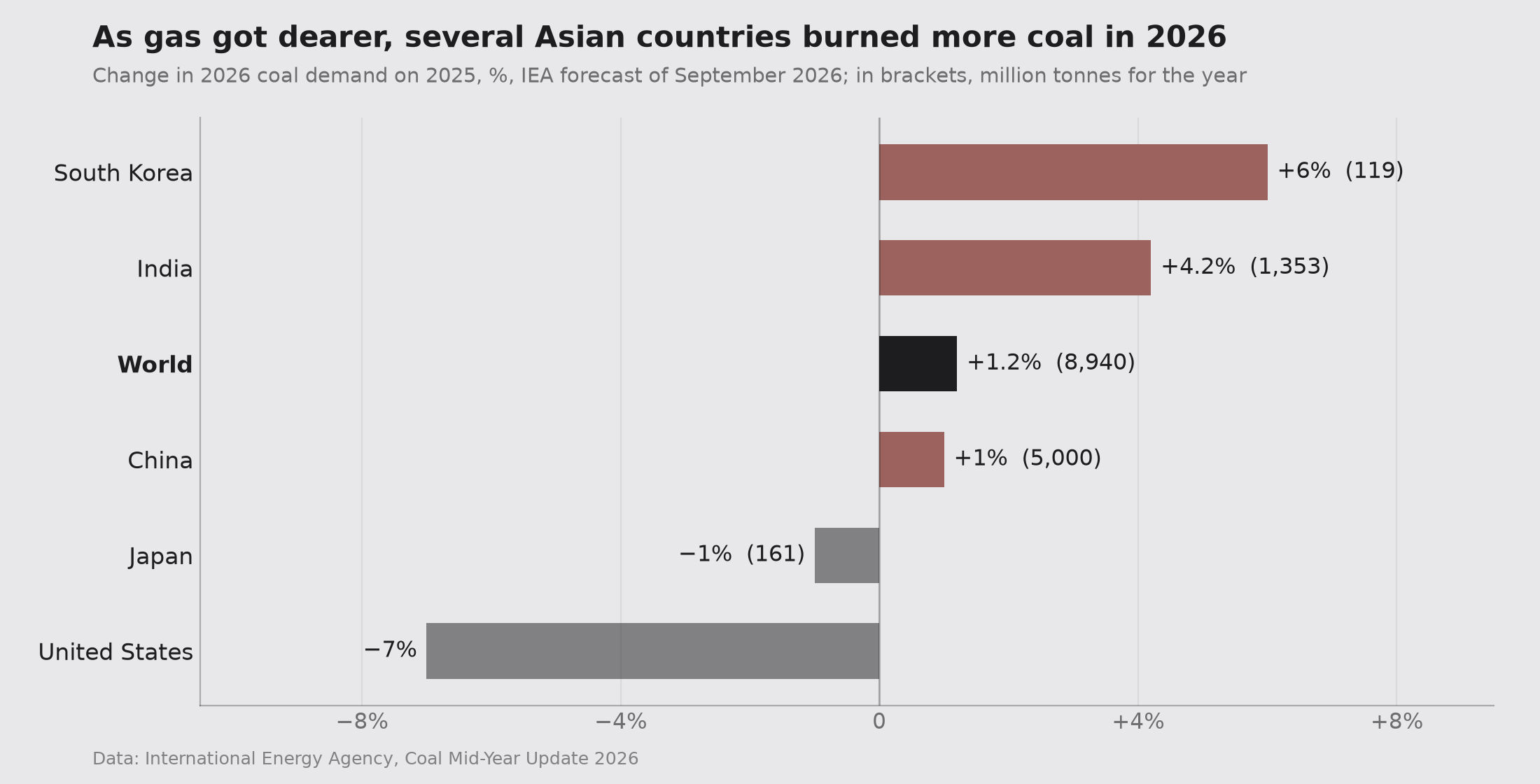
A strong El Niño, expected to raise cooling demand and cut hydropower output, would add to coal burning in India and Vietnam.33 The New York Times ran the story under the headline "The Iran War Is Pushing Global Coal Use to Record Highs."44 In carbon terms, coal emissions were projected to rise 5.9 percent in India and fall 6.7 percent in the United States.4 In the first half of the year, global greenhouse gas emissions had been only 0.2 percent above the year before, and fears of a major near-term rise in coal use "did not become a reality."31
By early April about 30 nations had cut fuel taxes, by far the most common domestic response, and 17 countries, including Mexico and Poland, had capped fuel prices.42 Australia halved its fuel excise for three months.38 Malaysia reportedly raised its petrol subsidy to hold the price of RON95,40 and South Korea set aside $17.3 billion, mostly for refiners operating under price caps and for vouchers.45 On March 25, Christine Lagarde, president of the European Central Bank, accepted short-term measures to "smooth the shock" but warned that "broad-based and open-ended measures may add excessively to demand."42 On June 29 the UN Development Programme put global fossil fuel subsidies on track for $1.1 trillion in 2026, $410 billion more than in 2025, assuming oil at $88.60 a barrel, and up to $1.43 trillion at $110.46 "To deal with today's crisis, governments are postponing tomorrow's investments," said Alexander De Croo, the UNDP administrator. "Money that should be building schools, hospitals, and clean energy systems is being used simply to keep economies afloat."46
In Houston on March 23, at the CERAWeek conference, US Energy Secretary Chris Wright urged producers to "produce more, and do it now." Brent was trading at $101–103 and American gasoline just under $4 a gallon. Jarrod Agen, executive director of the National Energy Dominance Council, said "Drill baby drill" was the administration's weekly mantra: "We haven't heard any pushback on wanting to produce more." He added: "The president's made it pretty clear he doesn't want new wind projects."47 The administration agreed to pay TotalEnergies nearly $1 billion of public money to drop a planned wind farm off the Atlantic coast and put the investment into US oil and gas instead,47 and Donald Trump told allies that had stayed out of the war to buy from the United States or "go get your own oil."38 The Energy Department began a 172-million-barrel emergency sale from the Strategic Petroleum Reserve in March,48 part of a record 400-million-barrel release that the IEA's 32 members reportedly agreed on March 11.49 The reserve, above 415 million barrels before the war, was reportedly down to about 284 million by October 1.50 Drilling appetite did not match the rhetoric: the third Gulf of America lease sale, on August 12, reportedly drew only $82 million in high bids, 69 bids on 59 tracts out of some 15,000 blocks on offer.51
On February 10, eighteen days before the war began, the European Parliament voted 413 to 226 for a binding 90 percent cut in net emissions by 2040, and as part of the deal postponed ETS2, the new carbon price on heating and road fuel, by a year, from 2027 to 2028.52 The Council gave final approval on March 5.53 Once the war began, Italy's prime minister, Giorgia Meloni, called for "the urgent suspension of the application of the ETS to electricity production." Julian Popov, Bulgaria's caretaker environment minister, called the direction of the debate "completely insane" and "very populistic." Ursula von der Leyen told the European Parliament that the carbon price made up 11 percent of the average energy bill and that "without ETS we would now consume 100 [billion cubic meters] more gas — again, making us more vulnerable and more dependent... So, we need ETS, but we need to modernise it."54 On April 1 the Commission proposed ending the automatic cancellation of surplus permits held in the market stability reserve.38 On July 17 it reportedly proposed slowing the annual cap reduction from 4.3 percent to about 3.7 percent from 2031 and 1.7 percent from 2036;55 by one count that would add 2 billion tonnes of CO2 equivalent.56 At the European Council on October 15 the leaders of Italy, Poland, Czechia, Estonia and Hungary asked for ETS2 to be delayed or scrapped. The majority said no, but Meloni won a promise to reconsider its start date. The same month, methane reporting rules for imported oil, gas and coal were delayed by up to three years, and Merz and Emmanuel Macron agreed to scrap the 2035 ban on new combustion-engine cars.57
On October 5, in London, Aramco's president and chief executive, Amin Nasser, called the war "the most serious energy supply shock in my career." The world had entered the crisis with almost 10 billion barrels of oil in storage, he said, and nearly 3 billion barrels of supply had been lost: "Emergency reserves might buy us a winter. They cannot fix long-term supply." His prescription followed: "Markets can diversify suppliers. They cannot diversify geology," and "Let's end the era of cyclical under-investment." Oil and gas, he said, "are not just tradable commodities. They are the lifeblood of modern civilization," and Middle East oil and gas would "remain central to that system for decades to come."58 Sultan Al Jaber, head of ADNOC, had reportedly told an audience in May that "we are dangerously under-invested," with upstream spending of around $400 billion a year that "barely offsets natural decline rates."59 The industry's third quarter supplied the context: by one tally, nine of the world's biggest oil companies made $95 billion in profit.60
In March, Philippine imports of Chinese solar equipment jumped 262 percent year on year, and Africa imported 37 percent more Chinese solar gear in the first half of 2026 than a year earlier.31 Electric car sales hit records across dozens of markets in the spring.61 For coal, the IEA laid out two paths for 2027. If tensions ease, demand slips 0.4 percent to 8.91 billion tonnes. If the strait stays largely closed to LNG tankers, demand "could increase further."35
3. Notches in the Curve
The Panic of 1907 dragged the world economy into recession, and the next year the carbon dioxide released by burning coal and oil and making cement fell by almost 4 percent. It is the first notch of the twentieth century in the Global Carbon Budget's data. Of the 125 years from 1901 to 2025, emissions fell in only 25, and the history books put the same words beside them: panic, world war, demobilization, depression, embargo, interest-rate shock, collapse, financial crisis, pandemic.62
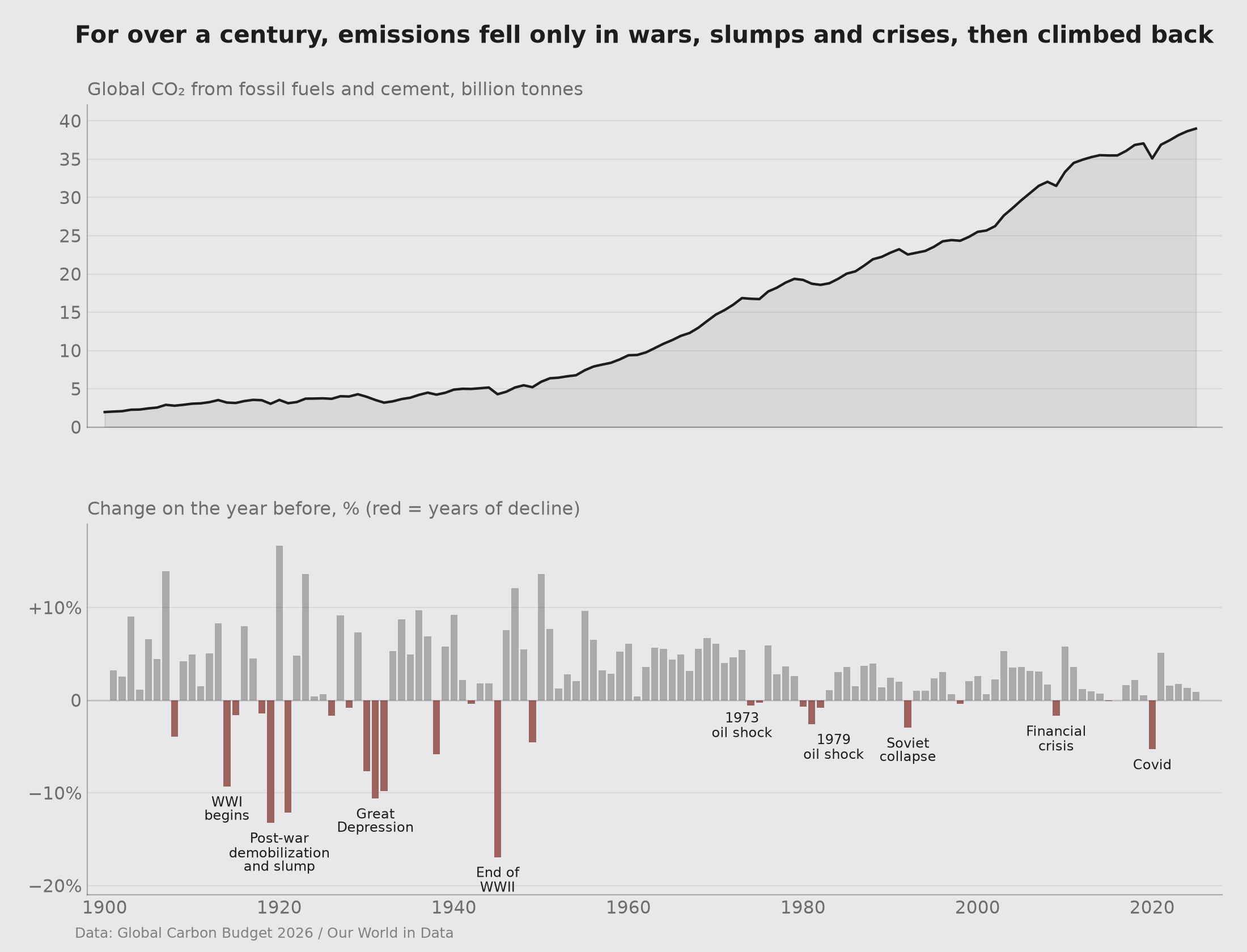
The First World War broke out in August 1914, and that year world emissions fell 9.3 percent, most of it coal. War soon became a vast industrial machine, and by 1917 emissions were back at their prewar level. The deeper falls came after the armistice, when demobilization and slump arrived together: 1919 and 1921 each lost more than a tenth. The rebound was just as abrupt. In 1923 alone, emissions rose 13.6 percent.62
After the Wall Street crash of October 1929, emissions fell three years running, and by 1932 a quarter of the world's fossil CO2 had gone, the deepest multi-year fall in the record. The hole filled more slowly than it had opened; the 1929 level was not passed again until 1937.62
Through the Second World War the line climbed almost without a break, peaking in 1944. The fall came in 1945, the year the war ended: 16.9 percent in a single year, the largest annual drop since 1900, almost all of it coal. Total emissions that year were nearly identical to 1929's, sixteen years of growth erased at once. By 1947 they had already passed the wartime peak.62
In October 1973 the Arab oil producers imposed their embargo, and oil went from $2.90 a barrel before it to $11.65 in January 1974. The Federal Reserve's chairman, Arthur Burns, said in 1974 that the oil manipulation "came at a most inopportune time for the United States."63 Oil had by then overtaken coal as the largest source of emissions, yet the shock left only a shallow mark on the total: less than 1 percent across 1974 and 1975, and by 1976 the 1973 peak was behind it.62
The Iranian revolution of 1979 took about 7 percent of world oil production off the market, and prices more than doubled in a year. Paul Volcker's Federal Reserve then pushed its funds rate to 19 percent in 1981, and the United States went into its worst recession since the Great Depression.64 World emissions fell three years in a row, from 1980 to 1982, about 4 percent in all, and were back at their old height by 1985.62
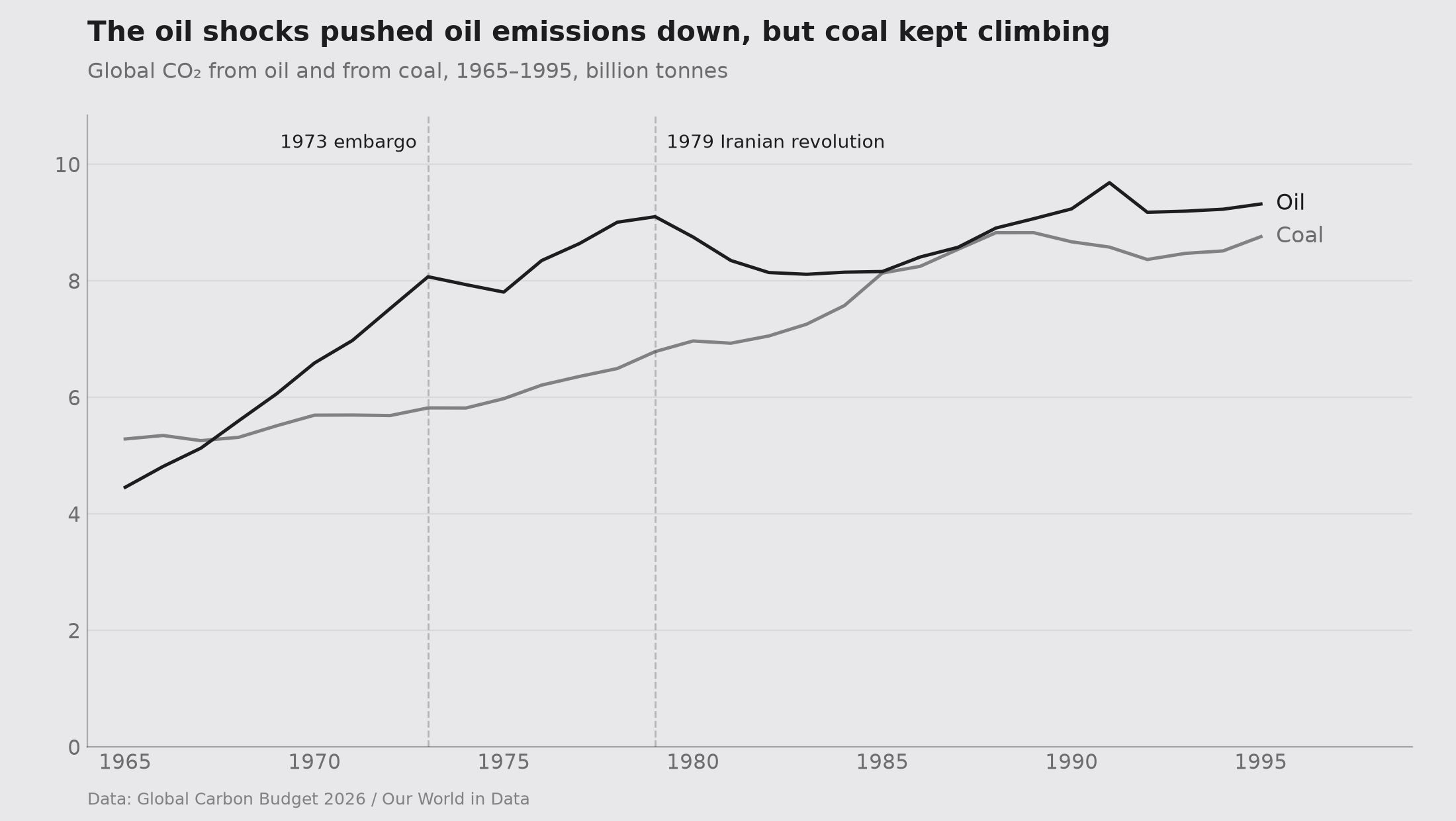
In the five years of decline the two shocks produced, oil emissions fell every time, while coal emissions rose in three of them; part of the demand simply moved from oil to coal.62 Oil itself took far longer to recover. Its 1979 emissions peak was not exceeded until 1990, and per person, world emissions did not pass their 1979 level until 2005.62
In 1991, with Kuwait's oil wells on fire, world emissions actually rose.65 In 1992, the first full year after the Soviet Union dissolved, they fell about 3 percent. Over the 1990s the fifteen former Soviet republics cut their emissions by more than two fifths, an amount equal to about 7.7 percent of world emissions in 1990, and growth elsewhere filled almost all of that hole.62 The financial crisis took 1.7 percent off in 2009; in 2010 emissions rose 5.8 percent, more than making it back.62
In 2020, with cities locked down and planes grounded, COVID-19 took almost 2 billion tonnes off the total and 11 percent off oil emissions. In absolute terms it was the largest fall in the record; in percentage terms it does not make the top five. By 2022 emissions had passed their 2019 level, and they kept rising every year after, to about 39 billion tonnes in 2025.62 On the day the 2026 Global Carbon Budget was released, Glen Peters of CICERO in Oslo recalled 2009 and 2020 to the Associated Press: people had hoped the recoveries would tilt toward clean energy, "but at the end of the day, we seem to go back to where we were before."3
In 1973 the world burned 0.97 barrels of oil for every $1,000 of GDP, measured in 2015 dollars, the highest on record; by 2019 the figure was 0.43.66 The steepest stretch came right after the shocks. After the Iranian revolution, oil intensity "went into a tailspin for a few years," and between 1980 and 1985 it fell 15 percent even as real oil prices dropped by more than 40 percent.66 With 1973 set at 100, America's ratio of oil use to output had fallen to 63 by 1985, and Denmark's to 48.67 The IEA's thirty-year review in 2004 reportedly concluded that the oil shocks and the policies they prompted had done considerably more to restrain energy demand and CO2 than later efficiency and climate policies.68 The total paused only for a few years: by 1985 world fossil CO2 was about 680 million tonnes above its 1979 level.62
4. Car-Free Sundays
On October 6, 1973, Yom Kippur, Egyptian and Syrian forces attacked Israel. Eleven days later, on October 17, the Arab members of OPEC met in Kuwait and agreed to cut production. When the embargo on the United States began depends on the record you open: one account dates it to the 17th, another to the 19th or 20th. Federal Reserve History puts it on October 19, "immediately following President Nixon's request for Congress to make available $2.2 billion in emergency aid to Israel," while a General Accounting Office report counts the embargo's effect on the United States from October 29.6369 The embargo was extended to other countries that supported Israel, including the Netherlands, Portugal and South Africa, and the price of oil "first doubled, then quadrupled."70 A barrel that cost $2.90 before the embargo cost $11.65 in January 1974.63
At 3 a.m. on Sunday, November 4, 1973, the Netherlands entered its first autoloze zondag, car-free Sunday. Joop den Uyl's cabinet ruled that from that day until January 6, 1974, nobody could drive on a Sunday without a special permit.71 Buses and trams, fire engines, ambulances, doctors, dentists, vets, foreign tourists and food tradesmen were exempt. Richard Norton-Taylor of the Guardian, reporting from Amsterdam, found the motorways abandoned, long queues at bus stops and empty taxis parked in rows at the ranks; "the sound of bicycle bells and rusty – and not so rusty – wheels purring almost delicately took the place of angry drivers blowing their horns and impatiently revving their engines." A police corporal let a hippie bus painted in psychedelic colors tour the city. "It's very nice, after all," he said. Television crews from Germany, Belgium and Sweden filmed "middle-aged couples sharing a single bicycle taken from the back of the garage." The police, out at 3 a.m. for the start of the ban, caught two car thieves. The legal basis was the re-enacted Distribution Law of 1939, with fines of up to £17,500 or six years in prison; the fines actually handed out were about £17, and only a dozen drivers were fined in Amsterdam and a handful in The Hague. The country had an estimated six million mopeds and three million cars. One Dutchman credited the good behavior to "the element of Calvinism."72
Photographers from the Anefo agency, whose negatives are now in the Nationaal Archief, caught cyclists, roller-skating children and picnicking teenagers sneaking onto the empty motorway, and a horse-drawn carriage trotting along beside a cyclist.71 Queen Juliana reportedly set an example by riding a bicycle, the railways added carriages, and the Wegenwacht road patrol, with no breakdowns to attend, mended cyclists' flat tires.73
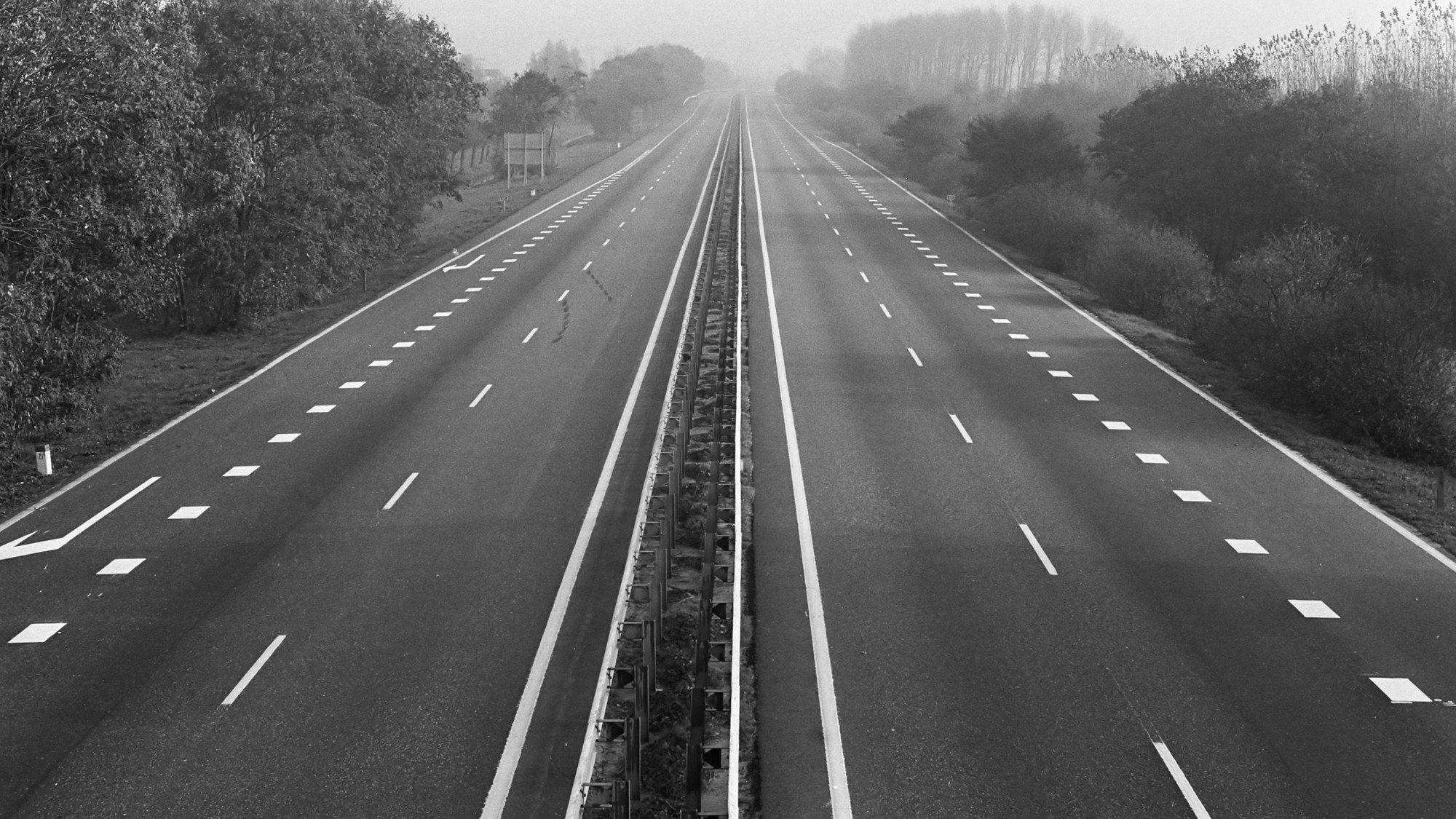
After ten car-free Sundays the Nationaal Archief records that the hoped-for petrol savings never came: the cars stood still on Sunday daytimes, but traffic on Saturdays and Sunday nights rose enormously.71 On December 1, Den Uyl reportedly went on radio and television to announce petrol rationing and told the country it would have to adjust permanently to a more frugal use of energy.73 Coupons took effect on January 12, 1974; one local museum gives January 7.7475 Each driver was allowed 15 gallons for the three weeks to February 3, a scheme designed to cut gasoline use by a fifth, but, as the New York Times reportedly put it, "as reports continue to appear that storage tanks in Rotterdam harbor are full of oil, few Dutchmen think that rationing is necessary."76 The economics minister, Ruud Lubbers, had doubts of his own. Pump owners near the borders did not bother asking for coupons; those in Limburg began a boycott after a week, and Frans Rutten, the ministry's secretary-general, wrote of a "pump-owners' revolt." On January 25, BOVAG, the trade body for 95 percent of pump owners, called a general boycott, and rationing was effectively over. The Netherlands was the only country in Western Europe to try this kind of petrol rationing. A 100 km/h motorway limit followed on February 6, and the Royal Dutch Automobile Club printed a bumper sticker: "Ik rij honderd als Den Uyl opdondert," "I'll drive 100 when Den Uyl clears off."74
West Germany passed its Energy Security Act, the Energiesicherungsgesetz, on November 9, 1973.77 An ordinance of November 19 reportedly banned cars, motorboats and powered aircraft on four Sundays, November 25 and December 2, 9 and 16, from 3 a.m. to 3 a.m. the next day;78 the economics minister, Hans Friderichs, is recorded as announcing it together with limits of 100 km/h on the Autobahn and 80 km/h on country roads.79 About 13 million car owners were affected, and the ADAC motoring club's badges read "Freie Bürger fordern freie Fahrt!", "Free citizens demand free driving!" On November 25, Hamburg's transit system carried more than a million passengers, twice a normal Sunday, and police on the A7 between Hanover and Göttingen counted two or three vehicles an hour in both directions combined. In Kiel, 580 police checks turned up a single offender, a 26-year-old on a moped who had "just nipped round the corner" for cake. Children sledged in the streets; the Kieler Nachrichten wrote that the city "turned into one big pedestrian zone," with "heavenly quiet from 3 a.m. for those living in the center" and, everywhere, "the smell of fresh country and sea air." The day was also Totensonntag, the Protestant day for remembering the dead, and with cemetery visits skipped, florists lost 70 percent of their sales. The AvD automobile club estimated about 60 million liters of fuel saved on that first Sunday, but exemptions multiplied and by the fourth Sunday there were traffic jams again.80 About a million special permits were issued in the end, leaving the measure "largely symbolic."81 Helmut Schmidt, then finance minister, said later: "That was a side effect. The real purpose was to make people understand: this is a serious situation." What lasted was a plan to build 40 nuclear plants and, from 1980, summer time.80 Luxembourg, Switzerland and Italy reportedly imposed Sunday bans of their own.82
Denmark held its first bilfri søndag on November 25, 1973, too. More than 90 percent of Danish energy came from imported oil, and according to Andreas Skov, the city archivist in Holbæk, streetlights were switched off, public buildings were kept cooler and private Sunday driving was banned: "for ten weeks the roads lay empty." On November 26 the Sjællands Tidende reported that "peace and idyll settled over Holbæk yesterday as never before, at least not since the infancy of the motor car… And it was really not so bad at all. Rather pleasant in a time full of stress – and cars." Old newspapers became valuable as fuel, and trucks drove around with signs reading "Aviser købes," "Newspapers bought." After oil deliveries were cut by 25 percent, the Holbæk swimming baths shortened their hours, hot water was shut off in the Slotsparken and Agervang housing estates, the technical committee announced "we must save about 60 bus hours," and the packaging firm Superfoss laid off staff.83 A caption in the Esbjerg archive reportedly notes that priests, doctors and locksmiths were allowed to drive, and that the shop windows went dark: "even the Christmas lights are off."84 Speed limits fell to 60 km/h in towns and 80 km/h in the country. One account has the Sunday ban ending on February 10, 1974, another on February 17.8586
On December 13, 1973, Prime Minister Edward Heath told the House of Commons that from December 31 most commercial and industrial premises would be limited in their use of electricity "to three specified days each week."87 Some 13 million workers faced sharp pay cuts, the New York Times reportedly wrote,88 and on television that evening Heath is reported to have said: "In terms of comfort, we shall have a harder Christmas than we have known since the war. But we have had to act."89 On December 4 the energy secretary, Peter Walker, had reported falling coal stocks at the power stations; Britain's crisis was driven mainly by the coal miners' overtime ban, and the oil shock compounded it. Cabinet papers released at the National Archives in Kew on January 1, 2004, show ministers discussing a ban on heating more than one room per home, then dropping it as "harsh and in practice unenforceable"; since domestic heating accounted for half of Britain's energy use, they chose rota power cuts instead. The chancellor, Anthony Barber, told colleagues it was the worst crisis since the Second World War. More than 18 million petrol ration books were printed, with 12 million supplementary coupons, and none was ever used. The Central Policy Review Staff in Downing Street said the Arab price rise had ended "cheap energy for ever" and suggested curbing 100 household appliances, among them electric toothbrushes, shoe polishers, hedge trimmers, coffee percolators, carpet shampooers, desk fans, saunas, blenders and "heated hostess trollies." Jim Prior's "annex A" listed heating only one room, banning Sunday motoring, a four-day school week, a compulsory 50 mph limit and a ban on Christmas package tours. Robert Armstrong, the cabinet secretary, wrote to Heath that the "psychology of public opinion" had to be moved off "business as usual." A line in the Queen's draft Christmas broadcast, "I cannot let Christmas pass without speaking to you directly of the hardship and difficulties with which so many are faced," was vetoed.87 The three-day week ran from January 1 to March 7, 1974. From December 17 all three television channels had to close down by 10:30 p.m.; the curfew was lifted in February, on the 8th by one account and the 23rd by another.9091 Office workers, a BBC program later recalled, sat "wrapped in blankets" working "by candle and torchlight," householders were urged to boil water for washing, and children went to school in luminous armbands.92
At 7:30 p.m. on November 7, 1973, Richard Nixon spoke to the nation from the Oval Office. By the end of the month, he said, "more than 2 million barrels a day of oil we expected to import into the United States will no longer be available. … We are heading toward the most acute shortages of energy since World War II." Supply that winter would fall at least 10 percent short of demand, and perhaps 17 percent. He asked Americans to "lower the thermostat in your home by at least 6 degrees so that we can achieve a national daytime average of 68 degrees," and added: "my doctor tells me that in a temperature of 66 to 68 degrees, you are really more healthy than when it is 75 to 78, if that is any comfort." More than 500,000 federal vehicles would be held to 50 mph, and he asked governors to cut highway limits to 50, which "could save over 200,000 barrels of oil a day." Then he reached for memory: "Gas rationing, oil shortages, reduced speed limits--they all sound like a way of life we left behind with Glenn Miller and the war of the forties." In the next seven days, he said, the average American would use as much energy as most of the world's people used in a year: "We have only 6 percent of the world's people in America, but we consume over 30 percent of all the energy in the world." He announced Project Independence, "in the spirit of Apollo, with the determination of the Manhattan Project," so that "by 1980 … we shall be able to meet America's energy needs from America's own energy resources." The speech closed on Watergate: "I have no intention whatever of walking away from the job I was elected to do."93
On January 2, 1974, in San Clemente, California, Nixon signed the Emergency Highway Energy Conservation Act, which tied each state's federal highway trust funds to a 55 mph limit; "we can save nearly 200,000 barrels of fuel a day," he said.94 Seventeen states had reportedly lowered their limits on their own between November 7 and November 26.69 Another law, signed on December 15, 1973, put the country on daylight saving time for about two years from 2 a.m. on Sunday, January 6, 1974, at an estimated saving equal to 150,000 barrels of oil a day in winter.95 The Department of Transportation reportedly found in 1974 that the gains for energy, traffic safety and crime were "minimal," and the National Bureau of Standards found "statistically significant evidence of increased fatalities among school-age children in the mornings" from January to April.96 Florida's governor, Reubin Askew, said cars had struck and killed eight Florida children on their way to school in the past month, against two in January 1973.97 In October 1974 Gerald Ford signed a bill returning the country to standard time from October 27, 1974, to February 23, 1975.9896 The embargo had already been lifted in March. The State Department's history of it is illustrated with a Library of Congress photograph of cars in a long line at a gas station; the measures it lists as lasting are the national 55 mph limit, the Strategic Petroleum Reserve, the fuel economy standards of the Ford years and the International Energy Agency, proposed by Henry Kissinger.70
5. Reactors and Coal
By January 1979, revolution had cut Iran's oil output by 4.8 million barrels a day, about 7 percent of world production, and oil prices more than doubled between April 1979 and April 1980.64 On May 5, 1979, with Californians waiting in line for fuel, Jimmy Carter issued a statement: "Although this particular crisis came on suddenly, we have known since 1973-74 that something like this was bound to happen. The reason for the gas lines and terrible inconvenience here... is that we have failed to be prepared."99 Two days later, the New York Times reported from San Francisco that an odd-even plan would start because of "half-mile-long lines of motorists at service stations in some areas of California."100 On May 9, the first day of rationing in nine California counties, cars lined up outside filling stations.64 A wire report from Los Angeles reportedly described a woman in a bathrobe who pulled into a Burbank station at dawn, locked her car beside the pumps, unhitched a bicycle from the bumper rack and pedaled away.101
In the Northeast that summer, TIME reportedly found drivers waiting "as long as four or five hours," with frustration that "all too often erupted in name calling, fistfights, occasional stabbings and shootings." In Levittown, Pennsylvania, "some 2,000 motorists and thrill-seekers clashed with the police in three days of rioting," and police arrested nearly 200.102 On June 26 the New York Times reportedly quoted a driver who "wanted to see how far I was from the gas station, but I was afraid to lose my place in line," at a station selling gas at 99.9 cents a gallon with a $5 limit.103
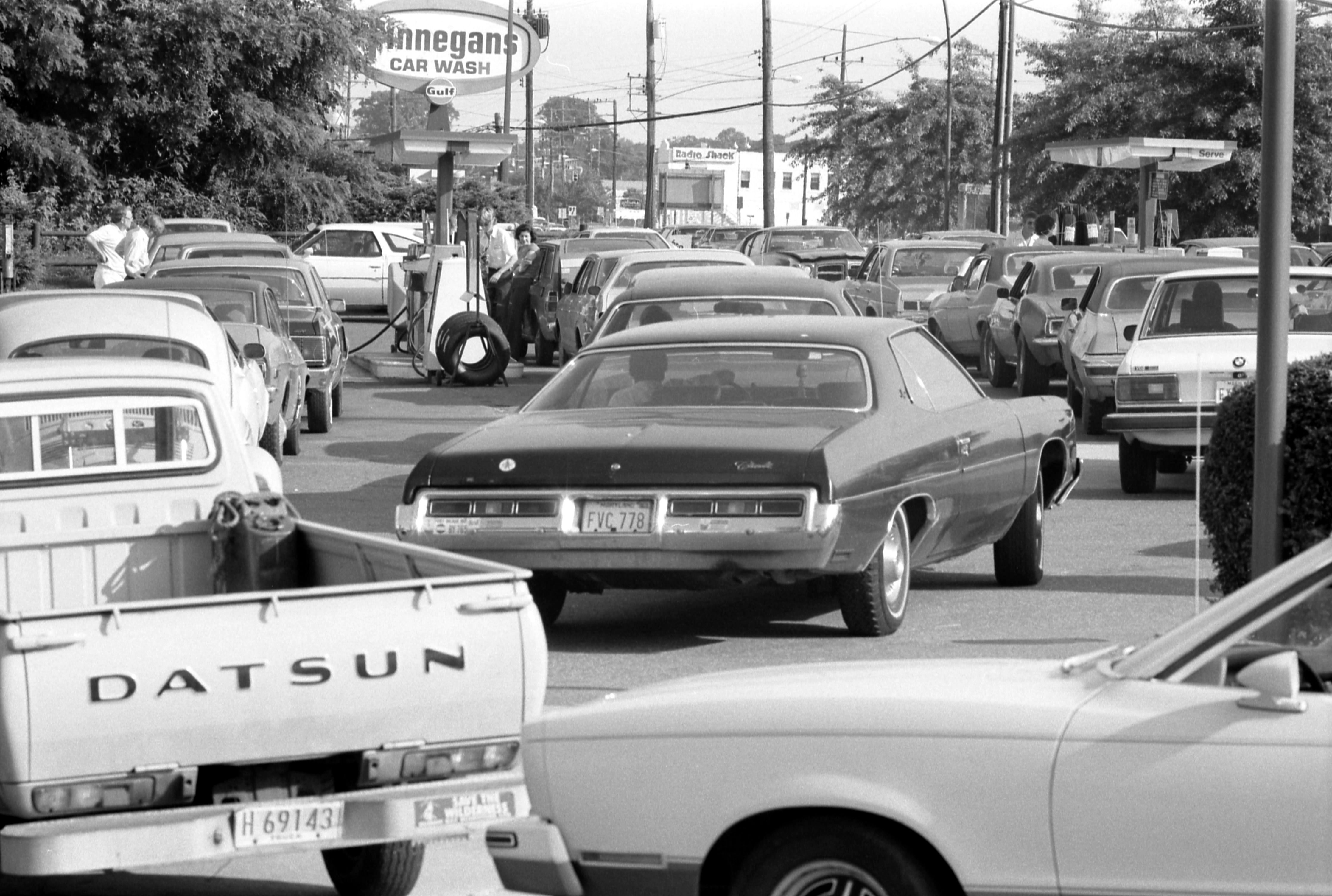
At 8 p.m. on April 18, 1977, two years before the lines returned, Carter had told the country from the Oval Office that he wanted "to have an unpleasant talk with you about a problem that is unprecedented in our history. With the exception of preventing war, this is the greatest challenge that our country will face during our lifetime." The effort would be "the 'moral equivalent of war,' except that we will be uniting our efforts to build and not to destroy." He reminded viewers that "the 1973 gas lines are gone, and with this springtime weather, our homes are warm again. But our energy problem is worse tonight than it was in 1973." "Ours is the most wasteful nation on Earth," he said. "We waste more energy than we import." Conservation could "buy a barrel of oil for about $2. It costs about $13 to waste it." Oil imports had cost $3.7 billion six years earlier and $36 billion the year before. His goals for 1985 included a strategic reserve of a billion barrels, insulation for 90 percent of homes, solar energy in more than 2.5 million houses, and, in the same breath, a shift "to plentiful coal," with output to rise "by about two-thirds to more than one billion tons a year."104
On June 20, 1979, Carter dedicated 32 solar thermal panels on the roof of the West Wing. "A generation from now," he said, "this solar heater can either be a curiosity, a museum piece, an example of a road not taken, or it can be a small part of one of the greatest and most exciting adventures ever undertaken by the American people—harnessing the power of the sun to enrich our lives as we move away from our crippling dependence on foreign oil."105 In the full text of his remarks he predicted that "in the year 2000, the solar water heater behind me, which is being dedicated today, will still be here supplying cheap, efficient energy."106 He also reportedly said: "No one can ever embargo the Sun or interrupt its delivery to us."107 The same day he set a goal of 20 percent of American energy from renewables by 2000 and reportedly proposed a $100 million solar energy bank.108

The panels heated water until 1986, when they came down during Ronald Reagan's second term.105 They were reportedly removed while the roof was being resurfaced and stored in a warehouse in Franconia, Virginia.109 The General Services Administration kept them until 1991, when Unity College in Maine obtained them through the federal surplus property program and used 16 of them to heat water for its cafeteria for 12 years.105 By one account, a Unity College team "pulled the seats out of an old school bus, drove to DC, and rescued the panels from obscurity in a government warehouse."110 In 2010, Bill McKibben and Unity students reportedly drove one back to Washington to ask Barack Obama to put it on the roof again.111 One panel is now at the Smithsonian's National Museum of American History and another at the Carter Library;105 a third reportedly went in 2010 to the Solar Science and Technology Museum in Dezhou, China, donated through Huang Ming, chairman of Himin Solar.112
On July 15, 1979, Carter went back on television with what became known as the "crisis of confidence" speech. "We believed that our Nation's resources were limitless until 1973," he said, and dependence on OPEC was "the direct cause of the long lines which have made millions of you spend aggravating hours waiting for gasoline." He read out what citizens had told him at Camp David: "Our neck is stretched over the fence and OPEC has a knife"; from a labor leader, "The real issue is freedom. We must deal with the energy problem on a war footing"; "When we enter the moral equivalent of war, Mr. President, don't issue us BB guns"; and from a young Chicano, "Some people have wasted energy, but others haven't had anything to waste." He pledged that the country "will never use more foreign oil than we did in 1977—never," set a target of "20 percent of our energy coming from solar power by the year 2000," and asked people to park their cars one extra day a week: "Every act of energy conservation like this is more than just common sense—I tell you it is an act of patriotism." Point four of the same plan asked utilities to "cut their massive use of oil by 50 percent within the next decade and switch to other fuels, especially coal, our most abundant energy source."113
Public energy research budgets in IEA countries peaked at $15 billion in 1980; in 1974, only $69 million of them had gone to renewables. In 2006, the IEA's executive director, Claude Mandil, asked governments to restore them "to at least the levels of the early 1980s."114 In the United States, Department of Energy budget authority for renewable, fossil and nuclear research fell in real terms from fiscal 1978 to fiscal 2005, "a decline of over 85 percent"; it had "peaked in the late 1970s in response to the... oil embargo of 1973 and fell sharply as crude oil prices plunged in the mid 1980s."115
France paid 15 billion francs for its oil in 1972 and 52 billion in 1974. On November 30, 1973, Prime Minister Pierre Messmer went on ORTF to announce that the nuclear program would be accelerated, along with the Eurodif enrichment plant.116 He reportedly also announced limits of 90 km/h on roads and 120 km/h on motorways, monuments left unlit at night and television ending at 11 p.m. except on Saturdays.117 At 8 p.m. on March 6, 1974, in a television interview with Jean-Marie Cavada, Messmer explained: "We have almost no oil on our territory, we have much less coal than England and Germany, and less gas than Holland." France's "great chance," he said, was "our electrical energy of nuclear origin": thirteen 1,000-megawatt plants, an effort no country in the world "except the United States" was matching. He mocked "circumstantial measures like the ban on driving on Sundays."116 Electricité de France reportedly ordered and began building 51 reactors in the decade after the plan.118 By 1990 nuclear power produced 75.5 percent of French electricity.67 The line people remember, "On n'a pas de pétrole mais on a des idées," "we don't have oil, but we have ideas," is often credited to Valéry Giscard d'Estaing; it was reportedly a slogan written by the Lintas agency for the Agency for Energy Savings in the autumn of 1975.119
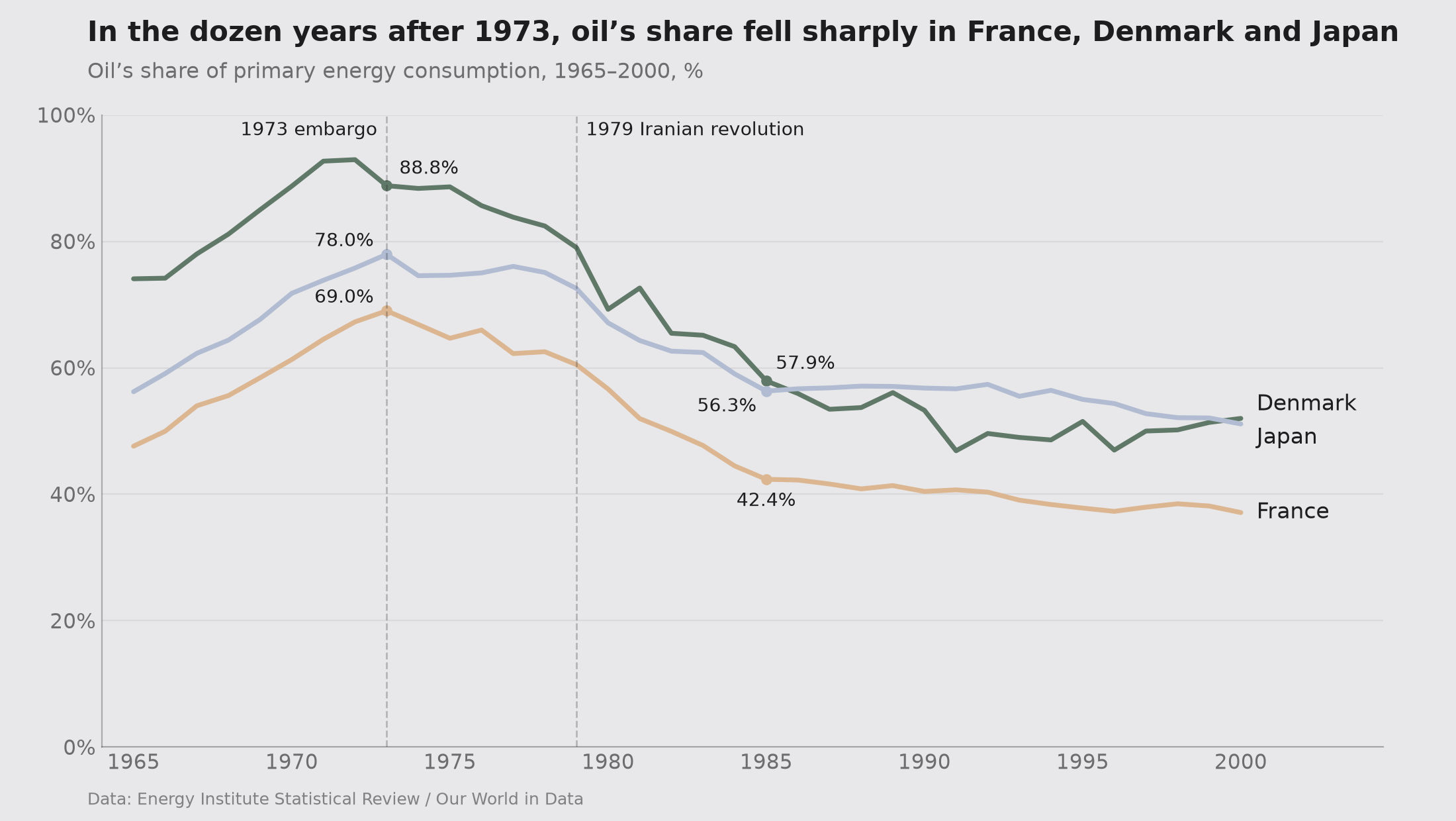
By 1990 coal generated 90.8 percent of Danish electricity.67 The country's first energy plan, Energy Policy 1976, reportedly aimed at gas and nuclear power as well as coal and renewables; "the immediate result was a change to coal in the electricity production," and nuclear was postponed.120 Japan, whose oil dependence had climbed from 17 percent in 1955 to 75 percent in 1973, reportedly passed an Energy Conservation Act in 1979.121 Between 1973 and 1985, oil's share of primary energy fell by 27 points in France, 31 in Denmark and 22 in Japan.67
In Brazil, which imported 70 percent of its crude, the military government raised petrol prices, closed filling stations at weekends and set an 80 km/h limit.122 On November 14, 1975, President Ernesto Geisel signed Decree 76.593 creating the National Alcohol Program.123 The program's architect, José Walter Bautista Vidal, told the Senate: "Blessed oil crisis, which woke us up to national problems... Alcohol is eternal; it will last as long as the Sun exists." Senator Teotônio Vilela called it "nothing other than liquid solar energy." The first ethanol-only car, a Fiat 147, went into production in July 1979, and in 1980 a quarter of the cars sold in Brazil ran on alcohol. An ethanol shortage in 1989 crashed the program.122 By one account, cars running on pure ethanol made up 92 percent of light-vehicle sales in 1986.124
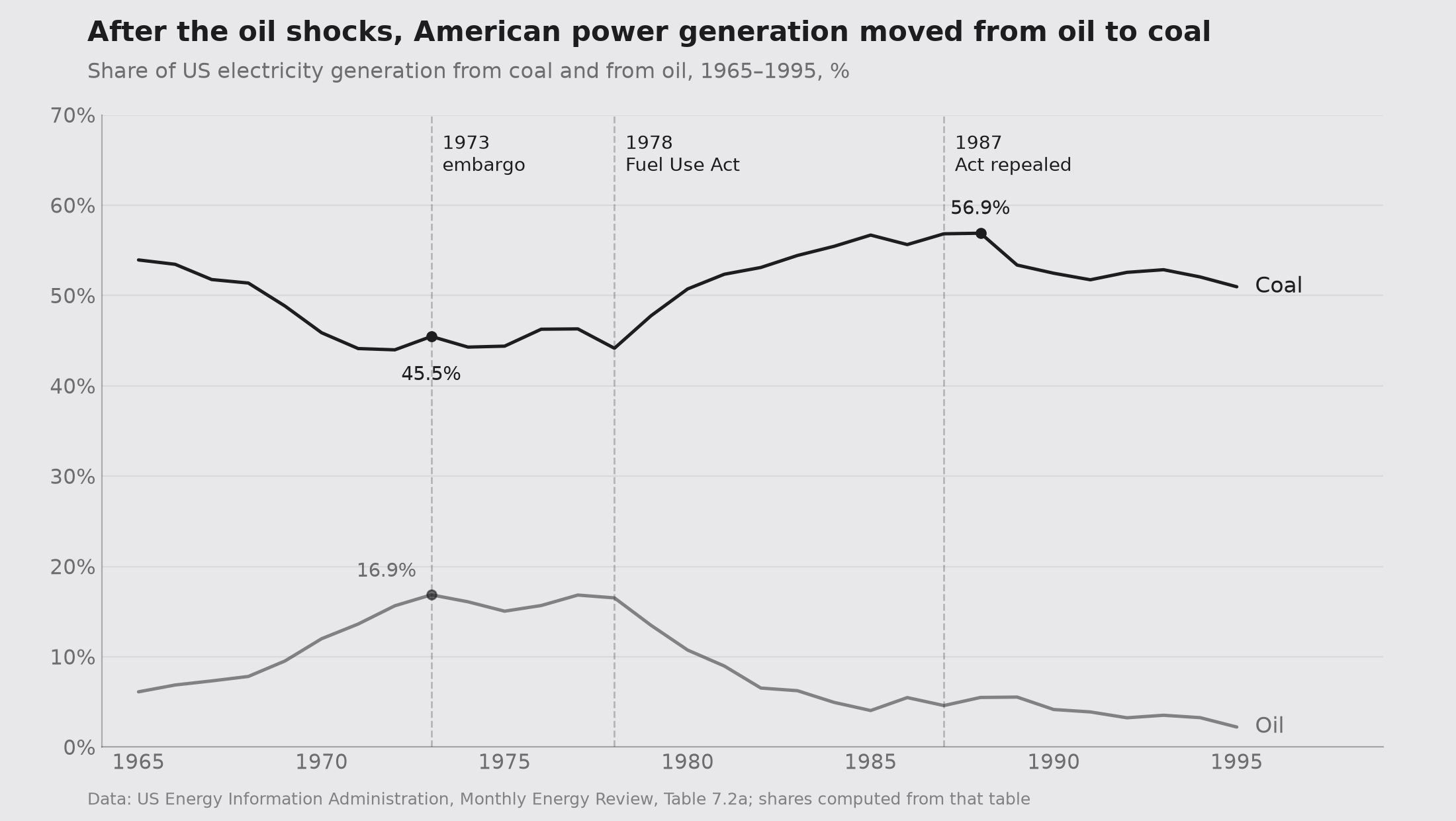
On November 9, 1978, Carter signed the Powerplant and Industrial Fuel Use Act, which provided that "natural gas or petroleum shall not be used as a primary energy source in any new electric powerplant" and that no new plant could be built "without the capability to use coal or any other alternate fuel."125 Nixon had already ordered, in his speech of November 7, 1973, that industries and utilities using coal be "prevented from converting from coal to oil," and that power plants be converted "from the use of oil to the use of coal."93 Most new baseload plants of the following decade were coal-fired or nuclear; the act was repealed on May 21, 1987, after which gas burned for power more than doubled by 2002.126 Coal supplied 45.5 percent of American electricity in 1973, when oil supplied 16.9 percent; by 1988 coal's share had peaked at 56.9 percent.127 American power plants burned 320.2 million short tons of coal in 1970;128 by 1990 the figure was reportedly 773.6 million.129 In 2018 many of the coal plants still running in the United States had reportedly been "commissioned in the 1970s and 1980s, when surging oil prices caused a shift from oil-fired to coal-fired generation."130
6. The Special Period
In 1989 the Soviet Union shipped 13 million tonnes of oil to Cuba. Soviet oil covered about 90 percent of the island's energy needs, trade with the USSR was worth $8.7 billion a year, and Soviet suppliers sent 1.3 million tonnes of fertilizer for the cane and tobacco fields.131 In August 1990 Havana declared a "Special Period." Sixteen months later the Soviet Union no longer existed.131
NotiSur, a Latin American news digest, expected Soviet crude deliveries to Cuba to fall below 8 million tonnes in 1991.132 One history of Havana puts them at 1.8 million tonnes in 1992.131 A 1995 economic study gives the island's total oil supply in 1993 as 6.8 million tonnes, against roughly 11 million tonnes a year in 1984–88.133 The series do not count the same thing, Soviet shipments in one case and total supply in another, and they do not reconcile neatly; all of them fall steeply. Cuba's imports as a whole dropped 77 percent and its fuel imports 76 percent.133 Trade with the former Soviet Union was down to $750 million in 1993, less than a tenth of the 1989 figure.131
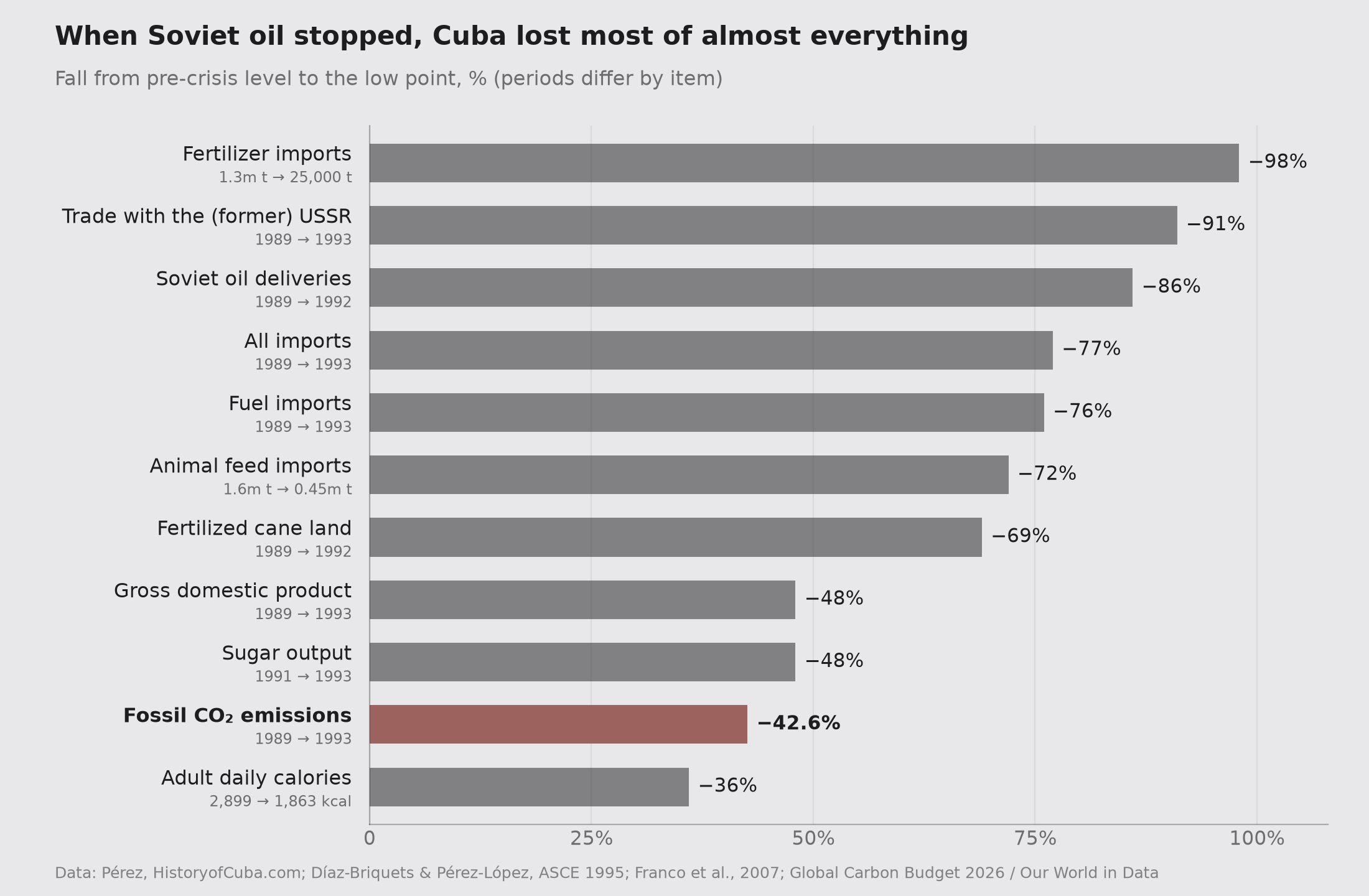
On December 10, 1991, NotiSur reported that the Cienfuegos refinery was idle. Fidel Castro had told Cubans that not one tonne of the fuel due in December had arrived. Daily bus trips had been cut from 29,000 to 17,000, and 10,000 tractors had been mothballed, their work handed back to horses and oxen.132 By November 1991, 100,000 oxen were already working Cuban fields.133 By one count the national ox herd grew from 163,000 in 1990 to 400,000 in 1997.134 The sugar harvest, the export that had paid for Soviet oil, fell by almost half between 1991 and 1993.131
Blackouts in the first years of the Special Period lasted 8 to 10 hours a day.131 In the summer of 1993 they ran 12 to 16 hours, and up to 80 percent of Cuban industry stood idle.133 In Havana, half of the city's 1,200 buses were out of service.131 Commuters switched to bicycles, and on the number of bicycles the sources again disagree: one account has about 700,000 distributed by 1994, another more than 1.2 million brought in from China.131133
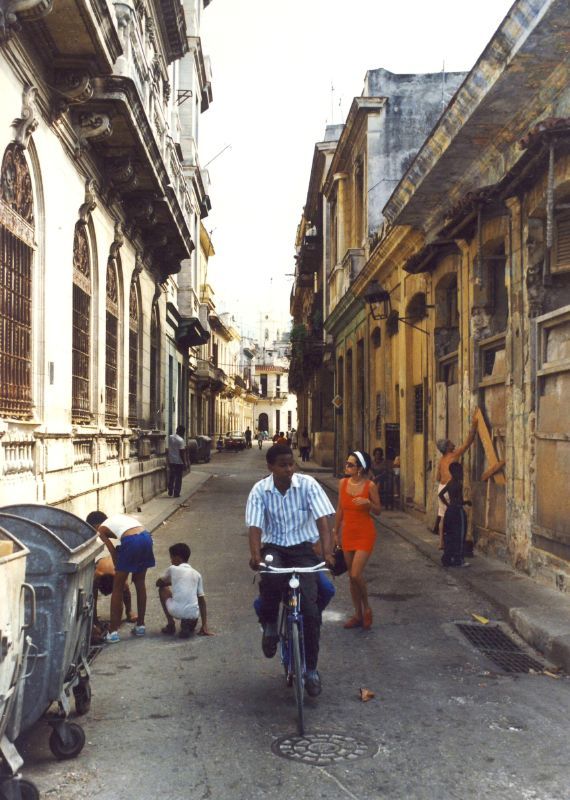
In the Zapata swamp, people cut mangroves for charcoal.133 Between 1989 and 1993 Cuba's gross domestic product fell 48 percent on one estimate.133 The Maddison series used by Our World in Data has output dropping about 45 percent; other sources put the decline nearer 35 percent.62
Average daily calorie intake in Cuba reportedly fell by more than a third over the crisis years. With buses gone, the share of physically active adults reportedly rose from 30 percent to 67 percent, and adult obesity halved, from 14 percent to 7 percent.135 People walked and pedaled because there was no fuel, and lost weight because there was not enough food. Around 50,000 Cubans developed optic neuropathy, an epidemic of damaged vision.131
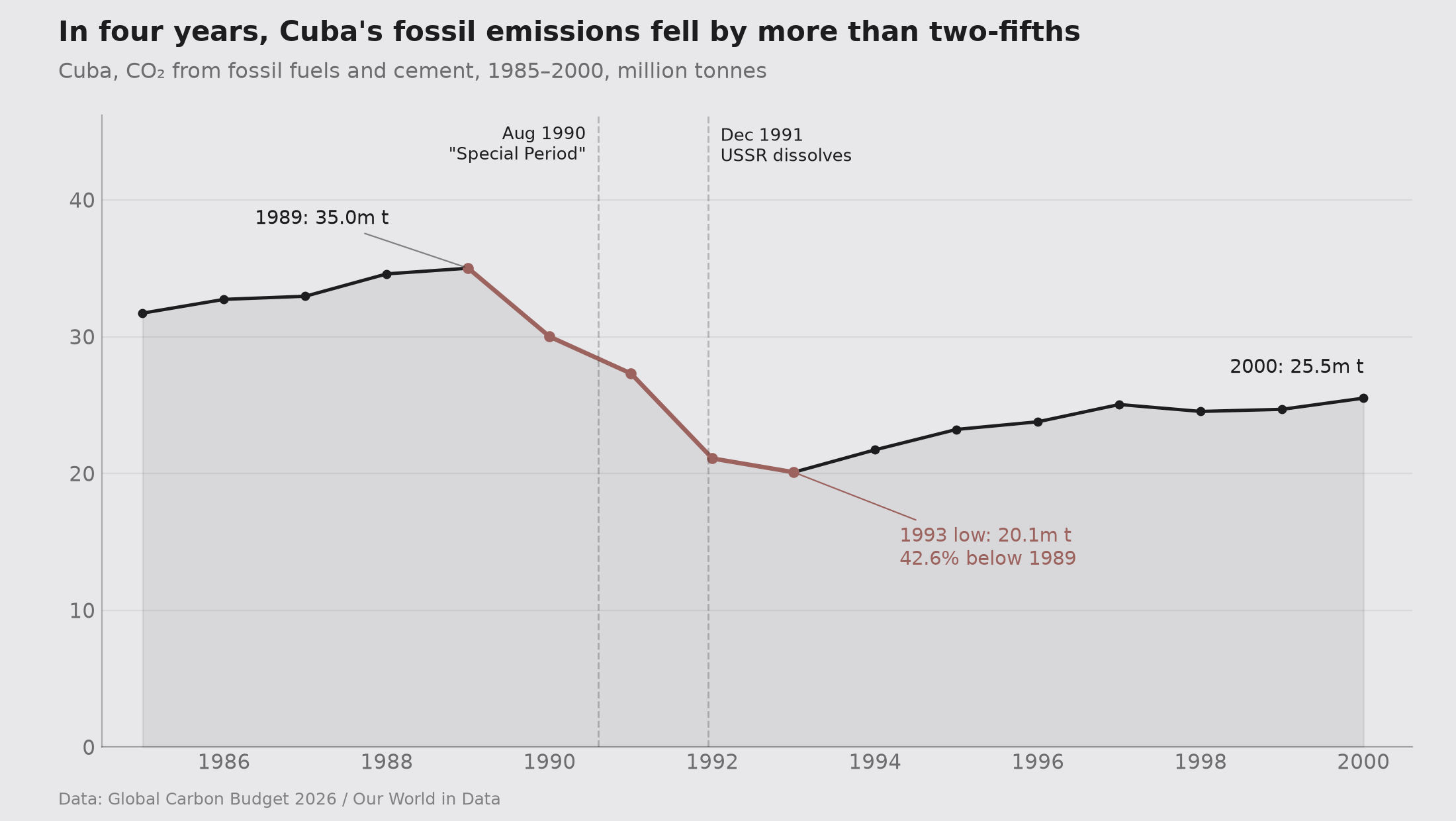
Cuba's fossil carbon dioxide emissions, cement included, fell from 35.0 million tonnes in 1989 to 20.1 million in 1993, 42.6 percent lower.62 The single worst year was 1992, when emissions fell close to 23 percent as the last large Soviet deliveries dried up.62131 At the start of the decade the average Cuban was responsible for 2.8 tonnes a year, against a world average of 4.3 tonnes and 17.1 tonnes for the average Russian.62
In North Korea over the same decade, recorded fossil CO2 fell by about half between 1990 and 1998. The North Korean figures are rough estimates; the series even shows an implausible 43 percent fall between 1989 and 1990 that looks more like a break in the data than a real event.62
By 2000 Cuba's emissions had climbed back to 25.5 million tonnes, still below the 1989 level but heading up as fuel came back.62
7. Hot Air
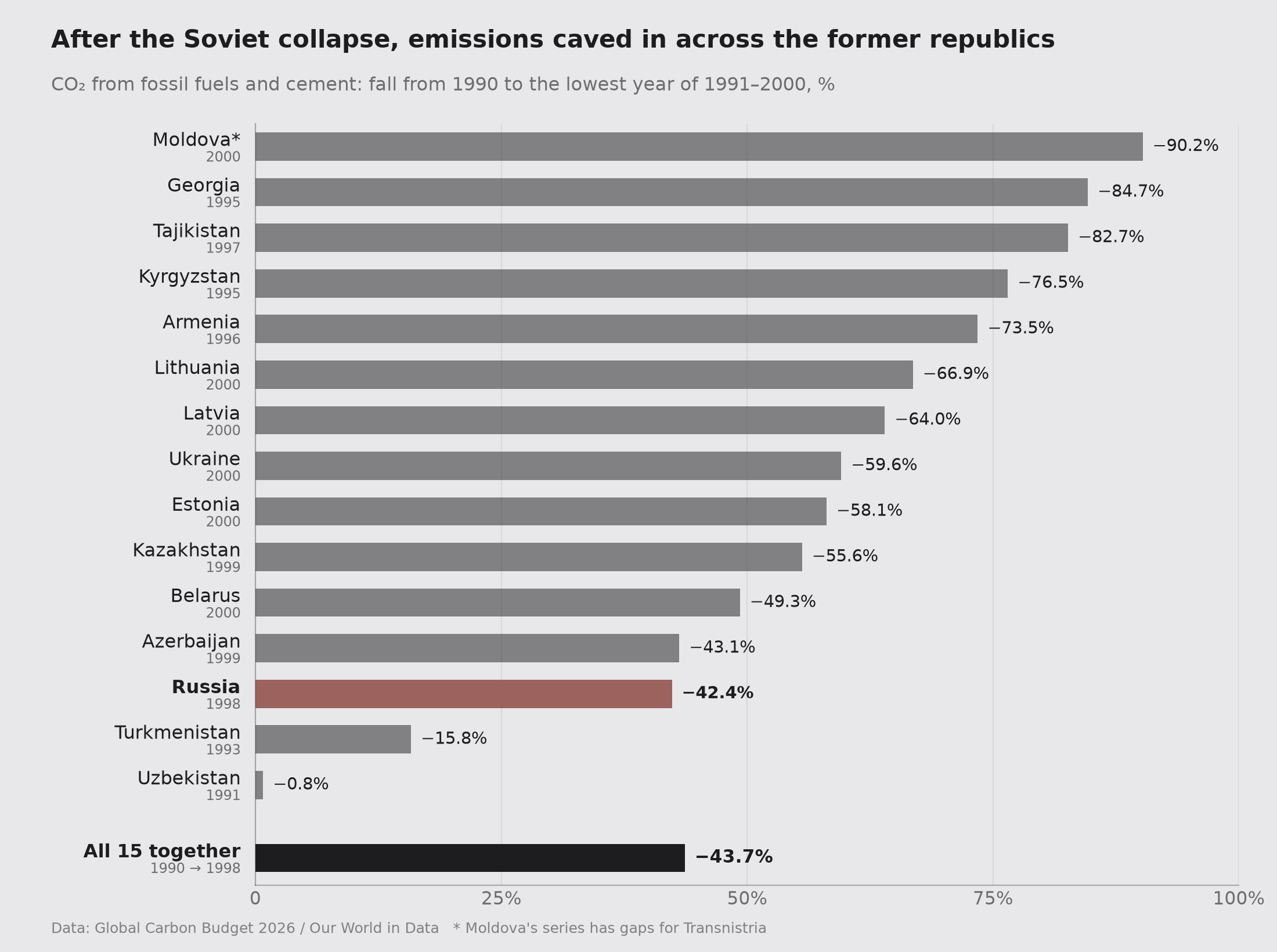
In 1990 the Russian Federation emitted 2.55 billion tonnes of fossil carbon dioxide, 17.1 tonnes for every inhabitant, four times the world average of 4.3 tonnes.62 By 1998 the figure was 42.4 percent lower. The steepest single step came between 1991 and 1992, the first year without the Soviet Union, when Russian emissions fell 18.6 percent.62 In 2012, more than two decades on, they were still a third below 1990.62
Ukraine lost 59.6 percent by 2000, more than Russia; in Georgia emissions fell 84.7 percent between 1990 and 1995, and in Armenia, cut off by an energy blockade, 73.5 percent. Moldova's recorded fall of 90.2 percent partly reflects gaps in the data for Transnistria. Uzbekistan was the outlier: its emissions barely dipped in 1991 and were 17 percent above 1990 by 1998.62 Summed together, the 15 former Soviet republics cut 1.75 billion tonnes, or 43.7 percent, between 1990 and 1998, about 7.7 percent of the world's entire fossil CO2 output in 1990.62 Outside the old Soviet borders, Romania's emissions fell by half between 1990 and 1999.62
The Russian statistical office's figures, as compiled by the International Monetary Fund, show gross domestic product shrinking 15 percent in 1992 alone; output of military goods dropped 37 percent in 1994. Compounded, Russian industry in 1996 was producing about 47 percent of what it had in 1990, and the whole economy about 58 percent.136 Between 1990 and 1994 Russian steel output reportedly fell by almost half and coal output by about 30 percent.137 In Ukraine GDP fell by 53 percent between 1990 and 1998.62
In April 1998 the unemployment office in Beryozovsky, a coal town of 57,000 in the Kemerovo region of western Siberia, had a queue. Alexander Novikov, 39, stood in it. He had not been paid his 780-ruble ($130) monthly salary for a year and a half and was living on vegetables from his garden. "When the mine closes down, we get paid, but if the mine is working we don't get anything," he told a Radio Free Europe/Radio Liberty correspondent.138 He had struck before: "I went on strike in 1989, but what came of it? Yeltsin promised a lot but didn't deliver."139 Alexander Ortunas, a mechanic with some 20 years at the Biryulinskaya mine, said: "This is a dying city." The government planned to shut 86 of the Kuzbass region's 200 mines that year, with at least 50,000 layoffs; 277 miners had been killed underground in 1997, against 172 the year before.138
Near Novokuznetsk, Nikolai Suyazov, 63, laid off from the Dimitrova mine, lived among huts without running water or heating, along "muddy paths blackened by coal." "Yeltsin has driven us into poverty," he said. "He has brought the country to a dead-end and he doesn't have a clue as to how to get us out of it."138 In January 1998 miners at the Kuznetskaya mine, unpaid for two years, had taken their director hostage.138 Mikhail Lavrov, who led the Independent Miners' Union in the Kuzbass, saw little point in another walkout: "If we strike, the mine will only close faster."139 Across Russia, wage arrears that spring totaled 60 billion rubles, about $10 billion, and coal miners alone were owed 3.2 billion rubles ($530 million); millions of workers went a year or longer without pay.139 In 1996, six in ten Russian workers were reportedly owed back wages.140 In May 1998 miners reportedly blockaded the Trans-Siberian Railway and other main lines over wages ten months or more overdue.141
In 1994 male life expectancy at birth in Russia was 57.6 years, 6.2 years lower than in 1990.142 One reconstruction has men's life expectancy falling from 63.4 years in 1991 to 57.4 in 1994, "an almost unprecedented decrease in life expectancy in three years"; another series reportedly has it going from 63.8 to 57.7 between 1990 and 1994.143144 Among men aged 40 to 44 the death rate more than doubled between 1989 and 1994, up 116 percent. Suicide among men aged 50 to 54 reached 140 per 100,000 in 1994. The real price of vodka fell 77 percent between 1990 and 1994.143 About 32 percent of the surge in male mortality from 1989 to 1994 is attributable to alcohol. Across the former communist countries of Europe the crisis caused some ten million excess deaths between 1990 and 2000, and male life expectancy in Russia, Ukraine and Belarus did not regain its 1989 level until 2013.145
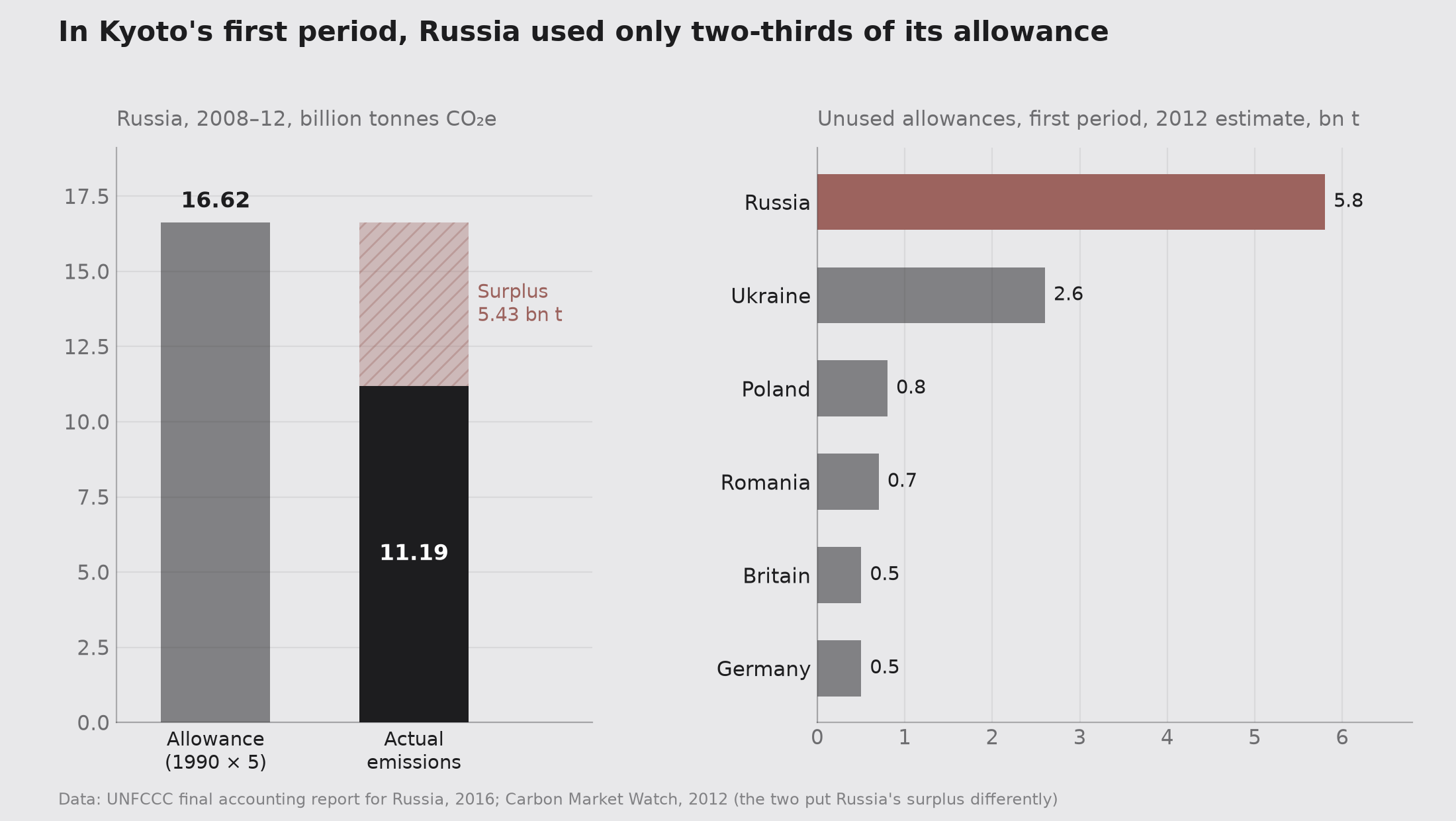
Diplomats meeting in Kyoto in December 1997 fixed 1990 as the base year for the first binding cuts in greenhouse gases. By then Russia's emissions had already fallen by a third and Ukraine's by half.146 Russia was asked for a freeze: its commitment for 2008–12 was 100 percent of its 1990 level. The final United Nations accounting, published on August 2, 2016, put Russia's allowance for the five years at about 16.6 billion tonnes of CO2 equivalent and its actual emissions at about 11.2 billion. Russia met the freeze by being about a third smaller than in 1990, and was left with roughly 5.43 billion tonnes of unused allowances.147
By 1998 critics had already dubbed the surplus "hot air," because it represented no cut below the level that would have occurred anyway.148 How much hot air there was depends on the count. A 2012 market estimate put the surplus for the first commitment period at more than 13 billion tonnes, most of it Russian and Ukrainian.146 Another tally reportedly gave Russia about 5.7 billion units, a third of its allowance, and Ukraine more than 2.5 billion, almost 57 percent of its own.149 A Dutch government assessment in 2009 reportedly put the total at 13 billion tonnes.150 In October 2009 an EU diplomat reportedly said: "The Russians have accumulated something like five billion units ... This is enormous."151
In April 2004 Andrei Illarionov, Vladimir Putin's economic adviser, gave his verdict on the treaty. "The Kyoto Protocol is a death pact," he said. "At first, we wanted to call this agreement a kind of international Gosplan. Then we realised Gosplan was much more humane and we ought to call the Kyoto Protocol an international gulag. In the Gulag, though, you got the same ration daily and it didn't get smaller day by day. In the end, we had to call the Kyoto Protocol an international Auschwitz."152 He had reportedly first used the phrase "economic Auschwitz" at a Moscow forum on February 20, 2004.153
With the United States out of the treaty, Russia, with 17.4 percent of industrialized countries' 1990 CO2, was the only country that could bring it into force.154 The Russian government approved ratification on September 30, 2004, as Moscow was pressing for membership of the World Trade Organization; Boris Makarenko, a Moscow political analyst, claimed at the time that the EU had agreed to drop its complaints over Russian energy tariffs in return.155 On October 22 the State Duma voted 334 to 73, with two abstentions, after two hours of discussion; the Federation Council followed on October 27 by 139 votes to one.155 Putin signed the law on November 4.156 On November 18 Russia's ratification was delivered to Secretary-General Kofi Annan, who called it "a great day for the whole world." The protocol entered into force on February 16, 2005.157
On March 18, 2009, Japan's New Energy and Industrial Technology Development Organization signed to buy 30 million tonnes of Ukrainian allowances.158 Ten days later in Kyiv, Prime Minister Yulia Tymoshenko said Ukraine would receive $560 million that year and that "to the last kopeck all the money will be spent for reconstruction and modernization of boilers." The country had more than 29,000 boilers, 67 percent of them gas-fired.159 Accounts of the sales differ. One has Ukraine selling 30 million tonnes to Japan and 3 million to Spain in 2009 for €320 million.160 Another has it receiving about 4.7 billion hryvnias that year for 47 million units, 44 million to Japan and 3 million to Spain.161
In 2010 President Viktor Yanukovych said "the money was stolen by the previous Government," and his government admitted that "not a single project was financed from these funds."160 Prosecutors opened a criminal case over 2.3 billion hryvnias, about $290 million, of 2009 allowance money. Prime Minister Mykola Azarov called Tymoshenko's 2009 budget "the most shameful in Ukraine's history." Tymoshenko answered: "Come closer and then we'll see who wins."162 In December 2010 she reportedly insisted that the €320 million ($425 million) had not been spent and was still at the environment ministry's disposal.163 Of 2.9 billion hryvnias in contracts handed out in 2012–14, 1.2 billion went to three companies tied to Yanukovych's son Oleksandr and his ally Yuriy Ivanyushchenko. Tekhbudtsentr, a firm "with no registered employees," got 286 million hryvnias for street lamps; Lifebuilding, with 2,000 hryvnias of capital and one employee, got 361 million. "I believe the information which is hidden is significant, and it is in someone's interest to make sure it stays that way," said Andrey Zheleznyi of the National Ecological Centre of Ukraine.161 In 2016 Ukraine reportedly returned €5 million of unspent money to Japan; the deadline to spend it had been 2012, and had been pushed back three times.164
Between 1990 and 2000 Germany's greenhouse gas emissions fell more than 18 percent and Britain's about 12 percent. Germany benefited from "wall-fall profits," the breakdown and restructuring of the East German economy after reunification; Britain from the liberalization of electricity, which switched power stations from coal to gas. Those special circumstances account for roughly half of each country's cuts in all greenhouse gases and about 60 percent of its cuts in energy CO2.165 In the eastern Länder, CO2 reportedly fell by more than 40 percent in five years.166 Under the EU's burden-sharing deal, Germany took a target of minus 21 percent for 2008–12 and Britain minus 12.5 percent, both measured from 1990.165
On the land, the Soviet collapse left more than 45 million hectares of Russian arable land, 23 percent of the farmed area, to go wild after the collective farms broke up. From 1990 to 2009 the abandoned soils absorbed about 156 million tonnes of CO2 a year, equal to a tenth of the yearly uptake of all Russia's forests.167 Across the former Soviet Union, 62.6 million hectares, 30 percent of late-Soviet cropland, went out of use between 1990 and 2011. Cattle and pig herds shrank by about half, and beef eaten per person fell from 32 kilograms in 1990 to 14.3 in 2000. Over 1992–2011 the changes in the region's food system cut net emissions by 7.61 billion tonnes of CO2 equivalent.168 From the 2000s the former Soviet Union became the world's second-largest beef importer, with about 80 percent of the meat in 2005–10 coming from South America, where cattle ranching drove deforestation in the Amazon.168 Some of the idle fields did not stay idle: at study sites in Orenburg, Uralsk and Volgograd, 43 to 45 percent of the abandoned land was reportedly plowed again.169 If the abandoned cropland of European Russia, Ukraine and Belarus were all recultivated, about 470 million tonnes of carbon could reportedly go back into the air.170
8. Beyond the Pipeline
In 2021 Russia sold the European Union about 150 billion cubic meters of gas by pipeline and tanker, around 45 percent of everything the bloc imported.171 By 2023 that share was down to 15 percent. On 18 May 2022, three months into the invasion of Ukraine, Ursula von der Leyen stood in Brussels and said: "Putin's war is disrupting the global energy market. It shows how dependent we are on imported fossil fuels." Her REPowerEU plan promised "close to EUR 300 billion," most of it for renewables and efficiency, but tucked inside it were "up to EUR 10 billion" for "missing links for gas and LNG so that no Member State is left in the cold," and up to 2 billion more for oil infrastructure.172
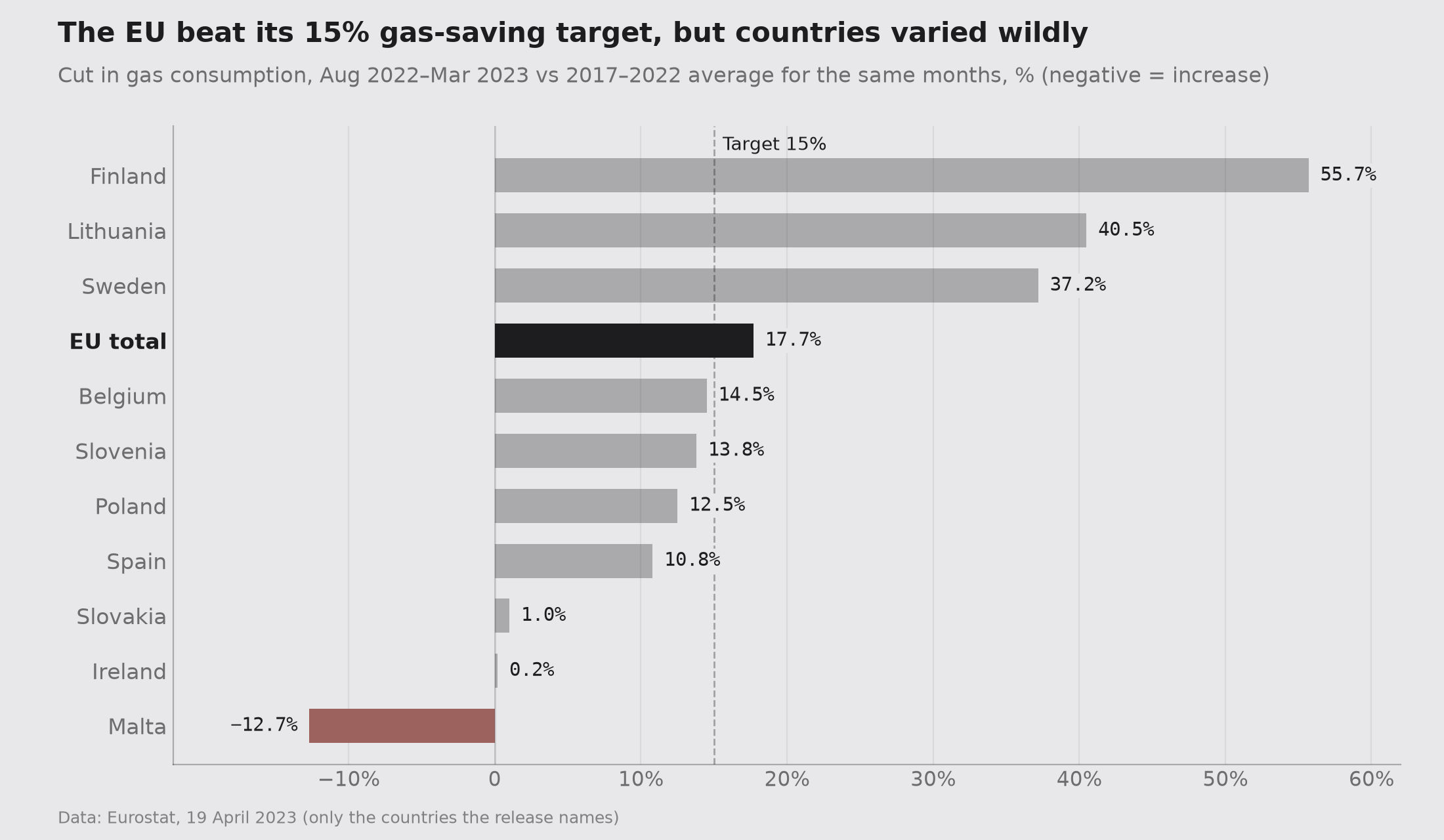
On 5 August 2022 the Council of the EU adopted Regulation 2022/1369, asking member states for a "voluntary reduction of natural gas demand by 15% this winter," measured against the average of the previous five years and running from 1 August to 31 March 2023. Russia, the Council said, "is continuously using energy supplies as a weapon." A "Union alert" could make the cut mandatory.173 Hungary and Poland reportedly voted against.174 The winter did more than the law asked. Eurostat counted a 17.7 percent fall in EU gas use between August 2022 and March 2023; Finland cut more than half, while Malta used more. November 2022 was the deepest month, a quarter below normal.175 A mild winter reportedly helped.176 By one later Commission tally the saving reportedly ran to 18 percent and about 138 billion cubic meters through May 2024.177
In 2021, 37 of BASF's 48 terawatt-hours of European gas demand reportedly went to a single site, the Ludwigshafen complex on the Rhine.178 On 27 July 2022 chief executive Martin Brudermüller reportedly told reporters, "We are reducing production at facilities that require large volumes of natural gas, such as ammonia plants."179 A spokesperson later reportedly warned that if supply fell "significantly and permanently below 50%," the site would have to shut.180 In Oslo, Yara announced on 25 August that curtailments would take its European ammonia plants to around 35 percent of capacity, idling the equivalent of 3.1 million tonnes of ammonia a year; it would use "imported ammonia when feasible."181 By late September roughly one in ten mid-sized German firms in a BDI survey had reportedly cut or stopped production.182
From 1 September 2022, German public buildings could be heated to no more than 19°C. "Overall the measures save energy," Economy Minister Robert Habeck reportedly said, "however, not to the extent that we can sit back and say, 'That'll do now.'"183 Under the accompanying ordinance, as reported at the time, illuminated advertising went dark from 10 p.m. to 6 a.m., shop doors had to stay shut, corridors in public buildings went unheated and private pools went cold.184 Spain's decree of 1 August capped air conditioning in shops and offices at no lower than 27°C and heating at no higher than 19°C, and ordered shop windows dark at 10 p.m. "We cannot afford to lose a single kilowatt-hour," said Teresa Ribera, the ecological transition minister.185 On the first night, the El Corte Inglés on Madrid's Calle de Preciados reportedly kept its lights on until after midnight.186 In Paris, Mayor Anne Hidalgo announced that from 23 September the Eiffel Tower would go dark at 11:45 p.m., when the last visitor left, instead of 1 a.m.187
On 8 July 2022, by the network agency's account, the Bundestag and Bundesrat passed a law to bring reserve coal and oil plants back to market so that less gas would be burned for power.188 Mehrum 3, a 690-megawatt hard-coal unit commissioned in 1979, returned on 1 August. Heyden 4 at Petershagen, 875 megawatts, came back on 29 August, twenty months after winning a government auction to close.189 Electricity had reportedly been generated on that site since 1951.190 In Brandenburg's lignite country, Jänschwalde's 500-megawatt Block E rejoined the grid in early October: on 5 October by the network agency's table, on 6 October by the operator's account, after three years on security standby. Block F followed on 10 October.189191 Even plants built in 1969 and 1970 were brought back. Coal produced 33.3 percent of the electricity fed into Germany's grid in 2022, up from 30.2 percent, while gas-fired output fell 11.3 percent.192
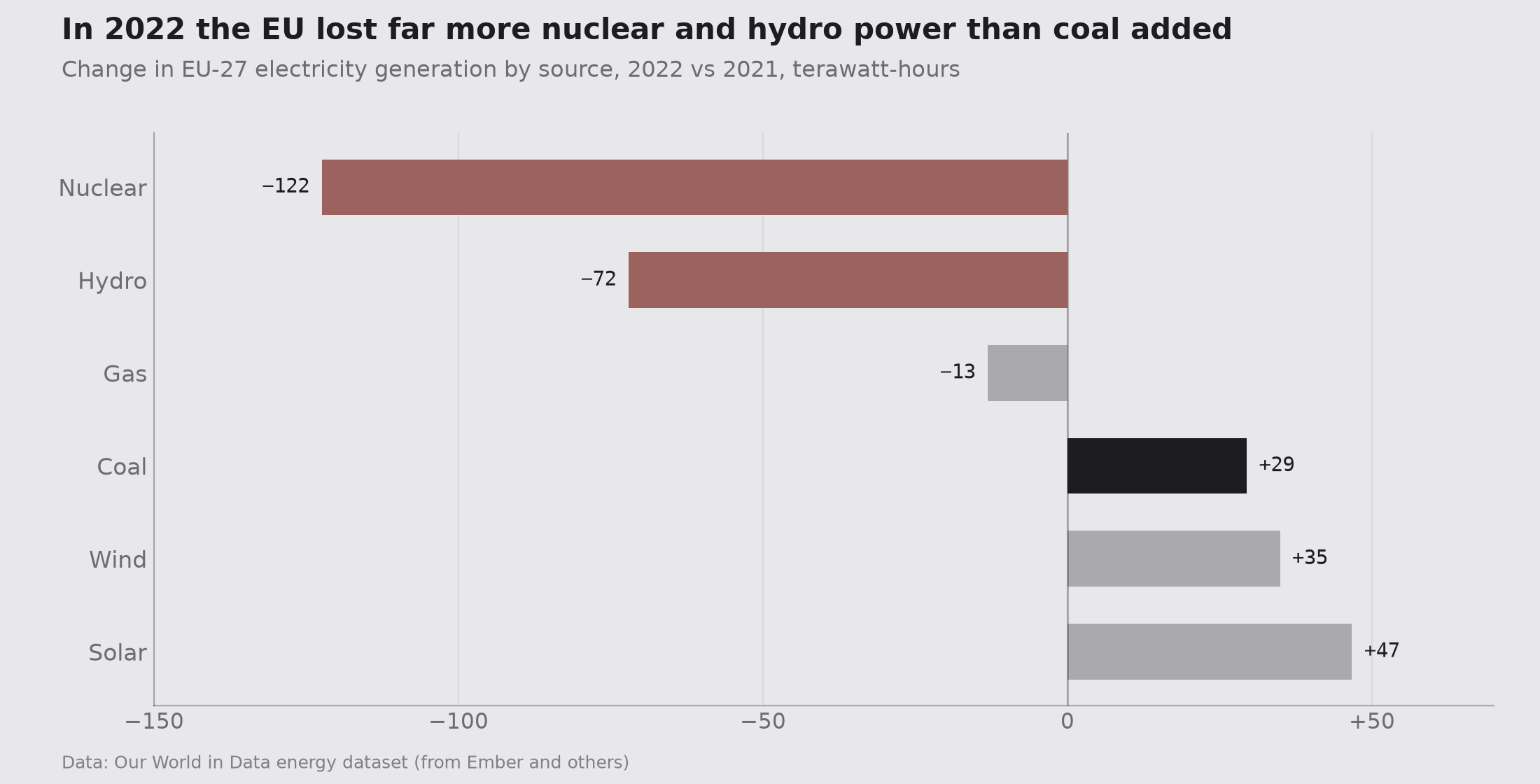
Across the EU, coal generation rose 7 percent in 2022, still 37 percent below 2015. Most of the rise filled a different hole: French reactor outages and a drought counted as a 500-year event cut nuclear and hydro output by 185 terawatt-hours, six times coal's increase. The 26 coal units allowed back in the last quarter ran at an average 18 percent of capacity. Thermal coal imports still rose by half after the EU banned Russian coal, and two-thirds went into stockpiles. Indonesia's energy ministry claimed Germany had asked for up to 150 million tonnes; the Indonesian embassy in Berlin later put it at 5 to 6 million.193
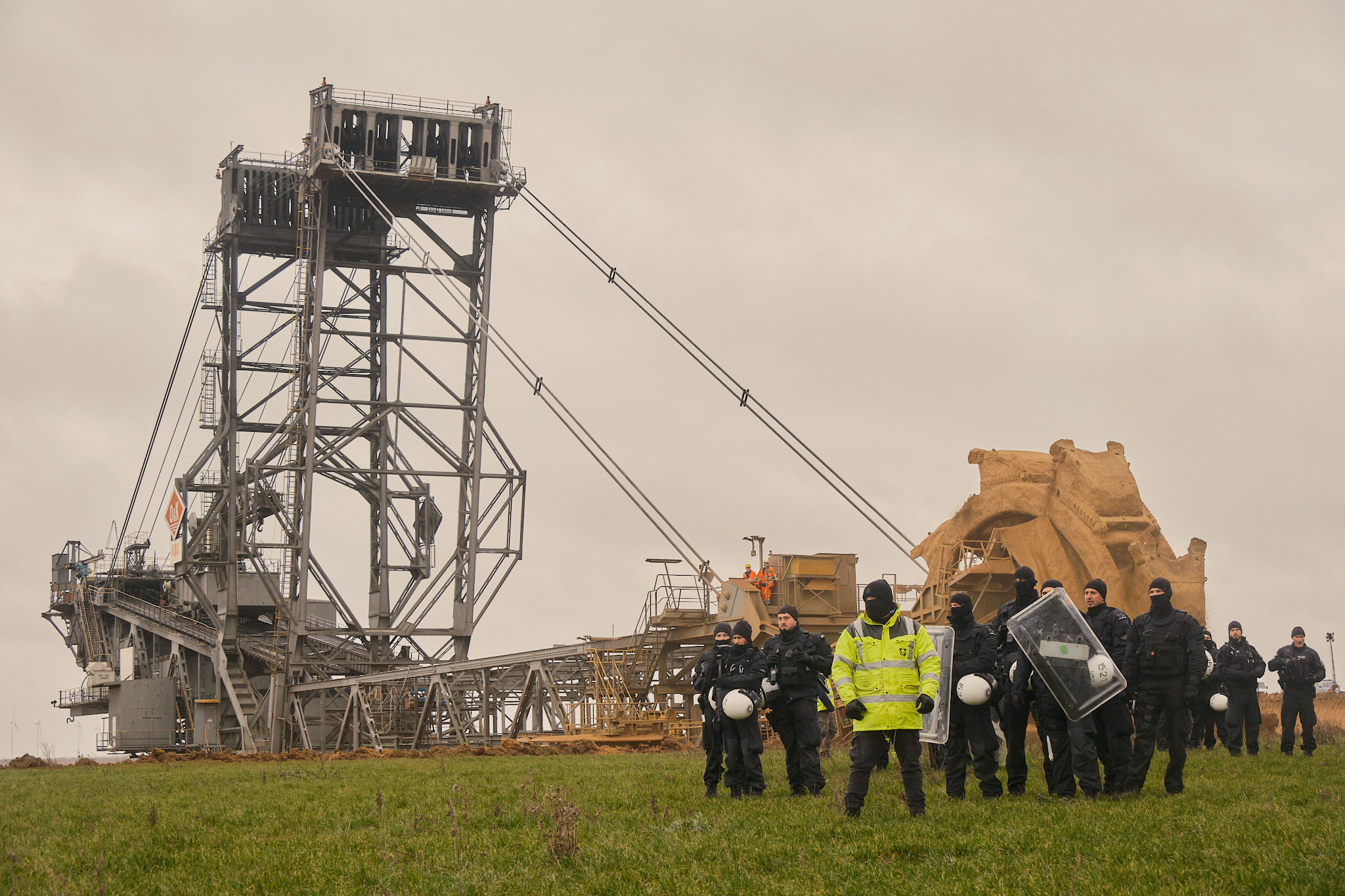
The village of Lützerath, on the lip of RWE's Garzweiler II opencast lignite mine, had lost its last resident more than a year before police reportedly began clearing it on 11 January 2023.194 Under a deal with the government, RWE could demolish the village in return for moving its coal exit forward from 2038 to 2030 and, reportedly, sparing five other villages.195193 At least 15,000 people reportedly marched on Saturday 14 January; hundreds of officers removed around 300 activists, two of whom, calling themselves Pinky and Brain, were holed up in a tunnel.196197 "Germany is really embarrassing itself right now," Greta Thunberg was quoted as saying.194 On 17 January police reportedly detained her at the edge of the mine, about 9 kilometers away, and released her after an identity check. "We knew who she was, but she did not get VIP treatment," Aachen police spokesperson Christof Hüls reportedly said. "She did not resist."198199
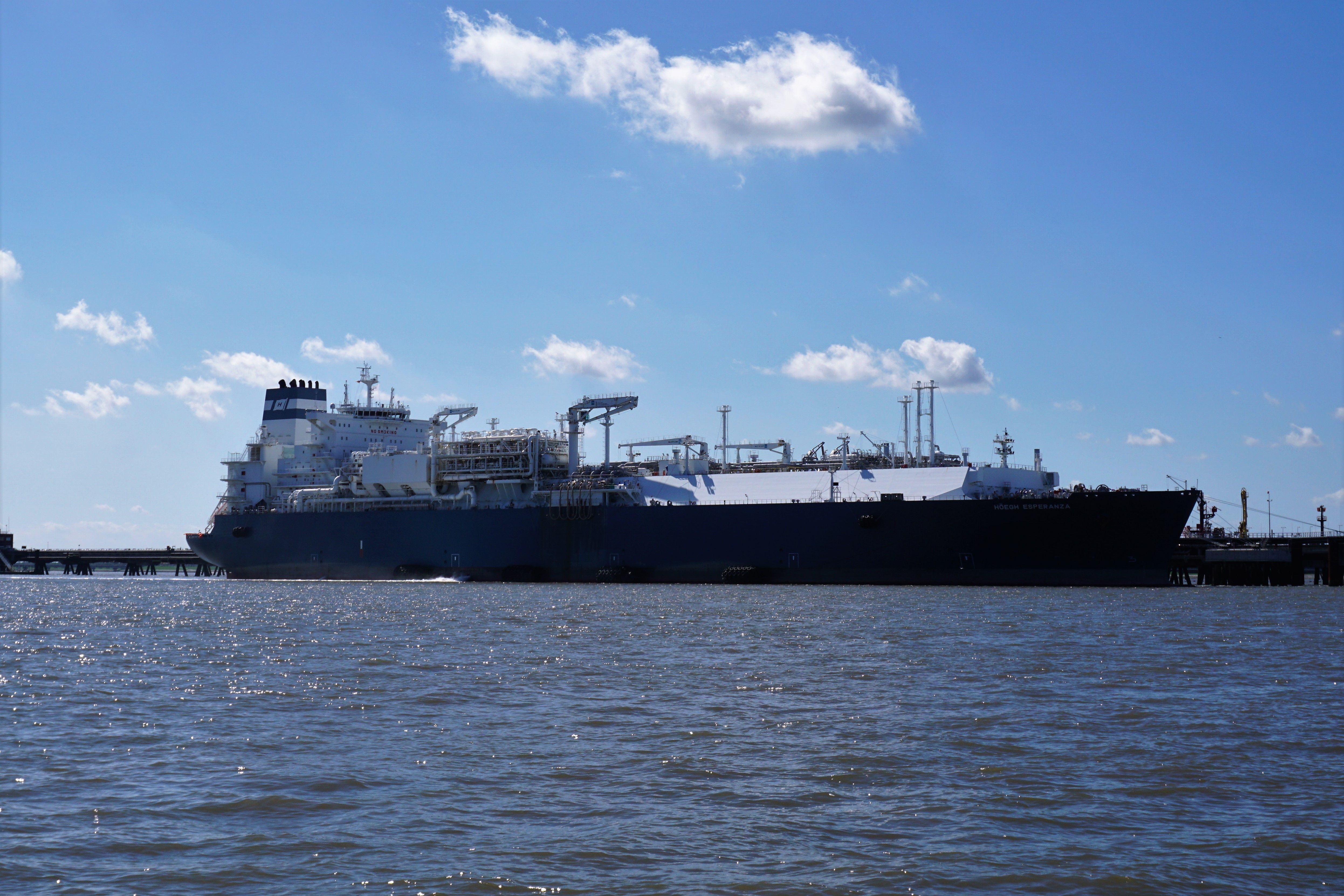
On 17 December 2022, Olaf Scholz opened Germany's first LNG import terminal at Wilhelmshaven on the North Sea. The floating storage and regasification vessel Höegh Esperanza, chartered by the federal government, had docked with about 165,000 cubic meters of liquefied gas, "enough to supply around 50,000 households for a year." Twenty-six kilometers of pipeline had been laid in five months, "less than 200 days from planning to commissioning." "This is a new world record," Scholz said, and spoke of "the new German pace at which we are expanding our infrastructure."200 In German he reportedly called it "das neue Deutschland-Tempo," meant to be a model "for many, many others."201 Lower Saxony's premier Stephan Weil, by one report, joked that he might have called it "Niedersachsen speed"; the terminal had taken 194 days.202 The government's English text promised more than 30 billion cubic meters of import capacity by the end of 2024; in the German reporting Scholz said by "the end of next year," meaning 2023.200203 Habeck, also at the opening, asked people to "use gas sparingly as it is still a scarce resource."
On 29 November 2022, in Houston and Doha, QatarEnergy and ConocoPhillips signed two sales agreements to ship LNG to Germany from the North Field expansion, with first deliveries expected in 2026 at Brunsbüttel on the Elbe.204 The volume was reportedly up to 2 million tonnes a year for at least 15 years.205 "Germany is the largest gas market in Europe," said Saad Sherida Al-Kaabi, Qatar's energy minister, "and we are committed to contribute to the energy security of Germany and Europe at large."204 Across the Atlantic, the United States became the world's largest LNG exporter in 2023 at 11.9 billion cubic feet a day, two-thirds of it bound for Europe; Germany began importing that year through three new floating terminals.206 On 26 August 2022, the front-month Dutch TTF gas contract had reportedly touched about €340 per megawatt-hour, against a decade average of €5 to €35; by another assessment of the month-ahead price, the peak was closer to €319.207208
On 16 June 2022, as European buyers scoured the spot market, Pakistan LNG Limited floated a tender for July deliveries. Three of the four delivery windows drew no bids at all; the fourth drew a single offer from QatarEnergy Trading at a record $39.8 per million British thermal units. "The bid was too expensive and we have not awarded the tender," an official told Dawn, adding that load-shedding would be the better option. The same report carried a line that explained the empty windows: "European customers suck spot market quantities to make up for Russian supply disruption."209 On 8 July a tender for ten cargoes through September drew nothing. Musadik Malik, the minister of state for petroleum, said LNG was not available anywhere, according to Dawn's paraphrase, because "there was no molecule in the market"; his gas utility in Punjab and Khyber Pakhtunkhwa had 670 million cubic feet a day against residential demand alone of 1,170.210 On 20 June the Islamabad administration reportedly ordered malls, factories, hotels, cinemas and wedding halls to close between 9 and 11:30 p.m. for two months.211 Pakistan's LNG imports in 2022 reportedly fell 17 percent, to a five-year low.212
In Bangladesh, where gas made 51.49 percent of the power, the government announced on 18 July 2022 an hour of daily load-shedding by area, closed every diesel plant, ordered shops shut at 8 p.m. and petrol pumps closed one day a week, and asked mosques to switch off air conditioning outside prayer times. "These measures, forced by the Russia-Ukraine War, are not long-term," said Nasrul Hamid, state minister for power. Tawfiq-e-Elahi Chowdhury, energy adviser to Prime Minister Sheikh Hasina, called it a "war-like situation": "Stern action will be taken against those defying these directives." Diesel power cost Tk30 a unit; gas, Tk1.5 to 2.213 Knitwear and textile output reportedly fell by 40 to 50 percent.214 In India, gas burn for power reportedly fell by about 28 percent in the first eight months of 2022, partly replaced with coal, and LNG imports suffered their steepest annual fall on record.215216
Provisional Commission figures reportedly put the EU's 2022 greenhouse gas emissions 2.4 percent lower than in 2021 even as GDP grew 3.5 percent, though power-sector emissions rose 3.9 percent.217193 In 2023 the bloc's net emissions fell 8.3 percent, the largest drop in decades outside 2020, in a year when real GDP reportedly grew 0.5 percent.218219 Germany's emissions fell to 673 million tonnes, the lowest since the 1950s. Energy-intensive production fell 11 percent that year while the wider economy shrank 0.3 percent; only about 15 percent of the carbon saved counted as permanent reductions. "The drop in production due to the energy crisis weakens Germany's industrial base," said Simon Müller, director of Agora Energiewende Germany. "If emissions are simply shifted abroad as a result, this won't benefit the climate."220 The first Qatari cargo under the 2022 contract was scheduled to sail from Ras Laffan to Brunsbüttel in 2026.204
9. Kuwait Burning
In August 1990, weeks after their tanks rolled into Kuwait on 2 August, Iraq's leaders settled on what they would do if they were ever driven out: they would destroy the country's ability to produce oil. That December, inside Iraq, their forces rehearsed on six mock-up wells. The real demolitions began on 16 January 1991, the night Coalition air strikes started, at the Wahfra field in the south, and worked northward. Engineers supervised the work. On each wellhead the troops packed 30 to 40 pounds of plastic explosive and strung detonation cord between wells so that several could be blown at once; on others they simply ruptured the "Christmas tree" valves and left the gas pouring out unlit. Smoke first showed on satellite images on 8 February. The number of fires peaked between 22 and 24 February, as the ground war began.221
The Pentagon's own environmental report on the fires says Iraq "ignited or damaged more than 750 of Kuwait's 943 oil wells distributed among eight fields," about 85 percent of the total. For the fires alone it adopted 605, from the US Army's satellite thermal analysis, while other studies it cites run from 609 to 732. Burgan alone, the great field south of Kuwait City, had 290 of its 409 wellheads on fire.221 On the day the last fire went out, the White House and UPI each gave a count of burning wells, and the two were more than a hundred apart.222223 Thirty-five years later, a Kuwaiti newspaper marking the anniversary reportedly used yet another number.224
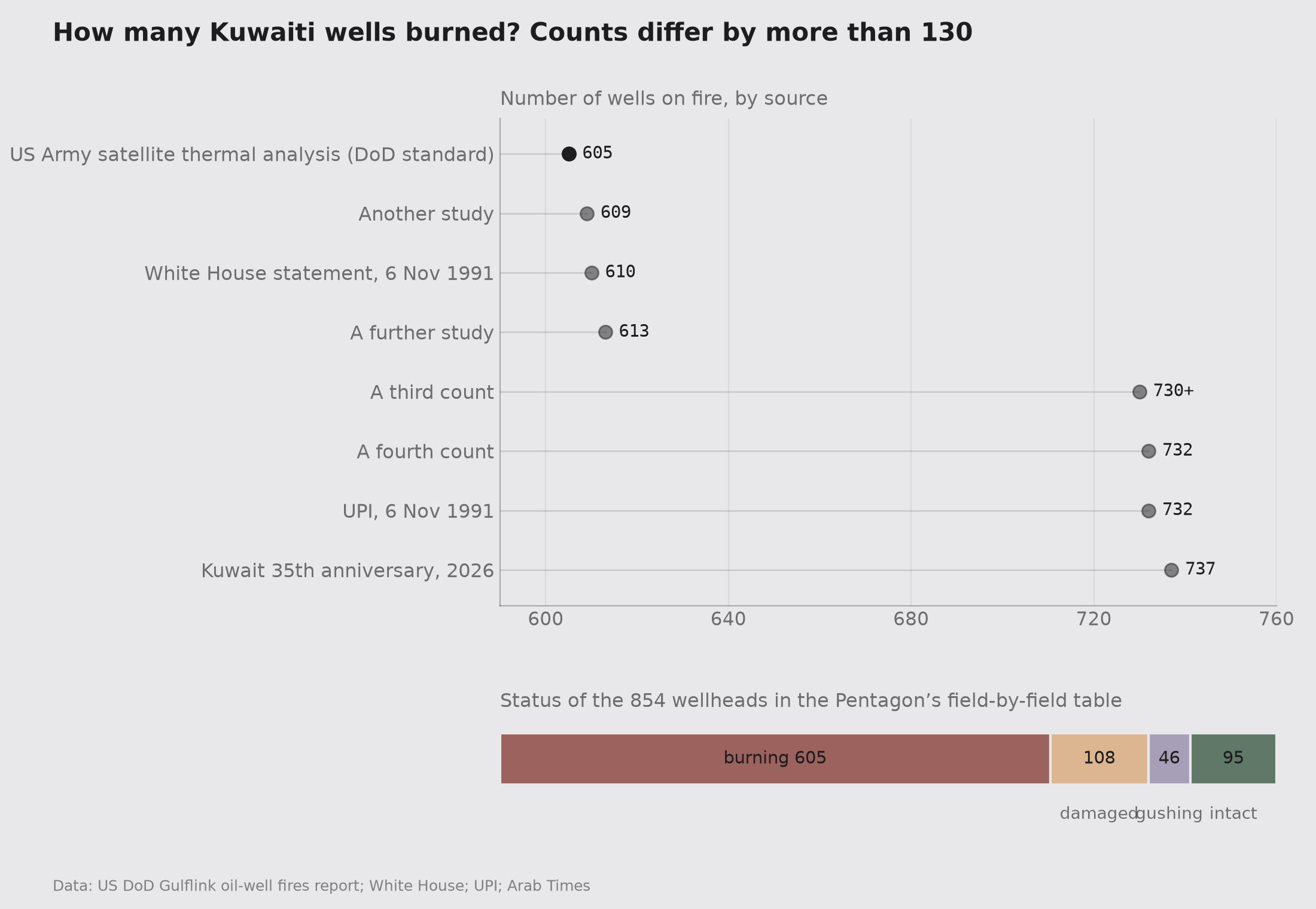
At the peak, by the Pentagon's count, 4 to 6 million barrels of oil and 70 to 100 million cubic meters of gas burned every day, at a time when Kuwait's entire pre-war crude output was 2 million barrels a day. By November more than a billion barrels had gone up or soaked into the sand, 1.5 to 2 percent of the country's reserves.221 One account in Nature reportedly put the initial loss at "something near 2-3 million barrels per day," well under the 6 million claimed by Kuwaiti authorities, and still worth up to $50 million a day.225 Single wells burned as much as 80,000 barrels a day, according to a later presentation to a US veterans' advisory committee, with flares up to 700 feet tall and plumes reaching 12,000 feet.226
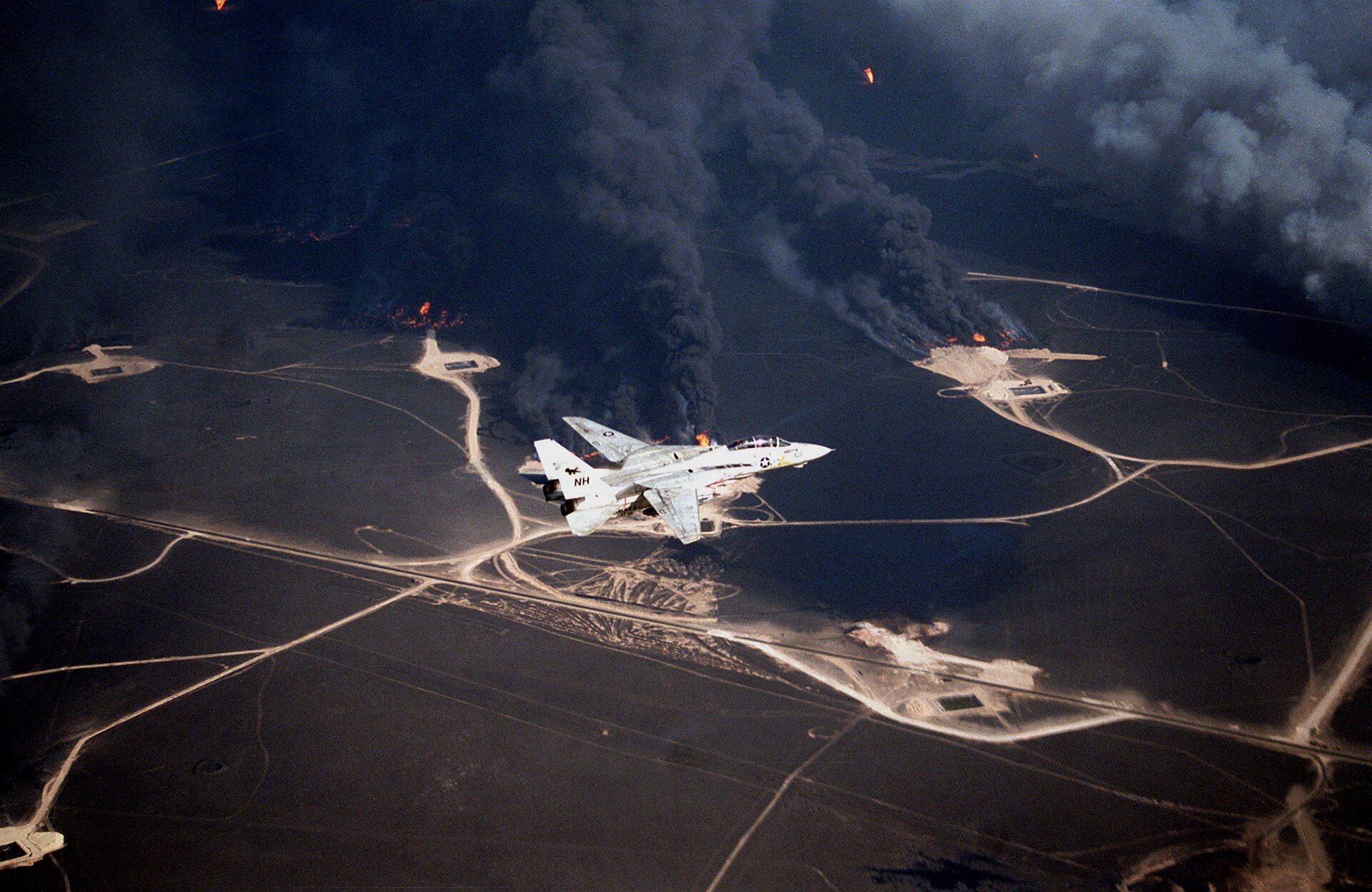
Under the smoke, the damaged wells that did not catch fire made lakes. More than 100 of them spread across 19 square kilometers, some deeper than 1.5 meters; 39 of the lakes alone, covering about 3 square kilometers, held an estimated 25 to 40 million barrels. Along the southern border Iraqi troops had dug "fire trenches" a kilometer long, 3 meters wide and 3 deep. Between 19 and 23 January they had also pumped Kuwaiti crude from the Sea Island terminal straight into the Gulf, until Coalition aircraft destroyed the main manifold and the flow stopped on 26 January. Coalition bombs, for their part, had destroyed 34 wells and 13 of the 18 gathering stations that month.221 The spill put between 1 and 1.7 million tonnes of oil into the sea, fouled some 700 kilometers of Saudi coastline and killed around 100,000 wading birds.227 One Gulf War veteran remembered a Monday when "the sky was so dark it was like night. People's eyes were running with black tears, your saliva was black, you had to have a bandanna over your nose to breathe."221
On 25 February, as the ground war ran into its second day, Red Adair took a call from President George H. W. Bush and reportedly told him the job would take a year.228 The crews arrived on 11 March and started work on 16 March.221 On 7 May, seven weeks in, UPI found the Houston outfits, Red Adair, Boots & Coots and Wild Well Control, on the Greater Burgan fields with 77 wells capped. Brian Krause, a Red Adair supervisor, stood watching a gusher throw crude 400 feet into the air. "The easy ones are out," he said. "Up until this one we were putting out two a day. But those were the small fires with the little leaks and little problems." He added: "It takes about a week to actually let your brain tell you what you're looking at… I've been working with Red Adair for 13 years and none of us have ever seen anything like this." Boots Mathews wiped soot off his brow: "It's going slower now than we expected… the bigger fires are yet to come." His crews, he said, had "basically been like scavengers trying to get equipment in here." George Hill of Wild Well Control kept it short: "It's bad, that's all you can call it. It's a mess."229
Ricky Loring, a Red Adair contractor from Houma, Louisiana, told the same reporter that "sometimes the inside of your nose gets pretty black… Nobody knows, because nobody has ever had anything to compare to this." The flames ran at around 3,000 degrees. The crews named the worst wells "Texas Longhorns" and "Big Bertha." Bechtel flew in about 1,500 men and laid pipe to bring Gulf seawater out to the fields. Ahmed Murad, a manager at the Kuwait Oil Company, did the arithmetic of delay: "Kuwait once had a 100-year reserve. Whether we lose 10 or 15 percent depends on how fast these firefighters move."229 The pace did pick up. Capping rose from an average of three wells a day in May to eight in October, and by 10 October, 566 of the roughly 750 damaged wells were sealed.221
By late October about 80 percent of the world's oil-well firefighters were in Kuwait, in 28 teams. From a night flight Burgan looked "like a monstrous California wildfire," red flame under black smoke; on the ground the desert lay under "two inches or more of oil that has fallen from the smoky sky," with camels, goats and foxes dead or dying in it. Adair's men in red coveralls worked within 20 yards of the flame, while the heat baked skin at 100 yards and the fire roared "like a passing train." When one well went dark, the Red Adair medic Dale Jones, from Starkville, Mississippi, drawled, "It's gusted." Jean-Paul Saulnier, a Canadian with the Houston firm Wellcaps, said: "The Iraqis knew what they were doing… They put their charges right where they would do the most damage." His colleague Gene Rose, from Oklahoma City, summed up the method: "Any way you do it, the idea is the same. You put water on the fire." Luther Young, 65, of Weatherford, Texas, had been called out of retirement: "I've been in the oil fields for 40 years. I don't think anyone has ever seen anything like this."230 The Hungarian team mounted old jet engines with water nozzles on a tank; the Romanians put theirs on a flatbed, "noisy but effective."230 The Hungarian machine, called Big Wind, was reportedly built that year by MB Drilling in a town about 50 miles southeast of Budapest, two MiG-21 engines on a Soviet T-34 chassis, each engine able to drive about 220 gallons of water a second.231232 One count credits it with nine fires in 43 days, and another gives the Canadian firm Safety Boss the most wells capped of any team, 180.233
The last well was capped on 6 November 1991.221 At Burgan, about 25 miles south of Kuwait City, the emir, Sheikh Jaber Al Ahmad Al Sabah, watched with diplomats and Gulf oil ministers. A senior Kuwaiti official said that "Sheikh Jaber himself operated the oil extinguishing system, symbolically declaring that war is left behind." The oil minister, Hmoud Al Raqba, called it "a historic day" and "a message to the Kuwaiti people that Kuwait's national wealth is now safe and protected." The job had taken about 250 days and cost Kuwait some $2 billion; the government had expected to finish only by March 1992.223 In Washington, Press Secretary Marlin Fitzwater said that "in less than 9 months, a unique international coalition capped nearly 700 wells, reversing Saddam's cruel efforts to achieve with sabotage what he could not do with his military," which he called "an act of mass ecological terrorism." Firefighters had come from 28 countries; American teams had capped more than half the wells.222
On 22 January, on ABC's Nightline, as the first wells were being lit, Carl Sagan said: "We think the net effects will be very similar to the explosion of the Indonesian volcano Tambora in 1815, which resulted in the year 1816 being known as the year without a summer." He warned of "massive agricultural failures," adding that "especially for South Asia, that seems to be in the cards, and perhaps for a significant fraction of the Northern Hemisphere as well."234 The next day he reportedly told a newspaper that "you need a very small lowering of the average temperatures of the Northern Hemisphere to have serious consequences for agriculture."235 With Paul Crutzen and Richard Turco he was working from their 1982 nuclear winter concept, and Turco worried the smoke would cool the Tibetan plateau and shut off the Asian monsoon.234 Other modelers reportedly disagreed at once. Lawrence Livermore calculations pointed to "at worst, minor local cooling," and Richard Small of Pacific-Sierra Research said there was "simply not a large enough amount [of smoke] to cause a temperature change."236237
Most of the smoke rose only about 2 miles, some of it to 4. Kuwait was at times 20°F colder than normal, and Bahrain, 150 miles away, had its coldest May on record. "But the monsoons did not disappear."234 Measurements later showed that the smoke absorbed 75 to 80 percent of the sunlight over parts of the Gulf, yet "probably had insignificant global effects": less of it was emitted than feared, it was less black, it was not lofted high, and it did not last.238 Some plumes were white with salt from the oil-field brines.239 Turco, looking back, said that "a conversation on 60 Minutes isn't going to be scientifically profound… you get saddled with one prediction, and it's hard to back out."234 Sagan later reportedly admitted the miss in print.240
In spring 1991, measurements over Kuwait found about 4.6 million barrels a day burning and carbon dioxide emissions "∼2% of global emissions."238 At Oak Ridge, the Carbon Dioxide Information Analysis Center found that global fossil and cement emissions rose 1.5 percent in 1991 and that "the Kuwaiti oil fires can account for all of the increase."241 How much CO2 that was is disputed. A 2004 study put it at 130 to 140 million tons, "corresponding to 2-3% of the global annual anthropogenic contribution."227 Early on, one British parliamentary briefing reportedly projected 171 million tonnes of carbon in the first year, assuming the fires would take two years to put out.242 A 2026 paper reportedly converts roughly a billion barrels into about 400 million tonnes, "about 2% of the world's fossil CO2 emissions in a single year."243 The Global Carbon Project still carries the fires as a row of their own, as if they were a country: "Kuwaiti Oil Fires," 477.9 million tonnes of CO2 in 1991, and zero in every other year.244
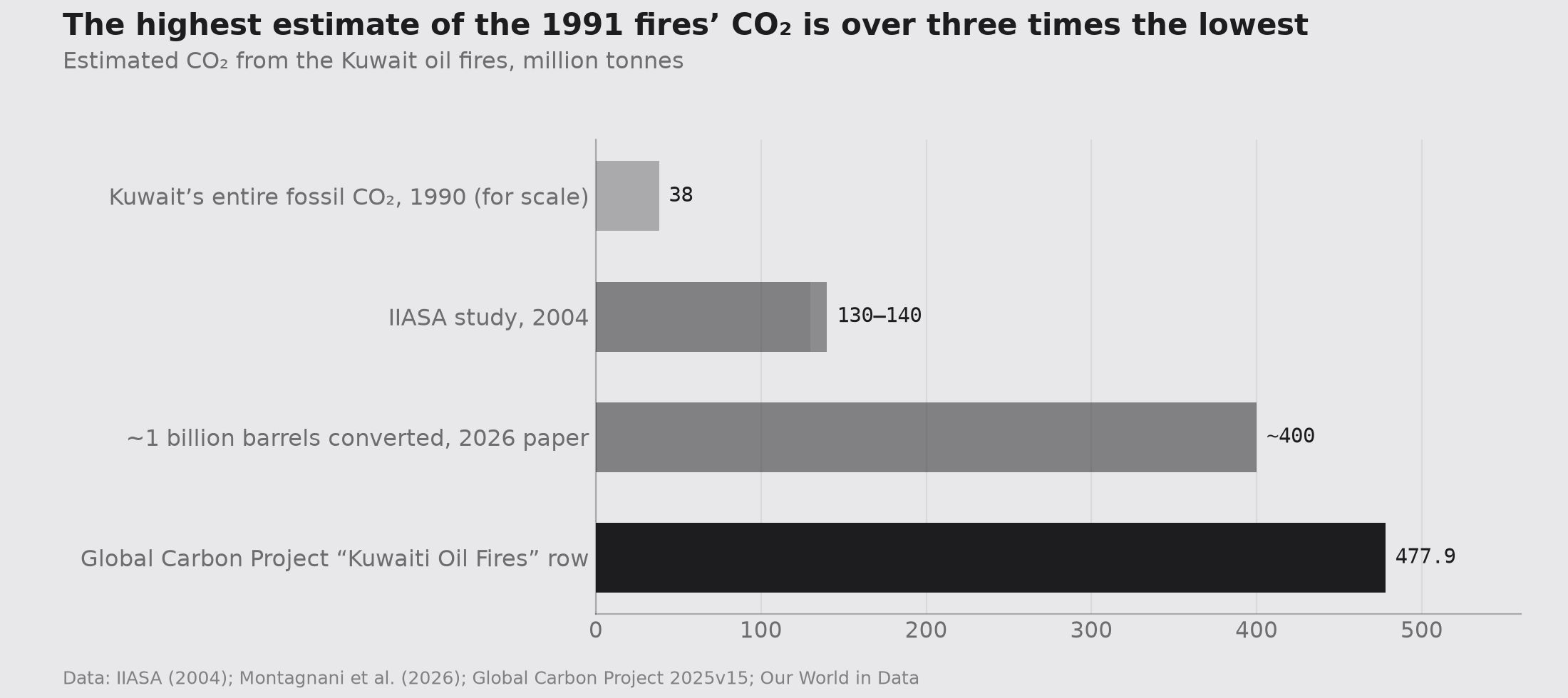
10. Off the Books
In March 2022, a few weeks after Russian columns crossed into Ukraine, a small group of carbon accountants and Ukrainian scientists began keeping a ledger that no government was keeping. The Initiative on GHG Accounting of War was led by Lennard de Klerk, with Svitlana Krakovska of the Ukrainian Hydrometeorological Institute, Sergiy Zibtsev of the Regional Eastern Europe Fire Monitoring Centre and Rostyslav Bun of Lviv Polytechnic among its authors. It took money from the European Climate Foundation and Sweden's Sida, cooperated with Ukraine's Ministry of Economy, Environment and Agriculture, and did "the assessments independently." Its first report, covering seven months, was presented at COP27 in Sharm el-Sheikh on 9 November 2022; others followed at Bonn, Dubai and Berlin, and at COP29 in Baku in November 2024 the group launched a written method for counting conflict emissions.245 At twelve months the count was reportedly about 120 million tonnes of CO2 equivalent, "a country like Belgium";246 at twenty-four months it was reportedly "more than the annual GHG emissions from a highly industrialized country like The Netherlands."247248 A preliminary three-year figure reportedly came out on 24 February 2025;249 the full report in October put it at 236.8 million, "the annual emissions of Austria, Hungary, Czech Republic and Slovakia combined."245 By 23 February 2026, four years in, the tally stood at 311.4 million tonnes, "comparable to the annual emissions of France."250
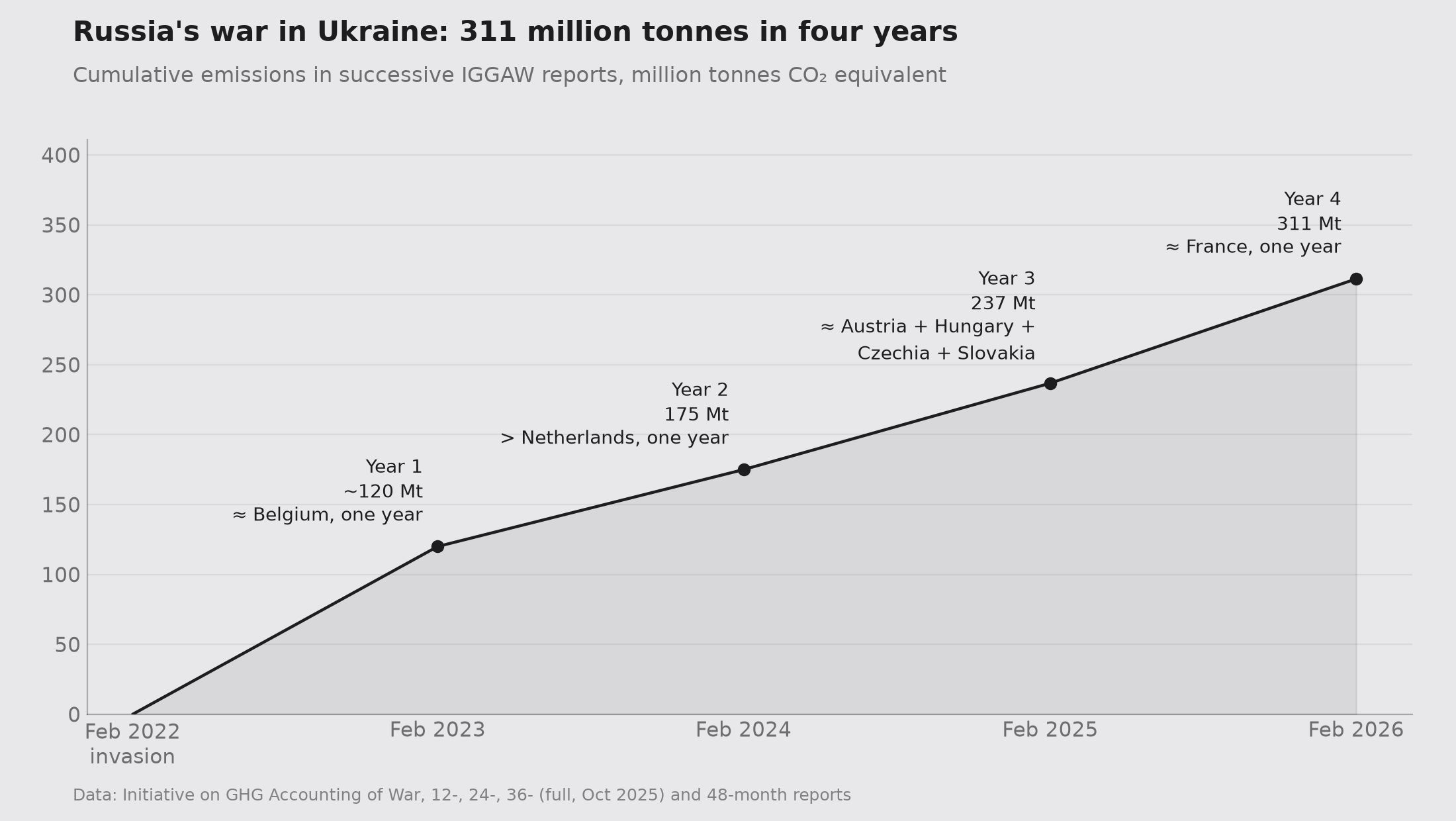
Warfare itself was the largest share of the four years, 37 percent, followed by the carbon locked into future reconstruction and by landscape fires.250 Tanks and fighter jets burning fuel made up 90 percent of the warfare share.
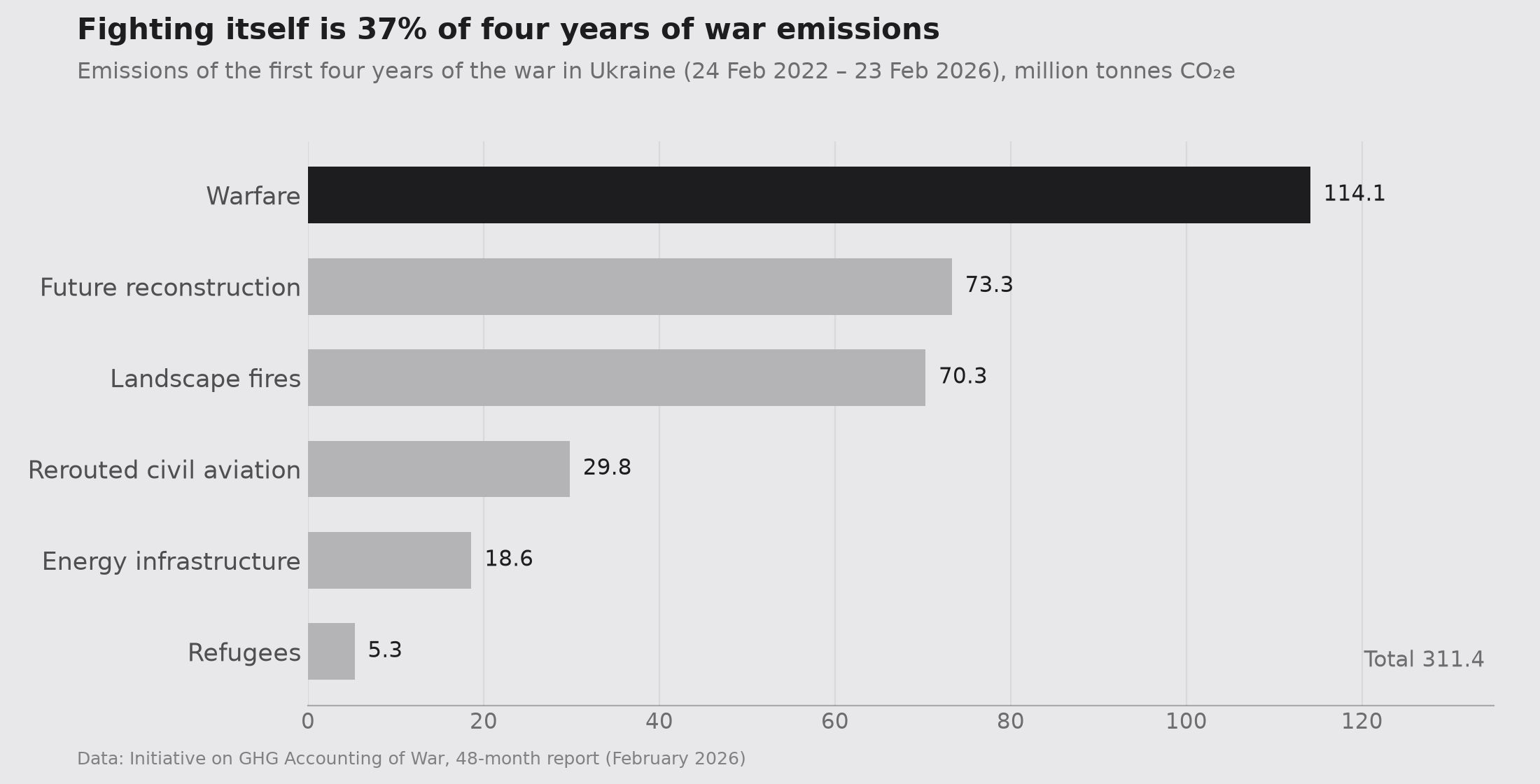
Over the first three years Russian forces' fuel came to more than four times Ukraine's. Early in the war Russia was firing "up to 50,000 or even 60,000 shells per day"; by 2024 it was about 10,000 a day against Ukraine's 2,000. Almost all the carbon in those shells was released in the factories that made them.250245 In 2024 the area burned in war-related fires was more than twenty times the 2006–2021 average, and 77 percent of three years' burned land lay inside the 30-kilometer frontline belt, where firefighting was impossible; 1,629 of Ukraine's 4,216 fire trucks had been damaged or destroyed. "Unusually hot and dry conditions — likely intensified by global warming — turned even minor sparks from combat into uncontrollable blazes," the report says.250 With Russian airspace closed to 36 countries, a London–Tokyo flight stretched from 11 hours 54 minutes to 14 hours 50.245
Ukraine's own iron and steel output fell more than 60 percent in 2022, cutting about 56.3 million tonnes of CO2 equivalent in the first eighteen months, and wrecked power and heating plants cut another 47.5 million. Attacks on the built and natural environment more than offset both.251 Part of the national decline was also an export: many emissions "shifted abroad together with the many refugees and shifted steel production." Ukraine's 2025 national inventory records its banks of sulfur hexafluoride, a gas with 23,500 times the warming potential of CO2, but notes that "large-scale losses are not reflected in the national inventory."245
On 26 September 2022, explosions ruptured the Nord Stream 1 and 2 pipelines under the Baltic, and gas reportedly kept escaping until 3 October.252 The only measurements taken on site, from aircraft, were made in early October by Germany's DLR and TU Braunschweig.253 On 20 February 2023, UNEP's methane observatory put the release at 75,000 to 230,000 tonnes of methane, "less than 0.1 per cent" of annual human-made methane emissions. "The Nord Stream incident reminds us it has never been more urgent to cut methane now," said Manfredi Caltagirone, who heads the observatory.254 On 15 January 2025 a study in Nature by about seventy scientists from thirty organizations more than doubled the figure, to between 445,000 and 485,000 tonnes, nearly five times the previous record at Aliso Canyon in California. "This release was extraordinary in its magnitude but it's just the tip of the iceberg," Caltagirone said; the blasts amounted to "just two days' worth of the global oil and gas industry's methane emissions."253 The Ukrainian war ledger books it as 465,000 tonnes, plus or minus 20,000, or 13.0 million tonnes of CO2 equivalent, "the largest recorded transient anthropogenic methane emission event."245
At COP30 in Belém in November 2025, Ukraine announced it would take the ledger to the Council of Europe's Register of Damage. "In many ways, Russia is fighting a dirty war and our climate is also a casualty," said Pavlo Kartashov, a deputy minister for economy, environment and agriculture. "The vast amounts of fuel burned, forests scorched, buildings destroyed, concrete and steel used, all these things are essentially 'conflict carbon.'" De Klerk said the claim "will make Ukraine the first to hold another country accountable for climate emissions from war." Doug Weir, director of the Conflict and Environment Observatory, said "the climate cost of war can no longer go unchallenged." On the three-year figure the bill came to $43.8 billion;255 on the four-year figure, more than $57 billion.250 The register's environmental category reportedly opened on 30 September 2026, with no Russian response on record as of mid-October.256
The first sixty days after 7 October 2023 in Gaza produced about 281,000 tonnes of CO2 equivalent, more than 99 percent of it from Israel's air and ground campaign and almost half from US cargo planes flying in military supplies. By 4 December at least 200 such flights had delivered 10,000 tonnes of equipment, burning jet fuel whose emissions were "more than the entire island of Grenada last year." At COP28 in Dubai, Ran Peleg, Israel's director of Middle East economic relations, said: "This is actually the first time this issue has been raised, and I'm not aware that there are any ways to count these kinds of things." David Boyd, the UN special rapporteur on human rights and the environment, called armed conflict "an idiotic way to spend our shrinking carbon budget."257 The count was redone at 120 days258 and again at fifteen months, to the January 2025 ceasefire.259
The peer-reviewed version, published in One Earth on 11 March 2026, settled on more than 1.3 million tonnes for the fighting itself through January 2025. Before the war, up to a quarter of Gaza's electricity came from rooftop solar, "one of the world's highest shares"; most of the panels were destroyed and replaced with diesel generators. Counting Hamas's tunnels, Israel's "Iron Wall," and the rebuilding of 436,000 apartments, the total reaches 33.2 million tonnes, about Jordan's emissions for all of 2024.260 UNEP reportedly counted more than 39 million tonnes of debris by May 2024, over 107 kilograms for every square meter of the Strip.261 By September 2025 it was 61 million tonnes, "about as much as 15 Great Pyramids of Giza," from the 78 percent of Gaza's buildings damaged or destroyed. "The situation is going from bad to worse," said Inger Andersen, UNEP's executive director, whose staff could not enter Gaza and worked from satellite images.262 Hadeel Ikhmais, who runs the climate office of the Palestinian Environmental Quality Authority, said that "not counting carbon emissions is a black hole in accountability."259
In the first fourteen days of the war on Iran, from 28 February to 14 March 2026, the same researchers counted 5,055,016 tonnes of CO2 equivalent, an annual rate of 131.4 million tonnes, about Kuwait's yearly output; damaged buildings, some 20,000 by the Iranian Red Crescent's count, and burning oil made up most of it. "Burning up the annual emissions of Iceland in two weeks is something we really cannot afford," said Fred Otu-Larbi, one of the authors.263264 Israel had chosen to strike about thirty oil processing and storage sites, and the fires around Tehran brought "black rain" down on some 9 million people.265 In the first 38 days the United States flew more than 10,200 sorties, more than it and its allies flew in Afghanistan in all of 2021.251 At COP31 in Antalya, in remarks reported on 11 November 2026, President Masoud Pezeshkian gave Iran's own number: 1.5 million tonnes of CO2, a million of it from a fuel depot near Tehran hit on 7 March and half a million from the Asaluyeh facilities struck on 18 March.266 One count puts two weeks of war at more than 5 million tonnes; the other, Tehran's, puts the attacks on Iran at 1.5 million.
In October 1997, two months before Kyoto, Deputy Under Secretary of Defense Sherri Goodman warned that the draft protocol would harm "military readiness."267 A Pentagon memo of that year said that even a 10 percent cut in fuel use would "represent a serious threat to national security" and that "we must not sacrifice our national security to achieve reductions in greenhouse gas emissions."251 Late on 6 December, a Committee of the Whole adopted the exemption language with "very little discussion," an Energy Department delegate noted. The decision of 11 December kept fuel "sold to ships or aircraft engaged in international transport" out of national totals and put multilateral operations under the UN Charter in a separate report. European delegates were "confused as to why this is such an important matter"; the Pentagon's Capt. Christopher Weaver called it an "extremely important aspect" of the US position. A State Department cable to all posts on 19 December called the exemptions a "major victory," and a fact sheet the next month said operations like Desert Storm would not count in national totals.267 The Paris Agreement dropped the exemption in 2015 and left military reporting voluntary; only four countries submit some incomplete data.257 Norway is one of the few that publishes a full military footprint, 1.44 million tonnes in 2024.251 At COP30, conflict emissions "were not acknowledged within the formal proceedings," and no UNFCCC outcome document has yet mentioned them.260
One estimate puts the world's armed forces and their suppliers at 3.3 to 7.0 percent of global emissions, about 5.5 percent at best guess, "the fourth largest national carbon footprint in the world – greater than that of Russia," and that figure leaves out the fighting itself.268 Another, called "conservative," gives 336 to 400 million tonnes for 2024, roughly Italy or Australia.251 The US Defense Department, "the largest institutional consumer of fossil fuels in the world," withholds its fuel data from Congress, so its emissions are reconstructed from Energy Department figures:269 about 46 million tonnes in 2024, and 3,983 million tonnes between 1975 and 2024.251 In Madrid on 28 June 2022, NATO's secretary-general, Jens Stoltenberg, reportedly promised that "what gets measured, can get cut" and pledged a cut of at least 45 percent by 2030, a target covering NATO's own operations, not its members' armies.270271 At COP27 that November he reportedly said militaries "were exempted from the whole equation. Now, military emissions are part of what is counted, but the data is not good."272
11. Where the Money Goes
On 28 April 2025 the Stockholm International Peace Research Institute put a figure on the previous year: world military expenditure of $2,718 billion in 2024, up 9.4 percent in real terms, the steepest year-on-year rise since at least the end of the Cold War and the tenth increase in a row.273 Twelve months later SIPRI added 2025 to the series: $2,887 billion, the eleventh consecutive rise, with military spending taking 2.5 percent of world GDP, the highest share since 2009.274 The slowdown came largely from Washington: US spending fell because Congress approved no new military aid for Ukraine, while the rest of the world kept climbing. Germany's spending rose above 2 percent of its GDP for the first time since 1990, Ukraine spent the equivalent of 40 percent of its economy, and the 29 European members of NATO increased their outlays faster than in any year since 1953.274
In The Hague on 25 June 2025, NATO's leaders signed a declaration five short paragraphs long. "Allies commit to invest 5% of GDP annually on core defence requirements as well as defence-and security-related spending by 2035," it read: at least 3.5 percent on core defense, and up to 1.5 percent "to inter alia protect our critical infrastructure, defend our networks, ensure our civil preparedness and resilience, unleash innovation, and strengthen our defence industrial base," with the trajectory to be reviewed in 2029 and the next summit set for Türkiye in 2026. The word climate does not appear in it.275 Mark Rutte, the secretary general, addressed the American president in his opening remarks. "President Trump, dear Donald, you made this change possible," he said, promising that the day's decisions "will produce trillions more for our common defence" and calling the industrial expansion "good for our jobs."276 Trump told reporters the target would add "more than $1 trillion a year" and that "This will be known as The Hague defense commitment." Spain's prime minister, Pedro Sánchez, reportedly called the target "unreasonable."277 Trump's answer: "I'm going to negotiate directly with Spain. I'm going to do it myself. They're going to pay."278
Three and a half months earlier, on 4 March 2025, Ursula von der Leyen had stood in Brussels and announced that "we are in an era of rearmament," reportedly a day after Washington paused military aid to Ukraine.279 Her plan, ReArm Europe, had five parts. Activating the escape clause of the Stability and Growth Pact would let member states raise defense spending by 1.5 percent of GDP and, she said, create "fiscal space of close to EUR 650 billion over a period of four years." A new €150 billion loan instrument, later named SAFE, would lend for weapons. The European Investment Bank would be brought in, and member states would get incentives to use cohesion policy programmes, the EU's regional-development money, for defense. "ReArm Europe could mobilise close to EUR 800 billion for a safe and resilient Europe," the Commission president said. "This is a moment for Europe."280
Germany moved two weeks later. On 18 March 2025 the outgoing 20th Bundestag, in its last scheduled session, amended Articles 109, 115 and 143h of the Basic Law. Defense spending above 1 percent of GDP was exempted from the constitutional debt brake, with no upper limit. A separate special fund of up to €500 billion, spread over 12 years, was created "for additional investments in the infrastructure and additional investments into reaching climate neutrality by 2045," and €100 billion of it was moved straight into the Climate and Transformation Fund.281 The tally announced on the floor was 513 to 207; the official count was later corrected to 512 to 206, against a two-thirds threshold of 489.282 SPD leader Lars Klingbeil called it a "historic decision," and Friedrich Merz said "a need for infrastructure renewal has built up over decades."281 The climate money was there because the Greens, who had just lost the election, reportedly negotiated it into the package: "100 Milliarden Euro des Infrastruktur-Sondervermögens werden für den Klimaschutz bereitgestellt," their party statement read.283 The military exemption carried no cap; the climate share was fixed at €100 billion over twelve years.
In London on 25 February 2025, Keir Starmer told the House of Commons that defense spending would reach 2.5 percent of GDP in 2027, 2.6 percent counting intelligence, with a target of 3 percent in the next Parliament. He would "fully fund" it by cutting overseas aid from 0.5 to 0.3 percent of gross national income in 2027, the lowest level since 1999. Aid had already been cut once, from 0.7 percent, in 2021. The Commons Library worked out that the cut meant about £6.1 billion less aid in 2027, while lifting defense to 2.5 percent would cost about £5.9 billion. The money moved almost pound for pound from one column to the other. Starmer conceded that the move "remains a cut" and named climate finance among the things Britain would go on supporting.284
Anneliese Dodds, the minister of state for international development, resigned three days later. "Undoubtedly the postwar global order has come crashing down," she wrote to Starmer on 28 February. "Instead, the tactical decision was taken for ODA to absorb the entire burden. You have maintained that you want to continue support for Gaza, Sudan and Ukraine; for vaccination; for climate; and for rules-based systems. Yet it will be impossible to maintain these priorities given the depth of the cut." The cut, she warned, would likely mean "a reduced voice for the UK in the G7, G20 and in climate negotiations. All this while China is seeking to rewrite global rules, and when the climate crisis is the biggest security threat of them all."285 Sarah Champion, the Labour MP who chaired the International Development Committee, called the decision "deeply shortsighted": "our finances should be spent on preventing [conflict], not the deadly consequences."284
By 9 April 2026, when the OECD published its preliminary aid figures for 2025, Britain's cut was one line in a much larger collapse. Official development assistance from the members of its Development Assistance Committee fell 23.1 percent in real terms, "the largest annual drop in the history of official development assistance," to $174.3 billion, back to the level of 2015. The American cut was the biggest by any donor in any year on record and three-quarters of the global fall; Germany, at $29.1 billion, overtook the United States, at $29.0 billion, as the largest donor for the first time. Aid to the least developed countries and to sub-Saharan Africa each fell by more than a quarter, humanitarian aid by more than a third, and the OECD projected a further 5.8 percent decline in 2026. Ukraine, at $44.9 billion, received the largest amount of aid ever given to a single country.286 "Fiscal pressures on developing countries are growing," Mathias Cormann, the OECD secretary-general, said that day, "and the ongoing conflict in the Middle East represents a significant risk for global growth and food security." Carsten Staur, chair of the committee, said the world needed "more ODA, not less," among other things "to further the green transition."286
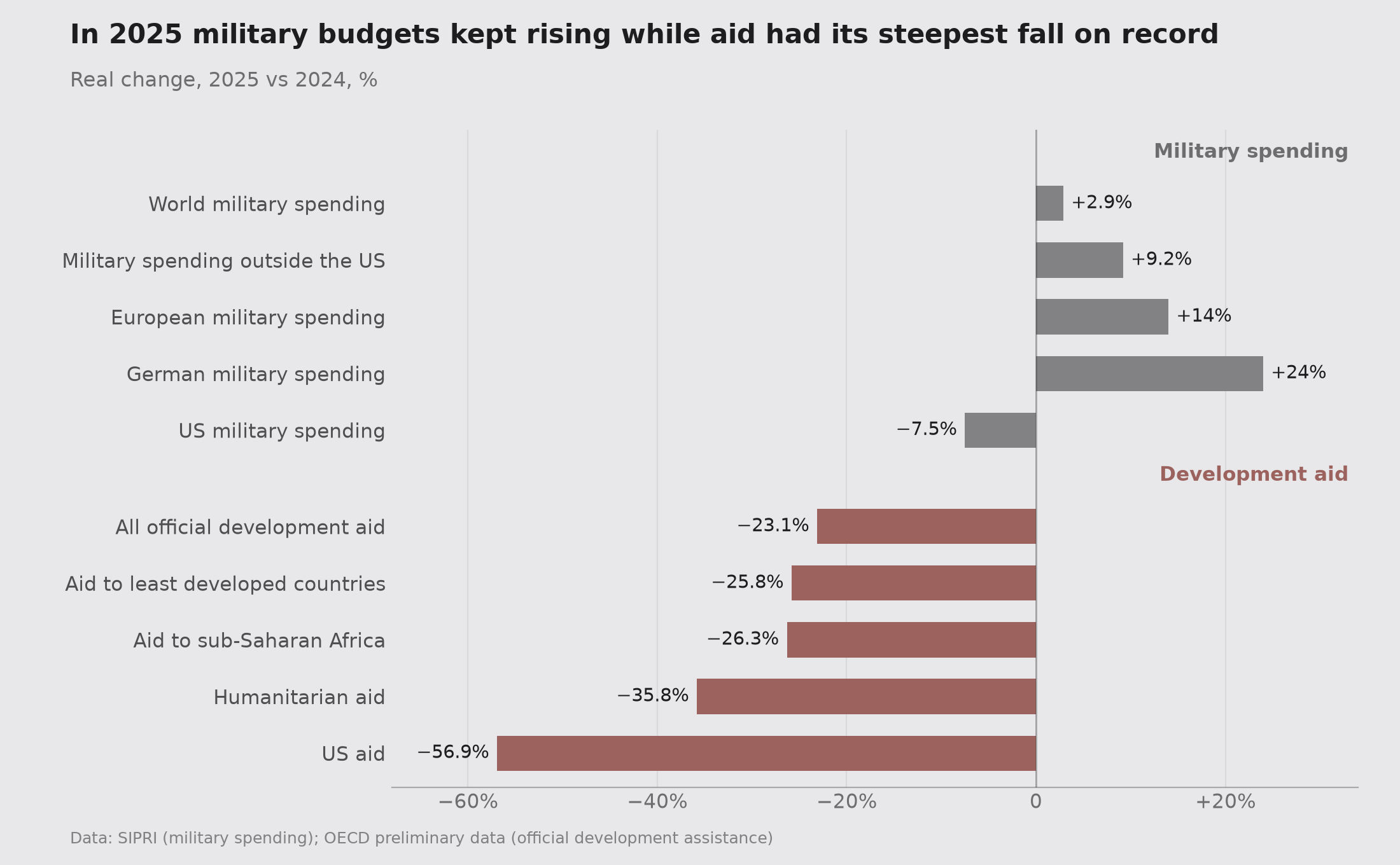
The United States had begun its share of that fall on 20 January 2025, when Trump halted all foreign aid pending review; by 10 March, 83 percent of USAID's programmes had reportedly been terminated.287 Under Biden, Washington had committed $11.4 billion a year in climate finance by 2024. As of mid-November 2026 it "will not provide any official climate finance in the coming years."288
At about 2:30 in the morning of 24 November 2024, in Baku, the COP29 president Mukhtar Babayev gavelled through the promise those cuts would later be measured against, reportedly without a pause for objections.289 Under the New Collective Quantified Goal, developed countries would "take the lead" in mobilizing $300 billion a year by 2035, up from the $100 billion goal set in 2009 and met two years late, in 2022; all actors would "aim to mobilise" $1.3 trillion a year.290 Chandni Raina, an adviser in India's Department of Economic Affairs, took the floor in the closing plenary. "I regret to say that this document is nothing more than an optical illusion," she said, according to reports from the plenary. "This, in our opinion, will not address the enormity of the challenge we all face. Therefore, we oppose the adoption of this document." The goal, she said, was "too little, too distant."291
On 11 November 2026, as delegates gathered in Antalya, the pledges behind that goal were tallied again. Public climate finance pledged to developing countries for the next few years came to $11.7 billion a year, down more than 70 percent from recent levels of about $40 billion. Only five nations had announced new multi-year pledges, and only one major donor, the United Kingdom, whose new commitment was itself a like-for-like drop. Germany and France had each pledged €6 billion a year by 2025 and committed nothing beyond it; Germany missed its 2025 goal. Australia, co-host of COP31 with Türkiye, had pledged nothing. European governments cutting aid cited "economic strain and defence spending needs." In late October the EU's climate commissioner, Wopke Hoekstra, had told Bloomberg that "any conversation on new fresh money is dead in the water."288
On 29 October 2025, UNEP had priced the other side of the ledger: the adaptation-finance gap facing developing countries by 2035 was twelve to fourteen times the international public adaptation finance then flowing.292 "Adaptation is not a cost – it is a lifeline," António Guterres said in his message on the report. A year on, on 4 November 2026, the next report put needs at about $305 billion a year by 2035, with 2024 flows up only about $1 billion on the year before; "the pace of growth is slowing when it should be accelerating." Even the tripling of adaptation finance called for at COP30 would cover only 20 to 29 percent of needs.293294 "The bottom line, however, is that the world is not ready to adapt to current climactic conditions," said Inger Andersen, UNEP's executive director, "never mind what overshoot of 1.5°C will bring."293
In New York on 9 September 2025, the UN secretary-general launched a report titled The Security We Need. World military spending of $2.7 trillion in 2024 was on course for $6.6 trillion by 2035 if trends held. "Reinvesting 15 per cent or $387 billion of the global military spending is more than enough to cover the annual costs of climate change adaptation in developing countries," it said, adding that "by some estimates, each dollar spent on the military generates over twice the greenhouse gas emissions of a dollar invested in civilian sectors." A billion dollars, by its count, created about 11,200 jobs in the military and 16,800 in clean energy.295 "The evidence is clear: excessive military spending does not guarantee peace," Guterres said. Redirecting 7 to 13 percent of 2024's military spending would have closed the adaptation-finance gap.296
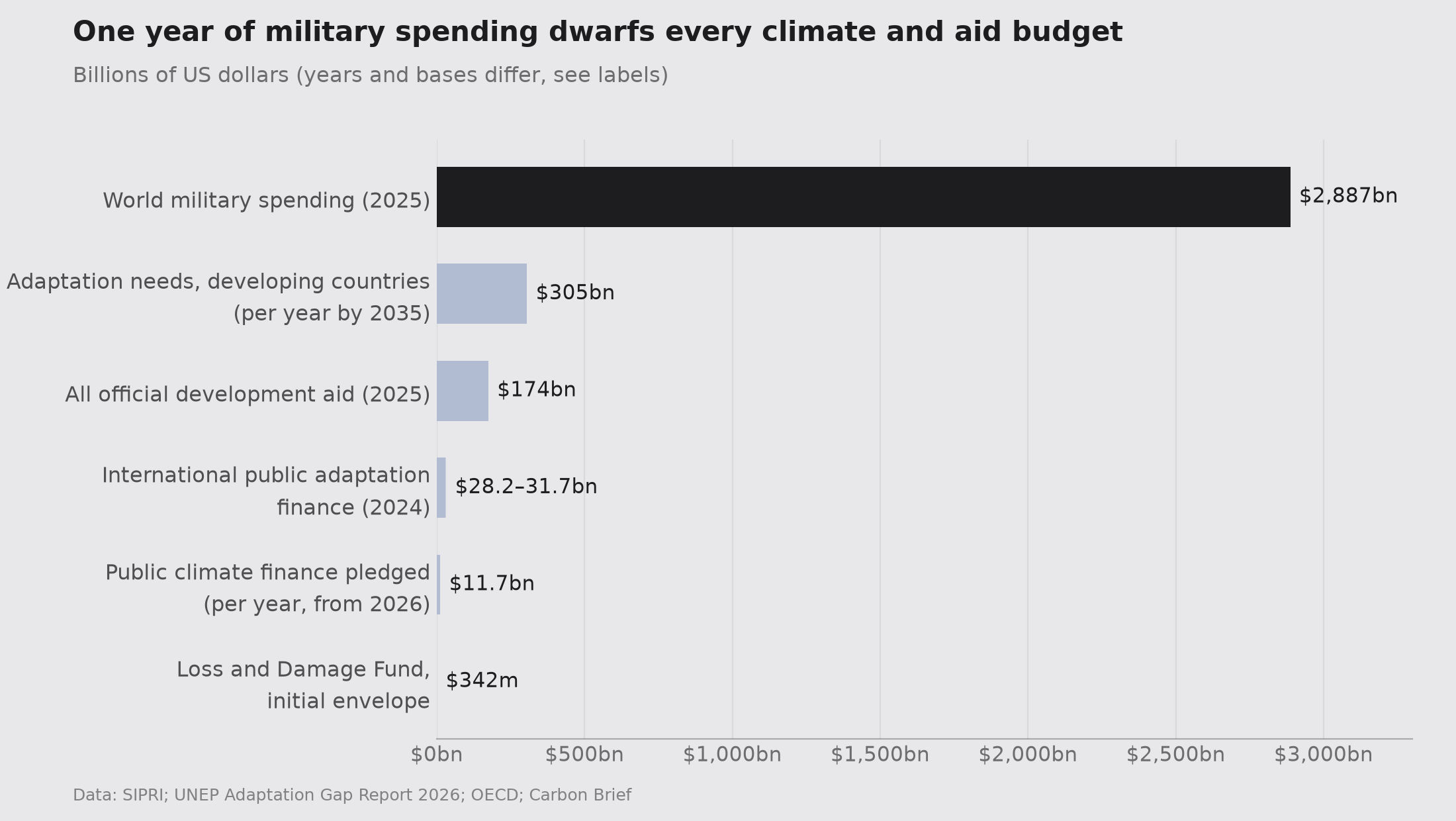
The Fund for responding to Loss and Damage, set up to pay for climate harm that adaptation can no longer prevent, started with an initial envelope of $342 million. Requests came in at roughly eight times that, reportedly about $2.8 billion from 119 countries.293297
12. Rooftops
On 8 July 2022, the same day Pakistan's ten-cargo LNG tender came back empty, Power Minister Khurram Dastgir Khan announced that Prime Minister Shehbaz Sharif would unveil a solar policy on 1 August. Households would start with one-kilowatt set-ups, then move up to three; irrigation tubewells would be solarized, starting in Balochistan; government buildings would switch over. The target was 7,000 to 10,000 megawatts of solar before the next summer.210 Electricity prices in Pakistan rose 155 percent over the following three years.298
In 2024 Pakistan imported 17 gigawatts of solar panels, more than double the year before, which made it the world's third-largest importer.298 Counts differ; one, of Chinese components only, reportedly shows a fivefold jump between 2022 and 2024.299300 Some 15 gigawatts went up in 2024 in a country whose peak demand is around 30. "Just mind boggling," said Dave Jones of the think tank Ember. "There is no policy push that is driving this; this is essentially people-led and market driven," said Mustafa Amjad, program director at Renewables First in Islamabad. "It was essentially the people forcing markets to import more solar panels." Jenny Chase of BloombergNEF looked at the roofs: "There are more solar panels than you'll see almost anywhere else in the world in terms of roof coverage. This is what cheap solar means. It means people who have never had power before, having power."298
Waqas Moosa, who chairs the Pakistan Solar Association, warned in the spring of 2025 that the boom had a cost. "Our grid is going to suffer," he said; with batteries, "suddenly all the power goes in the hands of consumers," and the utilities face a death spiral.298 On 13 March 2025 the Economic Coordination Committee, chaired by Finance Minister Muhammad Aurangzeb, reportedly cut the price paid for rooftop power fed back into the grid to Rs10 a unit, saying net-metering customers had already shifted Rs159 billion in costs onto everyone else by December 2024.301 Those left without panels, said Asha Amirali of the University of Bath, are "still stuck on the extremely expensive, often extremely unreliable, dirty fossil fuel-based grid." Her verdict: "I think Pakistan can only teach you what not to do right now." A Power Division official answered that the government "has to be given full credit," for zero tax on panels and about 4 gigawatts of net metering.298
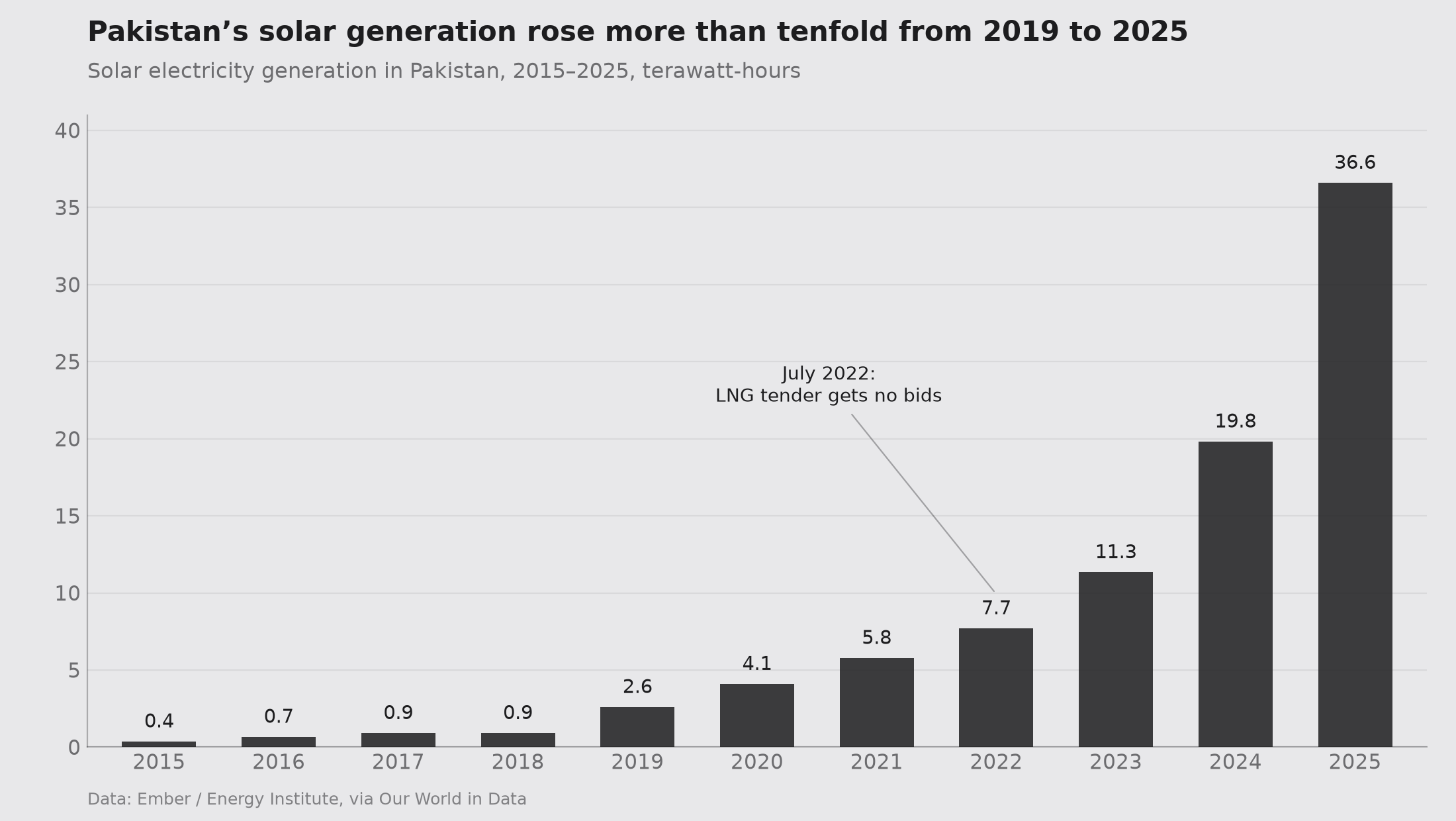
By June 2025 Pakistan reportedly had around 38 gigawatts of distributed solar.302 In 2025 solar reportedly made 22.5 percent of grid output, and in the first quarter of 2026 it was reportedly the largest single source of Pakistan's electricity, at 32.3 percent.303 That quarter, with 85 percent of the country's energy normally moving through Hormuz, Pakistan shut its schools for two weeks and cut fuel for government cars by half.2014 On 3 April 2026, vehicles queued for fuel in Peshawar.42
On 30 July 2026 the International Energy Agency, which counts road vehicles as nearly half of global oil use, reported that electric car sales in the second quarter had risen 35 percent from the first and set records in 50 countries, even as global car sales fell 5 percent in the first half. In Australia, Brazil, India, Korea and Viet Nam, sales roughly doubled between March and June compared with 2025. Electric cars were now expected to make up 29 percent of global car sales for the year.61 In August, electric cars reportedly took 51 percent of new-car sales in Vietnam; in Germany, petrol cost about $8.52 a gallon.304
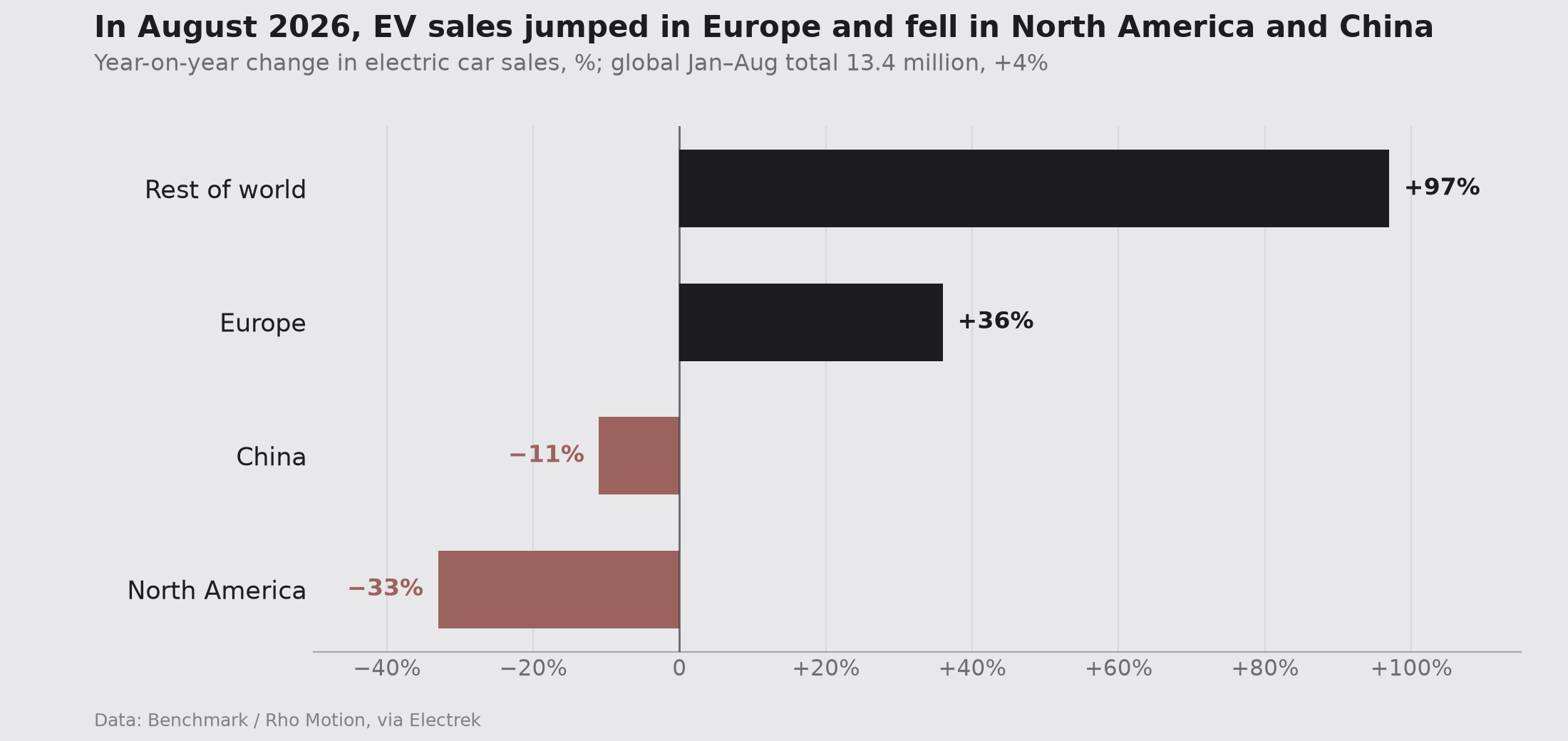
North American sales in August reportedly fell 33 percent.305 "In countries where consumers are not being well shielded from higher fuel prices, they are moving very quickly to adjust their energy consumption pattern," said Ethan Zindler of BloombergNEF.31
In June and July 2026, Indian buyers reportedly took more than 30,000 passenger electric cars a month, against fewer than 20,000 a year earlier; monthly sales roughly doubled in Indonesia and the Philippines.306 Many of the cars came from one place. Chinese electric car exports in the first half of 2026 almost matched the whole of 2025, while sales inside China, where more than 60 percent of new cars were already electric, were expected to stall for the first time this decade.61 In July alone, China shipped more than 500,000 electric and plug-in hybrid cars abroad, about 150 percent more than a year before.31 In Tokyo, where the government had let older coal plants run harder, calls grew to speed up wind and solar in a country that lagged other industrialized nations in both.3814
In March 2026, the month President Ferdinand Marcos Jr. put government offices on a four-day week, the Philippines' imports of Chinese solar equipment rose 262 percent year on year.1431 Africa imported 37 percent more solar equipment from China in the first half of 2026 than a year earlier.31 In Juba, where oil makes 96 percent of South Sudan's power and the distributor cut supply every day from 4 p.m. to 4 a.m., "This paralyses most businesses," said resident Ereneo Mogga. Some households turned to solar. "It is very expensive though, but it costs less in terms of consumption," one said. Zimbabwe raised its ethanol blend from 5 to 20 percent.30
One month into the war, at least 60 countries had announced 185 policies. Most cut fuel taxes; at least eight leaned harder on coal. Leaders in India, Barbados and the United Kingdom spoke of a structural shift to clean power; France and the Philippines tied new renewables announcements to the crisis; Chile offered taxi drivers credit for electric cars; Cambodia and Laos cut taxes on them; in Vietnam, Vingroup proposed scrapping an LNG power plant in favor of renewables.42 Wind and solar reportedly saved Britain £5.9 billion in gas imports during the Hormuz crisis.307 In March 2026, defending the EU's carbon price before the European Parliament, von der Leyen said: "Without ETS we would now consume 100 [billion cubic meters] more gas — again, making us more vulnerable and more dependent."54 At COP31 in Antalya, Turkey reportedly put forward a "35-by-35" commitment to raise electricity's share of final energy from about 20 percent to 35 percent by 2035.308
In March 1974 Pierre Messmer launched thirteen 1,000-megawatt reactors, and France's oil share of primary energy fell from 69 percent in 1973 to 42.4 percent in 1985; Denmark's fell from 88.8 to 57.9 percent over the same years, but by 1990 coal made 90.8 percent of Danish electricity.11667 In Pakistan in the first quarter of 2026, the largest source of power was the sun on its rooftops.303
Coda
The road up Mauna Loa reopened in 2026. A lava flow in 2022 had cut it, and NOAA restored access to the observatory that sits 11,141 feet up the volcano's flank on Hawaiʻi, among lava fields. It was there, on 29 March 1958, that Charles David Keeling's instruments recorded the first point of what became the Keeling Curve: 313 parts per million of carbon dioxide.309
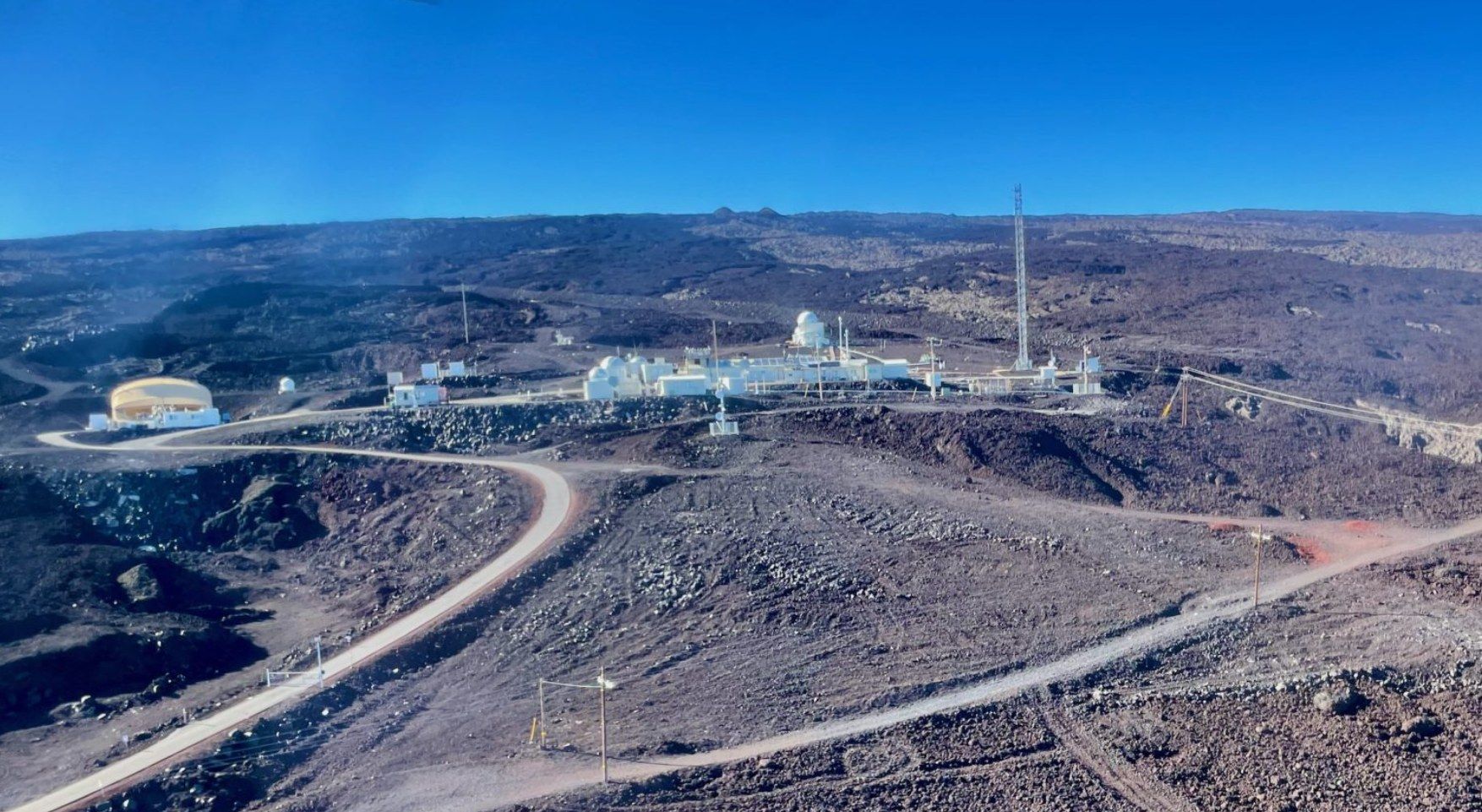
On 4 June 2026, the Scripps Institution of Oceanography announced the reading for May, the month when carbon dioxide at the mountain reaches its yearly peak. One count, Scripps's own, put it at 432.00 ppm; NOAA's laboratory, measuring at the same site, reported 432.3 ppm. Both were 1.8 ppm higher than May 2025.309 Secondary compilations of NOAA's data give it as the highest monthly mean on record.310 That May, three months into the war, the world was burning far less oil than it had in February. "Atmospheric CO₂ has continued its relentless rise over the past year, reaching yet another record high and moving us deeper into a high-CO₂ world," said Ralph Keeling, the director of the Scripps CO2 Program. "I wish we had better news."309
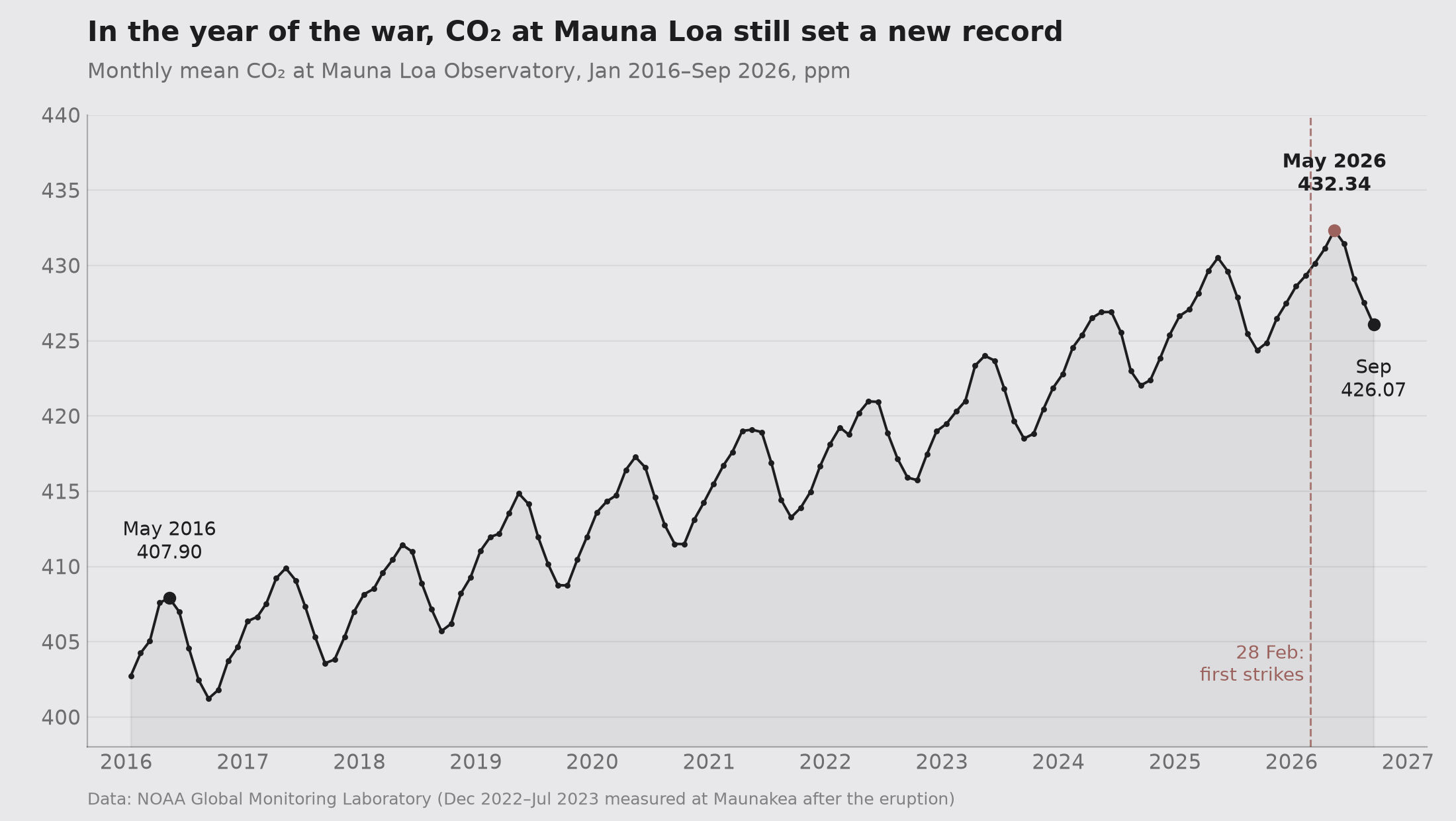
One secondary report, not confirmed by either laboratory, gives the highest single daily reading of the year as 433.95 ppm, on 1 May 2026, a little over two months after the first strikes on Iran on 28 February.311 Like every reading on the mountain, it took in the sum of every source and every sink at once: oil not burned in Colombo and Manila, extra coal burned in South Korea and, as the year went on, peat fires across Southeast Asia.
On 10 November in Antalya, the same scientists who announced that fossil emissions had dipped also published what the atmosphere was doing. Over the whole planet, carbon dioxide in 2026 is set to average 427.7 ppm, 54 percent above pre-industrial levels. It is projected to rise by 2.2 ppm over the year, more than the 2.1 ppm added in 2025, though below the record 3.8 ppm of 2024.4 The year's small fall in fossil emissions was offset elsewhere. Land-use emissions are projected at 5.1 billion tonnes, up from 4.4 billion in 2025, because peat in Southeast Asia, dried by El Niño and "almost entirely ignited by human activities," caught fire; Indonesia's fire emissions are on track to match the record for this century. The land sink that had soaked up a record 13.3 billion tonnes of CO2 in 2025, half again as much as in 2024, is expected to weaken in 2027.4
El Niño began in June 2026, and on 21 September the daily temperature anomaly in the Niño 3.4 region of the equatorial Pacific reached 3.11°C, beating the previous record of 3.08°C set on 18 November 2015. Of 674 model runs, 80 percent put the peak between 3.4°C and 4.6°C, most likely around 4.1°C, somewhere between November and January. Its effect on global temperature will fall mostly in 2027.312
By September, the month the curve bottoms out each year, the reading at Mauna Loa had fallen back with the season. NOAA's monthly means put it about six points below May.313
Plotted, the Keeling Curve begins at 313 in March 1958 and climbs to the right in a fine sawtooth, one tooth a year: up through each northern winter and spring, down through each summer, every peak above the last. The tooth for 2026 has its May high at 432 and its September low at 426, and from where it ends, the line is already climbing again toward the next May.
References
Footnotes
-
Fiona Harvey, "Slight fall in carbon emissions from fossil fuels as Iran war drives renewables push," The Guardian, 10 November 2026. https://www.theguardian.com/environment/2026/nov/10/slight-fall-in-carbon-emissions-from-fossil-fuels-as-iran-war-drives-renewables-push ↩
-
Global Carbon Budget, "Fossil CO2 emissions decrease in 2026" (press release), Global Carbon Budget, 10 November 2026. https://globalcarbonbudget.org/fossil-co2-emissions-decrease-in-2026/ ↩ ↩2 ↩3 ↩4
-
Seth Borenstein (Associated Press), "Oil shock from Iran war led to drop in carbon pollution, scientists say," PBS NewsHour, 10 November 2026. https://www.pbs.org/newshour/science/oil-shock-from-iran-war-led-to-drop-in-carbon-pollution-scientists-say ↩ ↩2 ↩3 ↩4
-
Carbon Brief, analysis of the Global Carbon Budget 2026: fossil-fuel CO2 emissions set to dip in 2026 as Iran conflict hits oil use, Carbon Brief, November 2026. https://www.carbonbrief.org/analysis-fossil-fuel-co2-emissions-set-to-dip-in-2026-as-iran-conflict-hits-oil-use ↩ ↩2 ↩3 ↩4 ↩5 ↩6 ↩7
-
International Energy Agency, "How global oil supplies have readjusted to help fill the huge gap left by the Strait of Hormuz shock" (commentary), IEA, June 2026. https://www.iea.org/commentaries/how-global-oil-supplies-have-readjusted-to-help-fill-the-huge-gap-left-by-the-strait-of-hormuz-shock ↩ ↩2 ↩3 ↩4 ↩5 ↩6
-
Global Carbon Budget 2026, preprint essd-2026-895, Earth System Science Data, November 2026 (abstract). https://essd.copernicus.org/preprints/essd-2026-895/ ↩
-
Science Media Centre Spain, "Pep Canadell: had it not been for the war in Iran, carbon emissions from fossil fuels would have risen slightly this year," 10 November 2026. https://www.sciencemediacentre.es/en/pep-canadell-had-it-not-been-war-iran-carbon-emissions-fossil-fuels-would-have-risen-slightly-year ↩
-
The Guardian, report on the COP31 opening plenary in Antalya (Simon Stiell: high fossil fuel prices spread inflation "like a cancer"), 9 November 2026. https://www.theguardian.com/environment/2026/nov/09/high-fossil-fuel-prices-spread-inflation-like-cancer-cop31egotiator-tells-cop31 ↩
-
The Guardian, "How the Iran war unfolded: every attack and oil price change visualised," 28 August 2026. https://www.theguardian.com/world/ng-interactive/2026/aug/28/how-the-iran-war-unfolded-every-attack-and-oil-price-change-visualised ↩
-
Xinhua, timeline of the 2026 Iran war, 28 August 2026. https://english.news.cn/20260828/7c0750bbf7d1409c9636d466ef8581c8/c.html ↩ ↩2
-
US Energy Information Administration, Today in Energy (first-quarter 2026 oil prices after the 28 February military action), EIA, 2026. https://www.eia.gov/todayinenergy/detail.php?id=67424 ↩ ↩2 ↩3
-
Hormuz.now, timeline of Strait of Hormuz transits (citing IMF PortWatch AIS data), 2026. https://hormuz.now/timeline ↩
-
Wikipedia, "2026 Strait of Hormuz crisis," accessed November 2026. https://en.wikipedia.org/wiki/2026_Strait_of_Hormuz_crisis ↩ ↩2 ↩3
-
Associated Press, "Asia scrambles to conserve energy as Iran war disrupts oil, gas supplies," Los Angeles Times, 19 March 2026. https://www.latimes.com/world-nation/story/2026-03-19/asia-scrambles-to-conserve-energy-as-iran-war-disrupts-oil-gas-supplies ↩ ↩2 ↩3 ↩4 ↩5 ↩6 ↩7 ↩8 ↩9 ↩10 ↩11 ↩12 ↩13
-
Alupetra, "Iran war 2026 timeline: oil and gas markets" (compiled from Reuters, AFP, Al Jazeera and others), 2026. https://www.alupetra.com/insights/iran-war-2026-timeline-oil-gas-markets.html ↩ ↩2 ↩3 ↩4 ↩5
-
Anadolu Agency, "Qatar says Iranian missile strikes cut LNG export capacity by 17%," March 2026. https://www.aa.com.tr/en/economy/qatar-says-iranian-missile-strikes-cut-lng-export-capacity-by-17-/3872423 ↩ ↩2 ↩3
-
Reuters, "Prices of oil, fuel cargoes smash record highs as Iran war chokes Middle East supply," 19 March 2026. https://www.reuters.com/business/energy/prices-oil-fuel-cargoes-smash-record-highs-iran-war-chokes-middle-east-supply-2026-03-19/ ↩
-
US Energy Information Administration, Today in Energy (third-quarter 2026 oil prices), EIA, 2026. https://www.eia.gov/todayinenergy/detail.php?id=68245 ↩ ↩2
-
Toril Bosoni / International Energy Agency, "Oil markets strain to plug the gap left by Middle East supply shortfall" (commentary), IEA, 18 September 2026. https://www.iea.org/commentaries/oil-markets-strain-to-plug-the-gap-left-by-middle-east-supply-shortfall ↩ ↩2 ↩3 ↩4
-
Hannah Ellis-Petersen, report on Sri Lanka's four-day week and fuel rationing amid the Iran war, The Guardian, 16 March 2026. https://www.theguardian.com/world/2026/mar/16/sri-lanka-four-day-week-oil-and-gas-iran-war ↩ ↩2 ↩3 ↩4 ↩5 ↩6
-
Siladitya Ray, "Fuel rationing, no AC, 4-day work week: how countries are dealing with the Iran war oil crisis," Forbes, 25 March 2026. https://www.forbes.com/sites/siladityaray/2026/03/25/fuel-rationing-no-ac-4-day-work-week-how-countries-are-dealing-with-the-iran-war-oil-crisis/ ↩
-
International Monetary Fund, Sri Lanka staff report, Country Report No. 26/111, 2026. https://www.elibrary.imf.org/downloadpdf/view/journals/002/2026/111/article-A001-en.pdf ↩
-
The Conversation, "Some countries in Asia are rationing energy: why they've been hit hardest by the crisis in the Gulf," 2026. https://theconversation.com/some-countries-in-asia-are-rationing-energy-why-theyve-been-hit-hardest-by-the-crisis-in-the-gulf-279888 ↩
-
The Straits Times, "Pakistan announces austerity measures to conserve fuel as Gulf conflict spirals," September 2026. https://www.straitstimes.com/asia/pakistan-announces-austerity-measures-to-conserve-fuel-as-gulf-conflict-spirals ↩
-
ACAPS, "Global impacts of the conflict in the Middle East," 10 July 2026. https://www.acaps.org/fileadmin/Data_Product/Main_media/20260710_ACAPS_Global_impacts_of_the_conflict_in_the_Middle_East_.pdf ↩
-
ORF Middle East, "ASEAN's energy vulnerability and the impact of the Hormuz crisis," 2026. https://orfme.org/research/aseans-energy-vulnerability-and-the-impact-of-the-hormuz-crisis ↩
-
ET EnergyWorld (The Economic Times), "Fuel tensions leave logistics industry tyred out," 26 May 2026. https://energy.economictimes.indiatimes.com/news/oil-and-gas/fuel-tensions-leave-logistics-industry-tyred-out/131320828 ↩
-
The New York Times, report on the Iran war's hit to oil and gas supplies in Asia, 9 March 2026. https://www.nytimes.com/2026/03/09/business/iran-oil-gas-asia.html ↩
-
BBC News, report on government fuel-saving appeals and fuel protests during the 2026 oil shock, 2026. https://www.bbc.com/news/articles/cjr9yr73xyeo ↩
-
BBC News, report on fuel shortages and power rationing in Kenya, South Sudan, Zimbabwe and Mauritius during the Iran war, 2026. https://www.bbc.com/news/articles/cq8wkq1n9epo ↩ ↩2 ↩3
-
Bloomberg via Los Angeles Times, "Six months of Iran war send oil prices soaring, clean energy into overdrive," 3 September 2026. https://www.latimes.com/business/story/2026-09-03/six-months-of-iran-war-send-oil-prices-soaring-clean-energy-into-overdrive ↩ ↩2 ↩3 ↩4 ↩5 ↩6 ↩7
-
PTI/AP via India Today, "Irbil fuel crisis: drivers queue overnight as Kurdistan petrol shortage worsens," 28 July 2026. https://www.indiatoday.in/world/story/irbil-fuel-crisis-drivers-queue-overnight-as-kurdistan-petrol-shortage-worsens-ptag-2958425-2026-07-28 ↩
-
International Energy Agency, "Global coal demand set to increase this year amid Middle East conflict," IEA news release, September 10, 2026. https://www.iea.org/news/global-coal-demand-set-to-increase-this-year-amid-middle-east-conflict ↩ ↩2 ↩3 ↩4
-
AFP, "Countries act to limit fuel price rise, cut consumption," France 24, March 23, 2026. https://www.france24.com/en/live-news/20260323-countries-act-to-limit-fuel-price-rise-cut-consumption ↩
-
International Energy Agency, "Coal Mid-Year Update 2026: Demand," IEA, September 2026. https://www.iea.org/reports/coal-mid-year-update-2026/demand ↩ ↩2 ↩3 ↩4
-
Reuters, "Japan considers increasing coal-fired power as war disrupts LNG imports," March 27, 2026. https://www.reuters.com/business/energy/japan-considers-increasing-coal-fired-power-war-disrupts-lng-imports-2026-03-27/ ↩
-
Observer Research Foundation, "ASEAN's energy vulnerability and the impact of the Hormuz crisis," ORF, 2026. https://www.orfonline.org/research/asean-s-energy-vulnerability-and-the-impact-of-the-hormuz-crisis ↩
-
Ajit Niranjan, explainer on how the world has responded to the Iran-war energy crisis, The Guardian, April 2, 2026. https://www.theguardian.com/environment/2026/apr/02/world-response-iran-war-energy-crisis-oil ↩ ↩2 ↩3 ↩4 ↩5 ↩6
-
Reuters via MarketScreener, "US-Iran war spurs Europe, Asia to boost renewables," July 2026. https://uk.marketscreener.com/news/us-iran-war-spurs-europe-asia-to-boost-renewables-ce7858d9d88ef72d ↩
-
Reuters, "South Korea says considering energy vouchers, boosting coal, nuclear power," March 13, 2026. https://www.reuters.com/sustainability/boards-policy-regulation/south-korea-says-considering-energy-vouchers-boosting-coal-nuclear-power-2026-03-13/ ↩ ↩2
-
OilPrice.com (citing Reuters/Kpler), "Global coal demand rises as LNG shortage deepens," 2026. https://oilprice.com/Energy/Natural-Gas/Global-Coal-Demand-Rises-as-LNG-Shortage-Deepens.html ↩
-
Carbon Brief, "Iran war analysis: How 60 nations have responded to the global energy crisis," April 8, 2026. https://www.carbonbrief.org/iran-war-analysis-how-60-nations-have-responded-to-the-global-energy-crisis ↩ ↩2 ↩3 ↩4 ↩5
-
Beyond Fossil Fuels, "Italy delays coal phase-out to 2038," March 30, 2026. https://beyondfossilfuels.org/2026/03/30/italy-delays-coal-phase-out-to-2038/ ↩
-
The New York Times, "The Iran War Is Pushing Global Coal Use to Record Highs," September 10, 2026 (headline only). https://www.nytimes.com/2026/09/10/climate/global-coal-demand-iran-war.html ↩
-
Carnegie Endowment for International Peace, on fuel subsidies in the Iran war and climate alternatives, Carnegie Emissary, May 5, 2026. https://carnegieendowment.org/emissary/2026/05/fuel-subsidies-iran-war-climate-alternatives ↩
-
UN Development Programme, "Middle East conflict fallout pushes countries toward US$1 trillion fossil fuel subsidy bill, warns UN Development Programme," press release, June 29, 2026. https://www.undp.org/press-releases/middle-east-conflict-fallout-pushes-countries-toward-us1-trillion-fossil-fuel-subsidy-bill-warns-un-development-programme ↩ ↩2
-
Inside Climate News, on Energy Secretary Chris Wright's call for more oil production at CERAWeek, March 24, 2026. https://insideclimatenews.org/news/24032026/energy-secretary-chris-wright-ceraweek-oil-production/ ↩ ↩2
-
US Government Accountability Office, report GAO-26-106918 on the Strategic Petroleum Reserve, May 2026. https://www.gao.gov/assets/gao-26-106918.pdf ↩
-
International Energy Agency, "IEA member countries to carry out largest-ever oil stock release amid market disruptions from Middle East conflict," March 2026. https://www.iea.org/news/iea-member-countries-to-carry-out-largest-ever-oil-stock-release-amid-market-disruptions-from-middle-east-conflict ↩
-
The National News Desk, interview with Energy Secretary Chris Wright on diesel and gasoline prices, October 2026. https://abc7amarillo.com/newsletter-daily/energy-secretary-chris-wright-defends-strategy-to-combat-high-diesel-and-gas-prices-united-states-holiday ↩
-
Washington Examiner, "Daily on Energy: How much did Trump's third oil and gas lease sale for the Gulf of America generate?," August 2026. https://www.washingtonexaminer.com/daily-on-energy/4685019/daily-on-energy-how-much-did-trumps-third-oil-and-gas-lease-sale-for-the-gulf-of-america-generate/ ↩
-
European Parliament, "EU climate law: a 2040 emissions reduction target of 90% for the EU," press release, February 2026. https://www.europarl.europa.eu/news/en/press-room/20260205IPR33620/eu-climate-law-a-2040-emissions-reduction-target-of-90-for-the-eu ↩
-
Council of the EU, "2040 climate target: Council gives final green light," press release, March 5, 2026. https://www.consilium.europa.eu/en/press/press-releases/2026/03/05/2040-climate-target-council-gives-final-green-light/ ↩
-
POLITICO Europe, "How Iran energy panic supercharged Europe's ETS climate debate," March 2026. https://www.politico.eu/article/how-iran-energy-panic-supercharged-europe-ets-climate-debate/ ↩ ↩2
-
Reuters, "EU to revamp carbon market to ease pressure on industry," July 17, 2026. https://www.reuters.com/business/environment/eu-revamp-carbon-market-ease-pressure-industry-2026-07-17/ ↩
-
Carbon Market Watch, response to the European Commission's ETS consultation, November 2, 2026. https://carbonmarketwatch.org/wp-content/uploads/2026/11/20261102-CMW-Response-EC-Feedback-Consulation.pdf ↩
-
Clean Energy Wire, "Dispatch: European Union, October 2026," 2026. https://www.cleanenergywire.org/news/dispatch-european-union-october-26 ↩
-
Amin H. Nasser, "Remarks by Amin H. Nasser at Energy Intelligence 2026," Aramco, London, October 5, 2026. https://www.aramco.com/en/news-media/speeches/2026/remarks-by-amin-h-nasser-at-energy-intelligence-2026 ↩
-
Energy Connects, "The Hormuz crisis is an 'everything story' threatening the global economy, warns H.E. Dr. Sultan," May 2026. https://www.energyconnects.com/opinion/features/2026/may/the-hormuz-crisis-is-an-everything-story-threatening-the-global-economy-warns-he-dr-sultan/ ↩
-
The Guardian, on nine of the world's biggest oil firms making $95bn profit in the third quarter, November 2, 2026 (headline only). https://www.theguardian.com/business/2026/nov/02/nine-of-world-biggest-oil-firms-95bn-profit-third-quarter-iran-war ↩
-
International Energy Agency, "Quarterly sales of electric cars break records in several key markets amid energy crisis," July 30, 2026. https://www.iea.org/news/quarterly-sales-of-electric-cars-break-records-in-several-key-markets-amid-energy-crisis ↩ ↩2 ↩3
-
Our World in Data / Global Carbon Project, CO2 dataset (owid-co2-data.csv, Global Carbon Budget 2026 release), world fossil and cement CO2, accessed November 12, 2026; year-on-year changes computed from the series. https://raw.githubusercontent.com/owid/co2-data/master/owid-co2-data.csv ↩ ↩2 ↩3 ↩4 ↩5 ↩6 ↩7 ↩8 ↩9 ↩10 ↩11 ↩12 ↩13 ↩14 ↩15 ↩16 ↩17 ↩18 ↩19 ↩20 ↩21 ↩22 ↩23 ↩24 ↩25
-
Michael Corbett, "Oil Shock of 1973–74," Federal Reserve History. https://www.federalreservehistory.org/essays/oil-shock-of-1973-74 ↩ ↩2 ↩3
-
Laurel Graefe, "Oil Shock of 1978–79," Federal Reserve History. https://www.federalreservehistory.org/essays/oil-shock-of-1978-79 ↩ ↩2 ↩3
-
Our World in Data, CO2 and greenhouse gas emissions dataset, README and changelog (including the 2022-11-11 note on the 1991 Kuwaiti oil fires). https://github.com/owid/co2-data ↩
-
Christof Rühl and Tim Erker, report on long-term global oil intensity, Columbia University Center on Global Energy Policy, 2021. https://www.energypolicy.columbia.edu/wp-content/uploads/2021/09/LongTermOilIntensity_CGEP_Report_111122.pdf ↩ ↩2
-
Our World in Data, energy dataset (owid-energy-data.csv), oil consumption, primary energy shares and GDP; oil-to-GDP index (1973 = 100) computed from the series. https://raw.githubusercontent.com/owid/energy-data/master/owid-energy-data.csv ↩ ↩2 ↩3 ↩4 ↩5
-
International Energy Agency, "Oil Crises and Climate Challenges: 30 Years of Energy Use in IEA Countries," 2004. https://iea.blob.core.windows.net/assets/9049fd65-2d4d-4b94-acd0-9e978c9ffcfd/OilCrisesandClimateChallenges30YearsofEnergyUseinIEACountries.pdf ↩
-
US General Accounting Office, "Speed Limit 55: Is It Achievable?" (CED-77-27), 1977. https://www.gao.gov/assets/ced-77-27.pdf ↩ ↩2
-
US Department of State, Office of the Historian, "Oil Embargo, 1973–1974," Milestones. https://history.state.gov/milestones/1969-1976/oil-embargo ↩ ↩2
-
Nationaal Archief, "Autoloze zondag in Nederland, 1973," Bronnenbox. https://www.nationaalarchief.nl/beleven/onderwijs/bronnenbox/autoloze-zondag-in-nederland-1973 ↩ ↩2 ↩3
-
Richard Norton-Taylor, "Holland saddle-sore but fume free," The Guardian, November 5, 1973 (archive, republished November 4, 2020). https://www.theguardian.com/world/from-the-archive-blog/2020/nov/04/netherlands-introduces-car-free-sundays-archive-1973 ↩
-
Trouw, "Autoloze zondag wegens olieboycot," 1999. https://www.trouw.nl/nieuws/autoloze-zondag-wegens-olieboycot~bf6a758b/ ↩ ↩2
-
Jasper Dekker, Centrum voor Parlementaire Geschiedenis (Radboud University), "De opstand der pomphouders." https://70.serieparlementairegeschiedenis.nl/oliecrisis/de-opstand-der-pomphouders/ ↩ ↩2
-
Vughts Museum, "Depotschatje 4: benzine op de bon," April 22, 2026; see also Geschiedenislokaal Amsterdam, "Benzinebonnen." https://www.vughtsmuseum.nl/2026/04/22/depotschatje-4-benzine-op-de-bon ; https://geschiedenislokaalamsterdam.nl/bronnen/benzinebonnen ↩
-
The New York Times, "The Dutch Ration Gasoline for Cars: Needed Precaution?", January 13, 1974. https://www.nytimes.com/1974/01/13/archives/the-dutch-ration-gasoline-for-cars-needed-precaution.html ↩
-
Bundesgesetzblatt I, 1973, p. 1585, Energiesicherungsgesetz of November 9, 1973. https://www.bgbl.de/xaver/bgbl/start.xav?start=%2F%2F*%5B%40attr_id%3D%27bgbl173089.pdf%27%5D ↩
-
German History in Documents and Images, "Das westdeutsche Fahrverbot für Motorfahrzeuge (20. November 1973)"; Verordnung über Fahrverbote und Geschwindigkeitsbegrenzungen für Motorfahrzeuge, BGBl. I 1973 S. 1676. https://germanhistorydocs.org/de/zwei-deutsche-staaten-1961-1989/das-westdeutsche-fahrverbot-fuer-motorfahrzeuge-20-november-1973 ; https://dejure.org/BGBl/1973/BGBl._I_S._1676 ↩
-
Friedrich-Ebert-Stiftung, Chronik, 19 November 1973. https://library.fes.de/fulltext/bibliothek/chronik/band3/e235g1932.html ↩
-
Irene Altenmüller, "1973: Ölkrise beschert Deutschland autofreie Sonntage," NDR. https://www.ndr.de/geschichte/chronologie/1973-Oelkrise-beschert-Deutschland-autofreie-Sonntage,autofreiersonntag146.html ↩ ↩2
-
German History in Documents and Images, "Auto-Free Sunday (November 1973)." https://germanhistorydocs.org/en/two-germanies-1961-1989/auto-free-sunday-november-1973 ↩
-
Deutscher Bundestag, Wissenschaftliche Dienste, WD 7-064-08 (on car-free Sundays). https://www.bundestag.de/resource/blob/413682/414756c62aeefb39b66b0349fe070d88/wd-7-064-08-pdf-data.pdf ↩
-
Andreas Skov, Holbæk Arkiverne, "Oliekrisen 1973." https://bibliotek.holbaek.dk/arkiverne/historier-fra-arkiverne/oliekrisen-1973 ↩
-
Esbjerg Byhistoriske Arkiv, photograph caption, arkiv.dk. https://arkiv.dk/vis/6399953 ↩
-
Poulsen, "Campaign Country" (Aalborg University), 2017. https://vbn.aau.dk/ws/portalfiles/portal/261328582/Poulsen2017_CampaignCountry.pdf ↩
-
Hjørring Kommunearkiv, "Energikrisen 1973," source pack. https://kommunearkiv.hjoerring.dk/kildepakker-til-undervisningsbrug/energikrisen-1973 ↩
-
Alan Travis, "Ministers considered one-room heating limit" (cabinet papers 1973), The Guardian, January 1, 2004. https://www.theguardian.com/politics/2004/jan/01/uk.past ↩ ↩2
-
The New York Times, "British Work Week Cut to 3 Days for Most Industries," December 14, 1973. https://www.nytimes.com/1973/12/14/archives/british-work-week-cut-to-3-da-ys-for-most-industries-to-counter.html ↩
-
The Herald, "How the three-day week of 1974 changed Britain," 2024. https://www.heraldscotland.com/life_style/24050928.three-day-week-1974-changed-britain/ ↩
-
Wikipedia, "Three-Day Week." https://en.wikipedia.org/wiki/Three-Day_Week ↩
-
The TV Room, "BBC makes power saving by keeping BBC Two off air during daytime." https://rewind.thetvroom.com/47565/features/bbc-makes-power-saving-by-keeping-bbc-two-off-air-during-daytime/ ↩
-
BBC Media Centre, "Archive on 4: The Three-Day Week," programme information, 2016. https://www.bbc.co.uk/mediacentre/proginfo/2016/28/archive-on-4-the-three-day-week ↩
-
Richard Nixon, "Address to the Nation About Policies To Deal With the Energy Shortages," November 7, 1973, American Presidency Project. https://www.presidency.ucsb.edu/documents/address-the-nation-about-policies-deal-with-the-energy-shortages ↩ ↩2
-
Richard Nixon, "Statement on Signing the Emergency Highway Energy Conservation Act," January 2, 1974, American Presidency Project. https://www.presidency.ucsb.edu/documents/statement-signing-the-emergency-highway-energy-conservation-act ↩
-
Richard Nixon, "Statement on Signing the Emergency Daylight Saving Time Energy Conservation Act of 1973," December 15, 1973, American Presidency Project. https://www.presidency.ucsb.edu/documents/statement-signing-the-emergency-daylight-saving-time-energy-conservation-act-1973 ↩
-
Congressional Research Service, "Daylight Saving Time" (R45208). https://www.congress.gov/crs-product/R45208 ↩ ↩2
-
The New York Times, "Benefits of Daylight Saving in Winter Widely Doubted," February 3, 1974. https://www.nytimes.com/1974/02/03/archives/benefits-of-daylight-saving-in-winter-widely-doubted-second.html ↩
-
Gerald R. Ford Presidential Library, White House press release on H.R. 16102, October 5, 1974. https://www.fordlibrarymuseum.gov/sites/default/files/pdf_documents/library/document/0248/whpr19741005-002.pdf ↩
-
Jimmy Carter, "Gasoline Shortages in California Statement by the President," May 5, 1979, American Presidency Project. https://www.presidency.ucsb.edu/documents/gasoline-shortages-california-statement-the-president ↩
-
The New York Times, "Odd-Even Gasoline Ration Plan to Start in California Tomorrow," May 8, 1979. https://www.nytimes.com/1979/05/08/archives/oddeven-gasoline-ration-plan-to-start-in-california-tomorrow-public.html ↩
-
Cayman Compass (wire report from Los Angeles), "California opts for modified gas rationing," May 8, 1979. https://www.caymancompass.com/1979/05/08/california-opts-for-modified-gas-rationing ↩
-
TIME, "Nation: And the Gas Lines Grow," 1979. https://time.com/archive/6854413/nation-and-the-gas-lines-grow/ ↩
-
The New York Times, "Notes From the Gas Line," June 26, 1979. https://www.nytimes.com/1979/06/26/archives/notes-from-the-gas-line.html ↩
-
Jimmy Carter, "Address to the Nation on Energy," April 18, 1977, American Presidency Project. https://www.presidency.ucsb.edu/documents/address-the-nation-energy ↩
-
Smithsonian National Museum of American History, "Jimmy Carter's Solar Vision." https://americanhistory.si.edu/explore/stories/jimmy-carters-solar-vision ↩ ↩2 ↩3 ↩4
-
Jimmy Carter, "Solar Energy Remarks Announcing Administration Proposals," June 20, 1979, American Presidency Project. https://www.presidency.ucsb.edu/documents/solar-energy-remarks-announcing-administration-proposals ↩
-
Science Museum Blog, "Solar panels and the White House." https://blog.sciencemuseum.org.uk/solar-panels-and-the-white-house/ ↩
-
University of Maine, Climate Chronology, "Solar White House," June 20, 1979; see also Maine Public, January 24, 2023. https://umaine.edu/climatechronology/1979/06/20/solar-white-house ; https://www.mainepublic.org/environment-and-outdoors/2023-01-24/as-solar-power-booms-in-the-us-a-key-part-of-its-history-lies-at-unity-college ↩
-
Wikipedia, "Solar power at the White House." https://en.wikipedia.org/wiki/Solar_power_at_the_White_House ↩
-
Maine Public, "As solar power booms in the US, a key part of its history lies at Unity College," January 24, 2023. https://www.mainepublic.org/environment-and-outdoors/2023-01-24/as-solar-power-booms-in-the-us-a-key-part-of-its-history-lies-at-unity-college ↩
-
Democracy Now!, "Unity College Students, Bill McKibben Launch…," September 9, 2010. https://www.democracynow.org/2010/9/9/unity_college_students_bill_mckibben_launch ↩
-
Scientific American, "Carter White House solar panel array." https://www.scientificamerican.com/article/carter-white-house-solar-panel-array ↩
-
Jimmy Carter, "Crisis of Confidence," July 15, 1979, Miller Center. https://millercenter.org/the-presidency/presidential-speeches/july-15-1979-crisis-confidence-speech ↩
-
Oil & Gas Journal, "IEA says governments should restore energy spending," February 2006 (on IEA, "Renewable Energy: RD&D Priorities"). https://www.ogj.com/general-interest/article/17282193/iea-says-governments-should-restore-energy-spending ↩
-
US Government Accountability Office, GAO-07-106, January 2007. https://www.gao.gov/assets/a254877.html ↩
-
Gaïc Le Gros, "Naissance du parc nucléaire français: le plan Messmer," SFEN / RGN, 2020. https://www.sfen.org/rgn/naissance-parc-nucleaire-francais-plan-messmer ↩ ↩2 ↩3
-
Journal de la CCAS, "1974, l'invention de la sobriété énergétique." https://journal.ccas.fr/1974-linvention-de-la-sobriete-energetique ↩
-
Andersson & Finnegan, "Industrial Policy and Decarbonization" (working paper). https://www.juliusandersson.com/Industrial_Policy_and_Decarbonization_JEEA_RevisedVersion.pdf ↩
-
Ministère de la Transition écologique, "Pour mémoire" no. 15, summer 2015, "Les politiques de maîtrise de l'énergie." https://www.ecologie.gouv.fr/sites/default/files/documents/Pour%20m%C3%A9moire%20n%C2%B015%20-%20%C3%A9t%C3%A9%202015%20-%20Les%20politiques%20de%20ma%C3%AEtrise%20de%20l%27%C3%A9nergie.pdf ↩
-
Danish Environmental Protection Agency, publication 87-7972-476-0, chapter 4, 2003. https://www2.mst.dk/udgiv/publications/2003/87-7972-476-0/html/kap04_eng.htm ↩
-
Institute of Energy Economics, Japan (IEEJ), report on Japan's energy conservation. https://eneken.ieej.or.jp/data/4236.pdf ↩
-
Ricardo Westin, "Há 50 anos, crise mundial do petróleo fez Brasil criar carro a álcool," Agência Senado, November 7, 2025. https://www12.senado.leg.br/noticias/especiais/arquivo-s/ha-50-anos-crise-mundial-do-petroleo-fez-brasil-criar-carro-a-alcool ↩ ↩2
-
Brazil, Decreto nº 76.593, November 14, 1975. https://legis.senado.leg.br/norma/499233/publicacao/15706117 ↩
-
Cortez et al., paper on Brazilian ethanol, ISAF 2016. https://bioenfapesp.org/gsb/lacaf/documents/papers/05_ISAF_2016_Cortez_et_al.pdf ↩
-
Powerplant and Industrial Fuel Use Act of 1978 (P.L. 95-620), 42 USC ch. 92 notes. https://uscode.house.gov/view.xhtml?edition=prelim&path=%2Fprelim%40title42%2Fchapter92 ↩
-
US Energy Information Administration, "Repeal of the Powerplant and Industrial Fuel Use Act (1987)." https://www.eia.gov/oil_gas/natural_gas/analysis_publications/ngmajorleg/repeal.html ↩
-
US Energy Information Administration, Monthly Energy Review, Table 7.2a (net generation, all sectors); shares computed from the data. https://www.eia.gov/totalenergy/data/browser/csv.php?tbl=T07.02A ↩
-
US Energy Information Administration, Annual Energy Review, Table 7.3. https://www.eia.gov/totalenergy/data/annual/pdf/sec7_9.pdf ↩
-
Congressional Research Service, R44922. https://www.congress.gov/crs-product/R44922 ↩
-
John Kemp, "U.S. power producers' coal consumption falls to 35-year low," Reuters, 2018. https://www.reuters.com/article/markets/currencies/us-power-producers-coal-consumption-falls-to-35-year-low-kemp-idUSKCN1M61ZW ↩
-
HistoryofCuba.com, essay on Havana and the Special Period. http://www.historyofcuba.com/history/havana/lperez2.htm ↩ ↩2 ↩3 ↩4 ↩5 ↩6 ↩7 ↩8 ↩9 ↩10
-
NotiSur (Latin America Data Base, University of New Mexico), report on Cuba's fuel crisis, December 10, 1991. https://digitalrepository.unm.edu/cgi/viewcontent.cgi?article=8860&context=notisur ↩ ↩2
-
Sergio Díaz-Briquets and Jorge Pérez-López, Cuba in Transition vol. 5, Association for the Study of the Cuban Economy (ASCE), 1995. https://www.ascecubadatabase.org/wp-content/uploads/2014/09/v05-FILE23.pdf ↩ ↩2 ↩3 ↩4 ↩5 ↩6 ↩7
-
Botella, article on Cuban agriculture, Historia Agraria no. 55. https://www.historiaagraria.com/FILE/articulos/HA55__Botella.pdf ↩
-
Franco et al., "Impact of energy intake, physical activity, and population-wide weight loss on cardiovascular disease and diabetes mortality in Cuba, 1980–2005," American Journal of Epidemiology, 2007. https://pubmed.ncbi.nlm.nih.gov/17881386/ ↩
-
International Monetary Fund, Russian Federation: Staff Country Report 97/63, Table 1, 1997. https://www.elibrary.imf.org/view/journals/002/1997/063/article-A001-en.xml ↩
-
Wang Shicai, article on Russia's economy, 东欧中亚研究 (Eastern Europe and Central Asia Studies), 2000 no. 2, via CASS. http://euroasia.cssn.cn/cbw/cbw_elsdozyyj/200910/t20091013_1849464.shtml ↩
-
Stephanie Baker, RFE/RL, report from Beryozovsky and Novokuznetsk, April 1998. https://www.rferl.org/a/1088433.html ↩ ↩2 ↩3 ↩4
-
Stephanie Baker, RFE/RL, report on Russian wage arrears and Kuzbass miners, April 21, 1998. https://www.rferl.org/a/1088432.html ↩ ↩2 ↩3
-
Lehmann, Wadsworth and Acquisti, "Grime and Punishment: Job Insecurity and Wage Arrears in the Russian Federation," CEP Discussion Paper 403, LSE. https://cep.lse.ac.uk/pubs/download/DP0403.pdf ↩
-
Article on the 1998 Russian miners' "rail wars," Tomsk State University Journal no. 450. https://doi.org/10.17223/15617793/450/20 ↩
-
Leon, Chenet, Shkolnikov et al., "Huge variation in Russian mortality rates 1984–94: artefact, alcohol, or what?," The Lancet 350:383–8, 1997. https://pubmed.ncbi.nlm.nih.gov/9259651 ↩
-
Elizabeth Brainerd, "Mortality in Russia since the fall of the Soviet Union," Comparative Economic Studies, 2021. https://pmc.ncbi.nlm.nih.gov/articles/PMC8553909/ ↩ ↩2
-
Notzon et al., "Causes of declining life expectancy in Russia," JAMA 279:793, 1998. https://jamanetwork.com/journals/jama/article-abstract/187318 ↩
-
Giovanni Andrea Cornia, "The mortality crisis in transition economies," IZA World of Labor, 2016. https://wol.iza.org/articles/mortality-crisis-in-transition-economies/long ↩
-
Carbon Market Watch, "JI and AAU surplus," May 30, 2012. https://carbonmarketwatch.org/2012/05/30/ji-and-aau-surplus/ ↩ ↩2
-
UNFCCC, Report on the final accounting for the Russian Federation, first commitment period of the Kyoto Protocol (FCCC/KP/CMP/2016/CAR/RUS), August 2, 2016. https://unfccc.int/resource/docs/2016/car/rus.pdf ↩
-
David G. Victor, Nebojsa Nakicenovic and Nadejda Victor, "The Kyoto Protocol Carbon Bubble: Implications for Russia, Ukraine, and Emission Trading," IIASA, 1998. http://pure.iiasa.ac.at/id/eprint/5558/1/IR-98-094.pdf ↩
-
WhoGains, "Kyoto Protocol first period hot air" (summarizing SEI 2015). http://whogains.org/case/kyoto-protocol-first-period-hot-air ↩
-
PBL Netherlands Environmental Assessment Agency, "Too hot to handle?," December 2009. https://www.pbl.nl/uploads/default/downloads/500114016.pdf ↩
-
Rapporteur, "Russian hot air threatens UN climate deal," October 22, 2009. https://www.rapporteur.com/news/russian-hot-air-threatens-un-climate-deal/ ↩
-
EUobserver, "Kyoto accord is an 'international Auschwitz' says Putin aide," April 2004. https://euobserver.com/25892/kyoto-accord-is-an-international-auschwitz-says-putin-aide ↩
-
BBC Russian Service, report on Illarionov at the Moscow Kyoto forum, February 2004. http://news.bbc.co.uk/hi/russian/russia/newsid_3507000/3507913.stm ↩
-
European Commission, Q&A on Russian ratification of the Kyoto Protocol (MEMO/04/245), October 22, 2004. https://ec.europa.eu/commission/presscorner/detail/en/memo_04_245 ↩
-
Robert Coalson, RFE/RL, analysis of Russia's Kyoto ratification, November 8, 2004. https://www.rferl.org/a/1055750.html ↩ ↩2
-
Ministry of Foreign Affairs of Japan, statement on Russia's ratification of the Kyoto Protocol, November 5, 2004. https://www.mofa.go.jp/announce/announce/2004/11/1105.html ↩
-
UN News, Russia's Kyoto ratification handed to Kofi Annan, November 18, 2004. https://news.un.org/en/story/2004/11/121282 ↩
-
WhoGains, "Ukraine: Joint Implementation and Kyoto unit sales." http://whogains.org/case/ukraine-joint-implementation-and-kyoto-unit-sales ↩
-
Bloomberg via The Japan Times, "Ukraine to use Japan's payments for energy efficiency," March 30, 2009. https://www.japantimes.co.jp/news/2009/03/30/national/ukraine-to-use-japans-payments-for-energy-efficiency ↩
-
Climate Action Network, ECO, "Ukraine's AAU black hole," June 8, 2010. https://climatenetwork.org/2010/06/08/ukraines-aau-%E2%80%A8black-hole/ ↩ ↩2
-
Matthew Luxmoore, Kyiv Post, on green-investment funds and fraudulent companies, June 29, 2014. https://archive.kyivpost.com/article/content/ukraine-politics/tax-ministry-some-250-million-in-state-funds-allocated-to-fraudulent-companies-in-2014-353907.html ↩ ↩2
-
Reuters / Kyiv Post, "Ukraine opens criminal case over $290 million," April 28, 2010. https://archive.kyivpost.com/article/content/ukraine-politics/update-ukraine-opens-criminal-case-over-290-millio-65290.html ↩
-
BBC News, report on the Tymoshenko investigation, December 15, 2010. https://www.bbc.co.uk/news/world-europe-12001004 ↩
-
Kyiv Post, "Ukraine returns 2.5 million euros in unspent green investments to Japan," March 1, 2016. https://archive.kyivpost.com/article/content/business/ukraine-returns-25-million-euros-in-unspent-green-investments-to-japan-409164.html ↩
-
Fraunhofer ISI, SPRU and DIW for Umweltbundesamt, "Greenhouse gas reductions in Germany and the UK: coincidence or policy induced?," Climate Change 01/01, 2001. https://www.umweltbundesamt.de/system/files/medien/publikation/short/k1987.pdf ↩ ↩2
-
Schleich et al., Climate Policy, 2001 (Fraunhofer repository). https://publica-rest.fraunhofer.de/server/api/core/bitstreams/5ae79b17-c5a4-422f-b3f1-5cf96188713a/content ↩
-
Kurganova, Lopes de Gerenyu, Six and Kuzyakov, Global Change Biology 20:938–947, 2013. https://doi.org/10.1111/gcb.12379 ↩
-
Schierhorn et al., Environmental Research Letters 14:065009, June 21, 2019. https://iopscience.iop.org/article/10.1088/1748-9326/ab1cf1 ↩ ↩2
-
Crawford et al., "Rural land abandonment is too ephemeral to provide major benefits for biodiversity and climate," Science Advances, May 2022. https://www.science.org/doi/10.1126/sciadv.abm8999 ↩
-
Nature news, December 18, 2013. https://www.nature.com/articles/504342a ↩
-
European Commission, DG Energy, "In focus: EU energy security and gas supplies", 15 February 2024. https://energy.ec.europa.eu/news/focus-eu-energy-security-and-gas-supplies-2024-02-15_en ↩
-
European Commission, "Press statement by President von der Leyen on the Commission's proposals regarding REPowerEU, defence investment", 18 May 2022. https://cyprus.representation.ec.europa.eu/news/press-statement-president-von-der-leyen-commissions-proposals-regarding-repowereu-defence-investment-2022-05-18_en ↩
-
Council of the EU, "Council adopts regulation on reducing gas demand by 15% this winter", press release, 5 August 2022. https://www.consilium.europa.eu/en/press/press-releases/2022/08/05/council-adopts-regulation-on-reducing-gas-demand-by-15-this-winter/ ↩
-
Council of the EU, written procedure outcome CM 4101/22, 5 August 2022. https://data.consilium.europa.eu/doc/document/CM-4101-2022-INIT/x/pdf ↩
-
Eurostat, "EU gas consumption decreased by 17.7%", 19 April 2023. https://ec.europa.eu/eurostat/web/products-eurostat-news/w/ddn-20230419-1 ↩
-
Montel News, "EU cut gas usage 18% from August-March – Eurostat", 20 April 2023. https://montelnews.com/news/1490206/eu-cut-gas-usage-18-from-august-march--eurostat ↩
-
European Commission, report COM(2024) 404 on gas demand reduction, 2024. https://eur-lex.europa.eu/legal-content/EN/TXT/HTML?uri=CELEX%3A52024DC0404 ↩
-
BASF, speech on Q2 2022 half-year financial report, July 2022. https://www.basf.com/dam/jcr:42e0898a-a4d3-3c32-8d92-461fc87fe2e7/basf/www/global/documents/en/news-and-media/events/2022/half-year-financial-report/P293e_Speech_Q2_2022.pdf ↩
-
Reuters, "BASF considers more ammonia production cuts amid gas supply crunch", 27 July 2022. https://www.reuters.com/business/energy/basf-considers-more-ammonia-production-cuts-gas-supply-crunch-sources-2022-07-27 ↩
-
Fortune, on BASF and the European gas crisis, 25 October 2022. https://fortune.com/2022/10/25/basf-russia-gas-ukraine-europe-energy-crisis/ ↩
-
Yara International, "Yara implements further production curtailments in Europe", 25 August 2022. https://www.yara.com/corporate-releases/yara-implements-further-production-curtailments-in-europe/ ↩
-
Reuters, "How Germany's industrial giants are preparing for winter", 27 September 2022. https://www.reuters.com/business/energy/how-germanys-industrial-giants-are-preparing-winter-2022-09-27/ ↩
-
Reuters, "German government approves energy saving measures to rein in gas usage", 24 August 2022. https://www.reuters.com/business/energy/german-government-approves-energy-saving-measures-rein-gas-usage-2022-08-24/ ↩
-
DW, "Germany's energy-saving rules come into force", September 2022. https://www.dw.com/en/germanys-energy-saving-rules-come-into-force/a-62996041 ↩
-
La Moncloa (Government of Spain), Council of Ministers, Shock Plan for Energy Saving, 1 August 2022. https://www.lamoncloa.gob.es/lang/en/gobierno/councilministers/paginas/2022/20220801_council.aspx ↩
-
El País, "Apagón nocturno de escaparates", 10 August 2022. https://elpais.com/economia/2022-08-10/apagon-nocturno-de-escaparates-comercios-sin-luz-para-cumplir-el-decreto-de-ahorro-de-energia.html ↩
-
AP, Paris to dim Eiffel Tower and monuments to save energy, 13 September 2022. https://apnews.com/article/russia-ukraine-france-paris-103898b33a6e8382f469eaac5947f09e ↩
-
Bundesnetzagentur, Ersatzkraftwerkebereithaltungsgesetz (EKBG) overview page. https://www.bundesnetzagentur.de/DE/Fachthemen/ElektrizitaetundGas/Kohleausstieg/EKBG/start.html ↩
-
SMARD / Bundesnetzagentur, "Coal power stations return to electricity market", updated 21 November 2022. https://www.smard.de/en/coal-power-stations-return-to-electricity-market-209518 ↩ ↩2
-
Uniper, "Heyden 4 hard-coal-fired power plant to be shut down permanently", 5 September 2023. https://www.uniper.energy/news/uniper-heyden-4-hard-coal-fired-power-plant-to-be-shut-down-permanently ↩
-
LEAG, "Jänschwalder Kraftwerksblock E ist zurück am Stromnetz", 6 October 2022. https://www.leag.de/de/news/details/jaenschwalder-kraftwerksblock-e-ist-zurueck-am-stromnetz/ ↩
-
Destatis, press release No. 090, electricity production in 2022, 9 March 2023. https://www.destatis.de/EN/Press/2023/03/PE23_090_43312.html ↩
-
Ember, "European Electricity Review 2023: The big picture", January 2023. https://ember-energy.org/latest-insights/european-electricity-review-2023/the-big-picture ↩ ↩2 ↩3
-
BBC News, on the Lützerath clearance and Greta Thunberg, 13 January 2023. https://www.bbc.co.uk/news/world-europe-64261197 ↩ ↩2
-
Reuters, "German police detain Greta Thunberg at German coal village protests", 17 January 2023. https://www.reuters.com/world/europe/german-police-detain-greta-thunberg-german-coal-village-protests-2023-01-17/ ↩
-
NPR, "Greta Thunberg detained by German police at coal mine protest", 17 January 2023. https://www.npr.org/2023/01/17/1149590122/greta-thunberg-detained-germany-police-coal-mine ↩
-
BBC News, on police clearing activists from Lützerath, 15 January 2023. https://www.bbc.com/news/world-europe-64285787 ↩
-
The Guardian, "Greta Thunberg detained at coal protest in Germany", 17 January 2023. https://www.theguardian.com/world/2023/jan/17/greta-thunberg-detained-at-coal-protest-in-germany ↩
-
CNN, "Greta Thunberg detained in Germany", 17 January 2023. https://www.cnn.com/2023/01/17/us/greta-thunberg-detained-germany-climate ↩
-
German Federal Government, Chancellor Scholz opens LNG terminal in Wilhelmshaven, 17 December 2022. https://www.bundesregierung.de/breg-de/service/archiv-bundesregierung/scholz-wilhelmshaven-2154424 ↩ ↩2
-
Die Zeit (dpa), "Scholz: Deutschland-Tempo bei LNG-Terminal soll Vorbild sein", 17 December 2022. https://www.zeit.de/news/2022-12/17/scholz-deutschland-tempo-bei-lng-terminal-soll-vorbild-sein ↩
-
Der Spiegel, "Olaf Scholz eröffnet LNG-Terminal: Das ist das neue Deutschlandtempo", 17 December 2022. https://www.spiegel.de/wirtschaft/olaf-scholz-eroeffnet-lng-terminal-das-ist-das-neue-deutschlandtempo-a-3918de6b-a473-495c-ba0e-8594e26ef049 ↩
-
Tagesspiegel, "Erstes LNG-Terminal wird eröffnet", 17 December 2022. https://www.tagesspiegel.de/politik/erstes-lng-terminal-wird-eroffnet-scholz-spricht-von-einem-guten-tag-fur-deutschland-9051631.html ↩
-
ConocoPhillips, "ConocoPhillips and QatarEnergy agree to provide reliable LNG supply to Germany", 29 November 2022. https://www.conocophillips.com/news-media/story/conocophillips-and-qatarenergy-agree-to-provide-reliable-lng-supply-to-germany/ ↩ ↩2 ↩3
-
Al Jazeera, "QatarEnergy, ConocoPhillips sign LNG deal for Germany", 29 November 2022. https://www.aljazeera.com/news/2022/11/29/qatarenergy-conocophillips-sign-lng-deal-for-germany ↩
-
U.S. Energy Information Administration, "The United States was the world's largest LNG exporter in 2023", 1 April 2024. https://www.eia.gov/todayinenergy/detail.php?id=61683 ↩
-
Carole Nakhle, GIS Reports, on European gas prices, 21 February 2023. https://www.gisreportsonline.com/r/gas ↩
-
Argus Media, "A year on, the TTF returns from the stratosphere", 2023. https://www.argusmedia.com/en/news-and-insights/market-opinion-and-analysis-blog/a-year-on-the-ttf-returns-from-the-stratosphere ↩
-
Khaleeq Kiani, Dawn, Pakistan rejects record-priced LNG bid, 25 June 2022. https://www.dawn.com/news/1696550 ↩
-
Dawn, Pakistan gets no bids for LNG cargoes; gas rationing and solar plan announced, 8 July 2022. https://www.dawn.com/news/1698797 ↩ ↩2
-
Bloomberg, "Energy crunch forces Pakistan to close malls and factories early", 20 June 2022. https://www.bloomberg.com/news/articles/2022-06-20/energy-crunch-forces-pakistan-to-close-malls-and-factories-early ↩
-
Reuters via Arab News, "Gas shortage exposes fragile Pakistan, Bangladesh economies to more pain", 20 February 2023. https://www.arabnews.pk/pakistan/gas-shortage-exposes-fragile-pakistan-bangladesh-economies-to-more-pain-2254781 ↩
-
Eyamin Sajid, The Business Standard, "Load-shedding from Tuesday, shopping malls to close at 8pm", 18 July 2022. https://www.tbsnews.net/bangladesh/energy/load-shedding-tuesday-shopping-malls-close-8pm-460630 ↩
-
Tritiyo Matra / New Age, "Gas crisis hits industries", 31 July 2022. https://tritiyomatra.com/news/29327/local/2022/07/gas-crisis-hits-industries ↩
-
International Energy Agency, Gas Market Report Q4 2022, October 2022. https://iea.blob.core.windows.net/assets/5c108dc3-f19f-46c7-a157-f46f4172b75e/GasMarketReportQ42022.pdf ↩
-
International Energy Agency, Gas Market Report Q1 2023, February 2023. https://www.oecd.org/content/dam/oecd/en/publications/reports/2023/02/gas-market-report-q1-2023_ff5ec4df/cfa3e593-en.pdf ↩
-
European Commission, Climate Action Progress Report 2023, COM(2023) 653. https://eur-lex.europa.eu/legal-content/EN/TXT/?uri=CELEX%3A52023DC0653 ↩
-
European Commission, press release IP/24/5605 on 2023 greenhouse gas emissions, 31 October 2024. https://ec.europa.eu/commission/presscorner/detail/en/ip_24_5605 ↩
-
European Commission, Climate Action Progress Report 2024, COM(2024) 498. https://climate.ec.europa.eu/document/download/d0671350-37f2-4bc4-88e8-088d0508fb03_en ↩
-
Agora Energiewende, press release on Germany's 2023 emissions, 4 January 2024. https://www.agora-energiewende.org/fileadmin/user_upload/2024-01-04_PM_Jahresauswertung_2023_Agora_Energiewende_EN_corr.pdf ↩
-
US Department of Defense, Office of the Special Assistant for Gulf War Illnesses, "Oil Well Fires: Environmental Exposure Report", Gulflink. https://www.gulflink.osd.mil/owf_ii/owf_ii_s03.htm ↩ ↩2 ↩3 ↩4 ↩5 ↩6 ↩7 ↩8
-
Marlin Fitzwater, "Statement by Press Secretary Fitzwater on the Extinguishing of the Last of Kuwait's Burning Oil Wells", The American Presidency Project, 6 November 1991. https://www.presidency.ucsb.edu/documents/statement-press-secretary-fitzwater-the-extinguishing-the-last-kuwaits-burning-oil-wells ↩ ↩2
-
UPI, "Kuwait declares end of the worst oil fires in history", 6 November 1991. https://www.upi.com/Archives/1991/11/06/Kuwait-declares-end-of-the-worst-oil-fires-in-history/4950689403600/ ↩ ↩2
-
Arab Times, "Kuwait marks 35 years since last oil well fire extinguished", 7 November 2026. https://www.arabtimesonline.com/news/kuwait-marks-35-years-since-last-oil-well-fire-extinguished/ ↩
-
Nature, "Quenching the wild wells of Kuwait", 1991 (PDF copy). https://rlg.fas.org/Taming%20Wild%20Wells%20of%20Kuwait%20354011a0(2).pdf ↩
-
Gary Friedman, Texas Lung Institute, presentation to the VA Research Advisory Committee on Gulf War Veterans' Illnesses, September 2005. https://www.va.gov/RAC-GWVI/docs/Minutes_and_Agendas/Minutes_Sep2005_AppendixA_Presentation03.pdf ↩
-
Lindén, Jernelöv and Egerup, IIASA Interim Report IR-04-019 on the environmental impacts of the 1991 Gulf War, 2004. https://pure.iiasa.ac.at/id/eprint/7427/ ↩ ↩2
-
Los Angeles Times, report on Red Adair and the Kuwait fires, 26 February 1991. https://www.latimes.com/archives/la-xpm-1991-02-26-mn-2129-story.html ↩
-
John Arundel, UPI, "Oil firefighters say biggest battles yet to come", 7 May 1991. https://www.upi.com/Archives/1991/05/07/Oil-firefighters-say-biggest-battles-yet-to-come/9123673588800 ↩ ↩2
-
Nick B. Williams Jr., Los Angeles Times, report from the Burgan oil field, 29 October 1991. https://www.latimes.com/archives/la-xpm-1991-10-29-mn-498-story.html ↩ ↩2
-
Car and Driver, "Stilling the Fires of War: Big Wind" (archived). https://web.archive.org/web/20140714155748/www.caranddriver.com/features/stilling-the-fires-of-war-big-wind-page-2 ↩
-
MIT Technology Review, editor's letter, July 2026 issue, 24 June 2026. https://www.technologyrreview.com/2026/06/24/1138853/editors-letter-july-2026/ ↩
-
Wikipedia, "Kuwaiti oil fires". https://en.wikipedia.org/wiki/Kuwaiti_oil_fires ↩
-
Carl Zimmer, Discover, article on the Kuwait fires and the nuclear-winter forecasts, 31 January 1992. https://carlzimmer.com/ecowar/ ↩ ↩2 ↩3 ↩4
-
The Baltimore Sun, report on Carl Sagan and the Kuwait fires, 23 January 1991 (archived). https://web.archive.org/web/20141006144456/http:/articles.baltimoresun.com/1991-01-23/news/1991023131_1_kuwait-saddam-hussein-sagan ↩
-
Science, "'Nuclear Winter' From Gulf War Discounted", 25 January 1991. https://www.science.org/doi/10.1126/science.251.4992.372 ↩
-
The Christian Science Monitor, report quoting Richard Small, 23 January 1991. https://www.csmonitor.com/1991/0123/adirt.html ↩
-
Peter V. Hobbs and Lawrence F. Radke, study of the Kuwait oil-fire smoke, Science 256:987, 15 May 1992. https://www.science.org/doi/10.1126/science.256.5059.987 ↩ ↩2
-
R. J. Ferek et al., study of Kuwait oil-fire emissions, Journal of Geophysical Research, 1992. https://doi.org/10.1029/92jd01247 ↩
-
Humanists International, "Carl Sagan: the humanist with extra-terrestrial intelligence", November 2009. https://humanists.international/2009/11/carl-saganthe-humanist-with-extra-terrestrial-intelligence/ ↩
-
R. J. Andres, G. Marland, T. Boden and S. Bischof, Carbon Dioxide Information Analysis Center, Oak Ridge National Laboratory, 1994. https://www.osti.gov/biblio/10185357 ↩
-
UK Parliamentary Office of Science and Technology, POST Briefing Note 23, March 1991. https://researchbriefings.files.parliament.uk/documents/POST-PN-23/POST-PN-23.pdf ↩
-
Montagnani, Ledoux and Scheffran, "Conflict-driven anomalies in carbon intensity", Environmental Research Communications 8:101009, 2026. https://doi.org/10.1088/2515-7620/aeb47f ↩
-
Global Carbon Budget fossil emissions dataset 2025v15, "Kuwaiti Oil Fires", via Openclimatedata. https://openclimatedata.net/emissions/gcb-fossil/2025v15/kuwaiti-oil-fires ↩
-
Initiative on GHG Accounting of War, "Climate Damage Caused by War: 36 months", October 2025. https://en.ecoaction.org.ua/wp-content/uploads/2025/10/Climate-Damage-Caused-by-War-36-months_EN_compressed.pdf ↩ ↩2 ↩3 ↩4 ↩5 ↩6
-
Initiative on GHG Accounting of War, "Climate Damage Caused by Russia's War in Ukraine: 12 months", June 2023. https://en.ecoaction.org.ua/wp-content/uploads/2023/06/clim-damage-by-russia-war-12months.pdf ↩
-
Initiative on GHG Accounting of War, "Climate Damage Caused by War: 24 months", June 2024. https://en.ecoaction.org.ua/wp-content/uploads/2024/06/Climate-Damage-Caused-by-War-24-months-EN.pdf ↩
-
Reuters, "Study details huge emissions resulting from Russia's invasion of Ukraine", 12–13 June 2024. https://www.reuters.com/world/europe/study-details-huge-emissions-resulting-russias-invasion-ukraine-2024-06-12 ↩
-
Initiative on GHG Accounting of War, "Climate Damage Caused by War: 36 months" (preliminary), 24 February 2025. https://www.lifegate.it/app/uploads/2025/02/climatedamagewarukraine36monthsenprelim-1.pdf ↩
-
Initiative on GHG Accounting of War, "Climate Damage Caused by War: 48 months", February 2026. https://en.ecoaction.org.ua/wp-content/uploads/2026/02/Climate-Damage-Caused-by-War-48-months_ENs.pdf ↩ ↩2 ↩3 ↩4 ↩5
-
Neta C. Crawford, "Mission impossible: quantifying military emissions", Bulletin of the Atomic Scientists, 24 August 2026. https://thebulletin.org/2026/08/mission-impossible-quantifying-military-emissions/ ↩ ↩2 ↩3 ↩4 ↩5 ↩6
-
UNEP, synthesis report on the Nord Stream methane release. https://wedocs.unep.org/items/333951c6-06f0-402d-adfc-d6328b5f46cb/full ↩
-
UNEP, "Pipeline blasts released record-shattering amount of methane: UNEP study", 15 January 2025. https://www.unep.org/news-and-stories/story/pipeline-blasts-released-record-shattering-amount-methane-unep-study ↩ ↩2
-
UNEP, "Impact of Nord Stream gas leak on methane emissions", technical highlight, 20 February 2023. https://www.unep.org/en/news-and-stories/technical-highlight/impact-nord-stream-gas-leak-methane-emissions ↩
-
Euronews, "The cost of 'conflict carbon': Russia faces €37 billion climate reparations bill for war in Ukraine", 19 November 2025. https://www.euronews.com/2025/11/19/the-cost-of-conflict-carbon-russia-faces-37-billion-climate-reparations-bill-for-war-in-uk ↩
-
WhoGains, case page "Ukraine war greenhouse gas emissions climate claim". http://whogains.org/case/ukraine-war-greenhouse-gas-emissions-climate-claim?lens=unknown ↩
-
The Guardian, report on the carbon emissions of the first 60 days of the Israel–Gaza war, 9 January 2024. https://www.theguardian.com/world/2024/jan/09/emissions-gaza-israel-hamas-war-climate-change ↩ ↩2
-
Queen Mary University of London, "New study reveals substantial carbon emissions from the ongoing Israel-Gaza conflict", June 2024. https://www.qmul.ac.uk/news/latest-news/2024/hss/new-study-reveals-substantial-carbon-emissions-from-the-ongoing-israel-gaza-conflict.html ↩
-
The Guardian, "Carbon footprint of Israel's war on Gaza exceeds that of many entire countries", 30 May 2025. https://www.theguardian.com/world/2025/may/30/carbon-footprint-of-israels-war-on-gaza-exceeds-that-of-many-entire-countries ↩ ↩2
-
Neimark et al., "Israel-Gaza conflict carbon emissions exceeded 30 million tons", One Earth 9(3):101648, published online 11 March 2026. https://www.cell.com/one-earth/fulltext/S2590-3322(26)00049-7 ↩ ↩2
-
UNEP, "Environmental Impact of the Conflict in Gaza: Preliminary Assessment", 18 June 2024, via ReliefWeb. https://reliefweb.int/report/occupied-palestinian-territory/environmental-impact-conflict-gaza-preliminary-assessment-environmental-impacts ↩
-
UNEP, "Environmental damage in Gaza Strip harming human health, threatening…", press release, Nairobi, 23 September 2025. https://www.unep.org/news-and-stories/press-release/environmental-damage-gaza-strip-harming-human-health-threatening ↩
-
Damien Gayle, The Guardian, report on the environmental and climate cost of the Iran conflict, 21 March 2026. https://www.theguardian.com/world/2026/mar/21/middle-east-iran-conflict-environment-climate ↩
-
Queen Mary University of London, "War in Iran has already produced emissions equivalent to a year of Iceland's carbon output", 25 March 2026. https://www.qmul.ac.uk/news/latest-news/2026/humanities-and-social-sciences/hss/war-in-iran-has-already-produced-emissions-equivalent-to-a-year-of-icelands-carbon-output.html ↩
-
Conflict and Environment Observatory, "Operation Epic Fury: emerging environmental harm and risks in Iran and the region", 10 March 2026. https://ceobs.org/operation-epic-fury-emerging-environmental-harm-and-risks-in-iran-and-the-region/ ↩
-
Dawn / Anadolu, report on President Pezeshkian's remarks at COP31, 11 November 2026. https://www.dawn.com/news/2043831 ↩
-
Burkely Hermann (ed.), National Security Archive Briefing Book #784, declassified documents on US military exemptions at Kyoto, 20 January 2022. https://nsarchive.gwu.edu/briefing-book/environmental-diplomacy/2022-01-20/national-security-and-climate-change-behind-us ↩ ↩2
-
Stuart Parkinson and Linsey Cottrell, Scientists for Global Responsibility and CEOBS, "Estimating the military's global greenhouse gas emissions", November 2022. https://www.sgr.org.uk/publications/estimating-military-s-global-greenhouse-gas-emissions ↩
-
Neta C. Crawford, "Pentagon Fuel Use, Climate Change, and the Costs of War", Costs of War, Watson Institute, Brown University, 2019. https://costsofwar.watson.brown.edu/paper/pentagon-fuel-use-climate-change-and-costs-war ↩
-
NATO, opening speech by Secretary General Jens Stoltenberg, Madrid, 28 June 2022. https://www.nato.int/en/news-and-events/events/transcripts/2022/06/28/opening-speech ↩
-
Conflict and Environment Observatory, "NATO won't say how it will count its carbon emissions". https://ceobs.org/nato-wont-say-how-it-will-count-its-carbon-emissions/ ↩
-
NATO, transcript of high-level discussion on climate security at COP27, 8 November 2022. https://www.nato.int/en/news-and-events/events/transcripts/2022/11/08/high-level-discussion-on-climate-security ↩
-
SIPRI, "Unprecedented rise in global military expenditure as European and Middle East spending surges," press release, 28 April 2025. https://www.sipri.org/media/press-release/2025/unprecedented-rise-global-military-expenditure-european-and-middle-east-spending-surges ↩
-
SIPRI, "Global military spending rise continues as European and Asian expenditures surge," press release, 27 April 2026. https://www.sipri.org/media/press-release/2026/global-military-spending-rise-continues-european-and-asian-expenditures-surge ↩ ↩2
-
NATO, "The Hague Summit Declaration," 25 June 2025. https://www.nato.int/en/about-us/official-texts-and-resources/official-texts/2025/06/25/the-hague-summit-declaration ↩
-
NATO, "Opening remarks by NATO Secretary General Mark Rutte at the meeting of the North Atlantic Council," 25 June 2025. https://www.nato.int/en/news-and-events/events/transcripts/2025/06/25/opening-remarks-sg-nac ↩
-
BBC News, report on Spain and the NATO spending target, June 2025. https://www.bbc.co.uk/news/articles/c4gd98qry6jo ↩
-
Anadolu Agency, "Trump says NATO allies' 5% defense spending target will add over $1T annually," 25 June 2025. https://www.aa.com.tr/en/americas/trump-says-nato-allies-5-defense-spending-target-will-add-over-1t-annually/3613256 ↩
-
Reuters, "EU defence plans could mobilise 800 billion euros, von der Leyen says," 4 March 2025. https://www.reuters.com/world/europe/eu-defence-plans-could-mobilise-800-billion-euros-von-der-leyen-says-2025-03-04/ ↩
-
European Commission, "Statement by President von der Leyen on the defence package," 4 March 2025. https://ec.europa.eu/commission/presscorner/detail/en/statement_25_673 ↩
-
Clean Energy Wire, "German parliament adopts reform to allow €500 bln in new debt for infrastructure and climate," 18 March 2025. https://www.cleanenergywire.org/news/german-parliament-adopts-reform-allow-eu500-bln-new-debt-infrastructure-and-climate ↩ ↩2
-
Tagesschau, report on the Bundestag vote on the finance package, 18 March 2025. https://www.tagesschau.de/inland/bundestag-finanzpaket-100.html ↩
-
Bündnis 90/Die Grünen, "Investitionen in Sicherheit, Klimaschutz und Infrastruktur durch Grüne gesichert," 18 March 2025. https://www.gruene.de/artikel/investitionen-in-sicherheit-klimaschutz-und-infrastruktur-durch-gruene-gesichert ↩
-
House of Commons Library, "UK to reduce aid to 0.3% of gross national income from 2027," 2025. https://commonslibrary.parliament.uk/uk-to-reduce-aid-to-0-3-of-gross-national-income-from-2027/ ↩ ↩2
-
The Independent, "Anneliese Dodds quits: resignation letter in full," 28 February 2025. https://www.independent.co.uk/news/uk/politics/anneliese-dodds-quits-resignation-letter-b2706631.html ↩
-
OECD, "International aid fell sharply in 2025, says OECD," press release, 9 April 2026. https://www.oecd.org/en/about/news/press-releases/2026/04/international-aid-fell-sharply-in-2025-says-oecd.html ↩ ↩2
-
European Parliamentary Research Service, "At a glance" briefing on the dismantling of USAID, 2025. https://www.europarl.europa.eu/thinktank/en/document/EPRS_ATA(2025)769540 ↩
-
Carbon Brief, "Analysis: Climate-finance pledges fall 70% as countries meet at COP31," 11 November 2026. https://www.carbonbrief.org/analysis-climate-finance-pledges-fall-70-as-countries-meet-at-cop31 ↩ ↩2
-
International Affairs Review, "Unpacking India's fuming response at COP29: what really transpired," 3 December 2024. https://internationalaffairsreview.com/2024/12/03/unpacking-indias-fuming-response-at-cop29-what-really-transpired/ ↩
-
The Hindu, "Overtime Baku talks fail to deliver on new climate finance target," 24 November 2024. https://www.thehindu.com/sci-tech/energy-and-environment/overtime-baku-talks-fail-to-deliver-on-new-climate-finance-target/article68905050.ece ↩
-
The Hindu, "Developed nations offer $300 billion annually after 10 years to Global South," 24 November 2024. https://www.thehindu.com/sci-tech/energy-and-environment/developed-nations-offer-300-billion-annually-after-10-years-to-global-south/article68903747.ece ↩
-
UNEP, "Slow climate adaptation threatening lives and economies" (Adaptation Gap Report 2025: Running on Empty), press release, 29 October 2025. https://www.unep.org/en/news-and-stories/press-release/slow-climate-adaptation-threatening-lives-and-economies ↩
-
UNEP, "UNEP Executive Director media statement: Adaptation Gap Report 2026," 4 November 2026. https://www.unep.org/en/news-and-stories/speech/unep-executive-director-media-statement-adaptation-gap-report-2026 ↩ ↩2 ↩3
-
UN News, report on the Adaptation Gap Report 2026, November 2026. https://news.un.org/en/story/2026/11/1168725 ↩
-
United Nations, "The Security We Need: Rebalancing World Military Spending for a Sustainable and Peaceful Future," 9 September 2025. https://www.un.org/en/unis-nairobi/rebalancing-world-military-spending-sustainable-and-peaceful-future ↩
-
Nan Tian and Xiao Liang, SIPRI, "Rebalancing Military Spending Towards Achieving Sustainable Development," policy report, November 2025. https://www.sipri.org/publications/2025/policy-reports/rebalancing-military-spending-towards-achieving-sustainable-development ↩
-
NCA Academy, "Adaptation Gap Report 2026," November 2026. https://ncaacademy.com/adaptation-gap-report-2026/ ↩
-
Laura Paddison, CNN, on Pakistan's solar boom, 1 May 2025. https://www.cnn.com/2025/05/01/climate/pakistan-solar-boom ↩ ↩2 ↩3 ↩4 ↩5
-
Renewables First, Pakistan Electricity Review 2025. https://uploads.renewablesfirst.org/Pakistan_Electricity_Review_2025_89f0b613d6.pdf ↩
-
Reuters, "Pakistan's solar surge lifts it into rarefied 25% club", 17 June 2025. https://www.reuters.com/markets/commodities/pakistans-solar-surge-lifts-it-into-rarefied-25-club-2025-06-17/ ↩
-
Press Information Department, Government of Pakistan, PR No. 85 on ECC net-metering decision, 13 March 2025. https://pid.gov.pk/site/press_detail/28297 ↩
-
Ember, "The solarisation of Pakistan's energy economy", 2026. https://ember-energy.org/app/uploads/2026/06/Report-The-solarisation-of-Pakistans-energy-economy.pdf ↩
-
Energy Research & Social Science, paper on Pakistan's solar transition, 2026, doi 10.1016/j.erss.2026.105016. https://doi.org/10.1016/j.erss.2026.105016 ↩ ↩2
-
Fast Company, "Here's how much Trump's Iran war is boosting EV sales around the world", 14 October 2026. https://www.fastcompany.com/91622861/heres-how-much-trumps-iran-war-is-boosting-ev-sales-around-the-world ↩
-
Electrek, "EV sales are booming in Europe and plunging in North America", 10 September 2026. https://electrek.co/2026/09/10/ev-sales-are-booming-in-europe-and-plunging-in-north-america ↩
-
BloombergNEF, "Six months in: the Iran war's global impact", 28 August 2026. https://about.bnef.com/insights/commodities/six-months-in-the-iran-wars-global-impact/ ↩
-
Carbon Brief, "Analysis: Wind and solar save UK from gas imports worth £5.9bn during Hormuz crisis", 30 September 2026. https://www.carbonbrief.org/analysis-wind-and-solar-save-uk-from-gas-imports-worth-5-9bn-during-hormuz-crisis ↩
-
COP31 Presidency, Leaders' Summit opening address, November 2026. https://cop31.tr/speech-detail/cop31-leaders-summit-opening-address ↩
-
Scripps Institution of Oceanography, "Annual carbon dioxide peak reaches 432 parts per million," 4 June 2026. https://scripps.ucsd.edu/news/annual-carbon-dioxide-peak-reaches-432-parts-million ↩ ↩2 ↩3
-
Halcyon Wire, "CO2 statistics" (compilation of NOAA Mauna Loa monthly data), 2026. https://halcyonwire.com/data/co2-statistics ↩
-
Ozone Daily News, "Keeling Curve CO2 annual peak at Mauna Loa, 2026," 2026. https://www.ozonedailynews.com/science/keeling-curve-co2-annual-peak-mauna-loa-2026 ↩
-
Carbon Brief, "Analysis: 'Super' El Niño reaches remarkable all-time record," September 2026. https://www.carbonbrief.org/analysis-super-el-nino-reaches-remarkable-all-time-record ↩
-
NOAA Global Monitoring Laboratory, "Monthly mean CO2 at Mauna Loa Observatory" (co2_mm_mlo.csv, file created 9 October 2026), accessed 13 November 2026. https://gml.noaa.gov/webdata/ccgg/trends/co2/co2_mm_mlo.csv ↩