A World Repriced by Technology
November 6, 2026
In a storeroom of the Museum für Naturkunde in Berlin there is a small glass jar, stoppered with a cork, half full of a pale, crumbly substance. The label reads: "Guano, excrement of birds, that was found in great abundance along the coast of Peru." The writer spelled the word "Huano", and the hand is very probably Alexander von Humboldt's. The jar most likely travelled with him from Peru in 1802.1
Humboldt reached Callao, the port of Lima, late that year, timing his arrival to observe the transit of Mercury on 9 November. On the docks he watched barges come in loaded with a cargo the locals called by its Quechua name, wanu. The smell of ammonia was so strong that he fell into fits of sneezing. The boatmen told him that on the Chincha Islands, offshore to the south, the deposits were at least fifteen metres thick.1
Two centuries before Humboldt, the chronicler Inca Garcilaso de la Vega had described how, under the Inca kings, nobody was allowed to set foot on the bird islands during the breeding season "under pain of death". Each island was allotted to particular provinces, each province's share divided among villages and householders, so that every family knew which heap of droppings was theirs. "Nowadays," Garcilaso added, "the manure is used quite differently." In 1589 the Jesuit José de Acosta wrote of the seabirds that they "are good for nothing except to void excrement; yet even so, they may be no less useful."1
Humboldt sailed home and reached France in August 1804. On 26 November that year the chemists Antoine Fourcroy and Louis-Nicolas Vauquelin stood before the Institut National in Paris and presented a quantitative analysis of his sample. In Berlin, Martin Klaproth found 16 per cent uric acid, 10 per cent phosphate of lime and 28 per cent quartz sand. Humphry Davy obtained some in 1805 and became the best-known experimenter with nitrogenous manures in Britain. In 1826 the Peruvian scientist Mariano Eduardo de Rivero surveyed the guano islands and showed that the old, compacted deposits were chemically much the same as fresh droppings.1
The Inca had valued guano, Spanish chroniclers had marvelled at it and European chemists had measured it, yet for almost forty years after Humboldt sneezed on the Callao waterfront there was no world market for it. It sat on the islands in the cold Humboldt Current, as it had for centuries, until the farms of Britain, short of nitrogen and phosphorus and newly persuaded by laboratory chemistry that they could buy them, decided they wanted it by the shipload.
1. The Great Heap
The first large cargo of Peruvian guano reached Liverpool in 1840–41, arranged by Francisco Quirós.1 The timing is often credited to Justus von Liebig, whose Organic Chemistry in Its Application to Agriculture and Physiology also appeared in 1840. One account has the book setting off the "great guano rush"; the book itself in fact played down the value of nitrogen-rich manures such as guano.1 British farmers spread the first cargoes, liked the results and ordered more.
From 1842, and for roughly two decades, one London firm, Antony Gibbs & Sons, held a virtual monopoly on Peru's exports. William Gibbs bought Tyntes Place near Bristol in 1843 and rebuilt it as Tyntesfield, a Gothic Revival mansion now owned by the National Trust.2 Peru exported guano from the Chinchas, about 120 miles south of Callao, and later from the Lobos and Ballestas islands.2 Between 1840 and 1880 guano exports, joined by smaller amounts from southern Africa and the Pacific, multiplied tenfold the quantity of concentrated nitrogen, phosphorus and potassium for sale on the world market. Much of it went onto fodder crops: turnips and grass for the cattle and sheep that put more meat on prosperous tables.1
In August 1853 Captain John Remington Congdon of the barque Hannah Thornton lay off the Chinchas and wrote home: "The fleet here is composed of 140 vessels, American, English, French, Russian, Italian, Dutch and Swede ... In our American fleet we have six ladies, captain's wives." On 1 November the same year the journalist George Washington Peck counted 112 ships waiting their turn.2 A ship could wait up to three months to be loaded. The guano was shot down to the ships through long canvas chutes, the mangueras, slung from the cliff tops.2
"When a ship or launch is loading she is in a complete smother, as if ashes were poured into her," Peck wrote. "The ammonia is so strong that it is like entering a bottle of hartshorn to go into her interior—eyes and nose and lungs are all assailed at once." Congdon agreed: "Every part of the vessel is penetrated with this dust. It will go where smoke will ... The vessels are all one color from truck to water."2 At the other end of the voyage, in March 1850, a seaman told Henry Mayhew of the Morning Chronicle that the cargo "oft makes people's noses bleed ... no trimmer can work more than fifteen or twenty minutes at a time." Mayhew went aboard a guano ship at the West India Dock in London and found that it "had altogether the smell of very strong and unsound cheese. The whole atmosphere of the ship was cheesy."2
On 11 March 1868 the Tudor, carrying 2,500 tons of guano, caught fire at Callao and sank. Commander Henry M'Clintock Alexander of HMS Mutine watched: "The poor captain and his wife had lived on board ten years, and their grief was great."2
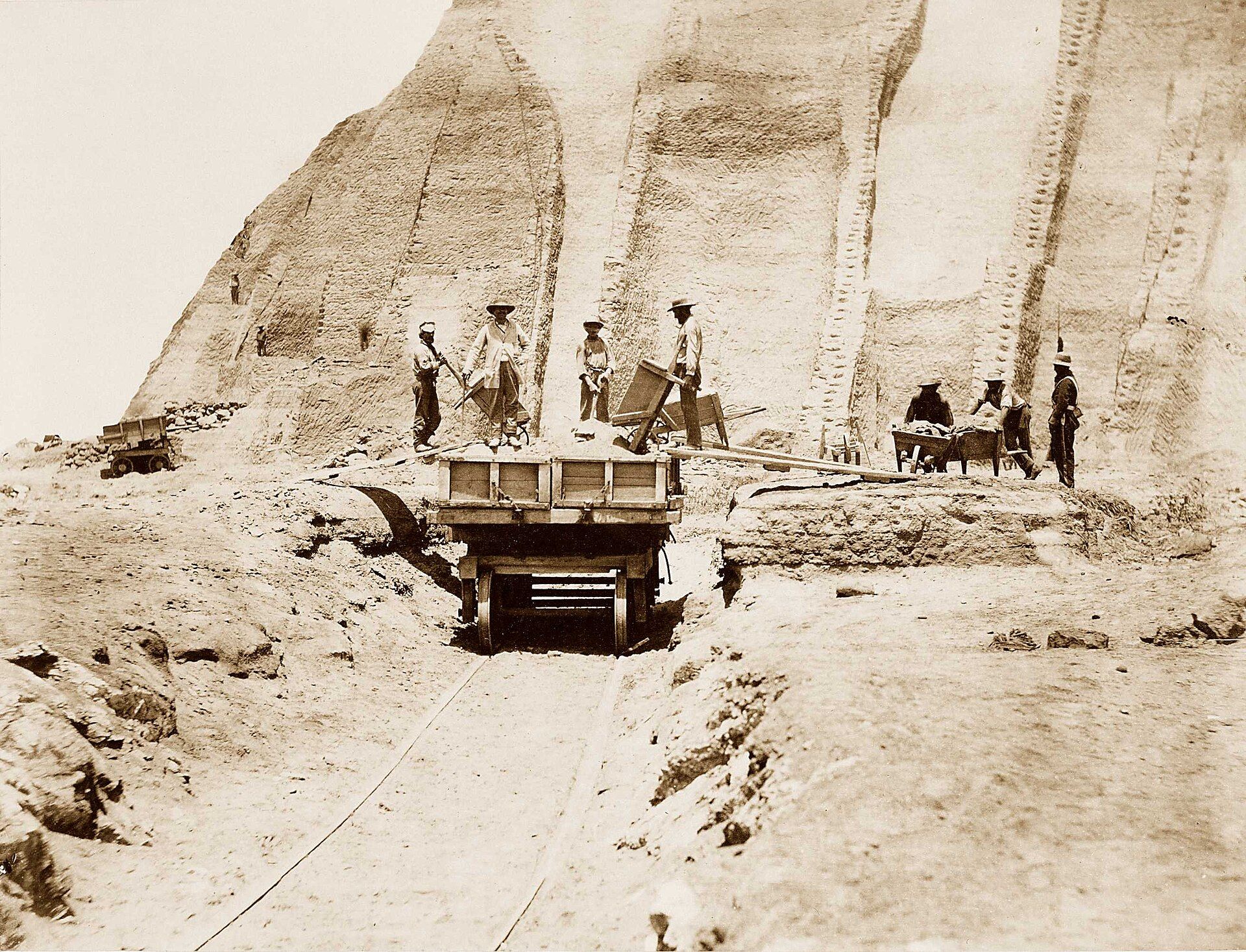
In the 1840s the digging fell mainly to slaves and to indigenous men from the mainland, then to convicts; from about 1850 it fell to thousands of indentured Chinese labourers, nominally contracted, in practice held like slaves.2 Tens of thousands of Chinese, Pacific Islander, Andean and Afro-Peruvian labourers did the work of excavating what were, in effect, mountains of dried excrement.1 In the early 1860s the photographer Henry de Witt Moulton carried his camera to the islands; his pictures of men with picks and wheelbarrows on the flank of "the Great Heap" were published in 1865.2 One newspaper account of the period said that on Middle Island every labourer, "strong and weak alike", was set a daily task of digging and wheeling five tons of guano.3
In the House of Commons, around February 1872, the MP Robert Fowler read out a published letter about the Chinchas. The Chinese, it said, were "inveigled to the islands for a term of three years" and "seldom live to complete the term of their slavery, for the nauseous dust and the overpowering effluvia of ammonia in which they work are of themselves rapidly destructive of life." "It is well known," the letter went on, "that shippers receive so much per head for every Chinese they land at the Chinchas. There they are detained by an armed force ... fed only after performing a certain amount of labour." It described men hung in ropes and chains from sunrise to sunset, men lashed to buoys at half tide, a lighter with a hole in its bottom that the offender had to bail without stopping or drown, and a point of rock "so small that sleep or change of position must result in their falling off." And it described one man who, having accidentally broken some tackle, "threw himself off the rocks, and was dashed to pieces, rather than submit to the tortures that awaited him."4
Fowler also told the House about the Dolores Ugarte, which had sailed from Macao for Peru in May 1871 with 656 Chinese labourers. After a disturbance the crew fastened down the hatches. Fire broke out. "The 600 Chinese below were left to their fate"; the boats held about forty. One survivor, Lai Awom, testified: "When I got on board I knew then that I was 'sold,' and I cried the whole of the first night I was on board." Viscount Enfield, for the government, added that 48 Chinese had been branded as slaves in Peru, according to a despatch received in March 1869.4
Guano revenue ran to several million pounds a year for the Peruvian state until the early 1870s.5 Peru borrowed against that income: bond issues in Europe in 1870 and 1872 pushed its external debt above £30 million, and servicing it cost about £2.7 million a year, around half the national budget. In December 1875 Peru stopped paying.5
2. Rocks, Keys and the Treasury of Spain
On 18 August 1856 the United States Congress passed a law that ran to a few short sections. Its operative sentence reads: "Whenever any citizen of the United States discovers a deposit of guano on any island, rock, or key, not within the lawful jurisdiction of any other government, and not occupied by the citizens of any other government, and takes peaceable possession thereof, and occupies the same, such island, rock, or key may, at the discretion of the President, be considered as appertaining to the United States." Later sections of the same chapter authorised the President to use "land and naval forces in protection of rights" and preserved the "right to abandon islands" once the guano was gone.6
Baker Island and Jarvis Island were bonded on 28 October 1856; Navassa Island on 31 October 1858; Howland Island on 3 December 1858; Johnston Atoll on 6 September 1859; Kingman Reef on 8 February 1860; Bajo Nuevo on 22 November 1869; Serranilla Bank on 8 September 1879 and again on 13 September 1880, according to the list the Interior Department still keeps.7 Most were specks of coral in the Pacific that no government had bothered to name. Navassa, a raised limestone island between Haiti and Jamaica, was claimed by Haiti. By one Interior Department account a representative of the Baltimore Fertilizer Company took possession in October 1857, a date that does not match the department's own bonding record.8
By 1889 Navassa was worked by the Navassa Phosphate Company. According to the record later laid before the Supreme Court, the people on the island "consisted of 137 colored laborers of said company and 11 white officers, or superintendents, all residents of the United States," the labourers "employed in digging the phosphate or guano."9 On 14 September 1889 the labourers rose against their supervisors over the conditions of their work; by one account five supervisors were killed.10 One of the accused, Henry Jones, was indicted for murder. His lawyers argued that the United States had no jurisdiction over an island it had taken for its droppings. On 24 November 1890, in Jones v. United States, the Supreme Court disagreed: "The Guano Islands Act of August 18, 1856 ... is constitutional and valid."9
On 14 April 1864 a Spanish squadron under Luis Hernández Pinzón, with the special commissioner Eusebio de Salazar y Mazarredo aboard, anchored off the Chinchas and took the islands "in the name of Spain, by hauling down the flag of Peru, and causing the flag of their country to wave over them." The Spaniards argued that the war of independence "was not complete in Peru" and that the Crown of Castile might "revindicate" its old possessions.11
On 29 October 1865 Chile's foreign minister, Álvaro Covarrubias, whose government feared it would be next, issued a counter-manifesto. Spain's demands, he wrote, would "import to the Peruvian nation not less than the loss of their deposits of guano. The appropriation of these deposits would not only relieve the utter insolvency of the Spanish treasury..." Covarrubias accused Admiral Pareja of having "sold peace to Peru in exchange for three millions of dollars." Chile had already, by a decree of 27 September 1864, declared coal to be contraband of war, on the grounds that "stone-coal has assumed the part of canvas at sea."11 The war ended in 1866 with Spain's withdrawal, after its ships bombarded Valparaíso and fought the batteries at Callao.11
The guano rush on Ichaboe Island off south-west Africa began in 1843 and was over in about two years.2 On the Chinchas the best deposits began to give out in the 1860s, and the guano houses of London started to look south, towards the Peruvian province of Tarapacá.12 By the 1870s guano no longer dominated Peru's trade and finance. By 1878 the revenue that had once run to millions came to only £418,000. That year The Economist put Peru's total debt at £50–55 million, for a population of roughly three million people.5
3. The White Desert
Charles Darwin landed at Iquique in July 1835. "The town contains about a thousand inhabitants," he wrote, "and stands on a little plain of sand at the foot of a great wall of rock, 2000 feet in height ... The whole is utterly desert."13 Behind that wall lay the Pampa del Tamarugal and, a few feet beneath its crust, a rock the miners called caliche.
Caliche contains sodium nitrate and lies in a layer usually several feet below the surface. Workers blasted it with dynamite and hauled the chunks by cart and rail to an oficina, a processing works, where by the system named after its inventor, Shanks, it was crushed, leached in hot water and crystallised into nitrate. Each step consumed coal, most of it imported from England, and water, in a desert where neither was found. The Shanks process was the standard from the 1870s until the 1920s. The deposits of the Atacama were the only commercially viable source of natural sodium nitrate in the world.5
Saltpetre had long been the key ingredient of gunpowder, and Chilean sodium nitrate went into both fertiliser and explosives.13 In the 1870s more than fifty oficinas went up in Tarapacá alone, quintupling the province's productive capacity. Tarapacá was then Peruvian territory and the cheapest place to produce: in 1879 its nitrate cost about a quarter less than Antofagasta's and a third less than Taltal's. Short of guano money, the Peruvian government nationalised the industry by stages from 1875–76, paying the owners £3.6 million in nitrate certificates bearing 8 per cent interest.5 In 1878 nitrate sold for £10.6 a ton.5
World consumption of Chilean nitrate, on a scale guano had never reached, was 441,800 metric tons in 1885, 1,389,700 tons in 1900 and 2,556,973 tons in 1913. In 1912 Chilean nitrate supplied 57.5 per cent of the world's commercial nitrogen. Ammonium sulphate, a by-product of coke ovens and gasworks, supplied 38 per cent; calcium cyanamide 3.1 per cent; the electric-arc process 1.4 per cent. The biggest importer was Germany, which spread most of its nitrate on sugar beet. Munitions were a secondary source of demand until the First World War.5
In 1866 Chile and Bolivia drew their border at the 24th parallel and agreed to split "all the guano business and export duties on minerals" between the 23rd and 25th parallels. In 1873 Peru and Bolivia signed a secret alliance. In 1874 a new treaty fixed the line, and Bolivia promised "not to increase during 25 years the export duties on minerals mined within this zone, or to impose any other taxes whatever on Chilean citizens or capital employed therein."14 The land in question was Bolivia's coast, the province of Antofagasta. The United States minister in Santiago, Thomas A. Osborn, described it in February 1879: the territory "is in the heart of what is known as the desert of Atacama, and was regarded, until about the time of the execution of the first treaty, except for the deposit of guano at Majillones, its northern boundary, as of little or no value. The discovery of vast nitrate deposits about that time, however ... soon brought it into prominent notice."15
The Compañía de Salitre y Ferrocarril de Antofagasta, financed with Chilean and British capital, claimed by early 1879 investments of more than $4,000,000 and had laid a railroad 40 miles inland, and Antofagasta, a few years earlier a cluster of shacks, had "developed into a city of nearly 10,000 people."15
On 14 February 1878 the Bolivian National Assembly passed a law imposing a tax of 10 centavos per quintal on the company's nitrate exports.16 Sources disagree on what a quintal meant here, 46 kilograms or 100; at the exchange rates of 1878 the tax came to about 3.7 pence per quintal, roughly 7 shillings a ton, around 3 per cent of nitrate's price.5 Bolivia argued that the tax fell "not upon Chilean citizens but upon Chilean companies."14 The company's manager, George Hicks, refused to pay. Bolivia said the company owed "something in excess of $90,000" in back taxes.15 The prefect of Cobija ordered Hicks arrested and the company's property seized and auctioned on 14 February 1879.16
Chile had floated bonds in Europe in 1870, 1873 and 1875 worth £4.4 million in all, and in July 1878 it suspended the convertibility of its currency. President Aníbal Pinto had told Congress in November 1877: "If a new mining discovery or other news in the same line does not come to improve our position, the crisis which has been affecting us for years will get even worse."5 In February 1879 Hicks wrote that Chile "no debería vacilar en recuperar este territorio; aprovechar la oportunidad para liberar la costa del pacífico de esta plaga de bolivianos" (should not hesitate to recover this territory, and should seize the chance to free the Pacific coast of this plague of Bolivians).16
The Chilean ironclad Blanco Encalada had been lying at anchor off Antofagasta for two days when the auction date came round. On the morning of 14 February 1879, a year to the day after the Bolivian law, Chilean troops landed.16 Osborn reported to Washington six days later: "On the 14th the Chilian forces occupied Antofagasta without firing a gun." He added: "The movement was an exceedingly popular one."15
4. "Muchachos, la contienda es desigual"
Bolivia declared war. Peru, bound by the secret treaty of 1873, would not abandon its ally. On 5 April 1879 Chile declared war on both.17
Six weeks later two old ships met off Iquique, then still a Peruvian port. The Esmeralda was a wooden corvette of 800 tons, built at Northfleet on the Thames in 1854–55; her boilers had been patched so often that she could barely make two or three knots. Against her came the Huáscar, an ironclad monitor built at Birkenhead in 1865, with 114 millimetres of armour and two 300-pounder Armstrong guns, commanded by Miguel Grau. Both ships had come out of British yards. On the morning of 21 May 1879 the Esmeralda's captain, Arturo Prat, gathered his crew. Lieutenant Luis Uribe recorded his words: "Muchachos, la contienda es desigual. Nunca se ha arriado nuestra bandera al enemigo; espero, pues, no sea esta la ocasión de hacerlo. Mientras yo esté vivo, esa bandera flameará en su lugar, y aseguro que si muero, mis oficiales sabrán cumplir con su deber." (Lads, the contest is unequal. Our flag has never been struck to an enemy; I hope this will not be the occasion. While I live that flag will fly in its place, and I promise you that if I die, my officers will know how to do their duty.)17
When the Huáscar rammed the corvette, Prat leapt onto the monitor's deck shouting "¡Al abordaje!" (Board her!). Only Sergeant Juan de Dios Aldea followed him. Prat was shot dead near the turret. The Huáscar rammed twice more, and at 12:10 the Esmeralda went down. Of her 201 men, 141 died. A Peruvian eyewitness wrote in El Comercio de Iquique the next day: "Lo último que desaparece en las aguas es el pabellón chileno; no se oye el más leve grito ... a todos nos tiene anonadados el horror de aquella tremenda escena." (The last thing to vanish beneath the water is the Chilean flag; not the faintest cry is heard ... the horror of that terrible scene has left us all stunned.)17
In July 1879, with Prat already Chile's national hero and the war far from over, Osborn wrote from Santiago: "Business in all its branches is at a standstill, and I can see nothing but universal bankruptcy in a long continuance of the war ... one of the movements demanded is the capture of Iquique." Chile took Tarapacá at the end of 1879. In 1880 it collected more than £700,000 from nitrate exports, against a little under £2 million spent on its army and navy that year. By 1884 its nitrate revenue had more than doubled. Peru paid for its share of the war by printing money, and prices rose about tenfold in two years.5
Article 2 of the Treaty of Ancón, signed on 20 October 1883, read: "The Republic of Peru cedes to the Republic of Chile in perpetuity and unconditionally the territory of the littoral province of Tarapacá," from the Camarones ravine to the river Loa. Article 3 left Tacna and Arica under Chilean rule for ten years, followed by a plebiscite. Article 4 dealt with the old cargo: under a Chilean decree of 9 February 1882, one million tons of guano would be sold and the net proceeds divided equally between Chile and Peru's creditors, whose loans were secured on guano, with Chile paying the 50 per cent "until the extinction of the debt or the exhaustion of the deposits."18 The plebiscite never took place. Peru got Tacna back only by a treaty in 1929; Arica stayed Chilean.5
Bolivia signed a truce at Valparaíso on 4 April 1884 that left Chile occupying its coast. Twenty years later, by the Treaty of Peace and Friendship signed in Santiago on 20 October 1904, it recognised those territories as "del dominio absoluto y perpetuo de Chile" (under the absolute and perpetual dominion of Chile), and was left landlocked, as it remains.19
John Thomas North was born in Leeds in 1842, the son of a coal merchant, and went to Peru in 1869 for the engineering firm Fowler & Co. to install nitrate machinery. From 1871 he managed an oficina near Iquique.12 When the war broke out, the Peruvian nitrate certificates issued for the nationalised works fell to almost nothing; by 1881 a certificate originally worth £180 could be had for £20 to £30. With Robert Harvey, Peru's former inspector-general of nitrate, and John Dawson of the Bank of Valparaíso in Iquique, North bought them. In 1881–82 Chile decreed that the oficinas would go back to private owners holding the certificates. The bonds for the oficina Ramírez cost Harvey £5,000, about a third of their real value; in 1883 they were sold to the Liverpool Nitrate Company for £50,000. The company paid dividends of 26 per cent in 1885, 20 per cent in 1886 and 40 per cent in both 1887 and 1888.12
In May 1888 the Financial News wrote of North: "Put North's name on a costermonger's cart, turn it into a limited liability company, and the shares will be selling at 300 per cent premium before they are an hour old ... Whatever he touches turns, if not to gold, at least to premiums." He liked to describe his own career as "from mechanic to millionaire."12 On 4 January 1889 he gave a "farewell" ball at the Hotel Métropole for a thousand guests representing, in the words of The South American Journal, the "aristocracy, the plutocracy and the histrionocracy of the kingdom." It cost £10,000.12 North himself, by one newspaper report, came in fancy dress as Henry VIII.20 A month later he sailed from Liverpool for Chile, with the Illustrated London News artist Melton Prior and the war correspondent W. H. Russell in his party, and met President José Manuel Balmaceda three times.12 Russell, standing in the Iquique roadstead that May, counted "a number of large ships, lying in regular tiers, full rigged barques, three-masted schooners, one large four-master."13
British capital owned about 13 per cent of Tarapacá's nitrate industry in 1878, by one count; by 1884 it owned 34 per cent, and by 1890, after a period of feverish activity on the London Stock Exchange, 70 per cent. The 70 per cent belonged to British investors as a whole, not to North alone.21
Chile had charged no export tax on nitrate before the war. From 1880 it charged a duty of 2.57 shillings per hundredweight, and kept it until the 1920s.5 Between 1890 and 1918 the duty supplied more than half of the Chilean treasury's ordinary revenue.22 Estimates for particular years run from 48 per cent in 1890 to the 55 per cent that the US minister in Santiago, Thomas C. Dawson, reported in 1909, writing that "practically the world's whole supply of nitrate comes from this region." Conquering Tarapacá, Dawson observed, had cut Peru's available revenue by more than half while doubling Chile's.14 Nitrates made up about 70 per cent of Chile's exports, and on the strength of them Chile took on £19 million of new foreign debt between 1885 and 1900.5
Balmaceda began to hint that the state might end its hands-off approach to nitrate, and he attacked the monopoly of North's Nitrate Railways. In 1891 Chile's Congress and navy rose against the president, and the civil war ended in August with his defeat; in September he shot himself. One account at the time, published in The Times on 19 May 1891, blamed "the English or Anglo-Chilean owners of the vast nitrate deposits in Tarapacá" as the "instigators, the wirepullers, the financial supporters" of the revolt; another finds no reliable evidence for it, and notes that North held 16,000 Nitrate Railways shares in 1888 and fewer than 400 by 1896.12 North died on 5 May 1896 at a board meeting of the Buena Ventura Nitrate Company in Gracechurch Street. The Economist's obituary called him "from first to last just a workman who had made a great fortune and loved to proclaim it by extravagant expenditure ... His great notion of hospitality was to drown his friends in champagne."12
In December 1907 the workers of the oficinas, paid in a currency that kept losing value, went on strike; the first stoppage, at San Lorenzo, came on 9 or 10 December. On the 15th a column of more than 2,000 strikers walked down from the pampa to Iquique. Their number grew to somewhere between 15,000 and 23,000. One of their central demands was to be paid at a fixed rate of 18 pence to the peso.23 On 21 December the nitrate employers told the regional governor, Carlos Eastman, that their objection was not money but an "asunto moral", a moral matter: to negotiate under pressure would endanger "la mantención del orden" (the maintenance of order) in the oficinas.23 At 2:10 that afternoon Eastman wired President Pedro Montt that he would use force. At 3:45 troops under General Roberto Silva Renard opened fire on the strikers gathered in the Escuela Domingo Santa María and the Plaza Montt.
Eastman's telegram reported 30 dead and 70 wounded; Silva Renard, the next day, about 140 dead or wounded. The official figure, released on 15 January 1908, was 126 dead and 135 wounded. Witnesses spoke of more than 200 bodies, and 200 to 400 wounded, more than 90 of whom died that night. Popular memory, carried by Luis Advis's Cantata Santa María de Iquique of 1969, puts the toll at 3,600.2324 On 14 December 1914 a man named Antonio Ramón Ramón, whose half-brother had died in the school, stabbed Silva Renard in the street. The general survived.23
5. Bread from Air
On 7 September 1898 Sir William Crookes, the new president of the British Association for the Advancement of Science, rose in the Colston Hall in Bristol to deliver an address on wheat. "England and all civilised nations stand in deadly peril of not having enough to eat," he said. "As mouths multiply, food resources dwindle."2526 The only fixed nitrogen available on a world scale, he explained, was "nitrate of soda, or Chili saltpetre," which came from "a narrow band of the plain of Tamarugal, in the northern provinces of Chili." Chile then exported about 1,200,000 tons a year, and it would run out.25
The Colston Hall itself, Crookes said, "contained 27 tons weight of nitrogen in its atmosphere ... In the free gaseous state this nitrogen is worthless; combined in the form of nitrate of soda it would be worth about £2,000." He described how carelessly the old stock was spent: "The nitrogen which with a light heart we liberate in a battleship broadside has taken millions of minute organisms patiently working for centuries to win from the atmosphere." "The fixation of atmospheric nitrogen therefore is one of the great discoveries awaiting the ingenuity of chemists," he said. "It is the chemist who must come to the rescue of the threatened communities. It is through the laboratory that starvation may ultimately be turned into plenty."25 He predicted a shortage of wheat by 1931. His address also carried the imperial and racial anxieties of its day, worrying aloud about which peoples would eat wheaten bread and which would be pushed aside.25
Nitrogen makes up nearly four-fifths of the air, and almost none of it is usable by plants, because the two atoms of a nitrogen molecule are held together by one of the strongest bonds in chemistry. Coke ovens gave some ammonia as a by-product; by 1912 cyanamide and the electric arc were fixing small amounts with enormous quantities of electricity.5 Fritz Haber, born in Breslau on 9 December 1868 and working at Karlsruhe since 1894, approached the problem from thermodynamics. In his 1905 book on technical gas reactions he recorded "the production of small amounts of ammonia from N2 and H2 at a temperature of 1000° C with the help of iron as a catalyst."27 The yields were tiny. The chemistry said that higher pressure and lower temperature would push the reaction towards ammonia, but at a lower temperature the reaction crawled. It needed a better catalyst and pressures far beyond anything used in industry at the time.
With his assistant, Robert Le Rossignol, Haber built a bench apparatus that circulated nitrogen and hydrogen over the catalyst at 150 to 200 atmospheres and about 500 °C.27 Early in 1909 they found that finely divided osmium gave 8 per cent ammonia by volume at 175 bar and 600 °C.28 Haber had filed his patent on the "synthesis of ammonia from its elements" on 13 October 1908.29 The chemical company BASF, in Ludwigshafen, was interested enough to send its people to watch.
On 2 July 1909, while the apparatus was being tightened for the demonstration, one of the bolts of the high-pressure vessel sprang, and the run was delayed for several hours; Carl Bosch could not wait and went back to Ludwigshafen.30 (One technical history places a convincing demonstration in April; a BASF group including Bosch had visited in March.)28 The chemist Alwin Mittasch stayed. The next day Haber wrote to the BASF directors: "Yesterday we began operating the large ammonia apparatus with gas circulation in the presence of Dr Mittasch, and were able to run it for about five hours without interruption. During this whole time it functioned correctly and produced liquid ammonia continuously ... All parts of the apparatus were tight and functioned well, so it was easy to conclude that the experiment could be repeated."30
Le Rossignol kept some of the ammonia from that day, sealed in glass tubes. More than forty years later he gave them to the Science Museum in London, which has displayed them in a pressure-tested case since 1986: "Sealed glass tubes containing the first specimens of liquified ammonia synthesised by the Haber process on 2nd July, 1909."31
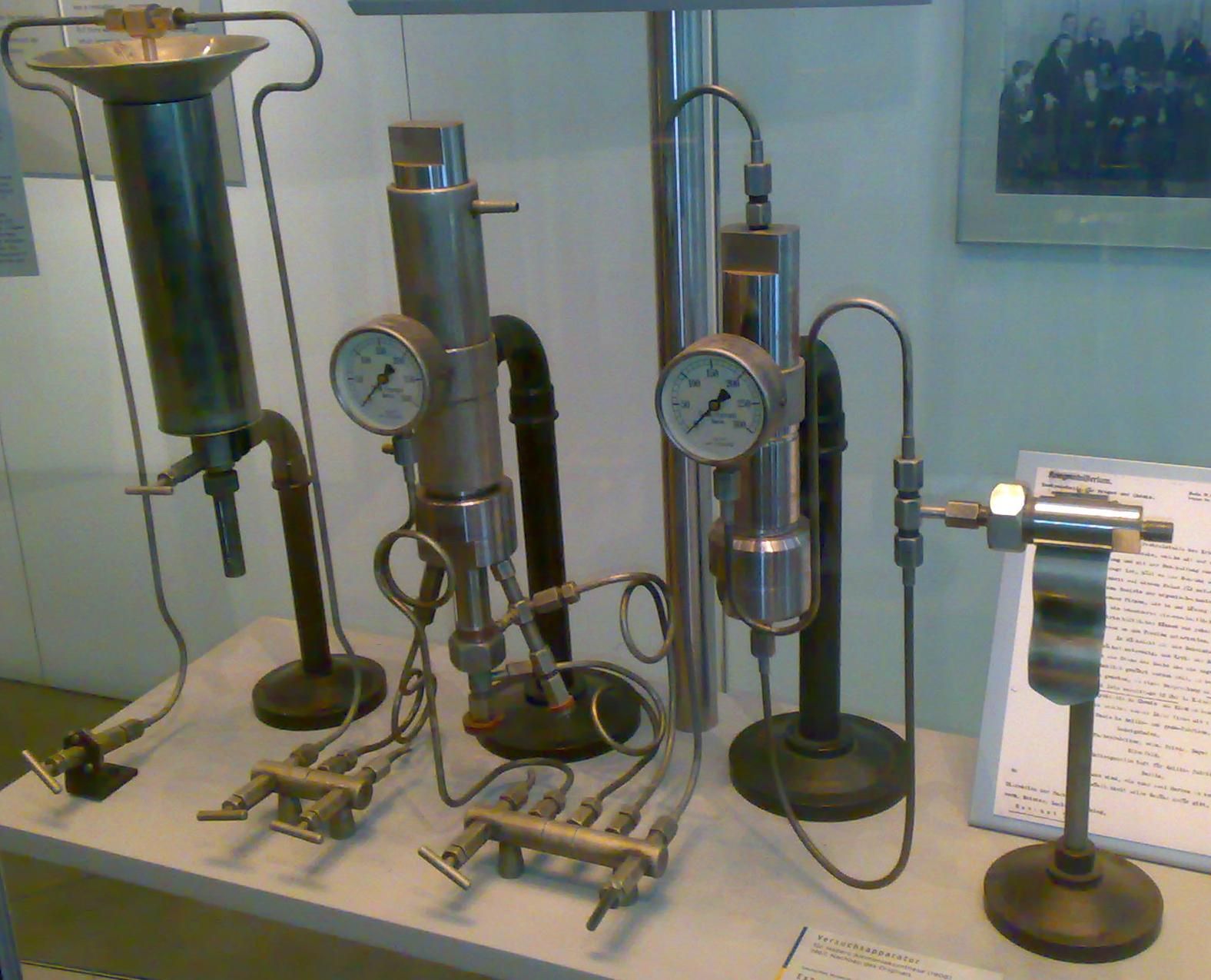
August Bernthsen, head of the company's laboratory, was horrified by the pressure. "One hundred atmospheres!" he said. "Just yesterday we had an autoclave under a mere seven atmospheres flying into the air!" Bosch, a metallurgist by training as much as a chemist, answered: "I believe it can go. I know exactly the capability of the steel industry. It should be risked."30
Osmium worked, but the world's entire stock of it amounted to a few kilograms.28 Mittasch set out to find a substitute by brute force, testing almost the whole periodic table. By 1910 his team had tried more than 2,500 different formulas in 6,500 runs. In November 1909 a magnetite ore from Gällivare in Sweden showed promise, and by 1911 the answer was settled: iron, with a few per cent of alumina and "a pinch of potassium". The programme of testing went on until 1922. The catalysts in ammonia plants today are much the same mixture.28
The first larger test reactors ruptured after only 80 hours. Hot hydrogen under pressure was soaking into the carbon steel of the walls and making it brittle. Bosch's solution was to line the pressure shell with soft iron and drill small vent holes through the outer steel, so that hydrogen that seeped past the liner could escape before it did damage. Engineers still call them "Bosch holes".28
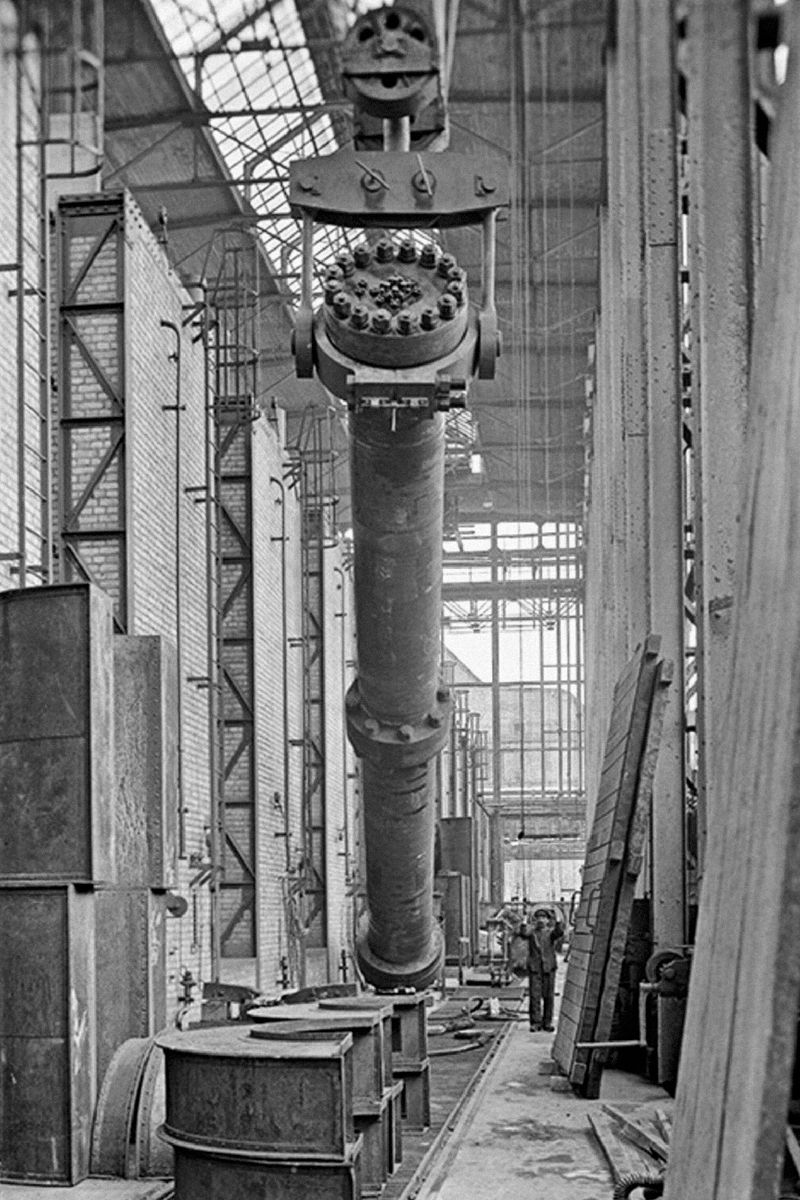
BASF built its first plant at Oppau, next to Ludwigshafen on the Rhine, designed for 30 tons of ammonia a day. Commercial production began on 9 September 1913, four years and two months after the demonstration in Karlsruhe, and the plant reached full capacity in 1914.3028 What it needed was not caliche or seabirds but coal and coke for hydrogen, steel that could hold the pressure, compressors, catalysts and a company with the capital to try.
In 1913 the world still consumed 2,556,973 tons of Chilean nitrate, and Haber's process was a very small part of the market. The largest single customer, taking 833,112 tons, was Germany.5
6. "What Is This Nitrate?"
Some time in the First World War a minister sat at the British War Cabinet table listening to his colleagues argue about submarines and about what they called "the Chile communications". Eventually he leaned towards his neighbour. "Tell me," he asked, "what is this nitrate they are all making such a fuss about?" The story was told in 1924 by the chemist Stanley Levy, in Chemistry and Industry.32
Until 1914 Chilean saltpetre supplied two-thirds of the world's fixed-nitrogen fertiliser.32 Measured against every kind of nitrogen produced, mineral and industrial, for farms and factories alike, Chile's share in 1914 was smaller, 54 per cent; ammonium sulphate from coke ovens made up 37 per cent, and the Haber–Bosch process 2.22 Germany had been the biggest buyer of Chilean nitrate since about 1900. In 1913 the country used 222,500 tons of nitrogen in all. Chilean saltpetre supplied 116,000 tons of it. Oppau's synthetic ammonium sulphate, in its first months, supplied 4,000.32
Before the Panama Canal, the sea route to the Atacama ran round the bottom of the world: ships bound for Europe rounded South America and worked their way up the Chilean coast, and in the autumn of 1914 a German cruiser squadron under Admiral Maximilian von Spee was loose in those waters. On 1 November, off Coronel, it destroyed a British squadron: more than 1,600 British sailors died, not a single German. It was Britain's first naval defeat of the war and its first anywhere in more than a century. In Valparaíso afterwards someone handed Spee a bouquet; by one account he said, "These will do nicely for my grave." The battle was about command of the trade routes in general, not about nitrate in particular.33 Five weeks later, on 8 December 1914, the British caught him off the Falkland Islands and sank four of his ships. More than 1,800 Germans died, and Spee went down with his flagship, the Scharnhorst.3332 "From then until the end of the war," one history of the nitrogen industry puts it, "the direct supply of Chilean saltpetre was cut off from Germany by the Royal Navy's blockade."32 Between the British closure of German ports and London's restrictions on re-exports, Chile's nitrate shipments fell by 30 per cent from 1913 to 1914.22
German planners reckoned that the army needed more than 12,000 tons of nitrates a month. In the first months of the war they got lucky: more than 20,000 tons of Chilean saltpetre were captured from the retreating Belgian army around Antwerp.32 That stock would not last a long war. BASF pushed Oppau to about 250 tons of ammonia a day, some 90,000 tons a year, by early 1917. A new works at Leuna sent out its first railway tank wagons of liquid ammonia on 27 April 1917, three weeks after the United States declared war. Leuna began with a capacity of 36,000 tons a year; the target was raised to 75,000, then 160,000, and someone proposed 240,000. By the armistice Germany was making 650 tons of synthetic ammonia a day, 250 at Oppau and 400 at Leuna.32
The Oppau and Leuna works, according to the biography the Nobel Foundation published at the time of Haber's prize, "enabled Germany to prolong the First World War when, in 1914, her supplies of nitrates for making explosives had failed."27 Ammonia is not itself an explosive; its nitrogen was turned into the nitrates Chile was no longer sending. The same process kept German fields supplied with fertiliser after the blockade closed,34 and Germany lost the war all the same.
As a consultant to the German War Office, Haber organised gas attacks and the defences against them.27 In 1915 he supervised the first release of chlorine at Ypres in Belgium.34 His wife, Clara Immerwahr Haber, was a chemist herself. On 1 May 1915 she sat down at her desk and wrote farewell letters to friends and family.34 Then she killed herself. Her husband's chlorine, by one account, "precipitated" her death.34
The Nobel Prize in Chemistry for 1918 went to Haber, and because of the war it was awarded in 1919.27 "There was great consternation" when the man who had directed chlorine at Ypres was honoured for synthesising ammonia.34 After the war he spent the years from 1920 to 1926 trying to extract gold from sea water, hoping to pay Germany's reparations with it. The scheme failed. In 1933, under the Nazi race laws, he resigned. He died in Basel on 29 January 1934, "his spirit broken," the Nobel biography says, "by his rejection by the Germany he had served so well."27
After the war Oppau had gone back to making fertiliser. One of its products, ammonium sulphate nitrate, tended to cake in storage, and the plant broke up the hardened heaps with small explosive charges; more than 20,000 such blasts had been set off without incident.35 Early in 1921 the works changed how it dried the mixture, spraying it so that it held about 2 per cent moisture instead of 3 or 4. Nobody tested whether the drier product behaved differently.36
At 7:32 on the morning of 21 September 1921, a loosening charge went off in silo Op 110, which held about 4,500 tons of the fertiliser.35 Only about a tenth of the mass detonated.36 It was enough to leave a crater 96 metres wide, 165 metres long and 18.5 metres deep, which slowly filled with groundwater.35 A dark green cloud covered the sky. In the village of Oppau nearly four-fifths of the buildings were levelled; more than 7,500 people lost their homes.36 Around 2,000 buildings were damaged and 1,036 destroyed. Windows burst in Heidelberg, Worms, Darmstadt and as far away as Frankfurt, more than 80 kilometres off, and the seismograph in Munich, some 300 kilometres away, recorded the shock.35 The explosion was heard more than 275 kilometres away. The French accident database counts 561 dead and 1,952 injured.36
Four days later, on 25 September, Carl Bosch spoke at the memorial service. President Friedrich Ebert was there. "We stand here, powerless and impotent," Bosch said. And then: "Of all substances, the material that was to provide nourishment and bring life to millions of people in our fatherland, and one we have produced and shipped for years, has suddenly proven to be a grim enemy for reasons we do not know."35 More than 10,000 construction workers came to rebuild the plant. Ammonia production at Oppau resumed eleven weeks after the explosion.35
7. Leaching Sheds in the Fog
In 1918 Chilean nitrate still supplied 36 per cent of the world's nitrogen and synthetic ammonia 15. By 1925 the mineral had recovered to 43 per cent, and the factories, at 14, had slipped. In 1930 Chile's share was 19 per cent and Haber–Bosch's 47; in 1934, 7 against 63.22 The change took about two decades from Oppau's first ammonia, and for the first half of that time the oficinas could tell themselves the war had been an interruption. Germany, the country that had bought more Chilean nitrate than any other before 1914, became the world's largest exporter of nitrogen in 1932, ahead of Chile.22
In the 1920s the oficinas of the Atacama began to replace the old Shanks process, which had crushed and boiled caliche with English coal since the 1870s, with a newer method, the Guggenheim system.5 A ton of Chilean nitrate fetched US$43.12 in 1926, $36.78 in 1929 and $18.80 in 1934.22 Synthetic nitrogen was made next to its customers; Chilean nitrate still had to be blasted out of the desert, hauled to an oficina, leached, dried and shipped halfway round the world.
Nitrates had made up more than 70 per cent of Chile's exports in 1913.37 The state had lived on the export duty for a generation, and it had borrowed abroad against nitrate as collateral. When the Depression came on top of synthetic competition, Chile's exports fell by 76 per cent, and the debts secured on such a volatile commodity helped push the country off the gold standard.37 To rescue the industry, a law of 21 July 1930 merged it into the Compañía de Salitre de Chile, COSACH; it began operating the following year.3822 It lasted until 1933, when it was dissolved. "The era of Chilean nitrate," one economic history concludes, "was over."22
The pampa had held more than 200 oficinas. Each was a company town: workers from Chile, Peru and Bolivia lived in them and made a culture of their own, the culture of the pampinos, linked to the ports by a railway built for the trade.39 As the works closed, the people left. One of them, Humberstone, and its neighbour Santa Laura, stand 45 kilometres inland from the port of Iquique, in the Tarapacá desert. Between them they had worked nitrate for more than sixty years from 1880.39
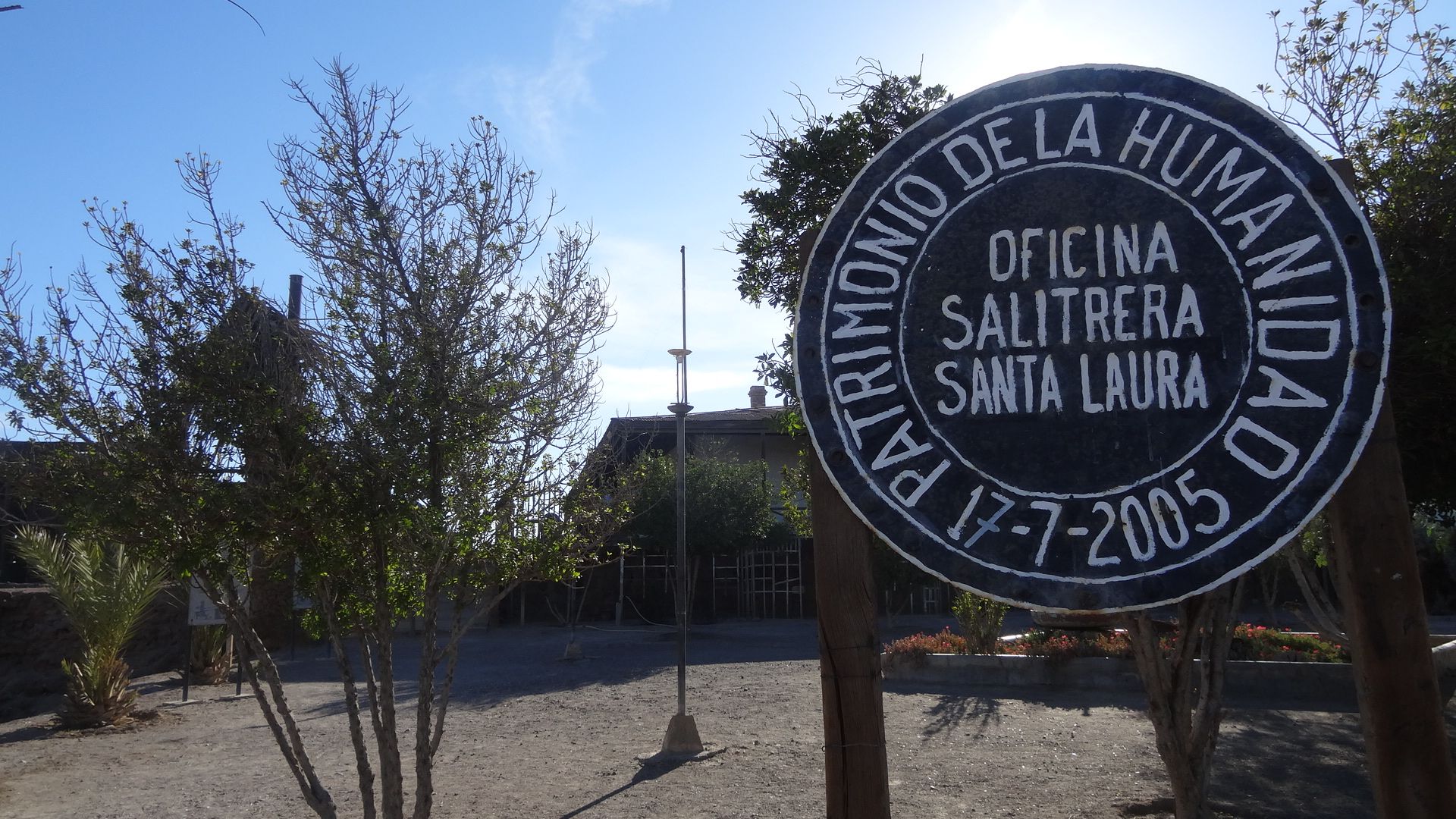
After they shut, the two towns were looted and partly demolished, until Chile declared them a national monument in 1970.39 In 2005 UNESCO inscribed them on the World Heritage List as "the best preserved and most representative remains" of the saltpetre works, a property of 573.48 hectares with a buffer zone of 1,826.39. In the same year it put them on the List of World Heritage in Danger, where they stayed until 2 July 2019. At Santa Laura stand the only leaching shed and saltpetre grinder still intact anywhere, and the installations where iodine was made from the same ore. The threat is the camanchaca, the sea fog that rolls in off the Pacific carrying enough salt to corrode metal, timber and stone. Every year former workers and their families gather at Humberstone for Saltpeter Week.39
In 2024 Chile was the world's largest producer of iodine, about 66 per cent of world output outside the United States: 22,711 tons, 14,500 of them from SQM, all of it "extracted from solutions produced by leaching caliche ore", the rock that once paid Chile's government.40 The company has described northern Chile's caliche as the only commercially exploited source of natural nitrates in the world.41 It is still producing them. In 2024 Chile turned out 756,262 tons of natural crude nitrates, against nearly 3 million tons exported in 1913.4022 Chile was also the world's second-largest lithium producer, with about 22 per cent of world output; lithium carbonate accounted for 61 per cent of the value of Chile's industrial-mineral exports, $2.6 billion, and iodine for 34.40
8. A Power Station That Makes Ammonia
Haber's catalyst still sits inside the world's ammonia reactors in much the same form BASF settled on before the First World War: iron, a little alumina, a pinch of potassium.28 In 1940 a BASF plant making its hydrogen from coke used 88 gigajoules of energy for every ton of ammonia. The best plants of the late twentieth century, making it from natural gas, used about 28, against a theoretical minimum of about 20.9. They produce about three times as much steam as ammonia, and one engineer's description of such a plant is "a sophisticated power station making ammonia as a by-product." In a steam-reforming plant natural gas is both the raw material and the fuel, and the cost of that gas is "the principal determinant of the overall production costs."28
Making ammonia takes about 2 per cent of the world's total final energy consumption, 8.6 exajoules a year, and produces about 450 million tons of carbon dioxide, 1.3 per cent of the energy system's emissions, as much as the whole energy system of South Africa. A little over 70 per cent of production runs on steam reforming of natural gas, which works out at 170 billion cubic metres of gas a year, a fifth of all the gas industry burns or consumes. Coal supplies much of the rest, 75 million tons of coal equivalent a year; China makes about 30 per cent of the world's ammonia, 85 per cent of it from coal. Each ton of ammonia releases about 2.4 tons of CO2, nearly twice as much as a ton of crude steel. About 70 per cent of the output goes into fertiliser, which the International Energy Agency calls "a bridge between the nitrogen in the air and the food we eat."42
In 1908, the year Haber filed his patent, a hectare of farmland supported 1.9 people; a century later it supported 4.3. By 2000 nitrogen fertiliser was feeding 44 per cent of the world's population, and by 2008 an estimated 48 per cent: "the lives of around half of humanity are made possible by Haber–Bosch nitrogen." Some 4 billion people born since 1908, 42 per cent of all births, were supported by it.43 An earlier estimate, from 1999, had put the figure at almost two-fifths of the world's population.30 Haber–Bosch nitrogen has been linked to between 100 and 150 million deaths in the armed conflicts of the twentieth century.43 Of about 100 million tons of nitrogen put into agriculture in 2005, people ate 17. Cereals that took up about 80 per cent of the nitrogen applied to them in 1960 took up about 30 per cent in 2000.43 In his Nobel lecture Haber had foreseen the scale, if not the waste: a demand "which at the beginning of this century could be satisfied with a few hundred thousand tons a year, must increase to millions of tons."43
In 2021 wholesale gas prices in Britain rose 250 per cent between January and September.44 On 15 September CF Industries announced that it was "halting operations at both its Billingham and Ince, UK, manufacturing complexes due to high natural gas prices," adding: "The Company does not have an estimate for when production will resume."45
The two plants produced around 60 per cent of Britain's carbon dioxide, a by-product of making ammonia, used mainly by the food industry.46 Within days the British Meat Processors Association warned that about a quarter of the country's pork production could shut down that Friday.44 On 21 September the government announced an "exceptional short term arrangement": it would pay towards the cost of running Billingham for three weeks.46 The environment secretary, George Eustice, said the price of food-grade carbon dioxide would rise from £200 a ton to £1,000. The business secretary, Kwasi Kwarteng, explained why no one had seen it coming: "it was abundant, it was very cheap and I think a lot of people were surprised at what happened."44
The fertiliser maker Yara had already cut production in September 2021, reportedly by around 40 per cent of its European ammonia capacity.47 By one report, its European plants could make 4.8 million of the company's 8.6 million tons of ammonia a year.48 On 25 August 2022, "as a result of record high gas prices in Europe," it announced further cuts that left its European ammonia plants running at around 35 per cent of capacity, idling the equivalent of 3.1 million tons of ammonia a year.49 Europe's ammonia plants are, on average, about forty years old.42 On 28 October 2026 the Dutch TTF, Europe's benchmark gas price, rose above €100 per megawatt-hour for the first time since December 2022, roughly three times its level before the war in the Middle East began that February. Yara had already cut 150,000 tonnes of ammonia output in the third quarter of 2026, mainly at its Ferrara plant in Italy. In the same quarter the American producer LSB Industries paid an average of $2.93 per million British thermal units for its gas; €100 per megawatt-hour works out at about $32.5.50
After Russia invaded Ukraine, the pipeline that carried ammonia from Togliatti on the Volga to the Black Sea port of Odesa shut, and Russian ammonia exports for January to August 2022 fell by 63 per cent. Potash is dug from the ground, not made from the air, and in 2020 Russia and Belarus between them accounted for 41 per cent of world potash trade. Belarus's potash exports in 2022 were at least 50 per cent below 2021's.51 By one account, the United States had sanctioned the Belarusian Potash Company on 2 December 2021, with effect from 1 April 2022, and Lithuania had barred Belarusian potash from its port of Klaipėda from 1 February 2022.52 By June 2022 export restrictions of one kind or another covered about a fifth of the world's fertiliser trade. China cut its urea exports by 47 per cent that year. In sub-Saharan Africa outside South Africa, fertiliser use may have fallen by about a quarter. Some three-quarters of the world's countries import at least half the fertiliser they use.51
9. A Basket of Hands
Mesoamericans had been making it for at least 2,500 years, among other things into the heavy balls of the game called ulama.53 In 1745 the French traveller La Condamine reported that people in South America shaped it into shoes and bottles; the English name came later, from the European habit of using it to rub out pencil marks. In 1823 Charles Macintosh dissolved it in naphtha and pressed it between layers of cloth to make raincoats, and a brief "rubber fever" followed in the early 1830s and ended abruptly: rubber goods "froze rock hard in the winter and melted in the summer."54
In 1839 Charles Goodyear, working on a kitchen stove, mixed rubber with sulphur and white lead, and the heated mixture neither cracked in the cold nor turned to glue in the heat.54 The process became known as vulcanisation. Goodyear's US patent, No. 3,633, "Improvement in India-Rubber Fabrics", was granted on 15 June 1844. In England Thomas Hancock had applied for a similar patent some eight weeks earlier, and Goodyear, who had already been jailed for debt, spent much of the rest of his life in litigation. He died in 1860 nearly destitute.5556
One account dates the pneumatic tyre to October 1887 in Belfast, where John Boyd Dunlop wanted to spare his nine-year-old son the jolting of solid rubber tricycle tyres on the cobbles. He improvised an air-filled rubber tube and held it to the wooden wheel with tacked-on linen.57 Another account puts the invention in 1888 and has Dunlop applying for his patent on 23 July that year. The dates of the patent itself differ in the same way: one version has it granted on 7 December 1888, another registered in December 1888 and granted in July 1889.5857 In one telling he tested it by rolling a rubber-shod wooden disc across his yard against a metal wheel.59 Nor was the idea wholly new: Robert William Thomson had patented a pneumatic tyre in the 1840s.57 By 1890 Dunlop held a United States patent too, No. 435,995, issued on 9 September and giving his address as 50 Gloucester Street, Belfast.60
By one count, bicycle production in the 1890s rose to nearly 2,000,000 a year.61 In 1891 Édouard Michelin brought out a tyre that could be taken off and mended in about fifteen minutes, and Charles Terront rode on it to win the 1,200-kilometre Paris–Brest–Paris race that September.62 Ford's Model T went on sale on 1 October 1908 for $850. More than 15 million were built before production ended in 1927, by which time the price had fallen as low as $260.63 In 1910 the United States had fewer than 50 passenger cars for every 10,000 people. By 1930 it had more than 1,800.64 Almost none of the rubber in those tyres came from plantations yet.
In the Congo Free State, the African territory King Leopold II of the Belgians ruled as his personal possession, rubber exports by one reconstruction rose from 100 tonnes in 1890 to 1,200 tonnes in 1896 and 6,000 tonnes in 1901, when the colony supplied something like 12 per cent of the world's rubber.6561 The latex came from wild vines in the forest. Villages were given quotas. Concession companies posted armed sentries to enforce them.
On 25 July 1903 the British consul Roger Casement stepped ashore at Lukolela on the Upper Congo. He had first seen the place in 1887. "When I visited it in 1887," he wrote, it "numbered fully 5,000 people; today the population is given, after a careful enumeration, at less than 600." Refugees told him that "nothing had remained for them at home but to be killed for failure to bring in a certain amount of rubber or to die from starvation or exposure in their attempts to satisfy the demands made upon them." Around Lake Mantumba he found villages without "goats, sheep, or fowls", and traced the emptiness "above all else to the continued effort made during many years to compel the natives to work india-rubber." He found a company sentry holding eleven women "to compel their husbands to bring in the right amount of rubber required of them on the next market day." He recorded two of the living: "a young man, both of whose hands had been beaten off with the butt ends of rifles against a tree; the other a young lad of 11 or 12 years of age, whose right hand was cut off at the wrist." Among the dead he described "a somewhat general mutilation... as proof that the soldiers had done their duty."66 A diary extract quoted from the report in the press, in a passage that survives only in later reprints, set out the accounting: "Each time the corporal goes out to get rubber, cartridges are given to him. He may bring back all not used; but for every one used he must bring back a right hand."67 A man named Ncongo described soldiers who "cut off their hands and put them into a basket and took them to the white man. He counted out the hands – 200 in all."65
When the report appeared as a parliamentary paper in 1904, the names of people and places had been replaced by capital letters: "a full-grown man named AA". Casement considered resigning over it. Behind the letters were a man called Biasia, a boy called Mongala, a sentry called Itala and a town called Bosombongo.65 Leopold answered with his own Commission of Inquiry in 1904–05. Its three judges, Nisco, de Schumacher and Janssens, largely confirmed what Casement had seen, yet set aside the Congolese witnesses on the ground that "the black man of the Congo has not the same notion of truth that we have."65 One Belgian was sentenced to five years' penal servitude for causing the shooting of at least 122 Congolese during a rubber expedition in 1903.66
On 14 May 1904 (one account gives 15 May), shortly after eight in the morning, a man named Nsala walked into the Baringa mission station on the Maringa River, inside the concession of the Abir company. He came from the village of Wala, and he was carrying the hand and foot of his five-year-old daughter, Boali. Fifteen Abir sentries had arrived in Wala a day earlier than expected to collect rubber, found the quota not ready, and killed Boali, Nsala's wife Bonginganoa and a boy named Esanga. On the mission veranda the missionary Alice Seeley Harris photographed Nsala with her Kodak as he looked at what he had brought.68 Her husband, John Harris, wrote that as a lantern slide it would "rouse any audience to an outburst of rage... the mute appeal of the hand and foot will speak to the most skeptical."68 The photograph was printed in E. D. Morel's King Leopold's Rule in Africa that year and in Mark Twain's pamphlet King Leopold's Soliloquy in 1905. That same year, 1904, Abir's rubber exports fell by about half. The vines within fifty miles of its posts had been tapped out.68
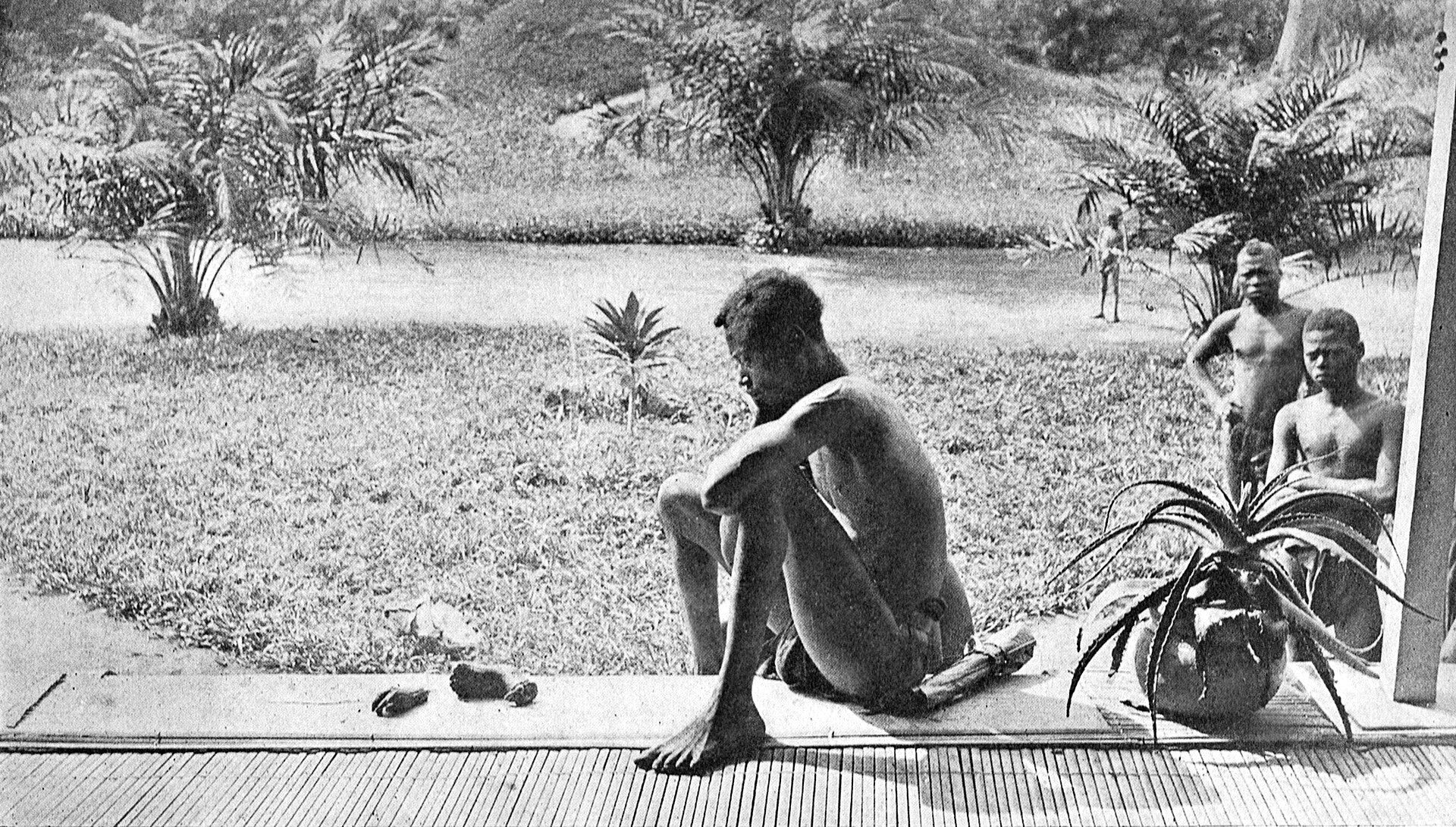
Casement and Morel founded the Congo Reform Association, which held its inaugural meeting on 23 March 1904. As a Foreign Office official, Casement could not formally join it.69 Belgium's Chamber of Deputies voted to annex Leopold's private colony on 20 August 1908, the Senate followed on 9 September, and the territory passed to the Belgian state on 15 November 1908.70 Estimates of the population lost in the rubber years run from 1.2 million to 10 million.6865
Brazil held what UNESCO calls "a near-total world monopoly" in latex between 1870 and 1912, and the money turned Manaus, "from a modest interior settlement to a cosmopolitan city."71 Its opera house, the Teatro Amazonas, had its foundation stone laid on 14 February 1884. Work stopped, resumed under Governor Eduardo Ribeiro in 1893, and the building opened on 31 December 1896.7172 Its dome is said to be covered in 36,000 ceramic pieces in the colours of the Brazilian flag, made in Alsace; walls and steelwork came from Glasgow, marble from Carrara.73 The first opera, by one record, was Ponchielli's La Gioconda, sung by an Italian touring company on 7 January 1897.74 In 2026 UNESCO inscribed the Teatro Amazonas on the World Heritage List together with the Theatro da Paz in Belém. In the same decision it recommended further research into what rubber had done to "Indigenous Peoples and migrants from the Nordeste."71
Between 1909 and 1913 a scandal grew around a British-owned rubber company operating on the Putumayo River. Hardenburg's articles appeared in the magazine Truth in 1909, followed by a book, The Putumayo, the Devil's Paradise, in 1912.7576 Casement made two journeys there, in 1910 and 1911. He reached La Chorrera, the company's headquarters on the Igaraparaná River, in September 1910.7577 His findings were published as a Blue Book on 13 July 1912. A figure that has circulated ever since, attributed to Casement and disputed, sets roughly 4,000 tons of rubber over a decade against some 30,000 Indigenous lives; other tallies go higher.76 In the House of Commons on 4 February 1913, the Foreign Secretary, Sir Edward Grey, was asked about punishment. "We have not heard that any have yet been punished," he said. Swift MacNeill supplied the figures: "157 warrants have been issued and only nine arrests made."78
10. Seventy Thousand Seeds
In the early hours of 14 June 1876, Henry Wickham delivered 70,000 seeds of the Pará rubber tree, Hevea brasiliensis, to Joseph Hooker, the director of Kew Gardens. Botanists had identified the Pará tree in 1869 as the best of the rubber-bearing species.53 Hooker's instruction had been: "Spare no expense to get living seeds." Wickham sailed with them from Santarém on the chartered steamer Amazonas. The India Office paid for the expedition, £1,505 4s 2d in all, and Kew paid £10 for every thousand seeds.7980 In the story later told, he assured Brazilian customs that his baskets held "exceedingly delicate botanical specimens specially designated for delivery to Her Britannic Majesty's own Royal Gardens." One account has it as smuggling; another holds that no law forbade the export and the legend grew later.8081
Counts of the seeds that germinated at Kew run from under 2,500 to 2,800, about 4 per cent.8079 In August 1876 nearly 2,000 seedlings went to Ceylon.53 From there the trees spread through Britain's Asian colonies, pushed hardest in Malaya by Henry "Rubber" Ridley, whose Times obituary noted that his "active life was cut short at the age of 101."79 By 1908 Malaya had ten million rubber trees. By 1910 plantation rubber from Asia had overtaken wild rubber from South America.7954 Between 1910 and 1915 Brazil's wild crop lost 80 per cent of its value, and by 1919 it had fallen to 8 per cent of world output.79 The rubber cycle that built Manaus "came to an abrupt end in the first decade of the twentieth century."71 Wickham was knighted in 1920.80
About 70 per cent of the four million acres of Eastern plantations were British. In 1921 the price fell as low as 14 cents a pound, and London appointed a committee under Sir James Stevenson. From 1 November 1922, growers in Ceylon, the Malay States and the Straits Settlements could export only 60 per cent of their "standard production" at the minimum duty. The Dutch planters in the East Indies "declined to co-operate".82 On 16 July 1925 rubber stood at $1.15 a pound, "about three times the normal price", according to a memorandum the Rubber Association of America left at the State Department the next day. The United States, it pointed out, accounted "for about three-fourths of the entire rubber consumption of the world", and "approximately 80 per cent of the rubber consumed in the United States goes into the manufacture of motor vehicle tires."82 The scheme was withdrawn on 1 November 1928.83
Squeezed by the scheme, Firestone looked towards a concession in Liberia, and chemists in the Soviet Union, Germany and the United States pursued synthetics in their laboratories between 1925 and 1932.8254 On 21 July 1927 Henry Ford received a free concession of a million hectares, some 2.5 million acres, on the Tapajós River in the Amazon, an estate it was reckoned could, under full cultivation, make tyres for two million cars a year. In August 1928 the steamer Lake Ormoc left for Brazil towing the barge Lake Farge, loaded with prefabricated buildings, a sawmill, a powerhouse and ice machinery. The village of Boa Vista was renamed Fordlândia.84
Ford paid 35 cents a day, against the 20 cents typical on plantations in the Far East. When workers learned they would be fed from a self-service line, they "grabbed their machetes and destroyed the cafeteria while the North American employees waited in their boats."84 In January 1931 the India Rubber Journal reassured its readers that "the Eastern planter need not worry from any competition from rubber produced by the Ford Company on the Amazon for at least another hundred years."84
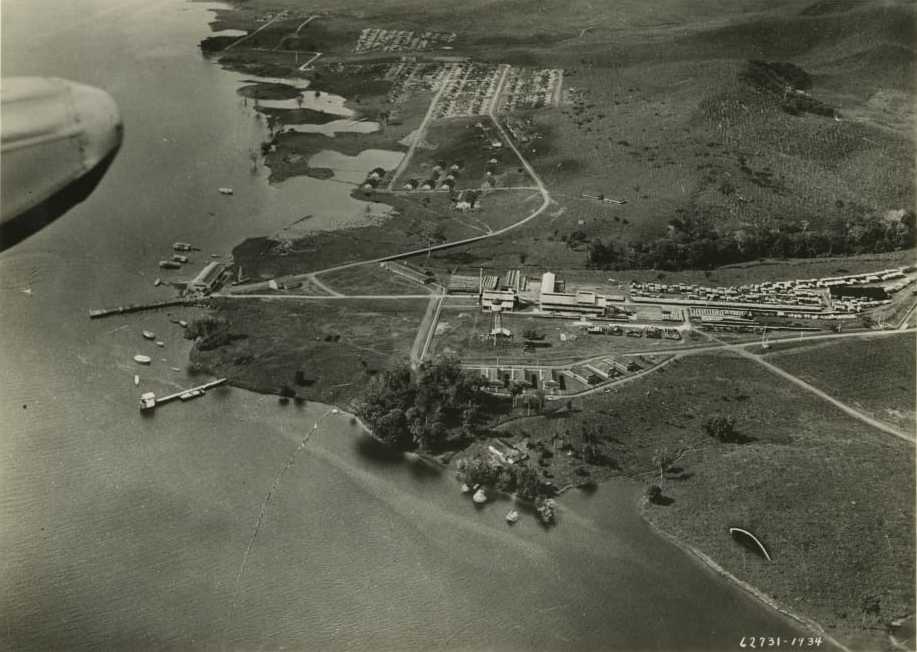
In the Amazon, Hevea's home, the trees lived alongside a leaf fungus, Microcyclus ulei, and a range of pests, from sauva ants to lace bugs. The blight had not followed Wickham's seeds to Asia. A plantation in Surinam, begun in 1911 with 40,000 trees, had been destroyed by 1918. Fordlândia's 3,200 hectares and 200,000 trees, planted from 1927, were gone by 1933.8584 Ford moved 80 miles downstream to Belterra, and the plant pathologist James Weir went to the Far East and brought back 2,046 buddings from high-yielding trees, Wickham's journey run in reverse. By 1941 Ford had planted 3,651,500 trees. Belterra's 6,478 hectares were destroyed in 1943.8485 The first commercial tapping, in 1942, produced 750 tons of latex. Ford needed 38,000 tons a year. After an investment of $20 million, the company sold the land to Brazil in 1945 for $250,000.84 An art deco water tower still rises above the trees, beside an empty turbine hall.79
Within the first three months of the Pacific war, by Washington's reckoning, the sources of 90 per cent of America's crude rubber were in Japanese hands.8687 America had formed a Rubber Reserve Company in June 1940, but in 1941 it produced just 231 tons of general-purpose synthetic rubber. A military aeroplane needed about half a ton of rubber, a tank about a ton, a battleship 75 tons.54 How much natural rubber was held in reserve is told two ways: one account says about a million tons; the Baruch committee counted 578,000 long tons on hand on 1 July 1942, against a normal consumption of some 600,000 tons a year.5488
Franklin Roosevelt appointed Bernard Baruch, Harvard's James Conant and MIT's Karl Compton on 6 August 1942. Their report, dated 10 September, warned: "We find the existing situation to be so dangerous that unless corrective measures are taken immediately this country will face both a military and a civilian collapse." "In rubber, the United States must be listed as a 'have not' Nation," it said. "Discomfort or defeat. There is no middle course."88 The committee proposed a national speed limit of 35 miles an hour, which would make tyres last about 40 per cent longer, cutting the average car's driving from 6,700 to 5,000 miles a year, and nationwide gasoline rationing. The rubber already on the roads, in the tyres of American cars, it put at 1,000,000 tons.88 It also recommended a rubber director, and William M. Jeffers, president of the Union Pacific railroad, took the job, with 51 plants to build.54
On 26 March 1942 the companies agreed a "mutual recipe" for GR-S: 75 per cent butadiene, 25 per cent styrene, with more than 200 patents shared among them. Firestone made the first bale on 26 April 1942; Goodyear followed on 18 May, US Rubber on 4 September, Goodrich on 27 November. Output went from 2,241 tons in 1942 to about 920,000 tons a year by 1945, 85 per cent of it GR-S.54 In 1955 the government plants were sold to private owners.54
In 1998 the American Chemical Society could write that 70 per cent of the rubber used in manufacturing was synthetic.54 In 2025 the world used 32.49 million tonnes of rubber, 15.73 million of them natural: about 48 per cent. Natural rubber production fell 488,000 tonnes short of demand, and the market is expected to "remain structurally tight."89 A wartime government pamphlet reported synthetic truck tyres, which build up more heat under heavy loads, running 15 to 16 degrees Fahrenheit hotter than natural ones, and blowing out.90 Today "commercial and military aircraft tire treads and heavy-duty truck and bus tread are made almost completely from natural rubber because of unique properties that synthetic rubber does not offer."91
More than 80 per cent of natural rubber comes from smallholders and family farms, millions of them; Thailand produces 34 per cent, Indonesia 14, Côte d'Ivoire 12. About 70 per cent goes into tyres. A new tree gives nothing for its first five to seven years, breeding a new variety takes around 24, and Hevea has "never been grown" where the mean temperature is above 28°C.92 The leaf blight that ended Fordlândia is still confined to South and Central America, and by one estimate still holds the region to about 2.7 per cent of world output.9394 Singapore lists it as a quarantine pest.95 An FAO report warned that its potential to reach other regions "rises with every transcontinental airline connection that directly links tropical regions."93 "The possible emergence of new diseases, including leaf fungi, is a real threat," the French agricultural research centre CIRAD wrote in 2025.92
Under the European Union's deforestation regulation, rubber and many products made from it cannot be sold in the EU without proof that they were not grown on land cleared after 31 December 2020. After two postponements, as of early November 2026 the rules apply to large and medium operators from 30 December 2026 and to small ones from 30 June 2027. In September 2026 a delegated act took retreaded tyres and some vulcanised-rubber articles out of scope.969798 On the smallholdings, meanwhile, the trees are tapped more than a hundred times a year, for about 15 kilograms a hectare each time.92
11. The Ice That Never Melts
In 1857 the harbour at New Bedford, Massachusetts, was the busiest whaling port on earth. Of the 593 whaling vessels registered in the United States that year, 329 belonged to New Bedford.99 Their holds came home full of two kinds of oil. Ordinary whale oil, boiled from blubber, lit kitchens and greased wheels. Sperm oil, and the waxy spermaceti drawn from the great organ in a sperm whale's head, was the luxury grade: it made what were then the longest-lasting, brightest-burning candles in the world, and the best lubricant for the spindles and shafts of the new factory machinery.100 New England had been refining spermaceti at candleworks since about 1750, and ever since a Nantucket captain named Hussey ran across sperm whales in 1712, Yankee ships had gone farther and farther out to sea for them. In 1823 New Bedford overtook Nantucket as the leading port.99
In the Whalemen's Shipping List, sperm oil sold for 53 cents a gallon in 1844 and peaked at $1.81 in 1855. Whale oil rose from 30 cents in 1841 to 79 cents in 1856.100 Then prices turned, and they turned before anyone had drilled for petroleum. By 1858 sperm oil had fallen to $1.20. Whale oil prices dropped by 65 per cent between 1856 and 1861. The fleet had grown too large, and the financial Panic of 1857 left barrels of unsold oil "stowed in sheds and along the river front, waiting for a satisfactory market that never came."100 Of 68 whalers that came back to New Bedford and Fairhaven during the panic, one count has 48 losing money on the voyage.101
In the 1840s a Nova Scotian physician and geologist, Abraham Gesner, began heating Trinidad pitch and coal and distilling off a light oil that burned in an Argand lamp more effectively than sperm oil did. He gave the first public demonstration in Charlottetown, Prince Edward Island, in 1846; Gesner later said it was August, but the lecture was probably on 19 June. Around 1850 he coined a name for his fluid from the Greek keros, wax, and elaion, oil: kerosene. He moved to New York in 1853, and on 27 June 1854 received three US patents, numbers 11,203 to 11,205, for an "Improvement in kerosene burning fluids".102
On 27 August 1859, near Titusville, Pennsylvania, a well drilled for the Seneca Oil Company by Edwin Drake struck oil at 69½ feet. The company's purpose was to supply crude for refining into kerosene.103 Once the refineries switched their feedstock from coal and shale to petroleum, the cost of kerosene fell to about a quarter of what it had been. Gesner himself made little from it.102 In 1860 a gallon of sperm oil cost $1.40; a gallon of kerosene, 75 cents.99
The Civil War cut supply so sharply that sperm oil climbed from $1.36 a gallon in 1859 to $2.55 in 1866.100 Confederate raiders burned 46 Yankee whalers between 1861 and 1865, and in 1861 the Union bought up old whaling ships, loaded them with stone and sank them as a "Stone Fleet" to block the harbours of Savannah and Charleston.99
In September 1871 a fleet of whalers working off Point Belcher, near present-day Wainwright on the north-west coast of Alaska, was caught by the pack ice as it closed toward the shore. Sources differ on whether 32 or 33 ships were lost; Harper's Weekly reported on 2 December 1871 that "thirty-three have been crushed in the ice."104105 Not one person died. All 1,219 men, women and children aboard took to the whaleboats and rowed some ninety miles south, past Icy Cape, to seven ships waiting in open water. Twenty-two of the abandoned vessels were from New Bedford, and the loss was put at about $1.6 million. Few of the ships were replaced. Most of the insurance money, it was reported, went into other industries.104
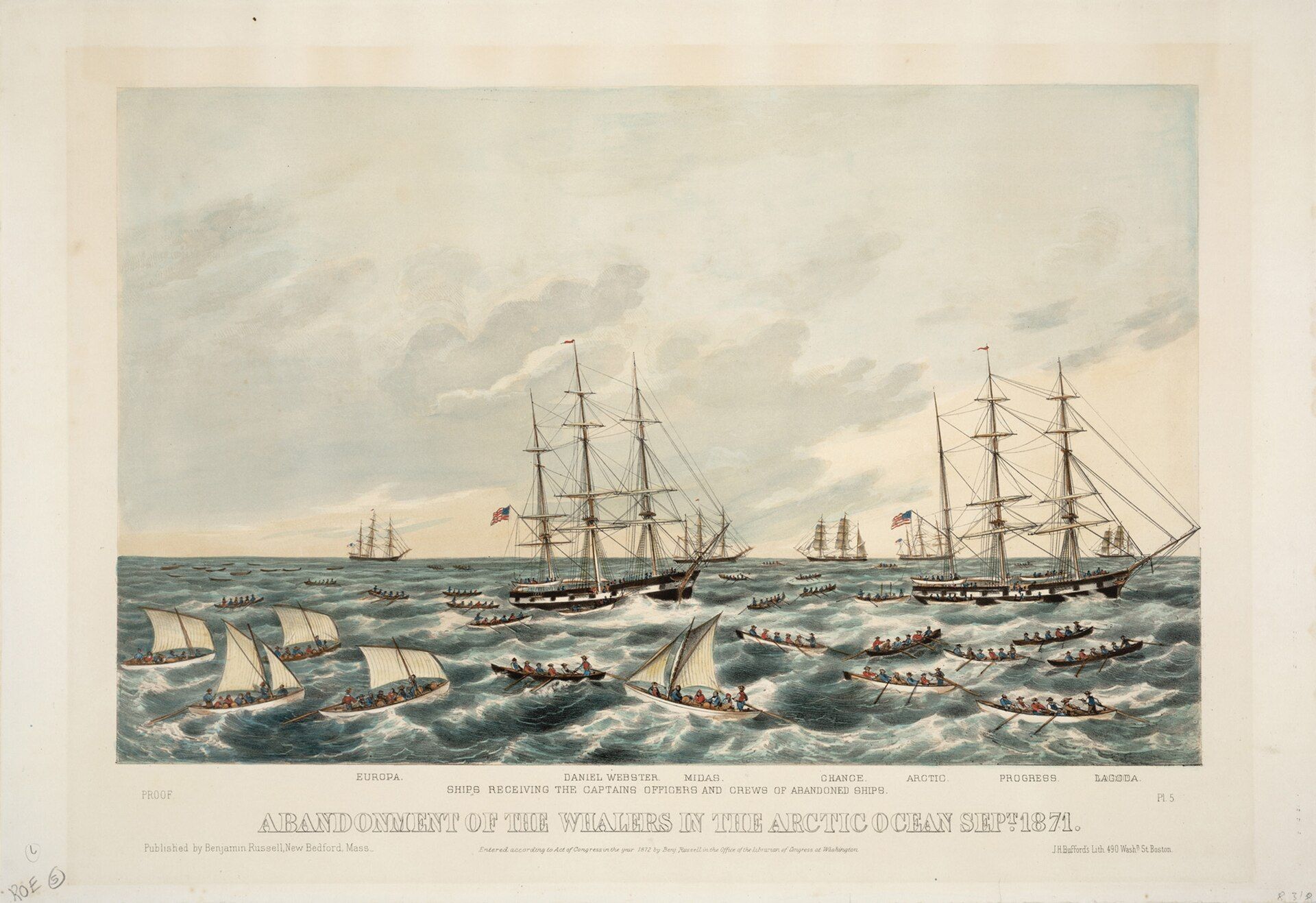
In 1874 the whaling captain Charles Scammon warned that whales could be hunted to extinction. By 1880 San Francisco, not New Bedford, was the leading US whaling port. In 1906 cheap spring steel destroyed what remained of the market for baleen, the flexible "whalebone" of corsets and buggy whips. The last whaling voyage out of New Bedford, by the schooner John R. Manta, sailed in 1927.99
Between about 1860 and 1870 a Norwegian, Svend Foyn, brought together steam-powered chaser boats and a heavy harpoon gun that fired an explosive head, devised around 1865.99106 The Yankee ships had hunted sperm and right whales because those were slow enough to catch from a rowing boat and floated when dead. Foyn's gun opened the fast rorquals, the blue and fin whales, to industry. Then, in 1905, chemists found that baleen-whale oil could be hydrogenated: hardened into a solid fat that could go into soap and, eventually, food. In the First World War whale oil became the prime source of glycerine for explosives. By 1929 a satisfactory, tasteless margarine made from whale oil was on the market.106
In the 1927/28 Antarctic season, 17 floating factory ships and 61 catcher boats produced about a million barrels of oil from roughly 14,000 whales. Three seasons later, in 1930/31, 41 factory ships and 200 catchers produced 3.6 million barrels from more than 40,000 whales; the Antarctic supplied more than 90 per cent of the world's catch, and more than 80 per cent of that came from blue whales.106 Lever Brothers, the soap company, ran its own whaling operations, and the capital needed for Antarctic whaling was one of the reasons it merged in 1929 with the Dutch Margarine Union to form Unilever.106 One estimate puts the industrial catch of the twentieth century at about 2.9 million large whales, far more than the Yankee fleets ever took, before a commercial moratorium took effect in the 1985–86 season.107
On the south-west coast of Greenland, at a fjord the Danes spelled Ivigtut and Greenlanders call Ivittuut, there was a white mineral that looked like ice and did not melt. Its chemical name is sodium hexafluoroaluminate. Its common name, cryolite, comes from the Greek cryos, frost, and lithos, stone. Samples were shown in Copenhagen in 1795, and a Danish physician, P. C. Abildgaard, described it in 1799.108
Long before, the Inuit had called it "seal blubber stone" and used the soft, water-worn lumps as sinkers on their fishing lines. Karl Ludwig Giesecke, the mineralogist who travelled in Greenland from 1806 to 1811, was candid about it: "We owe the first discovery of cryolite to the Greenlanders, who, in finding it to be a soft substance, employed the waterworn rounded fragments as weights on their anglings… I only found its geological situation, and I dare say by a mere accident." His first shipment, in 1807, was seized by the British in the war that followed the bombardment of Copenhagen, carried to Edinburgh as spoils, and left unexamined until 1822.108
In 1853 the Danish chemist Julius Thomsen patented a process for making soda, sodium carbonate, from cryolite. In 1856 about a hundred tonnes went out by skin boat to sailing ships waiting offshore, and full production began in 1857.108 Then, in 1886, Charles Martin Hall in Ohio and Paul Héroult in France, working independently, found that aluminium could be produced by electrolysis if alumina was dissolved in molten cryolite. Commercial Hall–Héroult production began in 1889.108 From 1887 until the mine closed a century later, Greenland's cryolite went chiefly to aluminium, as a flux.109
The ore body at Ivittuut was roughly 300 metres across. Accounts of how much it held run from about 3.5 million to about four million tonnes; all of it is gone.108109 It was the world's only reliable natural supply.110 The main pre-war buyer was the Pennsylvania Salt Manufacturing Company of Philadelphia. The mine was run as a colonial enclave. Its workers were mostly foreigners, Greenlanders were kept away from the site, the concession was exempt from customs and excise, and the settlement did not appear in Greenland's census.108
On 9 April 1940 Germany occupied Denmark. One Danish ship happened to be out of port, the S/S Julius Thomsen, named for the chemist of the soda patent, and it kept the cryolite moving.108 On 3 May the Danish ambassador in Washington, Henrik de Kauffmann, asked the United States for help. On 10 May the Coast Guard cutter Comanche left New England for Ivittuut; four other cutters followed, one carrying guns for the mine's defenders. Because the United States was still neutral, Roosevelt used a fiction: by the end of that summer, fifteen Coast Guard sailors had resigned from their ships and were living near the mine as "volunteers".110108
On 16 May 1940 Roosevelt went before Congress to ask for 50,000 aircraft a year, from an industry that had built 1,800 in 1938. "From the fiords of Greenland," he said, "it is four hours by air to Newfoundland … and only six hours to New England."110 Aluminium made up 60 per cent of a heavy bomber's engines, 90 per cent of its wings and fuselage, and all of its propellers.110 On 9 April 1941, a year to the day after the invasion, Kauffmann and Secretary of State Cordell Hull signed the Agreement Relating to the Defense of Greenland "on behalf of the King of Denmark", without authority from occupied Copenhagen. The Americans built an airbase, Bluie West One, at Narsarsuaq.110 By mid-1942 an Army camp behind Ivittuut held about 500 men; another 300 sat across the fjord. Some 500 American soldiers were guarding between 100 and 200 miners.108111
That year the mine shipped 86,000 tonnes to the United States and Canada, its wartime peak.111 No photographs were allowed and no letters went home. In 1943 the troopship Dorchester was torpedoed by a U-boat on its way to Ivittuut; there is a memorial at the site.111
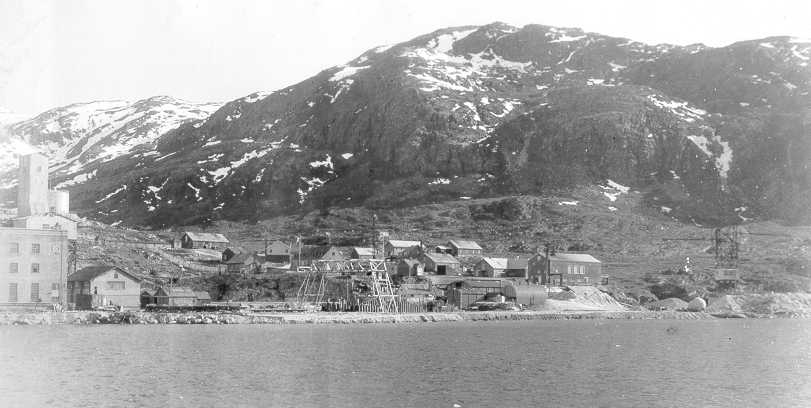
German chemical industry already had a substitute for natural cryolite, made from fluorspar. The Americans, guarding the pit with soldiers, simply preferred the real thing.110
The Americans handed back Ivittuut and the base in 1951. The ore was mined out in 1962 and the pit flooded; for years afterwards the company worked tailings and stockpiles, and in 1982 it drained the pit to collect the last of the cryolite. In 1985 it shipped 110,000 tonnes.111 The mine closed for good in 1987, and the company that ran it was dissolved.108 The world's aluminium smelters now use synthetic cryolite made from fluorspar.108
12. The Barrels on Staten Island
Before the Second World War, the ore at Shinkolobwe, in the Katanga province of the Belgian Congo, was valued for its radium. Marie and Pierre Curie had isolated the element in 1898, and it was soon being used to treat cancer and to paint the glowing numerals on watch dials. On the Colorado Plateau it took about 500 tonnes of carnotite ore to produce a single gram, and from the 1910s into the early 1920s radium sold retail for more than $100,000 a gram, while the uranium in the ore was treated as a leftover.112
In the mid-1920s Shinkolobwe's pitchblende, averaging more than 2 per cent uranium, proved rich enough that Union Minière du Haut-Katanga could cut the price of radium to $60,000 a gram and drive the American producers out of business. In 1937 the company shut the mine. It had stockpiled enough radium and uranium for about thirty years of expected demand.112
In 1938 the only commercial use for uranium was as a colouring agent in ceramics, the source of yellow and orange glazes. The United States consumed 168 tonnes of uranium oxides and salts that year: 26 tonnes from the Colorado Plateau, 106 from the Belgian Congo, 36 from Canada.113
Edgar Sengier, a Belgian mining engineer, ran Union Minière. In London, British scientists warned him what could happen if Shinkolobwe's ore reached Germany; the British and the French had both offered to buy it. In late 1940 Sengier shipped about half the mine's stockpile, roughly 1,200 tonnes of concentrate at 65 per cent uranium oxide, to the United States.114112 The ore travelled in 2,007 steel drums by way of the port of Lobito in Angola.115 The barrels, stamped "Uranium Ore — Product of Belgian Congo", went into a three-storey warehouse on Staten Island, near the Bayonne Bridge, and sat there untouched for more than two years.114
In March 1942 Sengier offered the ore to the State Department; officials showed little immediate interest. After Pearl Harbor the department asked him about cobalt. His mention of uranium went unheeded.113114
In August 1942 Vannevar Bush, who directed the government's wartime science office, learned that Eldorado, the Canadian mining company, was trying to buy 500 tonnes of the Staten Island ore, and he alerted the Army. In early September Colonel Kenneth D. Nichols was put in charge of ore procurement for what became the Manhattan Project. He met Sengier on 18 September 1942, and they quickly reached an agreement.113 As the meeting was later retold, Nichols opened with "I understand you have some uranium, Mr. Sengier," insisted that he had "more authority, I'm sure, than you have uranium to sell!", and Sengier answered: "Good, then let's make a deal, Colonel."116 By the end of 1942 the Army had bought the 1,200 tonnes on Staten Island and about 3,000 tonnes more that lay above ground in the Congo.113
About two-thirds of the uranium ore used by the Manhattan Project came from the Congo. Eldorado's mine in Canada supplied about a sixth; the Colorado Plateau, about a seventh. The Congo ore crossed the Atlantic in sixteen-knot ships through U-boat waters, and all but two cargoes got through.112114
In August 1943 General Leslie Groves told Roosevelt that North American supplies would soon be close to exhausted, and that the United States would have "no control whatever over the major world supply in the Belgian Congo". In June 1944 Roosevelt and Churchill signed an Agreement and Declaration of Trust creating the Combined Development Trust, with Groves as chairman, to control the world's uranium and thorium. In September 1944 the Belgians agreed to reopen Shinkolobwe and supply 1,720 tonnes of uranium oxide, with a ten-year right of first refusal on Congo uranium and thorium.113
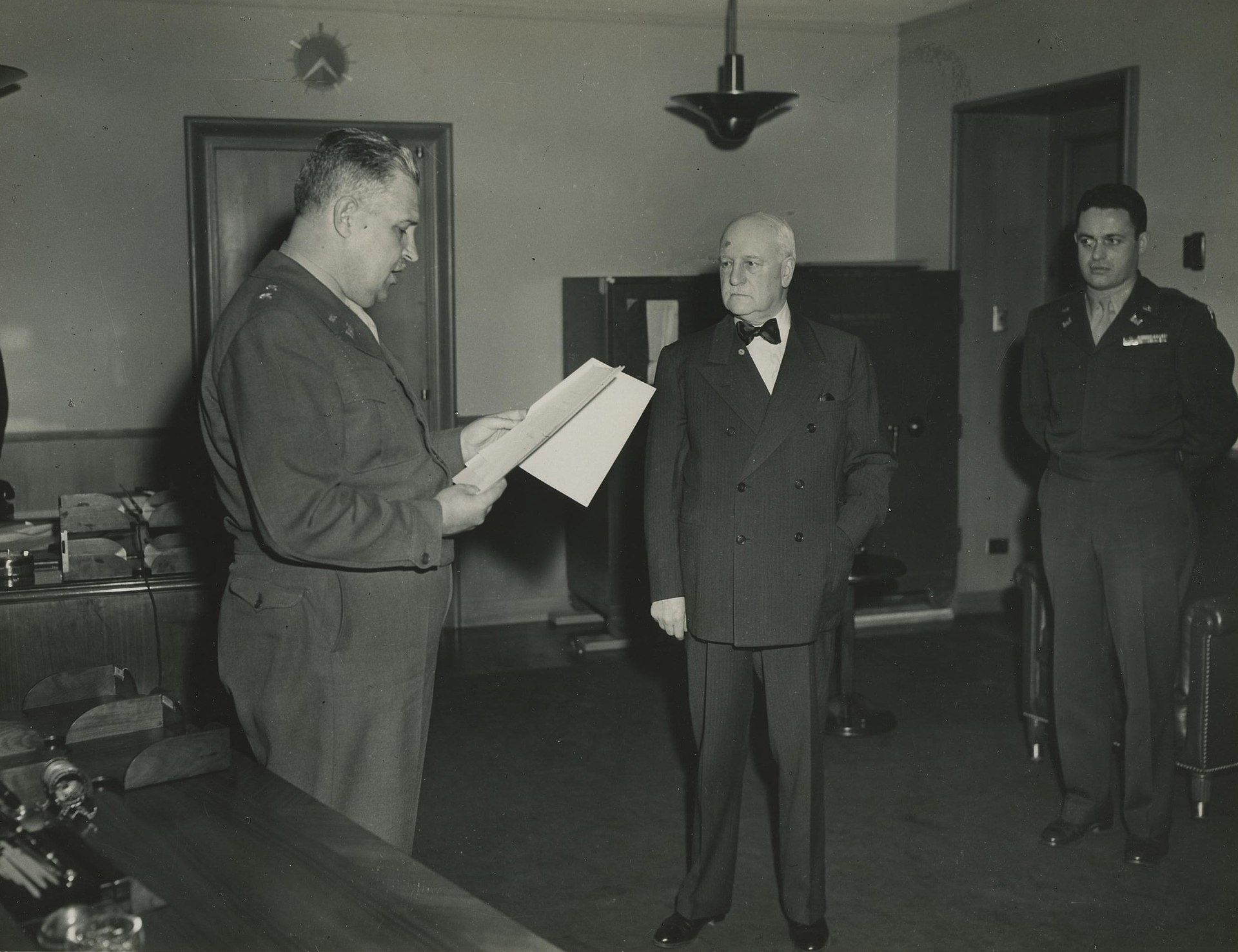
After the war the Atomic Energy Commission, created in 1947, advertised a $10,000 bonus for new discoveries, and in April 1948 guaranteed a minimum price: $3.50 a pound for uranium oxide found outside the Colorado Plateau. In 1949 the AEC and the Geological Survey published a booklet called Prospecting for Uranium. A 1957 manual described the people who answered: "Oil workers, farmers, clerks, mechanics, retired men, and even housewives." Radiac, a maker of Geiger counters, reported a 500 per cent jump in sales in 1954.117 The cost fell on the miners, many of them Navajo, whose exposure to radiation underground went on for years; federal mine-safety standards were not fully in force until 1971.117 The incentive period ended in 1956, and government purchasing ran to the end of 1970.117
The uranium price was high in the late 1970s, then for most of the 1980s and 1990s the spot price sat below what it cost most mines to produce it. It rose from $10.90 a pound in May 2003 to about $136 in June 2007; at the end of that month it slipped for the first time in fifty-one months.118119 In January 2024 the spot price passed $100 again for the first time since 2007, and at the end of August 2026 the long-term contract price stood at $96.50, above its 2007–08 peak.119
In 2024 the world's mines produced 60,213 tonnes of uranium, about 90 per cent of what utilities needed. Kazakhstan alone produced 39 per cent, Canada 24 per cent, Namibia 12.119120 In Niger, a military coup deposed President Mohamed Bazoum in July 2023. In December 2024 the French company Orano said it had lost control of its Nigerien subsidiaries, and on 19 June 2025 the government announced its intention to take over SOMAÏR, the mining venture Orano and the Nigerien state had owned together since 1968. Orano condemned "a systematic campaign to dispossess" it and went to international arbitration.121
13. A Rechargeable World
In 1980 John Goodenough showed that a cathode of cobalt oxide holding lithium ions between its layers could produce as much as four volts. The work went back to the oil crisis of the 1970s, when Stanley Whittingham built a battery with a titanium disulphide cathode and a lithium-metal anode that gave just over two volts and was too explosive to be viable. In 1985 Akira Yoshino, at Asahi Kasei in Japan, replaced the metallic lithium with petroleum coke and produced the first commercially viable lithium-ion battery. The three men shared the Nobel Prize in Chemistry in 2019, under the headline "They created a rechargeable world."122
Sony's battery business had been a joint venture with Union Carbide, Sony-Eveready, set up in 1975. In January 1986 a telegram from Union Carbide announced that the American company was selling its consumer businesses, to cover its liabilities after an explosion at one of its plants in India, the gas leak at Bhopal. Sony re-founded the battery business in March 1986 as Sony Energytec under Keizaburo Tozawa, later called the "godfather" of the lithium-ion battery. The project was formally launched in July 1987 with six research tracks running in parallel. The design that won used a lithium cobalt oxide cathode and a carbon anode, survived more than a thousand charge cycles and delivered about three times the energy density and voltage of a nickel-cadmium cell. A plant at Koriyama, in Fukushima prefecture, was tooled by 1988 for 100,000 units a month. Sony announced the battery in February 1990, began mass production in 1991, and put it into the CCD-TR1, an 8mm camcorder.123 One account holds that Sony's chemistry was essentially the same as Yoshino's at Asahi; Sony's own history credits its own team.124
Three decades later batteries take 87 per cent of the world's lithium. Ceramics and glass, which once took most of it, take 5 per cent.125 The price of battery-grade lithium carbonate, as an annual average, was $10,100 a tonne in 2020, $14,200 in 2021, $71,100 in 2022, $41,300 in 2023, and $14,000 in 2024.125 Lithium prices rose eightfold over 2021–22 and then fell by more than 80 per cent from 2023.126 Projects were postponed or cancelled. In Utah, a plant that recovered lithium from magnesium tailings was idled.125
On China's Guangzhou Futures Exchange, the main lithium carbonate contract peaked at 209,880 yuan a tonne on 13 May 2026. On 29 October it closed at 88,360, down 8.4 per cent in a day and nearly 58 per cent from the peak. The trigger was an environmental approval notice, published on 22 October, for restarting a large lepidolite mine in Yichun, Jiangxi, linked to the battery maker CATL. "The futures market is trading the 2027 balance sheet," one analyst told a Chinese financial site, "not October's production schedule."127
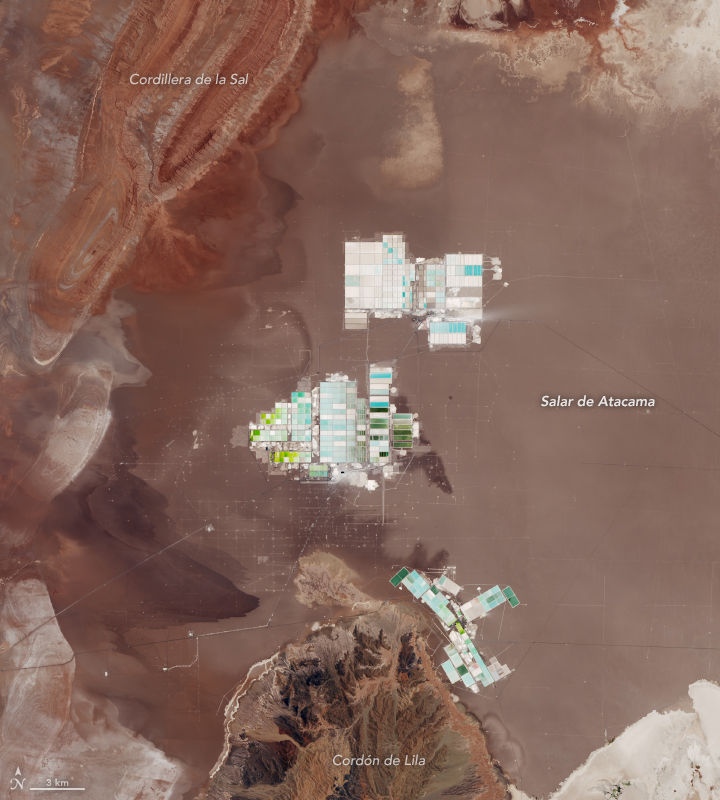
From the air, the Salar de Atacama in northern Chile looks like a paintbox: rectangles of blue, turquoise and yellow laid on a white crust, in the same Antofagasta region where the nitrate oficinas once stood. Two companies, SQM and Albemarle, pump brine from beneath the salt and leave it in the ponds to evaporate. About 90 per cent of the water in the brine is lost to the air.128 By one count they draw more than 63 billion litres of brine a year from 308 wells.129 Chilean law classifies brine as a mineral, not water, so it falls outside the country's Water Code. Groundwater levels at the salar fell 15 per cent between 2010 and 2019, faster than recharge; in places the salar is sinking by one to two centimetres a year, though a direct causal link to lithium mining has not been established. Two of the salar's three flamingo species have been harmed. The Lickanantay, or Atacameño, people, more than 30,000 of them, live around it.128 One hydrogeological study finds the extra evaporation from mining is no more than 4 per cent of the basin's total and the drawdown mostly outside the critical wetlands; another account blames drought rather than mining for the drying.130 SQM cut its brine extraction by 25 per cent in 2023 and says it will halve it by 2030.128
Chilean lithium has belonged to the state since 1979, and cannot be granted as a concession.128 On 27 December 2025 the state copper company Codelco and SQM formed NovaAndino Litio, a joint venture with majority state participation to run the Salar de Atacama until 2060; SQM manages it until 2030, Codelco from 2031. Codelco's chairman, Máximo Pacheco, called it "a new form of public-private collaboration: transparent, professional, and long-term."131
In 2024 the Democratic Republic of the Congo produced an estimated 220,000 of the world's 290,000 tonnes of cobalt, 76 per cent.132 On 19 January 2016 Amnesty International and the Congolese group Afrewatch published a report called This is what we die for. It traced cobalt from artisanal mines where children as young as seven worked, through a subsidiary of the Chinese company Huayou Cobalt, to battery-component makers whose customers included Apple, Microsoft, Samsung, Sony, Daimler and Volkswagen. At least 80 artisanal miners had died underground in southern Congo between September 2014 and December 2015. Children worked up to twelve hours a day for one or two dollars. UNICEF had estimated in 2014 that some 40,000 children worked in mines across the south of the country.133 A fourteen-year-old orphan the researchers called Paul described his shifts: "I would spend 24 hours down in the tunnels. I arrived in the morning and would leave the following morning."133
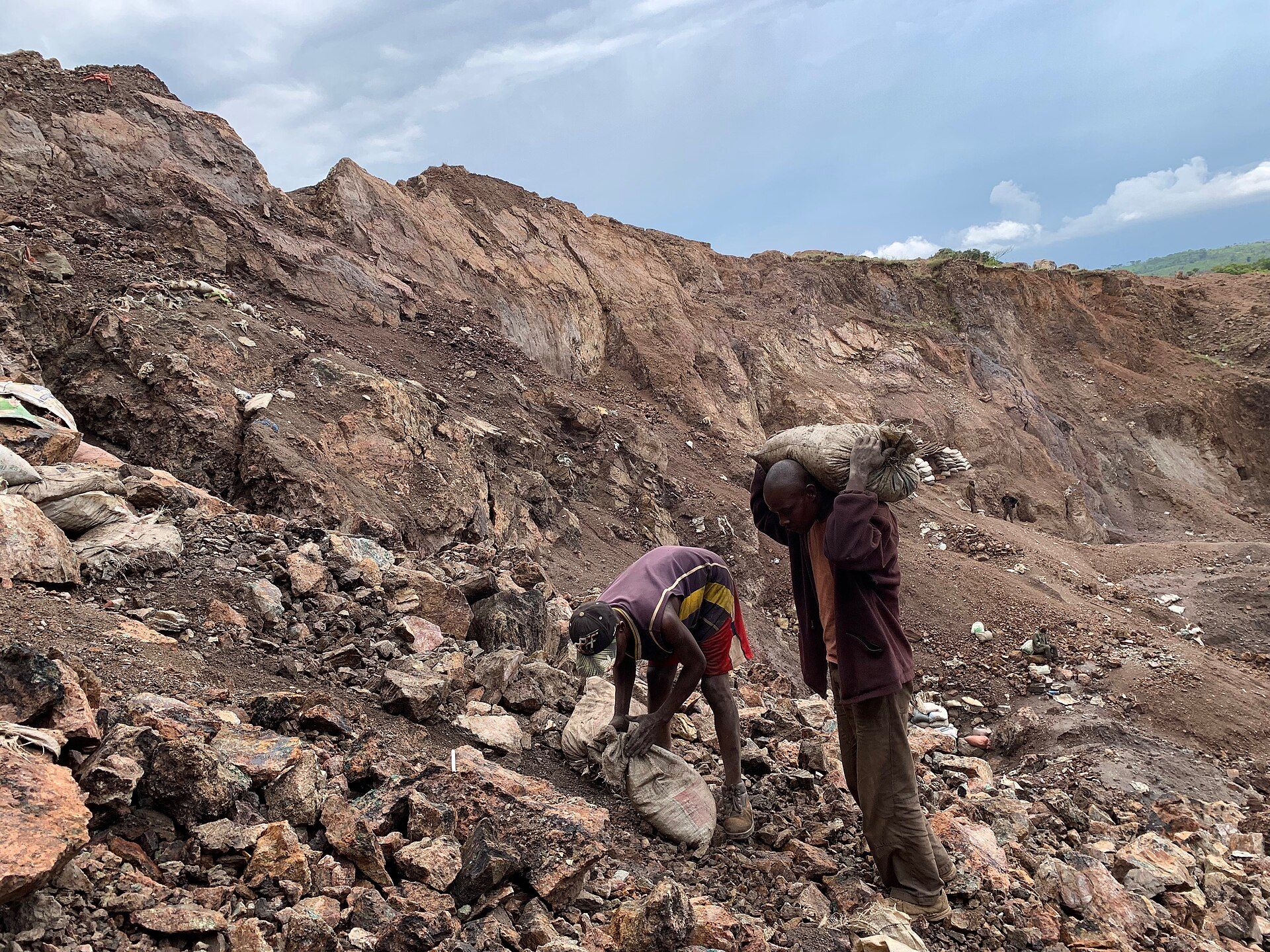
The London Metal Exchange cobalt price averaged $28.83 a pound in 2022 and $12 in 2024, and a cobalt-copper-gold mine in Idaho was suspended because of low prices.132 On 22 February 2025 the Congolese regulator, ARECOMS, suspended all cobalt exports, industrial and artisanal alike, citing "the high level of stock on the market". The suspension was extended twice, to 15 October.134 On 16 October 2025 it was replaced by quotas: 96,600 tonnes for all of 2026, including a strategic reserve the regulator can allocate at its discretion, less than half of what the country had mined in 2024.135132
Of twenty energy minerals the International Energy Agency analysed, China was the leading refiner of nineteen, with an average share of about 70 per cent. The average share of the top three refining countries rose from about 82 per cent in 2020 to 86 per cent in 2024.126
In September 2010, during a dispute over Japan's detention of a Chinese trawler captain near the Senkaku Islands, Chinese customs were reported to have stopped rare-earth shipments to Japan; China's Commerce Ministry denied any ban.136 One account holds that an embargo took place; another points out that Japanese port data showed no uniform drop in imports, that Beijing had announced a 40 per cent cut in global export quotas two months before the collision, and that it was this cut that made world prices quadruple. Cerium oxide went from $4.70 a kilogram in April 2010 to $36 in October. Premier Wen Jiabao said on 7 October 2010: "China does not and will not use rare earths as a bargaining tool."137 The United States, the European Union and Japan took China to the World Trade Organization. In 2014 a panel found that China's export quotas were "designed to achieve industrial policy goals rather than conservation", and the Appellate Body upheld the ruling; China removed the duties and quotas in 2015.138
Molycorp, owner of the Mountain Pass mine in California's Mojave Desert, built a $1.25 billion processing plant on the bet that prices would stay high.139 Instead China relaxed its restrictions, designers found ways around rare earths, and on 25 June 2015 Molycorp, "the only U.S. producer of rare earth elements", filed for bankruptcy to restructure $1.7 billion of debt. Its shares were worth 36 cents.140 At an auction on 15 June 2017 the mine sold for $20.5 million, to a group with a Chinese rare-earth company holding a non-voting minority stake.139
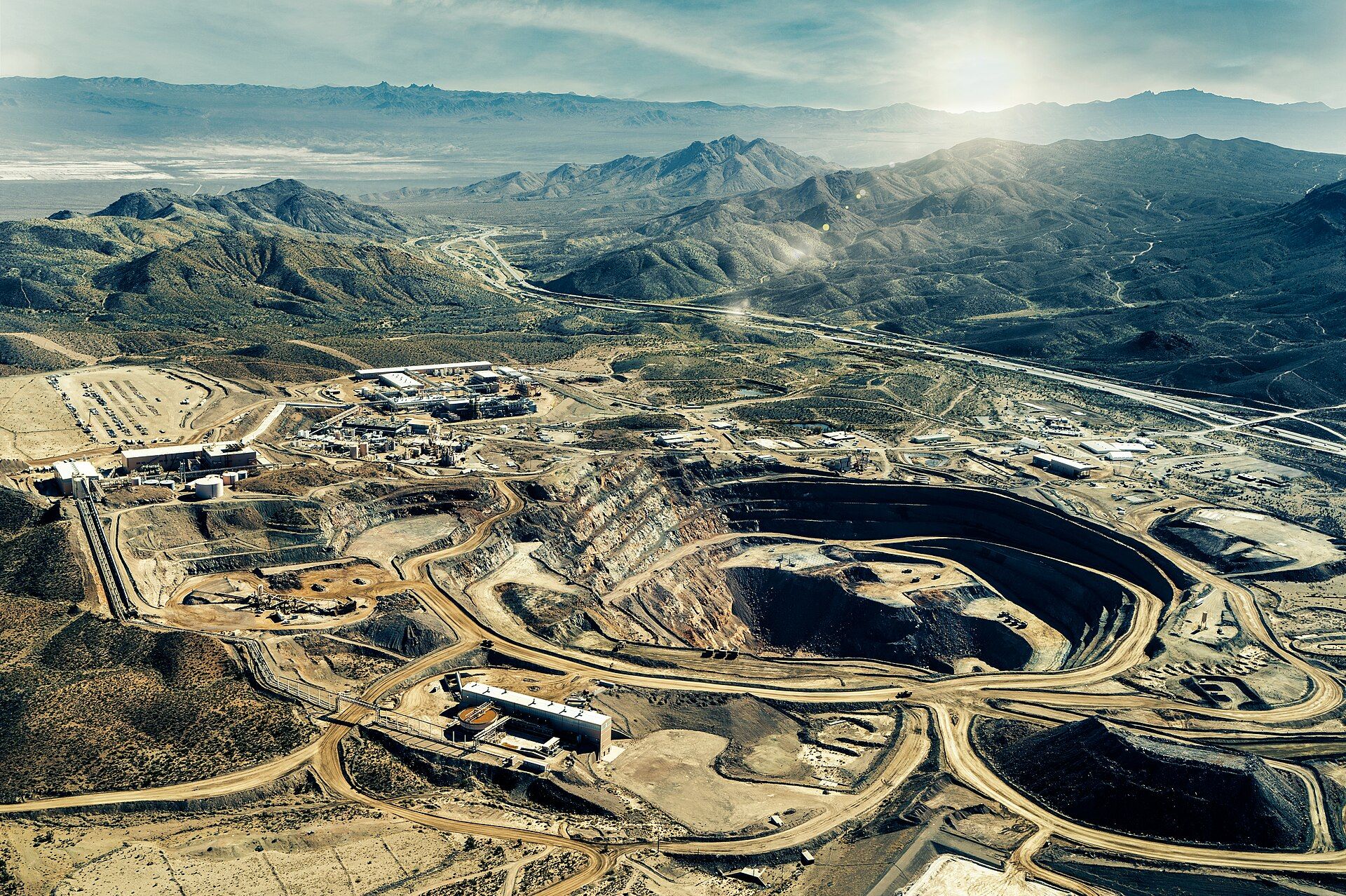
On 4 April 2025 China's Commerce Ministry and customs administration required export licences for seven medium and heavy rare earths, among them dysprosium and terbium, and for magnets containing them.141 Shipments stopped. In late May, Ford paused production of the Explorer at its Chicago Assembly Plant for about a week after a supplier ran out of rare-earth magnets, the small, strong magnets in braking and steering systems, power seats and fuel injectors.142 On 10 July 2025 the Department of Defense agreed to become the largest shareholder in MP Materials, the company that now owned Mountain Pass, and guaranteed it a floor price of $110 a kilogram for its neodymium-praseodymium for ten years. "This initiative marks a decisive action by the Trump administration to accelerate American supply chain independence," said James Litinsky, the chief executive.143 The floor was nearly twice the Chinese market price.144
On 9 October 2025 China extended its controls to five more rare earths, refining technology, and foreign products made with Chinese material.145 After Donald Trump and Xi Jinping met in Busan on 30 October, Beijing suspended the October measures until 10 November 2026.146 The April licensing on dysprosium and terbium was never part of the pause. At the time of writing, in early November 2026, the two governments have said they will extend the truce to 10 January 2027, but no legal text extending China's suspension beyond 10 November has been published.147
In December 2022 Zimbabwe banned exports of unprocessed lithium ore.148 On 25 February 2026 it suspended exports of all raw minerals and lithium concentrates "with immediate effect until further notice", including cargoes already in transit. In 2025 the country had exported 1.128 million tonnes of spodumene concentrate, most of it to China.149
Under the European Union's Battery Regulation, from 18 August 2031 new industrial and electric-vehicle batteries must contain at least 16 per cent recycled cobalt, 6 per cent lithium and 6 per cent nickel; from 2036, 26, 12 and 15 per cent.150151 The IEA estimates that scaling up recycling could cut the need for new mining by 25 to 40 per cent by 2050.152 But in 2023 China held 80 per cent of the world's battery pretreatment and material-recovery capacity, and global capacity in 2030 could be seven times the available feedstock.152 On 14 May 2025 Li-Cycle, a Toronto battery recycler founded in 2016, went into creditor protection; its largest secured creditor, Glencore, bid for its plants and completed the purchase in August.153154
Lithium iron phosphate batteries, which use no cobalt or nickel, now hold nearly half the electric-car market, up from less than 10 per cent in 2020; they bring their own chokepoints, since China produces 75 per cent of the purified phosphoric acid they need.126 On 5 February 2026, in Yakeshi, Inner Mongolia, where winter nights fall far below freezing, Changan and CATL unveiled what they called the world's first mass-production passenger car with sodium-ion batteries. The cells keep more than 90 per cent of their capacity at −40 °C. CATL had begun sodium-ion research in 2016 and spent nearly 10 billion yuan on it. "The arrival of sodium-ion technology," said Gao Huan, CATL's chief technology officer, "marks the beginning of a dual-chemistry era."155
14. The Smelter's Heirs
On 23 September 1940, at Vancouver, Washington, across the Columbia River from Portland, Alcoa poured the first aluminium ever made in the American West. The power came from the new federal dams on the Columbia.156 The Bonneville Power Administration's administrator, Paul Raver, had signed the contract in December 1939. His predecessor, J. D. Ross, had opposed selling power to smelters, because they used large amounts of electricity but did not employ large numbers of people. At its peak the Northwest aluminium industry had ten smelters, about 11,000 jobs and 40 per cent of American smelting capacity, drawing 3,150 average megawatts. Then BPA rates rose by about 250 per cent between 1979 and 1983, and during the West Coast energy crisis of 2000–01 every one of the ten smelters shut or curtailed. Alcoa idled the last two in 2016.157
An AI-focused data centre can draw as much electricity as an aluminium smelter, the International Energy Agency says, but data centres are far more concentrated geographically, and an AI data centre is ten times more capital-intensive than a smelter.158 In 2024 data centres used about 415 terawatt-hours, around 1.5 per cent of the world's electricity; the United States accounted for 45 per cent of that. By 2030 the figure is expected to more than double, to around 945 terawatt-hours, slightly more than all of Japan uses today. By then, American data centres are set to consume more electricity than the country's production of aluminium, steel, cement, chemicals and every other energy-intensive good combined.158
In Ireland, data centres used 5 per cent of the country's metered electricity in 2015, 21 per cent in 2023 and 22 per cent in 2024, more than all the homes in Irish towns and cities, which used 18 per cent.159 Just before Christmas 2021 the grid operator, EirGrid, began telling operators that it would not connect new data centres in the Dublin area until at least 2028, in effect a regional ban; Dublin then held 65 of Ireland's 70 operating data centres.160 In December 2025 the energy regulator lifted the moratorium on condition that new data centres also generate and supply power to the grid, a ruling under legal challenge. By July 2026 a market analyst reported that "Microsoft, Amazon and Meta are all pivoting away from Dublin."161 Amsterdam and the neighbouring municipality of Haarlemmermeer halted new data centres in July 2019; Singapore paused new development from 2019 and lifted the pause in January 2022, promising to be "more selective".162163
In July 2022 Dominion Energy told its customers in eastern Loudoun County, Virginia, the world's densest cluster of data centres, that power for new facilities would be delayed for years because of transmission bottlenecks. A county staff report said the constraints affected two-thirds of Loudoun's substations.164 "The longer-term solution," said Dominion's chief executive, Bob Blue, "will absolutely require additional transmission infrastructure." The head of the data-centre company Digital Realty, Bill Stein, put it more bluntly: "Prices are going to go up, because supply is constrained."164
Lead times for large power transformers, hand-built from copper windings and grain-oriented electrical steel, rose from about 50 weeks in 2021 to about 120 weeks on average in 2024; for large substation and generator step-up transformers, from 80 to 210 weeks.165 The price of a large generator step-up transformer went from $1.9 million in 2019 to almost $3 million in 2024.166 About 80 per cent of the power transformers installed in the United States are imported, and the country has a single domestic supplier of the special steel.167
PJM, which runs the grid for more than 67 million people in thirteen states and the District of Columbia, holds an annual auction for generating capacity. The clearing price was $28.92 per megawatt-day for 2024/25, $269.92 for 2025/26, and $329.17, the maximum allowed, for 2026/27; forecast peak load had jumped by more than 5,400 megawatts in a year, driven largely by data centres.168 PJM's independent market monitor attributed 63 per cent of the 2025/26 increase, about $9.3 billion, to data centres. From June 2025, residential bills from Pepco in Washington rose by an average of $21 a month.169
On 20 September 2024 Constellation agreed a twenty-year contract with Microsoft to restart Unit 1 at Three Mile Island, which had closed for economic reasons five years earlier to the day; renamed the Crane Clean Energy Center, it would supply about 835 megawatts. Unit 2, next door, had been shut since the accident of 1979.170 Amazon paid Talen $650 million in March 2024 for a data-centre campus beside the Susquehanna nuclear plant in Pennsylvania. On 1 November 2024 the Federal Energy Regulatory Commission voted 2–1 to reject an agreement that would have let more of the plant's output flow directly to it, after neighbouring utilities argued that other customers would end up paying for the transmission. "Access to reliable electricity is the lifeblood of those data centers," the dissenting chairman, Willie Phillips, wrote.171 On 14 October 2024 Google agreed to buy up to 500 megawatts from small modular reactors still to be built by Kairos Power.172
In June 2024 xAI announced it would build what it called the world's largest supercomputer in Memphis, Tennessee, and gas turbines went up at the site with no permits. Aerial photographs taken on 9 April 2025 showed 35 turbines; the mayor said only 15 were running. The county health department's hearing on 25 April drew hundreds of people, who opposed the plant unanimously.173 The site sits beside Boxtown, a predominantly Black neighbourhood.174 A permit for 15 turbines followed in July. The company then bought a former power-plant site across the state line in Southaven, Mississippi, and in March 2026 the state approved 41 turbines there. On 14 April 2026 the NAACP sued under the Clean Air Act.173
In 2025 Google consumed 10.9 billion gallons across its data centres and offices, 34 per cent more than the year before.175 In Cerrillos, a district of Santiago, Chile's Second Environmental Court partially annulled the permit for a Google data centre on 27 February 2024 and ordered the effects of climate change on the aquifer assessed; by the end only one resident was still pursuing the case.176 "The project was authorised to extract 169 litres per second from the Santiago Central Aquifer," said Judge Cristián Delpiano, who wrote the ruling, an aquifer "declared highly vulnerable."177 In Uruguay, in July 2023, during the worst drought in 74 years, when Montevideo was mixing salty water from the Río de la Plata into its drinking supply, it emerged that a planned Google data centre in Canelones would draw 7.6 million litres a day from the public system, as much as 55,000 people used at home. On the walls of Montevideo someone wrote: "This is not drought, it's pillage."178 Google later redesigned both projects to use air cooling.176179
The building of Microsoft's data centre in Chicago took 2,177 tonnes of copper. BHP expects copper demand from AI data centres to rise sixfold, from 500,000 tonnes in 2024 to 3 million by 2050.180 In Abilene, Texas, the first two buildings of the Stargate campus for OpenAI and Oracle went live in September 2025, on a site planned for 1.2 gigawatts.181
In the American midterm elections of 3 November 2026, 41 local ballot measures in ten states would have restricted the building of data centres in one way or another; Ohio alone had 21. By the results available the next day, voters sided against data centres in every one but Harwood, North Dakota, where they rejected an added review of industrial projects, data centres included. In a CNBC voter poll, 56 per cent said data centres were a crucial or major factor in their vote.182
Coda
The Dalles sits on the south bank of the Columbia River in Oregon. The river was dammed for power, and the town, like others along it, is listed as having had an aluminium smelter.183 Google's data centres now stand there, beside a substation.
In November 2021 the city council voted unanimously to approve two more of them. The town's 15,000 residents did not know how much water the new buildings would use, because Google regarded the figure as a trade secret, and when The Oregonian asked for the records, the city went to court on Google's behalf to keep them private. The suit lasted thirteen months. On 15 December 2022 the city dropped it.184
Google said its data centres in The Dalles had used 274.5 million gallons in 2021.184 City records put it at 355.1 million gallons, nearly three times the figure for 2017 and more than a quarter of all the water the city supplied.185 "Water is a public resource," said John DeVoe of the conservation group WaterWatch; the 2021 total, he calculated, would cover the city's seven square miles three inches deep.184 In 2025 Google consumed 469 million gallons in The Dalles. Its own assessment found that the local water sources "weren't at high risk for depletion."175
On the evening of 14 September 2026, with the city asking residents to cut back or stop watering lawns and yards, Widge Johnson stood up at the council's public comment. "Google doesn't participate in this," she said. "This is a Level 1 restriction. So that means that it's just the residents. It has nothing to do with commercial or industry." Google's share of the city's water, she said, had been 29 per cent in 2021, 33 per cent in 2024 and nearly 40 per cent in 2025; the figures were not verified at the meeting. She asked whether the city's contract with Google allowed any change during a drought or water emergency. Mayor Rich Mays mentioned the roughly $28 million Google had put into local water infrastructure. "I know, and we can talk money all day," Johnson answered. "I would like to know what's in the contract."186
Dawn Rasmussen draws her water from a well, and the level in it drops year after year. "I'm flabbergasted," she said, "and I'm scared for the future."184
In the photograph, dry grass grows along a chain-link fence. Behind it stand the steel gantries of the substation, hung with insulators, wires running overhead toward the low buildings beyond. The Columbia still runs past the town, west toward the sea. In Dawn Rasmussen's well the water stands a little lower than it did the year before.
References
Footnotes
-
Gregory T. Cushman, "Guano", in New World Objects of Knowledge: A Cabinet of Curiosities, University of London Press, 2021. https://read.uolpress.co.uk/read/new-world-objects-of-knowledge/section/3f0a14b5-04e1-40ae-bdaf-4d34e262bb92 ↩ ↩2 ↩3 ↩4 ↩5 ↩6 ↩7 ↩8
-
Roy and Lesley Adkins, Lloyd's Register Foundation Heritage & Education Centre, "Guano: the perilous cargo of flammable and noxious fertiliser". https://heritage.lrfoundation.org.uk/stories/guano-the-perilous-cargo-of-flammable-and-noxious-fertiliser ↩ ↩2 ↩3 ↩4 ↩5 ↩6 ↩7 ↩8 ↩9 ↩10
-
Deseret News (reprinted account of the Chincha Islands guano workings), 19th century, BYU Library digital collection. https://contentdm.lib.byu.edu/digital/api/collection/desnews1/id/175007/download ↩
-
UK Parliament, Hansard, House of Commons debate on the Chinese coolie traffic (R. N. Fowler MP), c. February 1872. https://hansard.parliament.uk/debates/GetDebateAsText/84a173f0-4260-4ffb-b29d-9e74003c5e4e ↩ ↩2
-
Richard Sicotte, Catalina Vizcarra and Kirsten Wandschneider, "Fertilizer, Fiscal Crises and the War of the Pacific" (draft paper, Canadian Network for Economic History), 2005. http://econ.queensu.ca/CNEH/2005/papers/SVW_CNEH.pdf ↩ ↩2 ↩3 ↩4 ↩5 ↩6 ↩7 ↩8 ↩9 ↩10 ↩11 ↩12 ↩13 ↩14 ↩15 ↩16
-
Office of the Law Revision Counsel, U.S. Code, Title 48, Chapter 8, "Guano Islands" (Act of Aug. 18, 1856, ch. 164, 11 Stat. 119). https://uscode.house.gov/view.xhtml?edition=prelim&path=%2Fprelim%40title48%2Fchapter8 ↩
-
U.S. Department of the Interior, Office of Insular Affairs, "Acquisition Process of Insular Areas". https://www.doi.gov/oia/islands/acquisitionprocess ↩
-
Supreme Court of the United States, Jones v. United States, 137 U.S. 202, decided 24 November 1890 (U.S. Reports, Library of Congress). https://tile.loc.gov/storage-services/service/ll/usrep/usrep137/usrep137202/usrep137202.pdf ↩ ↩2
-
Vox, explainer on the Guano Islands Act and US "bird shit imperialism", 31 July 2014. https://www.vox.com/2014/7/31/5951731/bird-shit-imperialism ↩
-
Office of the Historian, U.S. Department of State, Foreign Relations of the United States, 1866, Part II, Document 302 (Chilean counter-manifesto, 29 October 1865). https://history.state.gov/historicaldocuments/frus1866p2/d302 ↩ ↩2 ↩3
-
Harold Blakemore, "John Thomas North, the Nitrate King", History Today 12:7, July 1962. https://www.historytoday.com/archive/john-thomas-north-nitrate-king ↩ ↩2 ↩3 ↩4 ↩5 ↩6 ↩7 ↩8
-
Lloyd's Register Foundation Heritage & Education Centre, "Navigating nitrate: the hazards and historical significance of Chilean cargoes". https://heritage.lrfoundation.org.uk/stories/navigating-nitrate-the-hazards-and-historical-significance-of-chilean-cargoes ↩ ↩2 ↩3
-
Office of the Historian, U.S. Department of State, Foreign Relations of the United States, 1913, Document 1519 (memorandum of T. C. Dawson, 16 July 1909). https://history.state.gov/historicaldocuments/frus1913/d1519 ↩ ↩2 ↩3
-
Office of the Historian, U.S. Department of State, Foreign Relations of the United States, 1879, Document 98 (Osborn to Evarts, Santiago, 20 February 1879). https://history.state.gov/historicaldocuments/frus1879/d98 ↩ ↩2 ↩3 ↩4
-
Museo de Antofagasta, "Antecedentes de la Guerra del Pacífico". https://www.museodeantofagasta.gob.cl/colecciones/guerra-del-pacifico-en-antofagasta/antecedentes-de-la-guerra-del-pacifico ↩ ↩2 ↩3 ↩4
-
Armada de Chile, "Combate Naval de Iquique". https://www.armada.cl/combate-naval-de-iquique ↩ ↩2 ↩3
-
Treaty of Ancón between Chile and Peru, Lima, 20 October 1883 (Spanish and English texts), Dirección Nacional de Fronteras y Límites del Estado, Chile. https://controversiasinternacionales.difrol.cl/wp-content/uploads/2023/09/1883.10.20.-Tratado-de-Ancon-entre-Chile-y-Peru.-Espanol-e-Ingles.pdf ↩
-
Gobierno de Chile, "Tratado de 1904" (Treaty of Peace and Friendship between Chile and Bolivia, 20 October 1904). https://www.chileantelahaya.gob.cl/tratado-de-1904 ↩
-
Australian newspaper report on Colonel North's fancy-dress ball, 13 April 1889, National Library of Australia (Trove). https://trove.nla.gov.au/newspaper/article/71117381 ↩
-
Harold Blakemore, British Nitrates and Chilean Politics, 1886–1896: Balmaceda and North, Athlone Press, 1974. https://dokumen.pub/british-nitrates-and-chilean-politics-1886-1896-balmaceda-and-north-9780485177046-0485177048.html ↩
-
José-Ignacio Martínez Ruiz, "Nitrates", in History of World Trade Since 1450, via Encyclopedia.com. https://www.encyclopedia.com/history/news-wires-white-papers-and-books/nitrates ↩ ↩2 ↩3 ↩4 ↩5 ↩6 ↩7 ↩8 ↩9
-
Archivo Nacional de Chile, "Matanza de la Escuela de Santa María de Iquique en 1907". https://www.archivonacional.gob.cl/colecciones/matanza-de-la-escuela-de-santa-maria-de-iquique-en-1907/matanza-de-la-escuela-de-santa ↩ ↩2 ↩3 ↩4
-
Memoria Chilena, Biblioteca Nacional de Chile, "Matanza de la Escuela Santa María de Iquique". https://www.memoriachilena.gob.cl/602/w3-article-3604.html ↩
-
Sir William Crookes, The Wheat Problem (3rd ed., Longmans, Green & Co., 1917; reprints the presidential address to the British Association, Bristol, 1898). https://dn710106.ca.archive.org/0/items/wheatproblembase00croouoft/wheatproblembase00croouoft.pdf ↩ ↩2 ↩3 ↩4
-
Popular Science Monthly, Vol. 54, December 1898, "The Wheat-Growing Capacity of the United States" (Wikisource). https://en.wikisource.org/wiki/Popular_Science_Monthly/Volume_54/December_1898/The_Wheat-Growing_Capacity_of_the_United_States ↩
-
The Nobel Prize, "Fritz Haber – Biographical", Nobel Lectures, Chemistry 1901–1921. https://www.nobelprize.org/prizes/chemistry/1918/haber/biographical/ ↩ ↩2 ↩3 ↩4 ↩5 ↩6
-
Max Appl, "The Haber–Bosch Heritage: The Ammonia Production Technology", International Fertilizer Association, 1997. https://www.fertilizer.org/wp-content/uploads/2023/01/HABER.pdf ↩ ↩2 ↩3 ↩4 ↩5 ↩6 ↩7 ↩8
-
Jan Willem Erisman, Mark A. Sutton, James Galloway, Zbigniew Klimont and Wilfried Winiwarter, "How a century of ammonia synthesis changed the world", Nature Geoscience 1, 636–639, 28 September 2008. https://www.nature.com/articles/ngeo325 ↩
-
Vaclav Smil, "Detonator of the population explosion", Nature 400, 29 July 1999. https://home.cc.umanitoba.ca/~vsmil/pdf_pubs/nature7.pdf ↩ ↩2 ↩3 ↩4 ↩5
-
Science Museum Group Collection, "Sample of Haber's synthetic ammonia, 2 July 1909", object 1952-391/2. https://collection.sciencemuseumgroup.org.uk/objects/co525226/sample-of-habers-synthetic-ammonia-2-july-1909 ↩
-
Anthony S. Travis, "Nitrogen, Novel High-Pressure Chemistry…", Royal Society of Chemistry Historical Group, Occasional Paper No. 7 (quotes Stanley I. Levy, Chemistry and Industry, 14 March 1924). https://rschg.qmul.ac.uk/OccPapers/OccPap7.pdf ↩ ↩2 ↩3 ↩4 ↩5 ↩6 ↩7
-
BBC News, "Battle of Coronel" (centenary report on Coronel and the Falklands), 1 November 2014. https://www.bbc.co.uk/news/world-latin-america-29857302 ↩ ↩2
-
Science History Institute, "Fritz Haber" (scientific biography, with the related story "Casualty of War"). https://www.sciencehistory.org/education/scientific-biographies/fritz-haber/ ↩ ↩2 ↩3 ↩4 ↩5
-
BASF, "Oppau 1921" (corporate history of the explosion, quoting Carl Bosch's memorial speech of 25 September 1921). https://www.basf.com/global/en/who-we-are/history/Oppau1921 ↩ ↩2 ↩3 ↩4 ↩5 ↩6
-
BARPI / ARIA database, French Ministry of Ecological Transition, "Explosion in a fertiliser plant, Oppau, 21 September 1921", accident sheet no. 14373. https://www.aria.developpement-durable.gouv.fr/fiche_detaillee/14373_en?lang=en ↩ ↩2 ↩3 ↩4
-
N. Harris, "The rise and fall of Chile's nitrate empire", LSE Economic History Blog, 11 July 2025. https://blogs.lse.ac.uk/economichistory/2025/07/11/the-rise-and-fall-of-chiles-nitrate-empire/ ↩ ↩2
-
Archivo Nacional de Chile, "Dos testimonios de nuestra historia salitrera" (on Ley N° 4.863 of 21 July 1930 creating the Compañía de Salitre de Chile). https://www.archivonacional.gob.cl/dos-testimonios-de-nuestra-historia-salitrera ↩
-
UNESCO World Heritage Centre, "Humberstone and Santa Laura Saltpeter Works" (List entry 1178). https://whc.unesco.org/en/list/1178/ ↩ ↩2 ↩3 ↩4
-
U.S. Geological Survey, "The Mineral Industry of Chile", Minerals Yearbook 2024, vol. III, published August 2026. https://pubs.usgs.gov/myb/vol3/2024/myb3-2024-chile.pdf ↩ ↩2 ↩3
-
SQM, Green Finance Report 2024. https://ir.sqm.com/static-files/277f3159-1c8c-4a00-9b3e-3b78e31eadcf ↩
-
International Energy Agency, Ammonia Technology Roadmap, Executive Summary, October 2021. https://www.iea.org/reports/ammonia-technology-roadmap/executive-summary ↩ ↩2
-
Jan Willem Erisman, Mark A. Sutton, James Galloway, Zbigniew Klimont and Wilfried Winiwarter, "How a century of ammonia synthesis changed the world", Nature Geoscience 1, 636–639, 2008 (full text). https://www.rpgroup.caltech.edu/aph150_human_impacts/assets/pdfs/Erisman_2008.pdf ↩ ↩2 ↩3 ↩4
-
BBC News, report on the UK CO2 shortage and price rise (George Eustice, Kwasi Kwarteng), 22 September 2021. https://www.bbc.co.uk/news/business-58641394 ↩ ↩2 ↩3
-
CF Industries, "UK Operations Update", 15 September 2021. https://www.cfindustries.com/newsroom/2021/uk-operations-update ↩
-
UK Government (BEIS/Defra), "Government secures agreement to ensure CO2 supplies", 21 September 2021. https://www.gov.uk/government/news/government-secures-agreement-to-ensure-co2-supplies ↩ ↩2
-
Yara International, "Yara curtails ammonia production due to increased natural gas prices", September 2021 (page no longer online). https://www.yara.com/corporate-releases/yara-curtails-ammonia-production-due-to-increased-natural-gas-prices ↩
-
Reuters, report on Yara International results and European capacity. https://www.reuters.com/article/yara-intl-results-idUSKBN2HA14O/ ↩
-
Yara International, "Yara implements further production curtailments in Europe", 25 August 2022. https://www.yara.com/corporate-releases/yara-implements-further-production-curtailments-in-europe ↩
-
Dmitry Savinsky, "TTF gas price tops critical €100/MWh, squeezing Europe's ammonia producers", Fertilizer Daily, 2 November 2026. https://www.fertilizerdaily.com/20261102-ttf-gas-price-100-europe-ammonia/ ↩
-
Charlotte Hebebrand and Joseph Glauber, "Russia-Ukraine war after a year: Impacts on fertilizer production, prices, and trade flows", IFPRI Blog, 9 March 2023. https://www.ifpri.org/blog/russia-ukraine-war-after-year-impacts-fertilizer-production-prices-and-trade-flows/ ↩ ↩2
-
European Commission Joint Research Centre, Raw Materials Information System, briefing on potash, 20 April 2022. https://rmis.jrc.ec.europa.eu/uploads/220420_Briefing_Potash.pdf ↩
-
Stephen Harris, "Hevea brasiliensis (rubber)", Oxford Plants 400, University of Oxford Herbaria. https://herbaria.plants.ox.ac.uk/bol/plants400/Profiles/GH/Hevea ↩ ↩2 ↩3
-
American Chemical Society, "U.S. Synthetic Rubber Program" (National Historic Chemical Landmark), 1998. https://www.acs.org/education/whatischemistry/landmarks/syntheticrubber.html ↩ ↩2 ↩3 ↩4 ↩5 ↩6 ↩7 ↩8 ↩9 ↩10
-
DATAMP, "US Patent 3,633: Improvement in India-Rubber Fabrics" (Charles Goodyear, 15 June 1844). https://www.datamp.org/patents/displayPatent.php?id=67337&pn=3633 ↩
-
Smithsonian Institution, Charles Goodyear and vulcanization (video record). https://collections.si.edu/search/detail/edanmdm%3Ayt_N6Zd0HrTzHk ↩
-
Dictionary of Irish Biography, "Dunlop, John Boyd". https://www.dib.ie/biography/dunlop-john-boyd-a2849 ↩ ↩2 ↩3
-
Engineering Hall of Fame, "John Boyd Dunlop". https://engineeringhalloffame.org/profile/john-boyd-dunlop ↩
-
National Museums Scotland, "Dunlop tyre: air apparent". https://www.nms.ac.uk/discover-catalogue/dunlop-tyre-air-apparent ↩
-
J. B. Dunlop, US Patent 435,995, "Tire for the wheels of bicycles, tricycles, or other road-cars", 9 September 1890. https://patentimages.storage.googleapis.com/fd/b7/1c/8fee4e0db3da9d/US435995.pdf ↩
-
"The material foundations of the Congo rubber regime" (book chapter on Congo reform), ebrary. https://ebrary.net/34112/political_science/material_foundations_congo_rubber_regime ↩ ↩2
-
Michelin, "Heritage". https://www.michelin.com/en/group/heritage ↩
-
The Henry Ford, Ford Model T artifact record, collections. https://www.thehenryford.org/collections/explore/artifact/204421 ↩
-
National Bureau of Economic Research, Working Paper w31454 (early US automobile diffusion). https://doi.org/10.3386/w31454 ↩
-
"Casement report" article, A contrario, 2020/1, Cairn. https://shs.cairn.info/revue-a-contrario-2020-1-page-53?lang=en ↩ ↩2 ↩3 ↩4 ↩5
-
Roger Casement, Correspondence and Report from His Majesty's Consul at Boma respecting the Administration of the Independent State of the Congo, Cd. 1933, 1904 (extracts, Vancouver Island University). https://web.viu.ca/davies/H479B.Imperialism.Nationalism/Br.report.Congo.atrocities.1904.htm ↩ ↩2
-
The Spectator, "[The state] of affairs in the Congo State is not pleasant reading", 20 February 1904. https://archive.spectator.co.uk/article/20th-february-1904/6/of-affairs-in-the-congo-state-is-not-pleasant-read ↩
-
Wikipedia, "Nsala of Wala in the Nsongo District" (photograph; details after E. D. Morel, King Leopold's Rule in Africa, 1904). https://en.wikipedia.org/wiki/Nsala_of_Wala_in_the_Nsongo_District ↩ ↩2 ↩3 ↩4
-
"Organizing Congo reform" (book chapter), ebrary. https://ebrary.net/34122/political_science/organizing_congo_reform ↩
-
Catholic Encyclopedia, "Belgian Congo", New Advent. https://www.newadvent.org/cathen/04228a.htm ↩
-
UNESCO World Heritage Committee, Decision 48 COM 8B.34, "Amazonia Theaters", 2026. https://whc.unesco.org/en/decisions/9188/ ↩ ↩2 ↩3 ↩4
-
UNESCO/ICOMOS, nomination evaluation document, Amazonia Theaters. https://whc.unesco.org/document/227380 ↩
-
Governo do Amazonas, Secretaria de Cultura, "Teatro Amazonas". https://cultura.am.gov.br/espacos-culturais/teatros/teatro-amazonas/ ↩
-
FGV CPDOC, "Teatro Amazonas" (Primeira República entry). https://cpdoc.fgv.br/sites/default/files/verbetes/primeira-republica/TEATRO%20AMAZONAS.pdf ↩
-
Oxford Research Encyclopedia of Latin American History, "The Putumayo Atrocities". https://doi.org/10.1093/acrefore/9780199366439.013.1111 ↩ ↩2
-
Centro Nacional de Memoria Histórica (Colombia), "La Chorrera", Recorridos por paisajes de la violencia. https://www.centrodememoriahistorica.gov.co/micrositios/recorridos-por-paisajes-de-la-violencia/la-chorrera.html ↩ ↩2
-
Maynooth University, paper on Casement in the Putumayo ("SOS: More power"). https://mural.maynoothuniversity.ie/id/eprint/3605/1/SOS_More_power.pdf ↩
-
Hansard, House of Commons, "Putumayo Rubber District", 4 February 1913. https://api.parliament.uk/historic-hansard/commons/1913/feb/04/putumayo-rubber-district ↩
-
Royal Botanic Gardens, Kew, "Michael Palin on Hooker". https://www.kew.org/read-and-watch/michael-palin-on-hooker ↩ ↩2 ↩3 ↩4 ↩5 ↩6
-
Royal Botanic Gardens, Kew, data portal record on the Wickham Hevea seeds. https://records.data.kew.org/occurrences/f2d6ad4b-de4b-45f4-a7ba-217dc3c7b68d ↩ ↩2 ↩3 ↩4
-
ANU Press, book chapter 11 (on Wickham and the Hevea transfer). https://press-files.anu.edu.au/downloads/press/p20951/html/ch11.html ↩
-
Foreign Relations of the United States, 1925, Vol. II, Doc. 197: Rubber Association of America memorandum, 17 July 1925. https://history.state.gov/historicaldocuments/frus1925v02/d197 ↩ ↩2 ↩3
-
The New York Times, "British End Curb on Rubber Today; Government Withdraws Stevenson [Plan]", 1 November 1928. https://www.nytimes.com/1928/11/01/archives/british-end-curb-on-robber-today-government-withdraws-stevenson.html ↩
-
The Henry Ford, "Ford Rubber Plantations in Brazil". https://www.thehenryford.org/collections/explore/popular-research-topics/ford-rubber-plantations-in-brazil ↩ ↩2 ↩3 ↩4 ↩5 ↩6
-
Lieberei, "South American Leaf Blight of the Rubber Tree (Hevea spp.)", Annals of Botany (PMC). https://pmc.ncbi.nlm.nih.gov/articles/PMC2759241 ↩ ↩2
-
Office of War Information, Victory Speakers bulletin, 19 December 1942 (GovInfo). https://www.govinfo.gov/content/pkg/GOVPUB-PR32_5000-80b7181fc7143eca3122076a762574b1/html/GOVPUB-PR32_5000-80b7181fc7143eca3122076a762574b1.htm ↩
-
"War Production in 1942" (US government report, GovInfo). https://www.govinfo.gov/content/pkg/GOVPUB-P32_4800-088b03a699be3f11c42acab056dd6662/html/GOVPUB-P32_4800-088b03a699be3f11c42acab056dd6662.htm ↩
-
Rubber Survey Committee (Baruch, Conant, Compton), "Report of the Rubber Survey Committee", 10 September 1942 (GovInfo). https://www.govinfo.gov/content/pkg/GOVPUB-PR32_400-5ba5c11666f8237a0d7818f949cd87a7/html/GOVPUB-PR32_400-5ba5c11666f8237a0d7818f949cd87a7.htm ↩ ↩2 ↩3
-
European Rubber Journal, "IRSG expects 12% growth in rubber demand to 2032", January 2026. https://www.european-rubber-journal.com/article/2098626/irsg-expects-12-growth-in-rubber-demand-to-2032 ↩
-
US government wartime pamphlet on synthetic-rubber truck tyres (GovInfo). https://www.govinfo.gov/content/pkg/GOVPUB-PR32_4900-9836a273561eec1de88dd291f5f47b7b/pdf/GOVPUB-PR32_4900-9836a273561eec1de88dd291f5f47b7b.pdf ↩
-
U.S. Tire Manufacturers Association, "Sustainable Natural Rubber". https://www.ustires.org/advocacy/sustainable-natural-rubber ↩
-
CIRAD, "Hevea" roadmap (IRSG Rubber Statistical Bulletin Vol. 79), April 2025. https://www.cirad.fr/en/content/download/12911/file/202504_08%20FDR%20Hevea-EN-web.pdf ↩ ↩2 ↩3
-
FAO Regional Office for Asia and the Pacific, RAP Publication 2011/07, on South American leaf blight. https://www.fao.org/4/i2157e/i2157e00.htm ↩ ↩2
-
Guyot et al., Plant Pathology, 2014 (South American leaf blight). https://bsppjournals.onlinelibrary.wiley.com/doi/10.1111/ppa.12126 ↩
-
IPPC, "South American leaf blight in Singapore", pest report, September 2012. https://www.ippc.int/en/countries/singapore/pestreports/2012/09/south-american-leaf-blight-in-singapore/ ↩
-
European Commission, "Regulation on deforestation-free products". https://environment.ec.europa.eu/topics/forests/deforestation/regulation-deforestation-free-products_en ↩
-
European Commission, newsroom item on EUDR application and scope. https://ec.europa.eu/newsroom/env/items/955577/en ↩
-
French Ministry of Ecological Transition, "The European Deforestation-free Regulation (EUDR)". https://www.deforestationimportee.ecologie.gouv.fr/en/the-european-deforestation-free-regulation/article/the-european-deforestation-free-regulation-eudr ↩
-
New Bedford Whaling Museum, "Timeline: 1602 to Present." https://www.whalingmuseum.org/research/research-resources/regional-history/timeline-1602-to-present/ ↩ ↩2 ↩3 ↩4 ↩5 ↩6
-
Mello, "'A Compact With the Whales': New Bedford, the American Civil War, and a Changing Industry," MA thesis, Providence College, 2020 (prices from the Whalemen's Shipping List). https://npshistory.com/publications/nebe/mello-2020.pdf ↩ ↩2 ↩3 ↩4
-
National Park Service, New Bedford Whaling NHP, "Whaling Timeline" (brochure). https://npshistory.com/publications/nebe/brochures/whaling-timeline.pdf ↩
-
L. S. Russell, "GESNER, ABRAHAM," Dictionary of Canadian Biography, vol. 9. https://www.biographi.ca/en/bio/gesner_abraham_9E.html ↩ ↩2
-
Drake Well Museum and Park, "Site History." https://www.drakewell.org/about-us/site-history ↩
-
NOAA Office of National Marine Sanctuaries, "The Disaster of 1871." https://sanctuaries.noaa.gov/whalingfleet/disaster1871.html ↩ ↩2
-
Harper's Weekly, 2 December 1871 (transcription). https://whalesite.org/howland/1871_12_02_Harpers_Weekly.htm ↩
-
S. J. Holt, "Sharing the catches of whales in the Southern Hemisphere," FAO Fisheries Technical Paper 404/2. https://www.fao.org/4/y2684e/y2684e25.htm ↩ ↩2 ↩3 ↩4
-
Robert C. Rocha Jr., Phillip J. Clapham and Yulia V. Ivashchenko, "Emptying the Oceans: A Summary of Industrial Whaling Catches in the 20th Century," Marine Fisheries Review 76(4), 2015. https://spo.nmfs.noaa.gov/sites/default/files/pdf-content/MFR/mfr764/mfr7643.pdf ↩
-
Hale and Ali, "Mineral diplomacy in Greenland: learning from US-European history of engagement at the Ivittuut cryolite mine," Frontiers in Political Science 7:1584988, 2025. https://www.frontiersin.org/journals/political-science/articles/10.3389/fpos.2025.1584988/full ↩ ↩2 ↩3 ↩4 ↩5 ↩6 ↩7 ↩8 ↩9 ↩10 ↩11
-
Geological Survey of Denmark and Greenland (GEUS), "Cryolite" fact sheet (Geology and Ore no. 2). https://eng.geus.dk/media/13337/go_fs02.pdf ↩ ↩2
-
Thomas Robertson, "In World War II's dog-eat-dog struggle for resources, a Greenland mine launched a new world order," The Conversation, 17 February 2026. https://theconversation.com/in-world-war-iis-dog-eat-dog-struggle-for-resources-a-greenland-mine-launched-a-new-world-order-275630 ↩ ↩2 ↩3 ↩4 ↩5 ↩6
-
Katie Lockhart, "How an Abandoned Mining Town in Greenland Helped Win World War II," Smithsonian Magazine, 27 December 2019. https://www.smithsonianmag.com/travel/how-abandoned-mining-town-greenland-helped-win-world-war-ii-180973835 ↩ ↩2 ↩3 ↩4
-
U.S. Department of Energy / OSTI, "Uranium Mining," The Manhattan Project: An Interactive History. https://www.osti.gov/opennet/manhattan-project-history/Processes/UraniumMining/uranium-mining.html ↩ ↩2 ↩3 ↩4
-
U.S. Department of Energy / OSTI, "Procurement of Uranium," The Manhattan Project: An Interactive History. https://www.osti.gov/opennet/manhattan-project-history/Processes/UraniumMining/uranium-procurement.html ↩ ↩2 ↩3 ↩4 ↩5
-
National Park Service, Manhattan Project National Historical Park, "Staten Island, New York" (updated 14 January 2026). https://www.nps.gov/articles/000/staten-island-new-york.htm ↩ ↩2 ↩3 ↩4
-
U.S. Department of Energy, Office of Legacy Management, Staten Island warehouse site document. https://lmpublicsearch.lm.doe.gov/LMSites/6831-NY.22-4.pdf ↩
-
Y-12 National Security Complex, historical column (14 September 2012), retelling the Nichols–Sengier meeting after Stéphane Groueff. https://www.y12.doe.gov/sites/default/files/assets/document/2012-09-14.pdf ↩
-
Library of Congress, Inside Adams blog, "Prospecting for Uranium," September 2021. https://blogs.loc.gov/inside_adams/2021/09/prospecting-for-uranium ↩ ↩2 ↩3
-
World Nuclear News, "First uranium price fall in 51 months," 5 July 2007. https://world-nuclear-news.org/articles/first-uranium-price-fall-in-51-months ↩
-
World Nuclear Association, "Uranium Markets" (updated 23 October 2026). https://world-nuclear.org/information-library/nuclear-fuel-cycle/uranium-resources/uranium-markets ↩ ↩2 ↩3
-
World Nuclear Association, "World Uranium Mining Production" (updated 23 October 2026). https://world-nuclear.org/information-library/nuclear-fuel-cycle/mining-of-uranium/world-uranium-mining-production ↩
-
Orano, "Orano opposes nationalization plans of SOMAÏR in Niger," press release, 20 June 2025. https://www.orano.group/en/news/news-group/2025/june/orano-opposes-nationalization-plans-of-somair-in-niger ↩
-
The Royal Swedish Academy of Sciences, "The Nobel Prize in Chemistry 2019" press release, 9 October 2019. https://www.nobelprize.org/prizes/chemistry/2019/press-release/ ↩
-
Sony, "Sony History," chapter 13 (lithium-ion battery). https://www.sony.com/en/SonyInfo/CorporateInfo/History/SonyHistory/2-13.html ↩
-
IEEE Spectrum, on the origins of Sony's lithium-ion battery, 2023. https://spectrum.ieee.org/lithium-ion-battery-2662487214 ↩
-
U.S. Geological Survey, "Lithium," Mineral Commodity Summaries 2025. https://pubs.usgs.gov/periodicals/mcs2025/mcs2025-lithium.pdf ↩ ↩2 ↩3
-
International Energy Agency, Global Critical Minerals Outlook 2025, Executive Summary, 21 May 2025. https://www.iea.org/reports/global-critical-minerals-outlook-2025/executive-summary ↩ ↩2 ↩3
-
10jqka (同花顺), deep-topic report on the October 2026 lithium carbonate price collapse. https://news.10jqka.com.cn/deep-topic/topic/dt_01M65KAWAJ86FQ3PV7XE4VD2SR ↩
-
International Institute for Sustainable Development / IGF, "Lithium Mining in Chile," September 2026. https://www.iisd.org/system/files/2026-09/lithium-mining-chile.pdf ↩ ↩2 ↩3 ↩4
-
Mongabay, report on lithium mining and Indigenous communities in the Salar de Atacama, December 2024. https://news.mongabay.com/2024/12/as-lithium-mining-bleeds-atacama-salt-flat-dry-indigenous-communities-hit-back/ ↩
-
Water (MDPI) 17(22):3311, 2025, hydrogeological study of the Salar de Atacama. https://www.mdpi.com/2073-4441/17/22/3311 ↩
-
Codelco, "Codelco and SQM form NovaAndino Litio, the joint venture for the Salar de Atacama," 27 December 2025. https://www.codelco.com/en/prensa/2025/codelco-y-sqm-forman-novaandino-litio-la-sociedad-conjunta-para-el ↩
-
U.S. Geological Survey, "Cobalt," Mineral Commodity Summaries 2025. https://pubs.usgs.gov/periodicals/mcs2025/mcs2025-cobalt.pdf ↩ ↩2 ↩3
-
Amnesty International, "Exposed: Child labour behind smart phone and electric car batteries," 19 January 2016. http://www.amnesty.org/en/latest/news/2016/01/child-labour-behind-smart-phone-and-electric-car-batteries ↩ ↩2
-
International Energy Agency, Policies database, "Temporary suspension of cobalt export from the Democratic Republic of Congo." https://www.iea.org/policies/28969-temporary-suspension-of-cobalt-export-from-the-democratic-republic-of-congo ↩
-
International Energy Agency, Policies database, "DRC ARECOMS Decision No. 004/2025: cobalt quota system." https://www.iea.org/policies/29138-drc-arecoms-decision-no-0042025-cobalt-quota-system ↩
-
Keith Bradsher, "Amid Tension, China Blocks Vital Exports to Japan," The New York Times, 22 September 2010. https://www.nytimes.com/2010/09/23/business/global/23rare.html ↩
-
Amy King and Shiro Armstrong, "Did China really ban rare earth metals exports to Japan?," East Asia Forum, 18 August 2013. https://eastasiaforum.org/2013/08/18/did-china-really-ban-rare-earth-metals-exports-to-japan/ ↩
-
World Trade Organization, DS431, "China — Measures Related to the Exportation of Rare Earths, Tungsten and Molybdenum." https://www.wto.org/english/tratop_e/dispu_e/cases_e/ds431_e.htm ↩
-
MINING.com, report on the $20.5 million sale of Mountain Pass, June 2017. https://www.mining.com/mountain-pass-sells-20-5-million/ ↩ ↩2
-
Los Angeles Times, report on Molycorp's bankruptcy filing, 25 June 2015. https://www.latimes.com/business/la-fi-molycorp-rare-earth-bankruptcy-20150625-story.html ↩
-
Ministry of Commerce of the PRC and General Administration of Customs, Announcement No. 18 of 2025, 4 April 2025. https://english.mofcom.gov.cn/Policies/AnnouncementsOrders/art/2025/art_0dd87cbee7b045bf93fabe6ab2faceee.html ↩
-
MP Materials, "MP Materials Announces Transformational Public-Private Partnership with the Department of Defense," 10 July 2025. https://investors.mpmaterials.com/investor-news/news-details/2025/MP-Materials-Announces-Transformational-Public-Private-Partnership-with-the-Department-of-Defense-to-Accelerate-U-S--Rare-Earth-Magnet-Independence/default.aspx ↩
-
Reuters, report on the MP Materials–Department of Defense deal, 10 July 2025. https://www.reuters.com/business/mp-materials-partners-with-department-defense-boost-us-rare-earth-magnet-supply-2025-07-10 ↩
-
Reuters, report on China's tightened rare earth export controls, 9 October 2025. https://www.reuters.com/world/china/china-tightens-rare-earth-export-controls-2025-10-09/ ↩
-
State Council Information Office of the PRC, MOFCOM announcement suspending October 2025 export-control measures, 10 November 2025. http://english.scio.gov.cn/pressroom/2025-11/10/content_118168740.html ↩
-
Environment + Energy Leader, "Rare earth truce faces November deadlines," October 2026. https://www.environmentenergyleader.com/articles/45490-rare-earth-truce-november-deadlines-critical-minerals ↩
-
International Energy Agency, Policies database, "Export control on lithium ore in Zimbabwe." https://www.iea.org/policies/28974-export-control-on-lithium-ore-in-zimbabwe ↩
-
Al Jazeera, "Zimbabwe imposes ban on exports of all raw minerals and lithium concentrate," 25 February 2026. https://www.aljazeera.com/news/2026/2/25/zimbabwe-imposes-ban-on-exports-of-all-raw-minerals-and-lithium-concentrate ↩
-
EUR-Lex, summary of Regulation (EU) 2023/1542 on batteries and waste batteries. https://eur-lex.europa.eu/EN/legal-content/summary/sustainability-rules-for-batteries-and-waste-batteries.html ↩
-
Regulation (EU) 2023/1542, consolidated text, Art. 8(3). https://eur-lex.europa.eu/eli/reg/2023/1542/2026-08-13/eng ↩
-
International Energy Agency, Recycling of Critical Minerals, World Energy Outlook Special Report, Executive Summary, 18 November 2024. https://www.iea.org/reports/recycling-of-critical-minerals/executive-summary ↩ ↩2
-
Li-Cycle Holdings Corp., press release on CCAA filing and Glencore stalking-horse bid, 14 May 2025 (SEC exhibit 99.1). https://www.sec.gov/Archives/edgar/data/1828811/000119312525122542/d892872dex991.htm ↩
-
Business Wire, "Li-Cycle Completes Sale of Certain of its Subsidiaries and Assets to Glencore," 7 August 2025. https://www.businesswire.com/news/home/20250807105473/en/Li-Cycle-Completes-Sale-of-Certain-of-its-Subsidiaries-and-Assets-to-Glencore ↩
-
CATL, "Changan and CATL unveil the world's first mass-production passenger vehicle equipped with sodium-ion batteries," 5 February 2026. https://www.catl.com/en/news/6720.html ↩
-
HistoryLink.org, Essay 5265 (Alcoa's Vancouver plant produces the first aluminum in the West, 23 September 1940). https://www.historylink.org/File/5265 ↩
-
Northwest Power and Conservation Council, "Aluminum," Columbia River History. https://www.nwcouncil.org/reports/columbia-river-history/aluminum/ ↩
-
International Energy Agency, Energy and AI, Executive Summary, 2025. https://www.iea.org/reports/energy-and-ai/executive-summary ↩ ↩2
-
Central Statistics Office (Ireland), "Data Centres Metered Electricity Consumption 2024," 10 June 2025. https://www.cso.ie/en/releasesandpublications/ep/p-dcmec/datacentresmeteredelectricityconsumption2024/ ↩
-
RTÉ News, report on EirGrid's data centre decision, 16 January 2022. https://www.rte.ie/news/business/2022/0116/1273819-data-centres-eirgrid/ ↩
-
Ian Curran, "Computing giants pivoting away from constrained Dublin as data centre hub," The Irish Times, 28 July 2026. https://www.irishtimes.com/business/2026/07/28/computing-giants-pivoting-away-from-constrained-dublin-as-data-centre-hub/ ↩
-
Computer Weekly, report on the Amsterdam-area pause in datacentre construction, July 2019. https://www.computerweekly.com/news/252466764/Dutch-authorities-temporarily-halt-datacentre-construction ↩
-
DatacenterDynamics, report on Singapore lifting its data centre moratorium, January 2022. https://www.datacenterdynamics.com/en/news/singapore-lifts-data-center-moratorium-but-sets-conditions/ ↩
-
Data Center Frontier, "Dominion Resumes New Connections, But Loudoun Faces Lengthy Power Constraints," 2022. https://www.datacenterfrontier.com/energy/article/11436951/dominion-resumes-new-connections-but-loudoun-faces-lengthy-power-constraints ↩ ↩2
-
Wood Mackenzie, "Supply shortages and an inflexible market give rise to high power transformer lead times," 2 April 2024. https://www.woodmac.com/news/opinion/supply-shortages-and-an-inflexible-market-give-rise-to-high-power-transformer-lead-times ↩
-
Wood Mackenzie, "Making the connection: the electric T&D supply chain challenge," 28 October 2024. https://www.woodmac.com/news/opinion/making-the-connection-the-electric-td-supply-chain-challenge/ ↩
-
Wood Mackenzie, "Transformer troubles: manufacturing and policy constraints hit US transformer supply," 13 August 2025. https://www.woodmac.com/news/opinion/transformer-troubles-manufacturing-and-policy-constraints-hit-us-transformer-supply/ ↩
-
PJM Interconnection, "PJM Auction Procures 134,311 MW of Generation Resources; Supply Responds to Price Signal," 22 July 2025. https://www.pjm.com/-/media/DotCom/about-pjm/newsroom/2025-releases/20250722-pjm-auction-procures-134311-mw-of-generation-resources-supply-responds-to-price-signal.pdf ↩
-
Cathy Kunkel, "Projected data center growth spurs PJM capacity prices by factor of 10," IEEFA, 30 July 2025. https://ieefa.org/resources/projected-data-center-growth-spurs-pjm-capacity-prices-factor-10 ↩
-
Constellation Energy, "Constellation to Launch Crane Clean Energy Center, Restoring Jobs and Carbon-Free Power to The Grid," 20 September 2024. https://www.constellationenergy.com/newsroom/2024/Constellation-to-Launch-Crane-Clean-Energy-Center-Restoring-Jobs-and-Carbon-Free-Power-to-The-Grid.html ↩
-
Utility Dive, report on FERC's rejection of the Talen–Amazon interconnection agreement at Susquehanna, November 2024. https://www.utilitydive.com/news/ferc-interconnection-isa-talen-amazon-data-center-susquehanna-exelon/731841/ ↩
-
Michael Terrell, "New nuclear clean energy agreement with Kairos Power," Google blog, 14 October 2024. https://blog.google/outreach-initiatives/sustainability/google-kairos-power-nuclear-energy-agreement ↩
-
Southern Environmental Law Center, "Inside Memphis' fight against xAI." https://www.selc.org/news/inside-memphis-fight-against-xAI/ ↩ ↩2
-
CNN, report on xAI's Memphis turbines and pollution, 19 May 2025. https://www.cnn.com/2025/05/19/climate/xai-musk-memphis-turbines-pollution ↩
-
Google, 2026 Environmental Report. https://sustainability.google/files/google-2026-environmental-report.pdf ↩ ↩2
-
Segundo Tribunal Ambiental (Chile), sentencia R-271-2020 / R-270-2020, "Cerrillos Data Center," 26 February 2024. https://tribunalambiental.cl/sentencia-r27-270-2020-cerrillos-data-center ↩ ↩2
-
Radio Futuro, "169 litros de agua por segundo: el consumo que habría tenido data center de Google según el Segundo Tribunal Ambiental," 28 February 2024. https://www.futuro.cl/2024/02/169-litros-de-agua-por-segundo-el-consumo-que-habria-tenido-data-center-de-google-segun-el-segundo-tribunal-ambiental/ ↩
-
Grace Livingstone, "'It's pillage': thirsty Uruguayans decry Google's plan to exploit water supply," The Guardian, 11 July 2023. https://www.theguardian.com/world/2023/jul/11/uruguay-drought-water-google-data-center ↩
-
El Observador, "Sin agua, con enfriamiento por aire y un edificio en lugar de dos: los detalles del proyecto de Google en Uruguay," 22 November 2023. https://www.elobservador.com.uy/nota/sin-agua-con-enfriamiento-por-aire-y-un-edificio-en-lugar-de-dos-los-detalles-del-proyecto-de-google-en-uruguay-2023112116100 ↩
-
Claire Brousse, "AI and growth: data centres' challenges for the copper market," Banque de France Eco Notepad Post No. 402, 18 April 2025. https://www.banque-france.fr/en/publications-and-statistics/publications/ai-and-growth-data-centres-challenges-copper-market ↩
-
DatacenterDynamics, report on Crusoe's Abilene data center going live for Oracle and OpenAI's Stargate, 30 September 2025. https://www.datacenterdynamics.com/en/news/crusoes-abilene-data-center-officially-live-serving-oracle-and-openais-stargate/ ↩
-
MacKenzie Sigalos, "Voters rebuff data centers in every ballot measure except one during the 2026 midterms", CNBC, 4 November 2026. https://www.cnbc.com/2026/11/04/data-center-ballot-measures-2026-midterm.html ↩
-
Northwest Power and Conservation Council, Council Document 2002-20 (Pacific Northwest aluminum smelters). https://www.nwcouncil.org/sites/default/files/2002_20.pdf ↩
-
Andrew Selsky, "Oregon city drops fight to keep Google water use private," Associated Press, 15 December 2022. https://www.texomashomepage.com/news/tech-news/ap-technology/ap-oregon-city-drops-fight-to-keep-google-water-use-private ↩ ↩2 ↩3 ↩4
-
Mike Rogoway, "Google's water use is soaring in The Dalles, records show, with two more data centers to come," The Oregonian, 18 December 2022. https://www.oregonlive.com/silicon-forest/2022/12/googles-water-use-is-soaring-in-the-dalles-records-show-with-two-more-data-centers-to-come.html ↩
-
Tom Peterson, "Drought Restrictions Put Google Water Use Back in Spotlight at The Dalles City Council", Columbia Community Connection, 15 September 2026. https://columbiacommunityconnection.com/the-dalles/drought-restrictions-put-google-water-use-back-in-spotlight-at-the-dalles-city-council ↩