Flattening the Threshold: What People Have Done to Make the World Accessible
October 10, 2026
On March 18, 1967, at a crossing outside a school for the blind in Okayama, Japan, a man who ran a local inn laid 230 concrete blocks covered in raised bumps into the pavement. No ribbon, no press conference. He'd paid for the blocks himself.12
That yellow strip you step on at the edge of a subway platform started with those 230 blocks.
"Accessibility" sounds like a line in a policy document. Its actual history is a string of very specific people: a 15-year-old blind schoolboy, students taking sledgehammers to curbs at night, a German shepherd named Buddy, an eight-year-old girl hauling herself up the steps of the U.S. Capitol.
1. Teaching fingertips to read
An officer's night code, rewritten by a teenager
In the early 1800s, blind students read "embossed print": ordinary letters, enlarged and pressed into paper so fingers could trace them. A single letter took seconds to identify, a page took forever, and blind readers had no practical way to write anything back.
In 1821, a French artillery officer named Charles Barbier visited the Royal Institute for Blind Youth in Paris to demonstrate "night writing," a system of raised dots representing sounds, often said to have been meant for passing orders in the dark. Each symbol used up to 12 dots: too big for one fingertip, and it recorded only sounds, with no spelling or punctuation.3
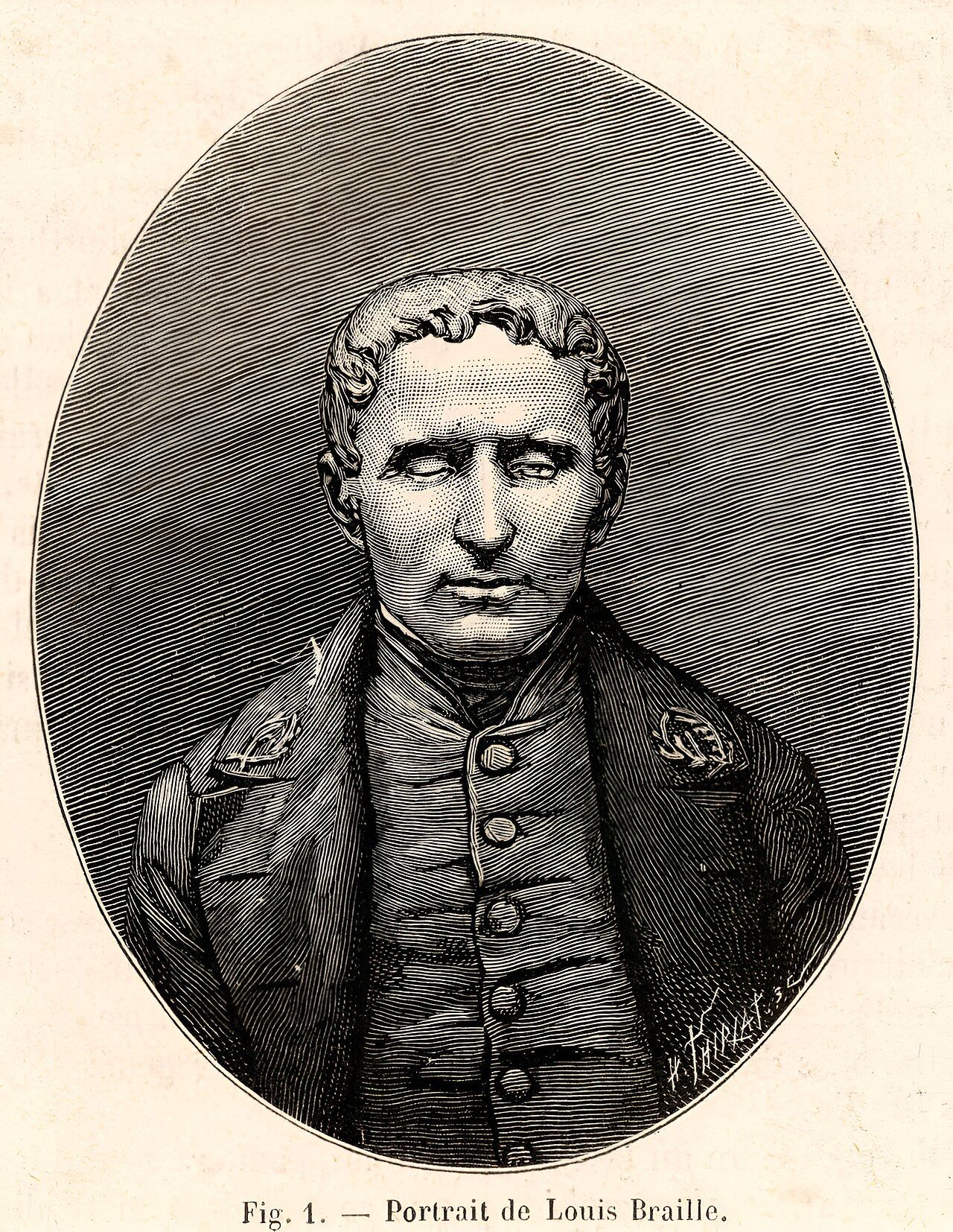
One of the students was Louis Braille. At three, playing with an awl in his father's leather workshop, he'd injured one eye; the infection spread to the other and left him blind.4 He took Barbier's idea and spent three years cutting it down to six dots. In 1824, at fifteen, he showed the system to his classmates.5 Six dots give 64 combinations, enough for letters, punctuation and numbers, and a single cell fits under one fingertip.6
He published the first book on the system in 1829. Small irony: that book was printed in the old embossed letters.5 Braille was gracious about his debt, writing that Barbier's method "gave us the first idea" of his own.7
He died of tuberculosis in 1852, at 43, without seeing his alphabet spread across the world.6
Why six dots, exactly
Braille's cut was dictated by the limits of the finger. The fingertip is packed with touch receptors called Merkel cells, and a young adult's fingertip can resolve detail of about 1.2 to 1.7 mm, worsening to around 3.4 mm after 65.8 Barbier's cell was two dots wide and six high, twelve dots in all, taller than a fingertip, so readers had to move up and down to feel one character. Braille halved the dots and switched from spelling sounds to spelling letters. One fingertip could now cover a whole cell in a single touch and glide from one cell to the next.910
Today the sizes are pinned down closely. The Library of Congress specification calls for dots about 0.48 mm high with a 1.44 mm base, 2.34 mm between neighboring dots in a cell, and 6.2 mm between the same dot in neighboring cells.11 Any lower and the dots vanish under the finger; any closer and they blur together.
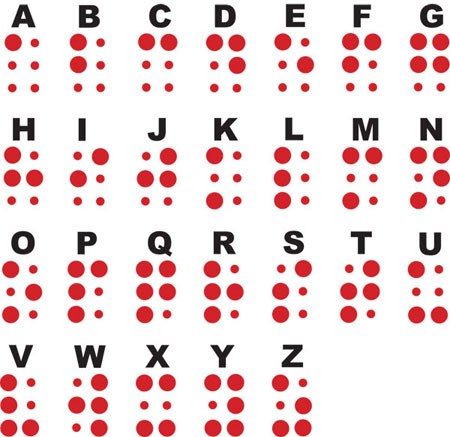
The alphabet has a pattern, too. The dots are numbered 1-2-3 down the left column and 4-5-6 down the right. The first ten letters, a through j, use only the top four dots (1, 2, 4, 5). Add dot 3 to each and you get k through t; add dot 6 as well and you get u through z. The one exception is w, which French barely used at the time and which was added later.129 Numbers need no new symbols: put the number sign (dots 3-4-5-6) in front of a through j and they read as 1 through 0.12 With one set of ten, the teenage Braille covered the whole alphabet and every digit.
To save paper and time, English braille also has a contracted form, Grade 2, which squeezes common words and letter groups into one or two cells. Its 192 contractions cut the character count by about a quarter.13 Even so, touch reading is slower than sight reading. In a standardized test of 44 experienced readers, the median braille speed was 124 words per minute; sighted readers of the same text in print reached 251. Researchers think the bottleneck is that a finger "sees" only one character at a time. Reading with both hands was 28% faster.13
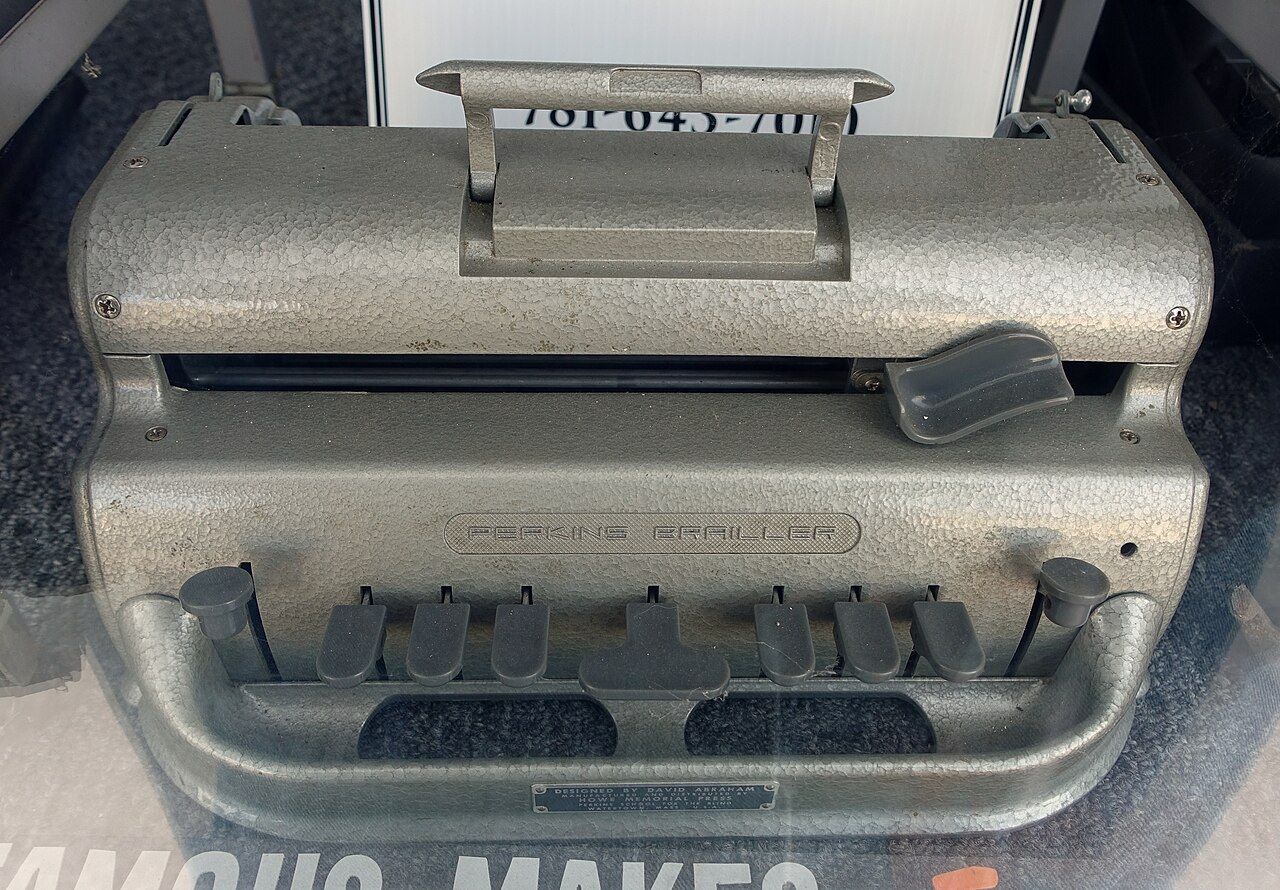
Writing braille is stranger still. The oldest tool is the slate and stylus: dots are pressed down from the back of the page, so you write a mirror image from right to left, then turn the paper over to read it left to right.14 In 1939, David Abraham, a teacher at the Perkins School for the Blind, designed a six-key braillewriter. Each key matches one dot, and pressing several at once, like a chord on a piano, prints a character. It went on sale in 1951 and remains the world's standard manual braille writer.1516 In the electronic age, refreshable braille displays use piezoelectric crystals to push tiny pins up and down, one crystal per dot. Most have 40 or 80 cells, so a blind user can read a computer screen on a constantly changing line of braille.17 The first commercial paperless braille device, the Digicassette, appeared in Paris in 1976, and its piezo technology still dominates.18
Chinese has no alphabet, so its braille goes through pinyin. In 1952, Huang Nai and colleagues designed what became "current braille," based on Beijing pronunciation: each syllable is spelled as initial, final and tone, with spaces between words. After the Ministry of Education published it in 1953, it replaced the other Chinese braille systems within six months.1920 But it marked tones only "when needed," and over the decades misread sounds and unclear meanings became a chronic problem. The National Common Braille Scheme, in force since July 1, 2018, added and removed no symbols at all. It changed only the tone rules: in principle every syllable carries a tone, and print editions drop some tone marks by rule, depending on the initial.19
The first typewriter was built for a blind countess
A little earlier, in Italy, around 1808, the inventor Pellegrino Turri built a writing machine for his friend Countess Carolina Fantoni da Fivizzano, who had lost her sight, so she could write private letters without dictating them to a maid. To ink the machine, he also came up with carbon paper.21 The machine is lost, but letters the countess typed on it survive in a museum in Reggio Emilia.22 In one, writing to Turri, she says she is "desperate": she was nearly out of the inked paper.23
(Historians argue over the details. Another account says her brother Agostino Fantoni built an earlier version and Turri improved it.21)
Lots of things that changed everyone's life were first built for one person who couldn't do something the usual way. That pattern keeps showing up in this story.
Books that talk
Braille made reading possible, but not fast, and not for everyone. Plenty of people lose their sight in middle age, when fingertips are hard to retrain. On March 3, 1931, President Herbert Hoover signed the Pratt-Smoot Act, giving the Library of Congress $100,000 a year to provide books for blind adults.24 At first that meant braille. But organizations like the American Printing House for the Blind argued that people who went blind after 50 might never get the touch for it. So a 1934 amendment set aside $10,000 for the first "talking books": books recorded on phonograph records.25
The program is now the National Library Service for the Blind and Print Disabled, and it still mails books and players for free.26 The audiobook in your earbuds on the commute is a descendant of those records.
2. A language of hands needs a classroom
Around 1760, a Paris priest, Charles-Michel de l'Épée, opened what became the first free public school for deaf children in his own house. He argued for teaching through sign rather than drilling speech, and he's remembered as the "Father of the Deaf."27 His smartest move was refusing to keep it secret: classes were open to visitors, and he trained foreign teachers.
That openness crossed the Atlantic half a century later. Thomas Hopkins Gallaudet, a young American minister, had a deaf neighbor, nine-year-old Alice Cogswell. The story goes that he scratched H-A-T in the dirt with a stick, pointed at his hat, and she got it immediately.28 He went to Europe to learn how deaf children were taught, was turned away in Britain, and in Paris recruited a deaf teacher, Laurent Clerc. On the voyage home, Clerc taught Gallaudet French Sign Language and Gallaudet taught Clerc English.29 On April 15, 1817, America's first permanent school for the deaf opened in Hartford. Alice was its first registered student.28
China had its own version of the problem: with a huge country and many dialects, sign language varied from region to region, and Chinese braille had long left tones unmarked. A deaf person from Beijing might not understand signers in Gansu. On July 1, 2018, China put into effect a National Common Sign Language Vocabulary and a National Common Braille Scheme, after seven years of work. The press summed it up neatly: sign language now had its "Mandarin," and braille its "standard script," for more than 33 million people with hearing or visual disabilities.3031
A water pump in Alabama
On March 3, 1887, 20-year-old Anne Sullivan arrived in Tuscumbia, Alabama, to teach a six-year-old girl who could neither see nor hear. The girl was Helen Keller, and she later called that day her "soul's birthday."32
Sullivan spelled words into Helen's palm every day, but Helen kept mixing up "mug," "milk" and the idea of drinking. On the morning of April 5, Sullivan took her to the pump house, had her hold a mug under the spout, and spelled w-a-t-e-r into her free hand as the water gushed out. "She dropped the mug and stood as one transfixed," Sullivan wrote in a letter. "A new light came into her face."33 Helen learned thirty new words that day.34
Keller went on to graduate from college, write books and campaign for blind and deafblind people for the rest of her life. The lesson of the pump: the question was never whether a child could learn, but whether anyone had found the way in.
1988: Deaf students want a Deaf president
Gallaudet University in Washington, D.C., is the only university in the world where every program is designed for deaf and hard-of-hearing students. In 124 years, it had never had a deaf president.35
On March 6, 1988, the board of trustees picked the one hearing finalist over two deaf ones. Students shut the campus down: they barricaded the gates, boycotted classes, marched, and issued four demands. The protest became known as Deaf President Now.36 A week later, on March 13, the board chair resigned, a deaf trustee took her place, and I. King Jordan was named Gallaudet's first deaf president. All four demands were met.37 Jordan called it "an historic moment for deaf people around the world."38
3. Leaving the house: a cane, a dog, a row of bricks
The white cane started with a can of paint
People have walked with canes forever, but the white cane is a 20th-century idea. In 1921, James Biggs, a photographer in Bristol, England, lost his sight in an accident. Nervous about the growing traffic near his home, he painted his walking stick white so drivers would see him.39
What turned it into a recognized symbol was a Frenchwoman, Guilly d'Herbemont. On February 7, 1931, in front of several French government ministers, she handed the first two white canes to blind people, and later sent out 5,000 more.40 After World War II, Richard Hoover, a rehabilitation specialist working with blinded veterans in the U.S., developed the "long cane" technique of sweeping the cane side to side in front of you. The Hoover method is still the basis of orientation and mobility training.39
The guide dog: a one-word telegram
In 1927, Dorothy Harrison Eustis wrote an article in The Saturday Evening Post about dogs being trained in Switzerland. Someone read it aloud to Morris Frank, a 19-year-old blind man in Tennessee. He wrote to her: "Is what you say really true? If so, I want one of those dogs!"41
On June 11, 1928, Frank arrived back in New York with his dog, Buddy. Reporters didn't believe a dog could guide a blind man, so he crossed the notoriously dangerous West Street in front of them. Then he sent Eustis a one-word telegram: "Success."42 The Seeing Eye was incorporated on January 29, 1929. It's now the oldest existing guide dog school in the world.43
Tactile paving: Seiichi Miyake's 230 blocks
Back to the inn owner from Okayama. According to Japanese accounts, in 1963 Seiichi Miyake watched a man with a white cane nearly get hit by a car, and switched his tinkering to the problem of crossing streets safely without sight.2 In 1965, with his own money, he built prototypes: round bumps meant "careful, danger ahead," straight bars meant "this way." A cane or the soles of your feet could tell them apart.44
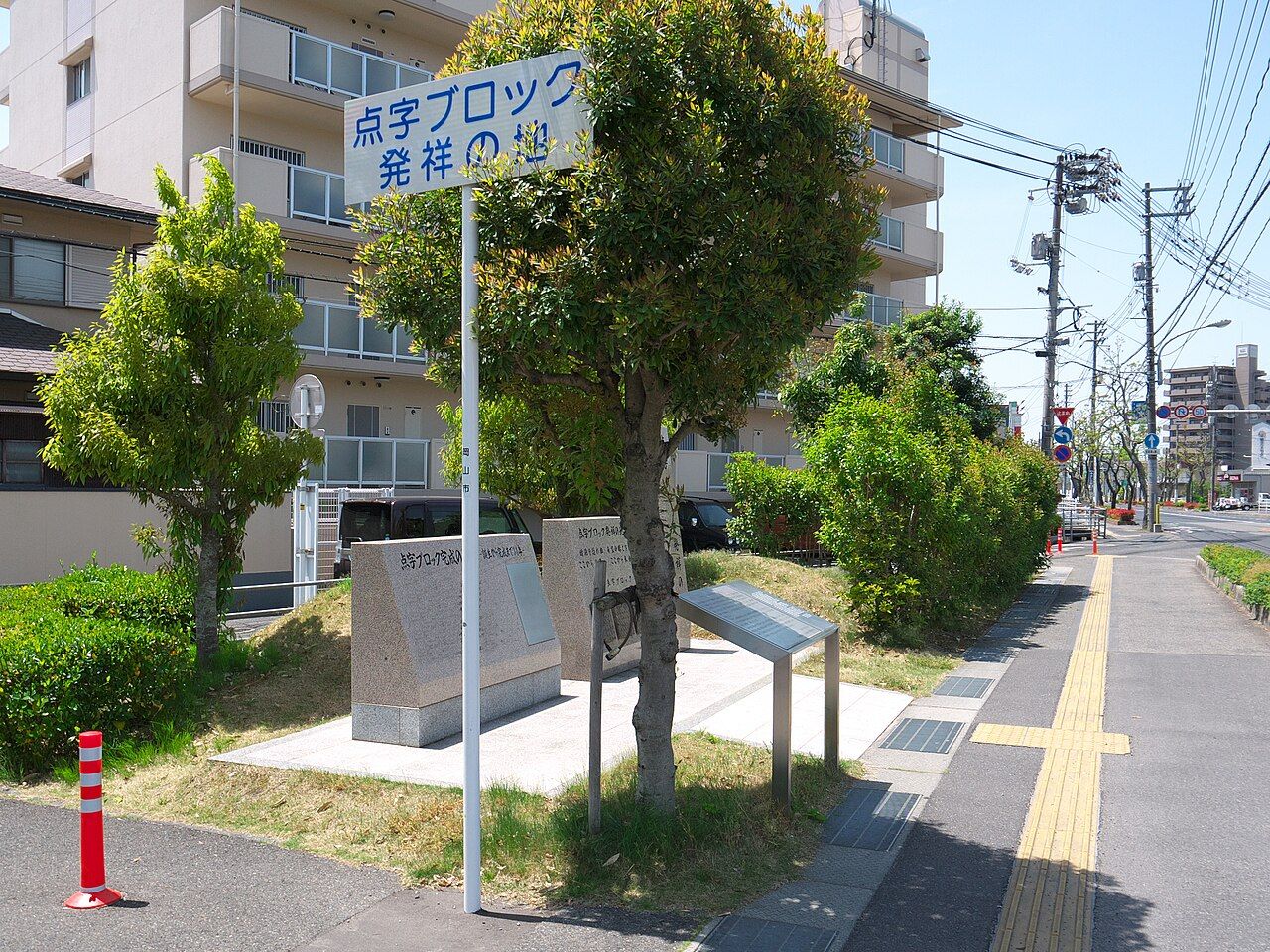
On March 18, 1967, the 230 blocks went down outside the Okayama School for the Blind.2 Within about a decade they were on Japan National Railways platforms, though they weren't standardized under Japanese Industrial Standards until 2001.45 Today the Okayama crossing has a monument reading "点字ブロック発祥の地" (Birthplace of Tactile Paving), and March 18 is Tactile Paving Day in Japan.46
A language for the soles of your feet
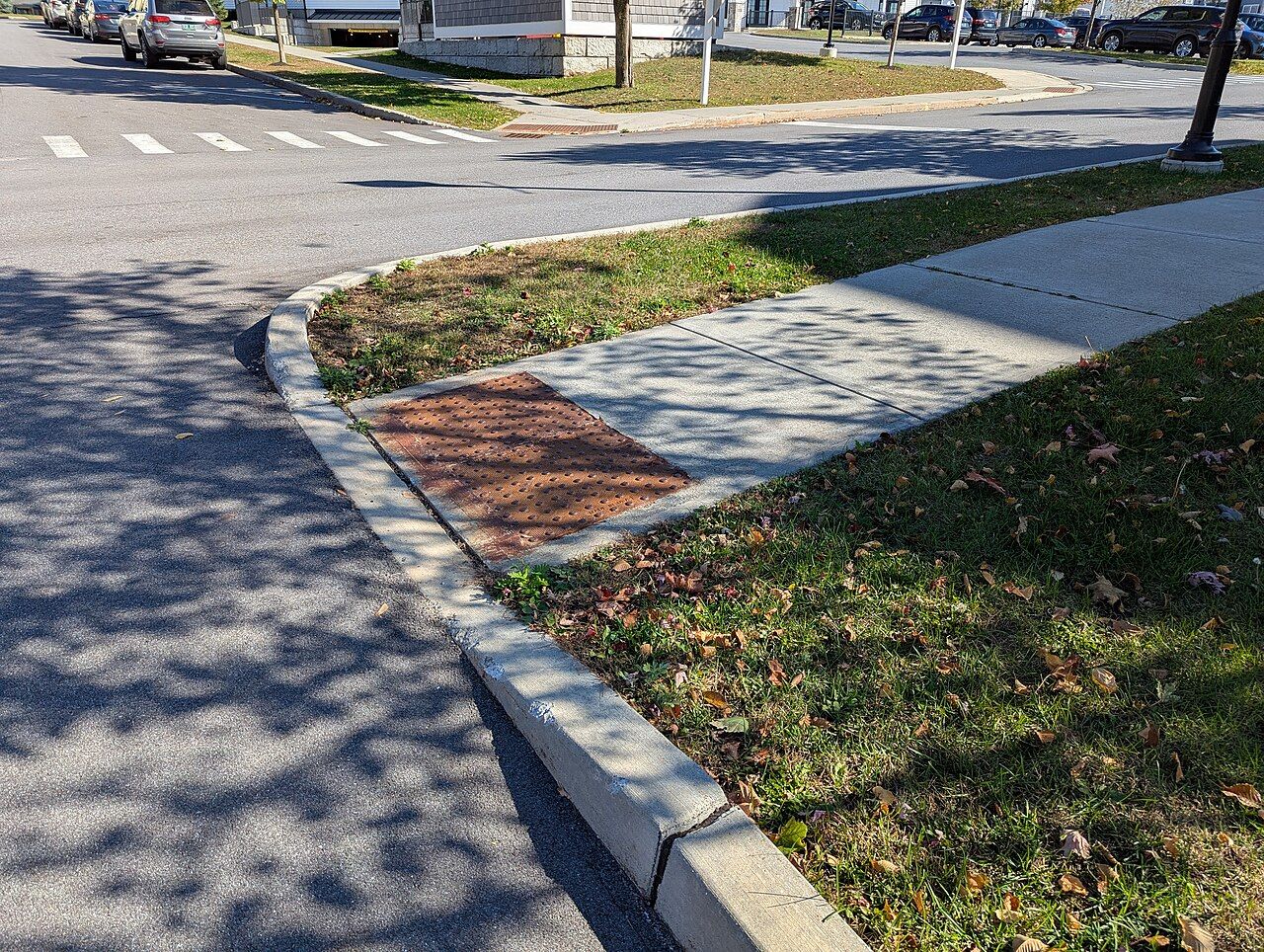
Tactile paving has only two words. Bars are guiding blocks, and they point the way to walk. Dots are warning blocks, meaning "stop, something changes here," and they go at the tops of stairs, before crosswalks, along platform edges, and wherever a guide path turns or branches.4748 The Japanese standard defines the raised parts as bumps "recognized by touching them with a shoe sole or a white cane."49
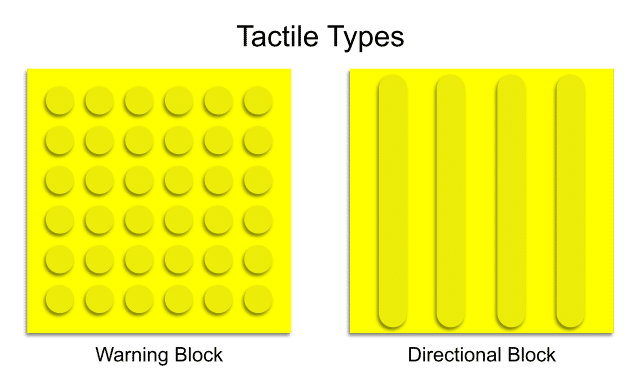
The sizes were found by testing. Japanese researchers tried heights from 2.5 mm to 10 mm: about 15% of participants couldn't detect 2.5 mm bumps, while nearly everyone detected and correctly identified 5 mm ones. Spacing mattered too, with bars 50 mm apart much harder to detect than bars 75 to 86 mm apart. That research became the basis for the Japanese standard JIS T 9251.48 So the standard specifies dots 5 mm high, 12 mm across the top and 55 to 60 mm apart, and bars 17 mm wide at the top and 75 mm apart.50 The international standard, ISO 23599, likewise calls a 12 mm top diameter optimal for feeling through shoe soles, but warns that a height "more than what is necessary for reliable detection can cause tripping."51 Width matters as well: in one experiment, a 300 mm warning strip let only some blind participants stop in time, while a 600 mm strip stopped all of them before they stepped past it.48
Blind people read the paving with a cane in one of two main ways. With two-point touch, you swing the cane side to side and tap each edge of your path; with constant contact, the tip never leaves the ground. Constant contact picks up more: in one test it detected 82.7% of drop-offs, against 62.5% for tapping.52 Japanese mobility training teaches "long touches" that keep the cane on the ground near steps and tactile blocks.53
The yellow isn't decoration. Miyake's first blocks were gray and were changed to yellow so that people with low vision could see them.1 The ISO standard says visibility depends mainly on luminance contrast and only secondarily on color, and whole blocks need more than 30% luminance contrast with the surrounding ground.5148 China's code recommends a medium yellow because it is "bright and easier to spot."54
Platform edges later got an extra idea. Ordinary dots say "danger here" but not "which side is the track," so a disoriented person could step the wrong way. In 2001 and 2002, Japanese researchers tested five designs with 38 fully blind participants and chose one that adds a single raised line on the platform side, 90 mm from the dots: feel the line, and you know the track is on the other side.55 After a guide-dog user fell to his death at Tokyo's Aoyama-itchome station in 2016, the government prioritized stations with 10,000 or more daily users, which account for about 90% of platform falls.56
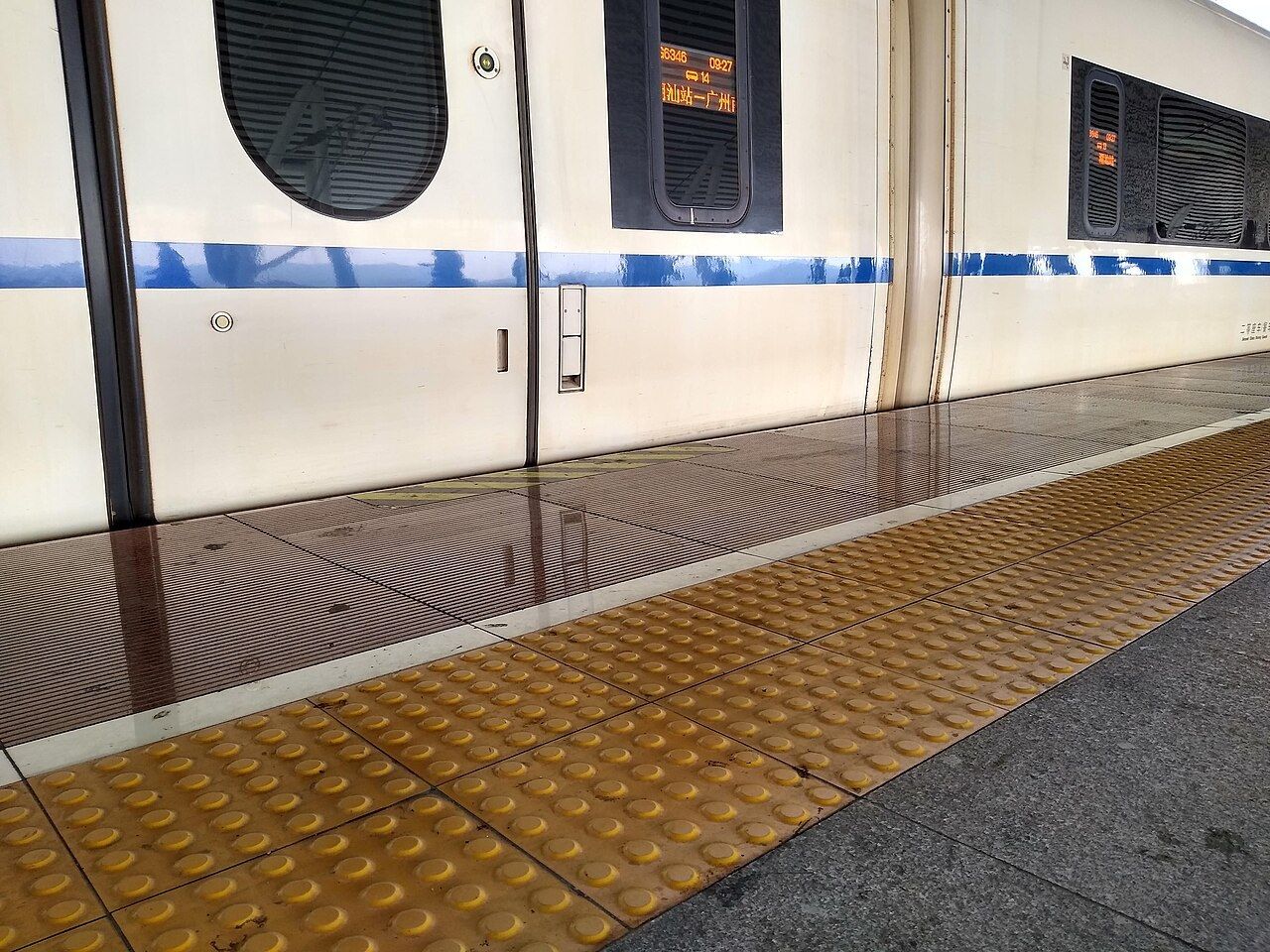
The paving has costs. It can jolt wheelchair and walker users, throw off their control and cause pain, and it gets slippery in rain or ice.4847 In China, the bigger problems are often in execution. State broadcaster CCTV reported a stretch of blind lane under 10 meters long with three problems at once: bad design, obstruction and damage. People's Daily reported in 2025 on lanes blocked by parked e-bikes, a metro-station lane that ran "straight into a wall," and stainless-steel studs that turn slippery in rain.5758 China's mandatory national accessibility code, in force since 2022, states that "no facility may occupy a blind lane."59
The folding wheelchair, built in a garage
Early 20th-century wheelchairs were heavy, often wood or wicker, and wouldn't fit in a car. Herbert Everest, a mining engineer, was paralyzed in a mining accident in 1918, and he complained about it to his friend Harry Jennings, a mechanical engineer. In 1933, in Jennings's garage in Los Angeles, the two built a lightweight tubular steel chair that was rigid in use but folded for transport.6061
The trick was an X-shaped brace under the seat. They patented it in 1937 and started Everest & Jennings, the first company to mass-produce wheelchairs.61 London's Science Museum calls the X-frame folder one of the most commercially successful wheelchairs ever made, and the design is still everywhere.62 A chair that fits in the trunk means getting to work, traveling, and going to a friend's for dinner.
4. Curbs, broken open with sledgehammers
That little ramp at the corner of the sidewalk is called a curb cut, and it might be the most underrated invention on Earth.
Some of the earliest in the U.S. appeared in Kalamazoo, Michigan, in 1945. Jack Fisher, a lawyer and disabled veteran, petitioned the city because the downtown curbs were too high for veterans in wheelchairs. The city built the ramps, handrails included.6364
The curb cut became a movement in Berkeley, California, in the late '60s and '70s. Disabled students living in the campus hospital, who called themselves the Rolling Quads, sometimes slipped out at night with sledgehammers and chisels, knocked chunks out of curbs, and patched crude ramps with asphalt.65 One activist recalled: "The police threatened to arrest us. But they didn't."66
They worked the system too. Berkeley city council minutes from September 28, 1971, declared it city policy that streets and sidewalks be designed to make them usable by people with disabilities.67 In 1972, the first official curb cut went in on Telegraph Avenue, later called "the slab of concrete heard 'round the world."66 In 1973 the city approved 125 more, at locations chosen by disabled people themselves.68
Then something odd happened. Parents with strollers, travelers dragging suitcases, delivery workers with hand trucks, kids on bikes: everyone started using the ramps. The phenomenon now has a name, the "curb-cut effect." Something designed for a minority ends up helping almost everyone.66
5. A stick figure that got its head later
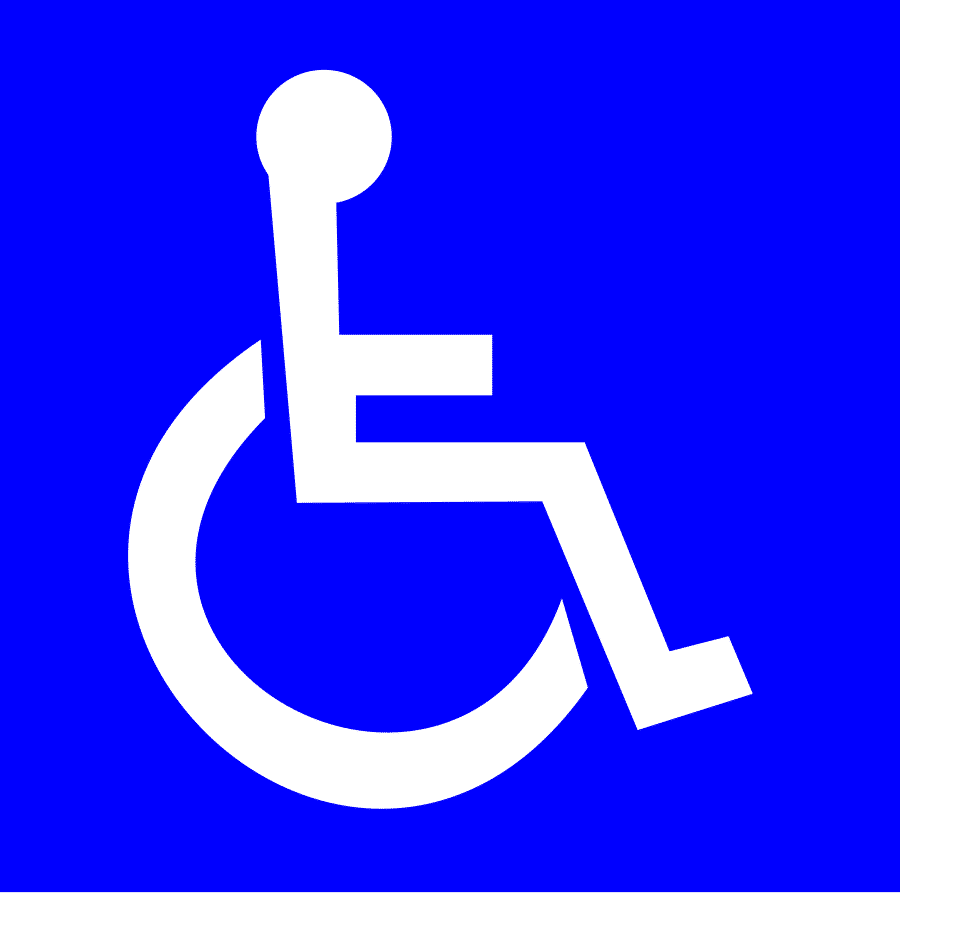
The white wheelchair figure on a blue square, on parking spaces, elevators and restroom doors, is officially the International Symbol of Access.
In 1968, Susanne Koefoed, a Danish design student at a student workshop in Stockholm, drew the original: a simple figure in a wheelchair. Her version had no head. Karl Montan, the Swede running the project, added a circle on top to "humanize" it, and Rehabilitation International adopted the symbol at its 1969 World Congress in Dublin.69 It later became part of the ISO 7001 standard.70
One practical reason for the head: without it, the symbol could be mistaken for a monogram of letters.71
6. Rights that were sat in for, and crawled for
1977: weeks inside a federal building
Section 504 of the U.S. Rehabilitation Act of 1973 barred discrimination against disabled people by any program receiving federal money. The law existed; the regulations to enforce it went unsigned for four years.72
On April 5, 1977, disabled protesters in ten cities walked into regional offices of the Department of Health, Education and Welfare. Most sit-ins ended within a day or two. At 50 United Nations Plaza in San Francisco, more than 100 people stayed for nearly a month (accounts say 25 or 26 days).7374 One of the organizers, Judy Heumann, was 29.75
Many had walked in with just a toothbrush and their medications. Without their usual attendants, they looked after each other: blind protesters helped turn quadriplegics at night, and quadriplegics read printed material to the blind.76 The Black Panther Party brought in food.77 On April 28, 1977, the regulations were signed unchanged.78 Participant Kitty Cone called it "the public birth of the disability rights movement."78
1978: "We will ride!"
Section 504 was signed, but buses were still impossible to board. In 1978, Denver's Regional Transportation District had just ordered 250 new buses, none with wheelchair lifts.79
On July 5, the Rev. Wade Blank led 19 wheelchair users to Colfax Avenue and Broadway, one of downtown Denver's busiest intersections. They boxed in two buses front and back and chanted "We will ride!" The blockade lasted about 24 hours; at night, some protesters got out of their chairs and slept on the asphalt.80 They became known as the Gang of 19.
RTD agreed to put lifts on its buses. On December 4, 1978, Denver's first lift-equipped bus pulled up at that same intersection and wheelchair users boarded it on their own; by 1982 the whole fleet had been retrofitted.81 The Gang of 19 became the core of ADAPT, the group behind the Capitol Crawl twelve years later.82
1990: an eight-year-old climbs the Capitol
Thirteen years later, the much broader Americans with Disabilities Act was stalled in the House. On March 12, 1990, more than a thousand people marched from the White House to the Capitol. At the foot of the steps, about 60 of them left their wheelchairs and crutches and began to climb on hands and knees.83
The one everyone remembers is eight-year-old Jennifer Keelan, who has cerebral palsy, dragging herself upward and shouting, "I'll take all night if I have to!"84 Four months later, on July 26, 1990, President George H.W. Bush signed the ADA: "Let the shameful wall of exclusion finally come tumbling down."85
Sport: it started with archery on a hospital lawn
On July 29, 1948, the day the London Olympics opened, 16 veterans with spinal cord injuries competed in wheelchair archery on the lawn of Stoke Mandeville Hospital in England. The organizer was Ludwig Guttmann, a neurosurgeon who had fled Nazi Germany.86 He told them: "I dream of the time when there will be Olympic Games for people with disabilities."87
In Rome in 1960, 400 athletes from 23 countries competed in what is now counted as the first Paralympic Games.86
7. Turning sound into text, and text into sound
The phone: "let's quit for now and gloat"
For most of a century, the telephone was useless to deaf people, and plenty were passed over for promotion because they couldn't take calls.88
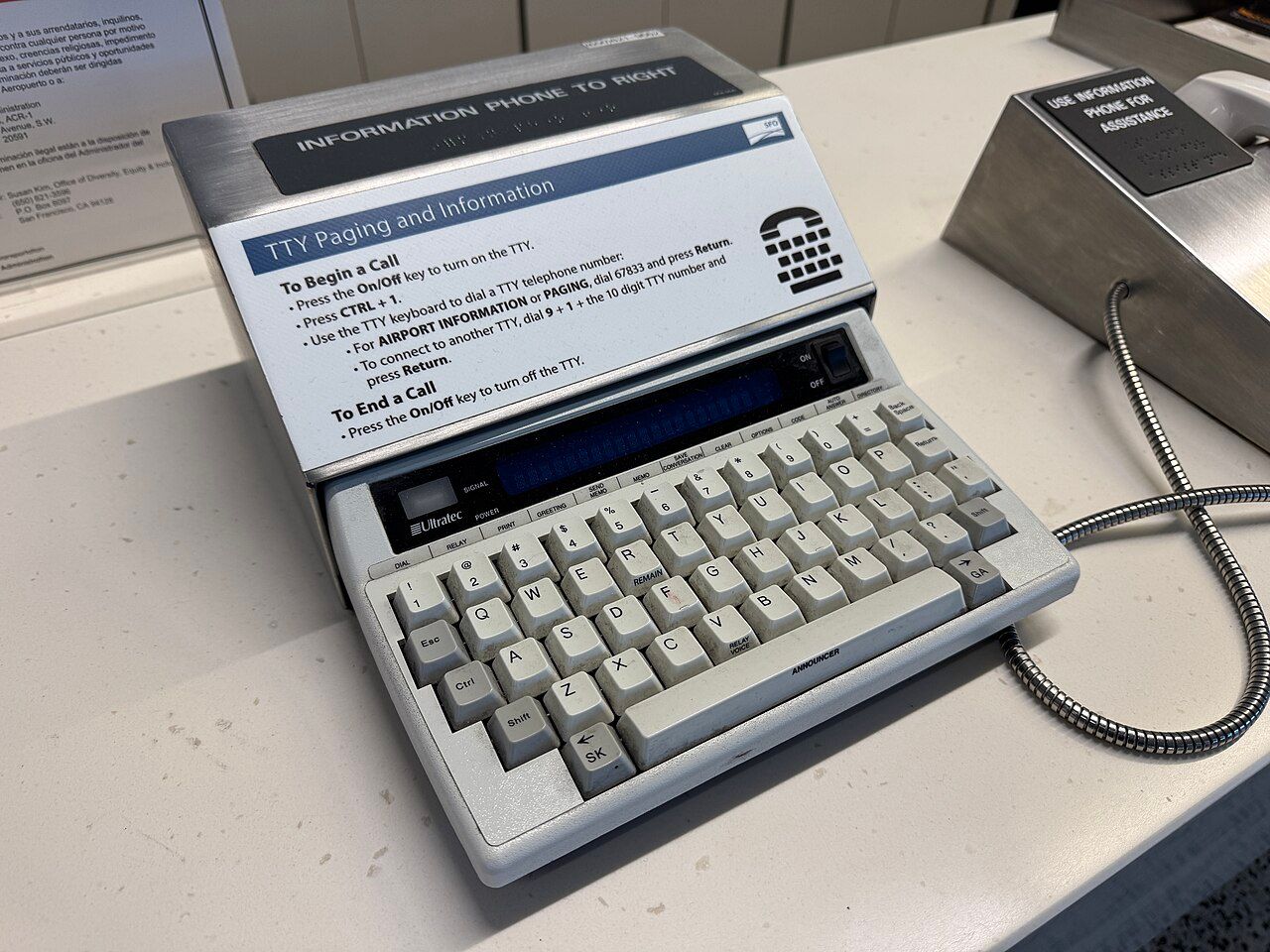
In 1964, Robert Weitbrecht, a deaf physicist, built an acoustic coupler: set a telephone handset in it, and two old teletype machines could "type" to each other over an ordinary phone line. He in Redwood City and James Marsters, a deaf orthodontist in Pasadena, made the first long-distance TTY call between two deaf people.89 It took several tries before Weitbrecht's words came through clearly: "Are you printing now? Let's quit for now and gloat over the success."90
TTY calls had their own etiquette: you typed "GA," for "go ahead," when it was the other person's turn.88
1,400 hertz and 1,800 hertz
The hard part was that phone lines were built for voices and carry only about 300 to 3,400 Hz.91 Teletypes could already send text over long distances, but they used expensive dedicated lines that individuals couldn't afford.92 Weitbrecht's answer was to make the data sing. Two tones stood for binary: 1,400 Hz for a 1 and 1,800 Hz for a 0, both inside the band a phone line carries.9394
Each character was sent in 5-bit Baudot code, which has only 32 combinations. That isn't enough for letters and numbers, so two codes are set aside to shift between a LETTERS set and a FIGURES set, like the shift key on a typewriter. That's also why TTYs type only in capitals.9594 Each bit lasts 22 milliseconds, or 45.45 baud, and each character gets one start bit in front and 1.5 stop bits behind.93 That works out to about 165 milliseconds per character, or roughly 60 words a minute.95 Why such an old code? Because thousands of retired Baudot teletypes were sitting around. As Weitbrecht later put it, there was "a great surplus waiting to be used."92
The system had no error correction and was half-duplex: if both sides typed at once, the other end got garbage. So you took turns, like on a CB radio, and that is where the "GA" etiquette came from; "SK," for "stop keying," meant you were about to hang up.9496 Miss a single shift code and the next run of letters came out as numbers and symbols. It usually took about eight characters before the user noticed and fixed it.94
None of the early equipment was portable. The sheet-metal teletypes stood about four feet high and were noisy and shaky in use, and volunteers hauled hundreds of pounds of gear up rickety stairs into deaf people's homes.9295 The machines came from AT&T, Western Union and others as they retired old stock. TTY stations grew from 174 in 1968 to between 50,000 and 100,000 by 1981.92
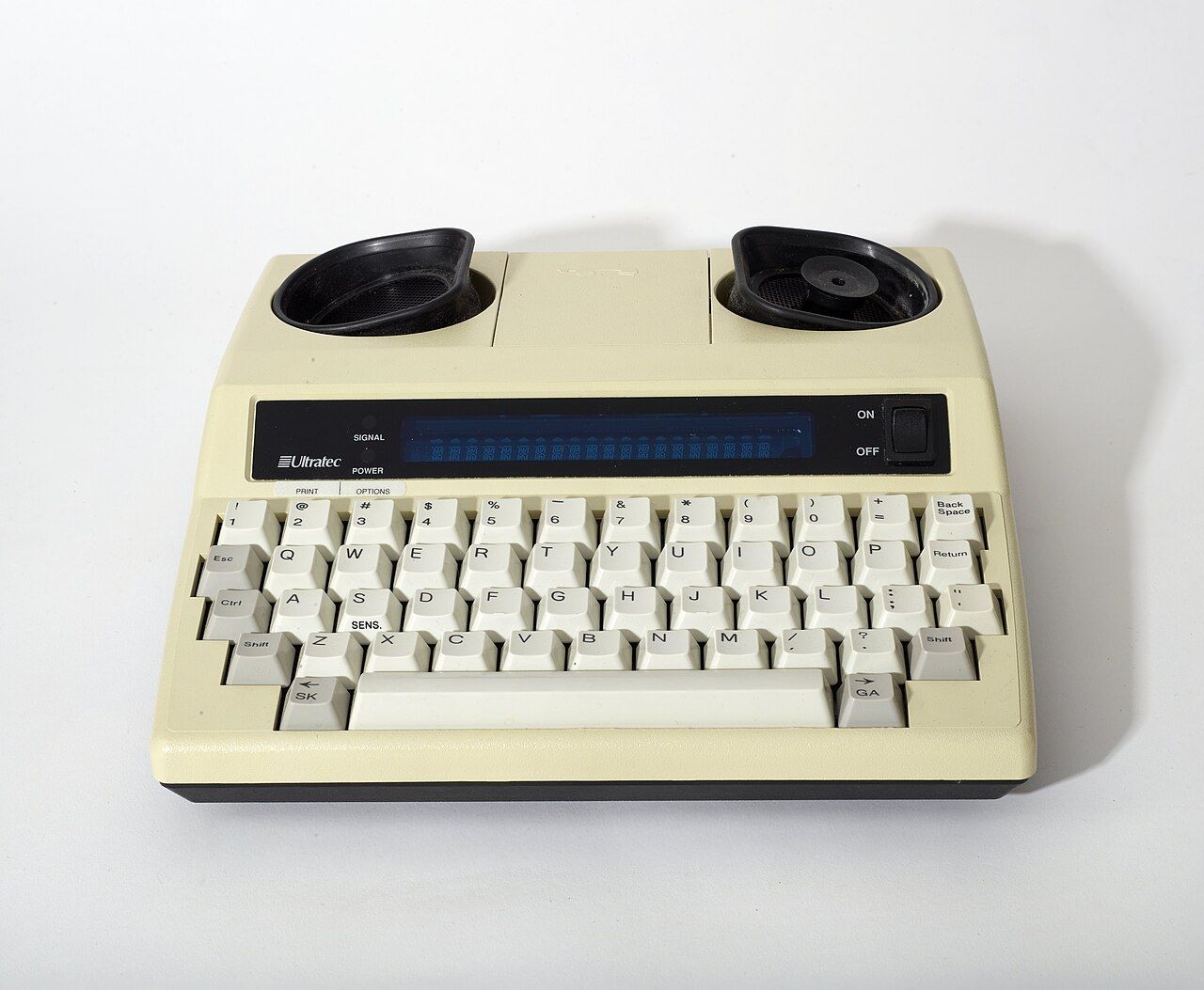
A TTY could only call another TTY. To reach an ordinary phone, you needed a relay service: an operator in the middle voices what the deaf caller types and types what the other person says.97 Title IV of the 1990 Americans with Disabilities Act required phone carriers to offer 24-hour relay within three years, and it went nationwide in July 1993; from 2001, dialing 711 connected you anywhere in the US.9798 Later came video relay, where callers sign to an interpreter, and captioned telephones, where speech recognition turns the other person's words into text. In 2016 the FCC let wireless carriers replace TTY with real-time text (RTT), which sends each character as you type it, without waiting for "send."9799
Television: Julia Child's chicken
In 1972, WGBH in Boston aired Julia Child's The French Chef with captions while she taught one of her chicken recipes. It was the first time deaf and hard-of-hearing Americans could follow a national TV program.100 Those were open captions, burned in for every viewer.
On March 16, 1980, ABC, NBC and PBS aired the first closed-captioned programs. You needed a decoder box; Sears sold them for $250.101
Hidden on line 21
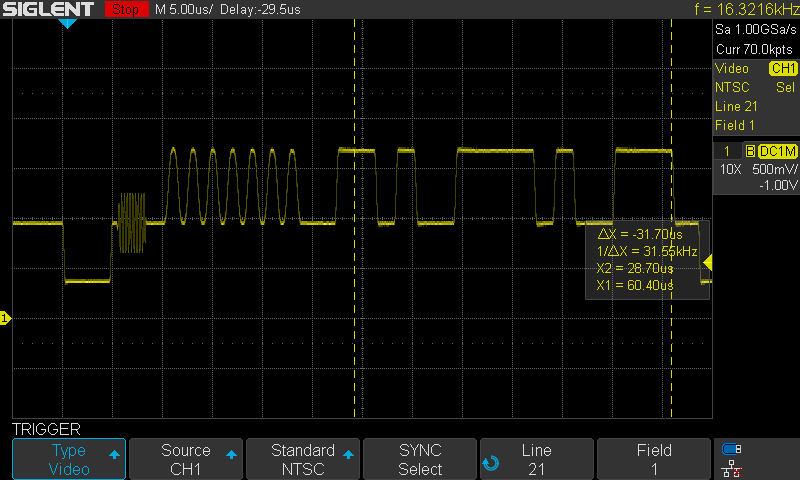
Closed captions could hide because of a gap in the old analog TV picture. The electron beam painted the screen line by line from top to bottom, then had to return to the top. During that return, 21 lines carried no picture, a stretch called the vertical blanking interval. Line 21 is the last of them: viewers never see it, but it can carry data.102 In December 1976, the FCC approved reserving line 21 for captions.103101
Why hide them at all? Mostly for commercial reasons. Early tests found that about one in ten hearing viewers disliked captions on screen, and planners feared the networks would decide that one-tenth outnumbered the entire deaf audience. So they chose a system that showed captions only on sets fitted with a decoder.103
Line 21 holds very little. Each field starts with seven cycles of a clock signal, then start bits, then two characters of 7 data bits plus 1 parity bit each, for a maximum of 60 characters per second.104 Control codes are usually sent twice in a row in case one is missed, and a character that fails its parity check shows up as a solid block.105 Captions come in three styles. Prerecorded shows mostly use pop-on, where the decoder builds a full caption in hidden memory and then swaps it onto the screen all at once. Live TV mostly uses roll-up, two to four lines scrolling upward. And paint-on captions appear character by character.105
Decoder boxes sold poorly: by 1986 there were only about 30,000 in use, and people complained about the price.106 The turning point was a chip. In 1989, NCI and ITT built caption decoding into a single chip, and the Television Decoder Circuitry Act that followed required every TV with a screen of 13 inches or more sold in the US from July 1, 1993, to decode captions.101105
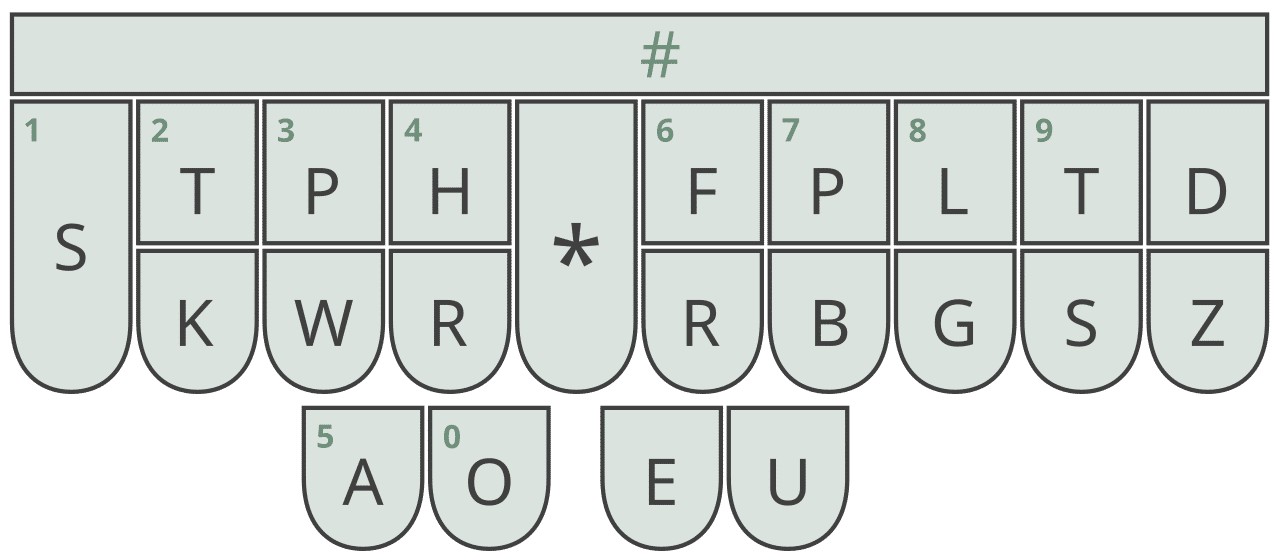
Live captions were harder. In 1982 NCI began real-time captioning, first for parts of the Academy Awards and then, from October, for ABC's World News Tonight.101103 Captioners use a stenotype: a keyboard of 22 keys pressed several at a time, like piano chords, to write a syllable or even a whole word by sound, so "cat" takes a single stroke. Software then translates the strokes into text using a dictionary each captioner builds up, and captions land one to four seconds behind the speaker.107108 The National Court Reporters Association's realtime captioner certification requires 180 words a minute for five minutes, with no editing, at 96% accuracy.109 Another method, respeaking, has a captioner listen to the program and repeat it into speech-recognition software.110 In 2009, YouTube launched automatic captions generated entirely by speech recognition.111
Decades later, captions became the default on trains, late at night and in loud restaurants: another curb cut. A 2023 YouGov poll found that 63% of American adults under 30 prefer to watch TV with subtitles on, most often to understand the content better or to follow accents.112 In a UK survey, 80% of 18- to 24-year-olds used subtitles at least some of the time, and only about one in ten of them was deaf or hard of hearing.113
A machine that reads aloud
On January 13, 1976, Ray Kurzweil unveiled the Kurzweil Reading Machine, which scanned printed text and read it out in synthetic speech. That night, at the end of the CBS Evening News, Walter Cronkite's famous sign-off, "And that's the way it was," was delivered by the machine instead of by Cronkite.114 It was the size of a dishwasher and cost $30,000 to $50,000.115
Stevie Wonder heard about it on TV and called the company. The receptionist doubted it was really him. He became the first customer and rode home in a taxi with his reading machine.116114
Screen readers
Once personal computers arrived, blind programmers had a new problem: you can't touch a screen's contents. At IBM, Jim Thatcher and his former thesis advisor Jesse Wright, a blind mathematician, built IBM Screen Reader, released in 1986. Thatcher then led Screen Reader/2, the first screen reader for a graphical interface on the PC.117118 "Screen reader" became the generic name for a whole category of software.119
The history of screen readers is really the history of "what's on the screen?" getting harder to answer. In the DOS era it was easy. The screen was 80 columns by 25 rows of characters, and each character took two bytes in video memory: one for the character, one for its color and other attributes.120 Early screen readers simply read those few kilobytes of video memory and sent the text to an external hardware speech synthesizer.121 In 1986, an Echo synthesizer cost about $250; the far better-sounding DECtalk cost about $4,000.122
Graphical interfaces closed that road. The screen became pixels, and there was no longer any purely textual version of what it showed.123 Screen readers had to install hooks in the system, intercept every call that drew text or a button, and assemble their own "off-screen model" in memory, a guess at what the screen contained. JAWS and Window-Eyes even installed their own mirror display drivers.121 It was fragile: misrecognitions, memory leaks, and special code for every application, so only the most popular or critical programs ever became accessible.121
The turning point was the accessibility API. In 1997 Microsoft introduced Microsoft Active Accessibility (MSAA), which lets each program report the objects in its interface, each with a role (button or checkbox?), a name, a value and a state.124 Apple and the Linux desktop later got their own equivalents.125126 The web works the same way: the browser parses a page into a DOM tree, then builds an accessibility tree from it and hands that to the system's accessibility API.127 A menu or tab panel a developer cobbles together from plain divs means nothing to the browser, so in 2014 the W3C made WAI-ARIA a formal standard for adding roles, states and properties.128 Alt text is the same idea: without it, a screen reader may read out a filename or a URL instead.129 As one accessibility writer put it, the one thing screen readers no longer do is read the screen.121
On the output side, many experienced users set the speech extremely fast, as high as 500 words a minute, against 120 to 180 for ordinary speech.130 And they don't listen from top to bottom: in WebAIM's 2026 survey, 67.8% of screen reader users said that on a long page they first navigate by headings.131 For them, a page's headings are its table of contents.
Wiring sound into the inner ear
Graeme Clark, an Australian ear surgeon, grew up watching his father struggle with hearing loss. For years he couldn't work out how to thread electrodes safely into the spiral of the cochlea. The breakthrough reportedly came on a beach holiday, poking a blade of grass into a seashell: stiff at the base and flexible at the tip, it wound its way around the spiral.132
On August 1, 1978, at the Royal Victorian Eye and Ear Hospital in Melbourne, he implanted the first multichannel cochlear implant in Rod Saunders, who had gone completely deaf after a head injury.133 The first tests picked up nothing, until the team found a fault in the test equipment.134 When Saunders finally understood speech, Clark said, "I was so moved, I went into the next lab and burst into tears of joy."135
A rolled-up piano
To see why Clark insisted on many electrodes, start with how the cochlea works. Uncoiled, it is about 32 to 35 mm long, wound in two and a half turns or a little more. The basilar membrane inside is narrow and stiff near the entrance, where it responds to high pitches, and grows wider and floppier deeper into the spiral, where it responds to low ones, covering roughly 20 to 20,000 Hz.136 The Lasker Foundation compares the unfurled cochlea to a piano, with pitch running in order from highest to lowest.137 Along the way sit about 3,500 inner hair cells, which turn vibration into nerve signals.136 In most severe deafness, it's these hair cells that are lost, while the nerve cells behind them generally survive.137 Hair cells don't grow back. A hearing aid can only make sound louder; a cochlear implant skips the hair cells and stimulates the auditory nerve directly with electric current.138139
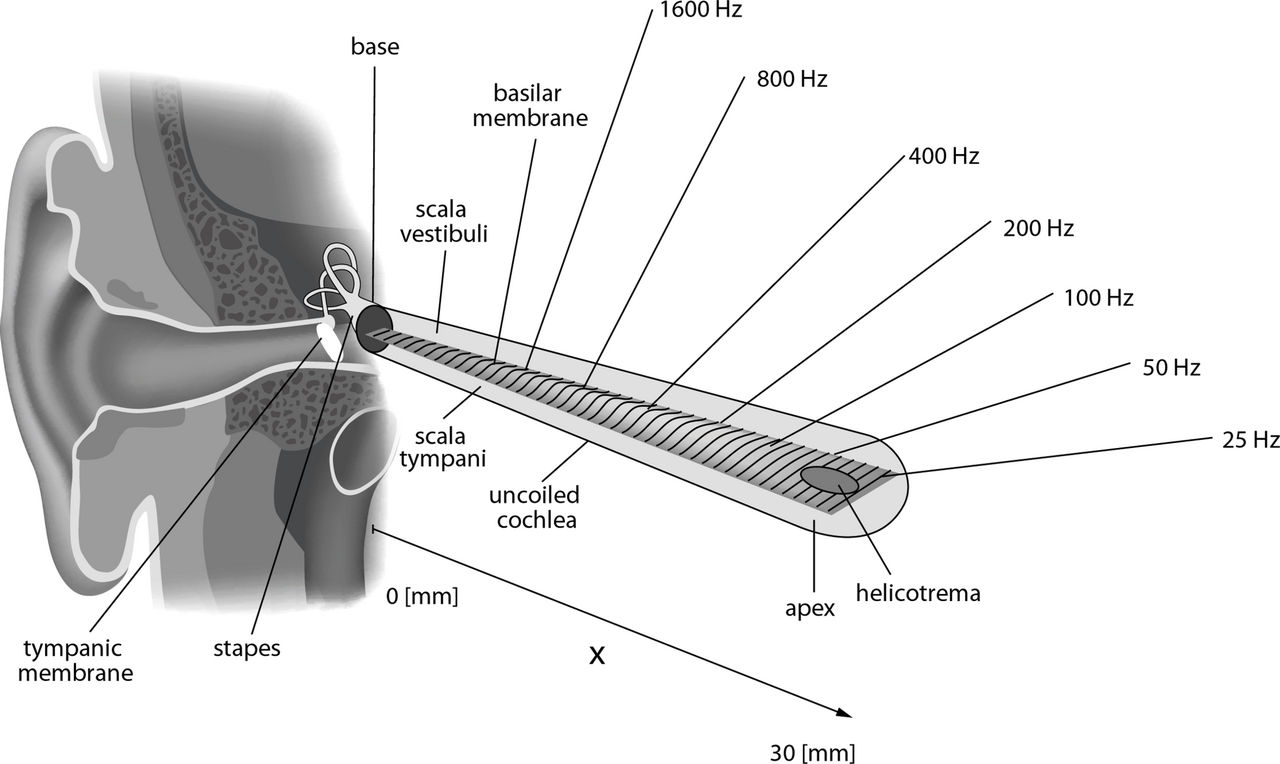
The first attempts used a single electrode. In 1957 in Paris, André Djourno and Charles Eyriès passed current near a patient's auditory nerve and the patient heard sounds. In 1961 William House began experiments in Los Angeles, and from 1972 he implanted a single-channel device.140 But one electrode could convey only rhythm, through how fast it fired. Patients became aware of sounds around them and lip-read better, but could rarely understand speech.141137 Clark, and Ingeborg and Erwin Hochmair in Vienna, used the cochlea's own "place coding" instead: send each pitch to its own spot along the spiral. That meant a row of electrodes along the spiral.137
A modern implant has two halves. Behind the ear, an external unit holds a microphone and a speech processor; the processed signal passes through a coil and travels by radio through the skin to the implant, with a magnet on each side holding the coil in place.139140 Think of the processor as splitting sound into a dozen or two frequency bands, tracking the loudness of each, and handing each band to the electrode at the matching spot in the cochlea. In 1991, Blake Wilson introduced continuous interleaved sampling (CIS), in which the electrodes take turns and never fire at the same time, so their currents don't interfere.142 It raised sentence recognition from about 30% to 70 to 80%.141 Wilson put the NIH-funded technique in the public domain, so every manufacturer could use it.137 Cochlear's default ACE strategy picks the 8 to 12 strongest of 22 channels in every stimulation cycle.143
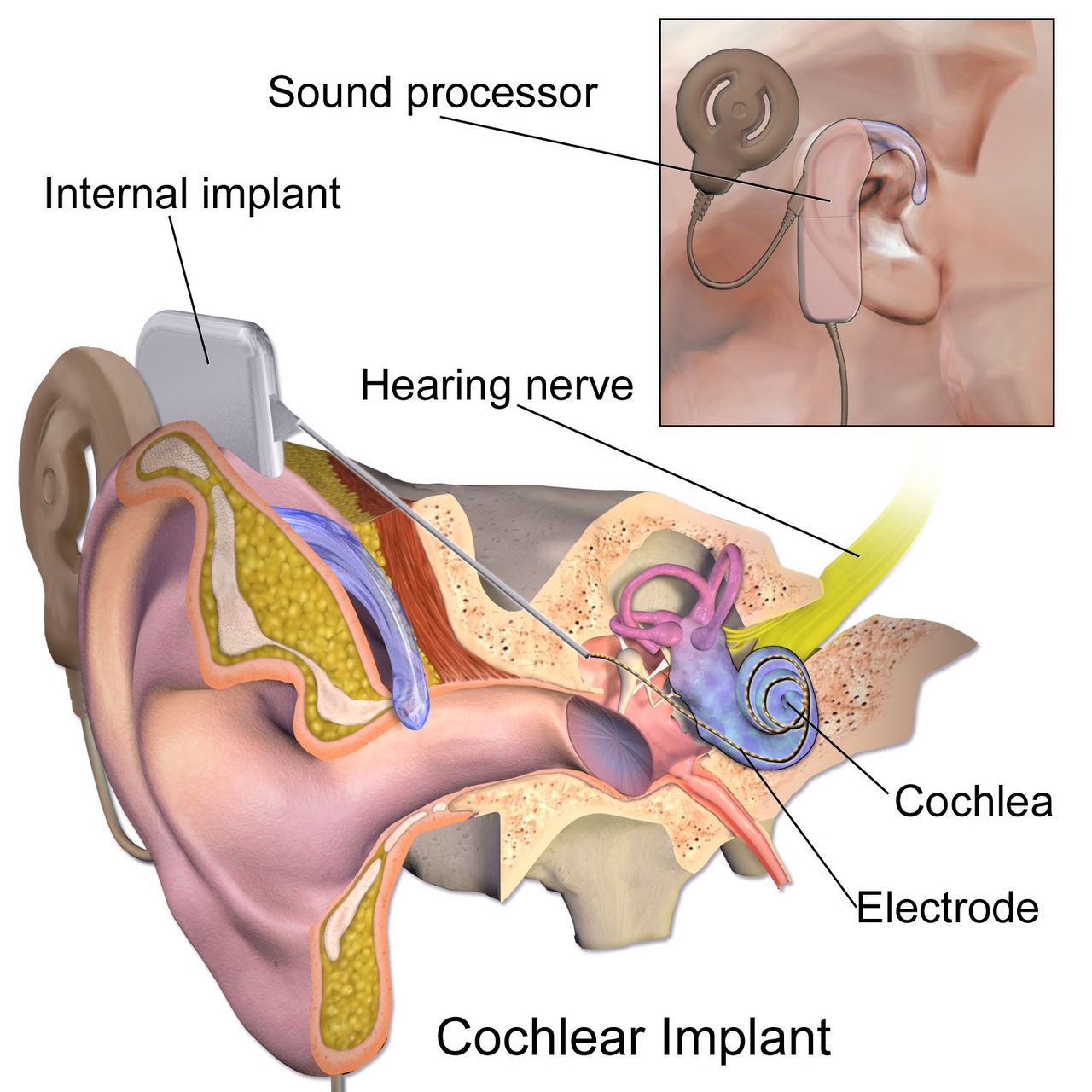
Electric hearing is still far from natural hearing. A normal cochlea has about 3,500 sites; an implant has at most about 22, and research shows speech recognition stops improving beyond about 4 to 8 effective channels.142 That's why implant users can talk comfortably in a quiet room but struggle in noise, have trouble telling melody and timbre apart, and mostly don't enjoy music; tone languages such as Mandarin are a challenge too.141137 In China, the implant is usually switched on three to four weeks after surgery, with about five tuning visits in the first year, and the brain needs weeks or months of practice to make sense of these new, crude sounds.138137
By 2022, more than a million cochlear implants had been placed worldwide.144 In China, more than 100,000 people have received one since the first operation in 1995, and a national bulk-purchasing deal in December 2024 cut the price from over 200,000 yuan to about 50,000.145
(Worth saying: Deaf communities don't all see cochlear implants the same way. Many hold that sign language and Deaf culture are complete in themselves, with nothing to fix. Access has never had just one road.)
Describing the picture out loud
In 1981, Arena Stage in Washington, D.C., got a $10,000 grant to make its shows more accessible. The house manager called Margaret Pfanstiehl, who had low vision herself and had founded the Metropolitan Washington Ear, a service that read newspapers over the radio for blind listeners.146 She and her husband Cody trained volunteers to describe, through headsets and in the gaps between lines, what was happening on stage: who walked in, what they wore, what they did. The first audio-described production was George Bernard Shaw's Major Barbara.147 It's considered the world's first ongoing audio description service.148
China's version started in a courtyard house on Gulou West Street in Beijing. In 2004, Wang Weili was watching The Terminator at home when a blind friend dropped by, so he narrated the picture between the lines of dialogue. His friend called it an experience like nothing before.149 The next year, Wang and his wife Zheng Xiaojie opened the Xinmu Cinema ("Heart's-Eye Cinema") in that courtyard: a 20-square-meter room, one TV, one DVD player, a few dozen chairs, and a film narrated live every Saturday morning.149 By 2022, blind and low-vision audiences had made more than 38,000 visits.150
8. Web pages, phones and games have steps too
A building code for the web
On May 5, 1999, the World Wide Web Consortium (W3C) published the Web Content Accessibility Guidelines (WCAG) 1.0.151 WCAG 2.0 followed on December 11, 2008 and became an ISO standard in 2012; WCAG 2.2 became a W3C Recommendation on October 5, 2023.152153154 One of 2.2's additions: logging in shouldn't depend only on cognitive tests like solving puzzles or recognizing objects.155
Alt text on images, captions on video, enough color contrast, everything usable without a mouse: for a website, these rules do roughly what a ramp does for a staircase.
Where 4.5:1 comes from
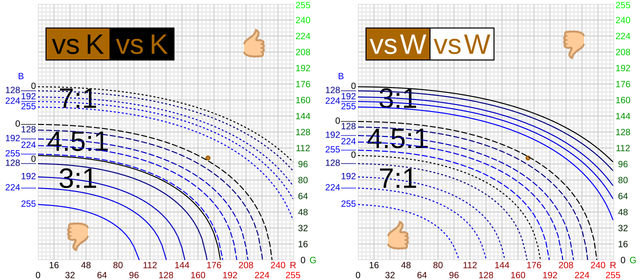
The most quoted number in WCAG is probably 4.5:1, the minimum contrast between body text and its background. Behind it sits a formula, and a very particular reader.
First, each color is converted to "relative luminance." The red, green and blue channels are each linearized to undo gamma, then weighted 0.2126, 0.7152 and 0.0722 and added up: pure black is 0, pure white is 1, green counts for the most and blue for the least. Then you take the lighter color plus 0.05 and divide by the darker color plus 0.05. Black on white gives (1 + 0.05) ÷ (0 + 0.05), exactly 21:1, the maximum; a color against itself is 1:1.156 The 0.05 isn't a fudge. It stands for flare: in a real room, ambient light always lands on the screen, so black is never truly black. The value comes from the "typical viewing flare" in the draft sRGB standard.156
The thresholds were built up step by step. 3:1 comes from ergonomics standards such as ISO 9241-3, as the minimum for ordinary text and normal vision. Research found that people with 20/40 vision lose roughly a factor of 1.5 in contrast sensitivity, and 3 times 1.5 is 4.5. W3C adds that 20/40 is commonly reported as the typical acuity of people around age 80. The stricter 7:1 corresponds to 20/80 vision.156 In other words, the rule was set for the eyes of an eighty-year-old reader.
A million home pages
After more than twenty years of rules, how is the web doing? Every year the nonprofit WebAIM runs automated checks on the home pages of the world's top one million websites. In the February 2026 scan, 95.9% of home pages had detectable WCAG failures, up from 94.8% the year before, ending six years of small improvements. The average home page had 56.1 errors.157
Low-contrast text came first, on 83.9% of home pages, followed by images missing alt text (53.1%), form fields without labels (51%), empty links (46.3%), empty buttons (30.6%) and no declared page language (13.5%). Those six account for 96% of all errors, and they've been the same six for seven years. By language, Chinese-language pages averaged 136.2 errors each, the most of any language in the report.157 The report suspects growing reliance on third-party frameworks and AI-assisted coding ("vibe coding").157
What an "empty button" actually sounds like comes up again with phones.
A pizza that never got ordered
In the U.S., whether a website is allowed to be inaccessible got settled in court. In 2006 the National Federation of the Blind sued Target because blind shoppers using screen readers couldn't buy things on Target.com. They settled in August 2008: Target set up a $6 million fund and agreed to fix the site.158
The more famous case was over a pizza. Guillermo Robles, who is blind, couldn't order one on Domino's website or app with his screen reader, so he sued. Domino's argued that the 1990 Americans with Disabilities Act hadn't anticipated the internet. The Ninth Circuit didn't buy it: an unusable website and app blocked customers from the goods and services of the pizza shops themselves. On October 7, 2019, the Supreme Court declined to hear Domino's appeal, and the ruling stood.159
Some companies looked for a shortcut. Vendors sold "accessibility overlays," promising that one line of code would make a site compliant automatically. In January 2025 the Federal Trade Commission went after one of them, accessiBe, for claiming without evidence that its AI widget could make any website WCAG-compliant, and for publishing paid articles dressed up as independent reviews. The FTC ordered it to pay $1 million.160
The EU simply legislated. The European Accessibility Act has applied since June 28, 2025, covering computers and operating systems, smartphones, ATMs and ticket machines, e-readers, and the websites and apps for e-commerce, banking, e-books and transport.161
Big print for the grandparents
In China, much of the push to fix websites and apps came from older people. On December 24, 2020, the Ministry of Industry and Information Technology (MIIT) issued a special action plan for making internet apps age-friendly and accessible, a year-long drive starting in January 2021.162 The first batch was 115 websites and 43 apps across government, news, transport, finance, social media, shopping and search, and the age-friendly or "care" versions would carry no advertising plug-ins.163
The design rules that followed in April 2021 put numbers on it: in an app's elder mode, main text at least 18 dp/pt and tap targets at least 60×60 dp/pt (44×44 elsewhere); text contrast at least 4.5:1, the same as WCAG; ads and ad plug-ins "strictly forbidden" in the elder interface, and no pop-up ads; graphical CAPTCHAs that can be zoomed and that have an alternative such as a voice code. Sites are scored out of 100, with 60 to pass, and those that pass can display an accessibility badge for two years.164 By January 2024, 2,577 websites and apps had completed the work, and MIIT says more than 3,000 more did so during 2024.165166
A slab of glass with no buttons
When the iPhone arrived, many blind people despaired: a smooth sheet of glass with not one button to feel.
The iPhone 3GS, released June 19, 2009, answered with VoiceOver, a built-in screen reader. Slide a finger across the screen and it tells you what's under it; double-tap to activate.167 Twist two fingers on the screen like turning a dial and you get the rotor, which switches between jumping by headings, links and more.168 The American Foundation for the Blind called it the first screen reader driven by touchscreen gestures, and it cost nothing extra, no "blindness tax."169170 After that, accessibility became part of every big tech company's job.171
A G1 and a guide dog named Hubbell
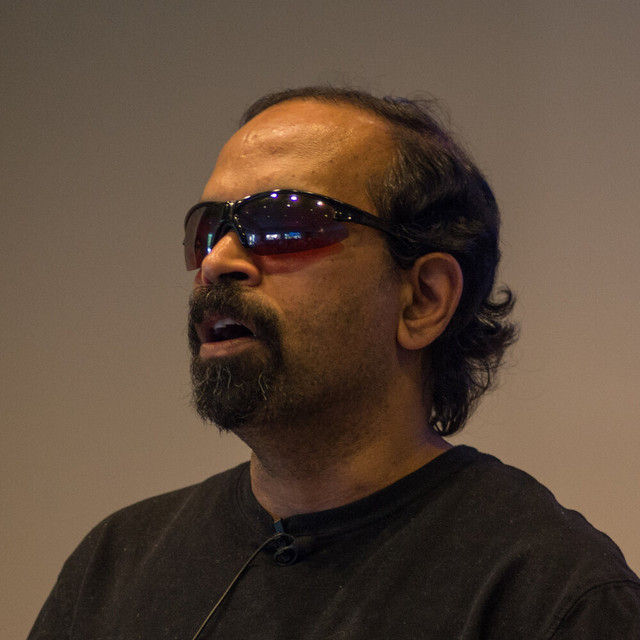
On the Android side, the lead came from a blind engineer. T.V. Raman was born in Pune, India, lost his sight to glaucoma at 14, and joined Google in 2005.172 In April 2009 The New York Times photographed him with his guide dog Hubbell and his colleague Charles Chen, in a piece about the software they'd written for the T-Mobile G1 touchscreen phone. Raman's dialer was clever: wherever his finger first touched the screen counted as 5, and he slid toward the other digits from there; to erase a mistake, he shook the phone. He also found that more sighted people than blind people were using the apps. "People are saying they are using it in their cars."173
That October, Google added its first accessibility API to Android 1.6 and open-sourced a screen reader called TalkBack. Most Android phones then had trackballs, and blind users moved around the interface with them.174 Android 4.0 in 2011 added Explore by Touch: touch once and it tells you what's underneath; touch the same control again to activate it. That mattered, because new phones were dropping hardware keys and putting Back and Home on the screen as virtual buttons.175
How a screen reader "sees" a button
As we saw earlier, desktop screen readers stopped reading the screen long ago; they read the accessibility tree the system hands them. Phones work the same way. Android represents each window's content as a tree of AccessibilityNodeInfo nodes, which doesn't necessarily match the actual view hierarchy one to one.176 On iOS, each element has a label (accessibilityLabel), a value, a hint, and a set of traits saying whether it's a button, a link, a heading, or a slider you can adjust.177
What the screen reader says is assembled from those pieces: the trait says "this is a button," the label says which button. If a developer puts in an icon, say a magnifying glass, and never writes a label, all the user hears is "button." In one test, VoiceOver on every iOS version from 7.1 to 18.6 said only "button" for an image button on a web page with no alt text.178 That is what WebAIM's 30.6% "empty buttons" means. Android's developer docs ask for a contentDescription on every icon, with a tip: write "Submit," not "Submit button," because the screen reader adds the "button" itself.179
The gestures run the other way from what sighted users expect. Drag a finger slowly across the screen and the screen reader announces everything you pass; swipe left or right to move one element at a time; once you've found the one you want, double-tap anywhere on the screen to activate it, without aiming for where it was.180181 For a blind user, where things sit on the screen matters less than the order they come in.
Using a touchscreen without touching
Touchscreens also assume you can tap, pinch and shake. Before iOS 5 added AssistiveTouch in 2011, the tech columnist David Pogue wrote, "it was tough rocks if you had motor-control problems. How are you supposed to shake the phone… if you can't even hold the thing?" Turn on AssistiveTouch and a white dot appears on the screen. Tap it for a floating palette with Home, Lock, Volume, Shake and multi-finger gestures. "All you have to be able to do is tap with a single finger — even a stylus you're holding in your teeth or fist."182
iOS 7 added Switch Control in 2013: the whole phone can be run from a single switch, whether that's an external button, a movement of the body, or a puff into a tube.183 Christopher Hills, from Queensland, Australia, has athetoid cerebral palsy. In a 2012 video he said he kept reading that touchscreens would replace the mouse and keyboard, "and this really scares me." He went on to become an Apple-certified Final Cut Pro editor. Asked what technology had changed, the first thing he thought of was a phone call at 15: "I was able to call mum at work."183
iOS 18 went a step further in 2024, using the front camera to track the eyes: rest your gaze on an element for a moment and it counts as a tap, with no extra hardware.184185
Ears, wired to the phone
Hearing aids used to be islands. In February 2014, GN ReSound launched LiNX, billed as the first "Made for iPhone" hearing aid: calls and music went straight from the phone into the ear with no intermediary gadget, and you could find a lost aid with the phone.186 In August 2018 Google published ASHA, a hearing-aid streaming spec for Android that any manufacturer could build to.187
On September 12, 2024, the U.S. Food and Drug Administration authorized the first over-the-counter hearing aid software: a feature for AirPods Pro, for adults 18 and over with perceived mild to moderate hearing loss. In a 118-person clinical study, people who set it up themselves got about the same benefit as those fitted by a professional.188 The accompanying hearing test uses pure-tone audiometry, the standard clinical method, takes about five minutes, and saves an audiogram that the hearing aid feature then uses to shape sound.189 The WHO estimates that about 1.5 billion people live with some degree of hearing loss, and 430 million of them need rehabilitation.189190
Captions moved into the phone too. Live Caption, launched with the Pixel 4 in October 2019, captions video and audio playing on the phone in real time, entirely on the device, with no connection needed. One Deaf tester said, "Now I don't have to wake up my mom or dad and ask what's being said."191 In 2020 iOS 14 learned to listen around the house, sending a notification when it hears a fire alarm or a doorbell.192
Borrowing a pair of eyes
In January 2015, Hans Jørgen Wiberg, a Dane who began losing his sight at 25, launched Be My Eyes: a blind user points their phone camera at something and gets connected to a random sighted volunteer, who can say whether the milk has expired or what color the shirt is.193 On the first day, a thousand blind people and ten thousand volunteers signed up, and Wiberg says the team was "completely blown away."194 By March 2026 the app had 1 million blind and low-vision users and 10 million volunteers.195 Volunteers have always far outnumbered the people asking for help, which is a nice problem to have.196
In March 2023, Be My Eyes plugged in OpenAI's GPT-4 to build a "Virtual Volunteer": send a photo and ask anything about it. The company's example was a photo of the inside of a fridge: it identifies what's there, suggests recipes and walks you through one, and if it can't answer, it offers to connect you to a human volunteer.197 After seven months of testing with more than 19,000 blind and low-vision beta testers, the feature, now called Be My AI, opened up in September 2023. One tester said she could finally make sense of the photos her family posted to WhatsApp groups with no context at all.198 Be My Eyes is also clear that it does not and should not replace a white cane or a guide dog.198
A controller with no thumbsticks
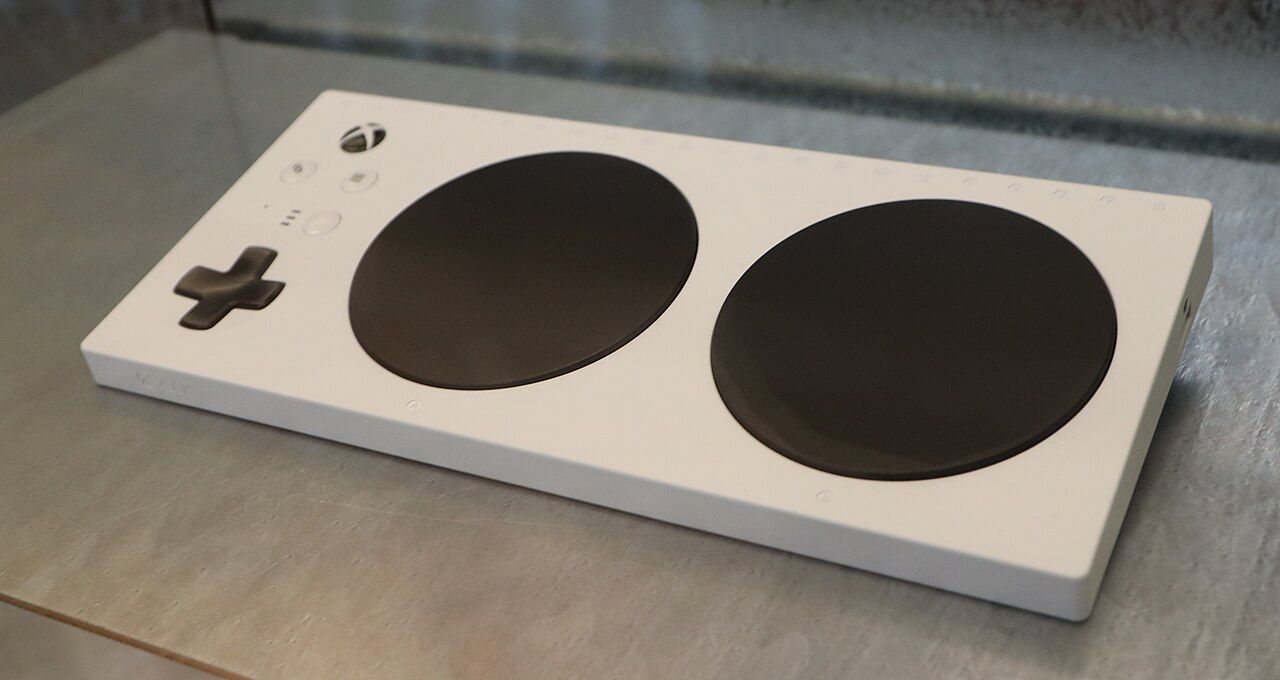
A standard game controller assumes two agile hands and ten working fingers. In May 2018, Microsoft announced the Xbox Adaptive Controller: a flat white slab with two huge round buttons and 19 jacks on the back for foot pedals, sip-and-puff switches, big buttons and other gear.199 It went on sale September 4, 2018, for $99.99, and even the box was redesigned so it could be opened easily with limited mobility.200 The idea traced back to a photo on Twitter of a custom controller made by a nonprofit that helps wounded veterans play games.201 The controller is now in the collection of the Victoria and Albert Museum in London.200
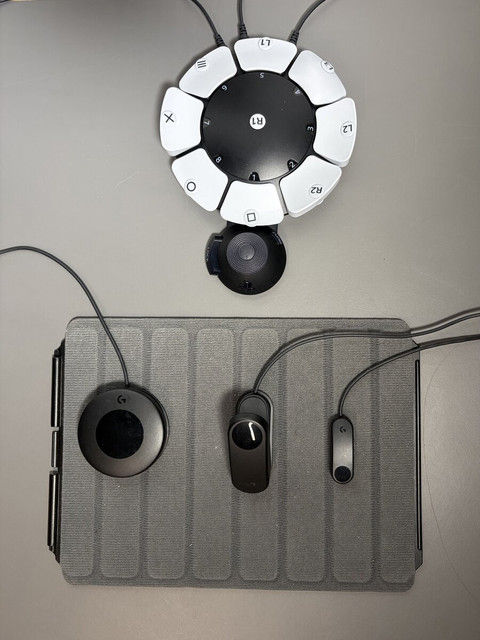
Five years later Sony had its own answer. The PlayStation Access controller, released December 6, 2023 for $89.99, is a round disc that works in any orientation and can sit on a wheelchair tray. It comes with 19 swappable button caps and has four 3.5 mm ports for external switches. Up to two Access controllers and a standard controller can be combined into one virtual controller.202203 It was developed over five years with groups including AbleGamers.202 AbleGamers was founded in 2004 by Mark Barlet, an Air Force veteran, after his best friend was diagnosed with multiple sclerosis.204
Finishing a blockbuster with your eyes closed
The Last of Us Part II, released June 19, 2020, has more than 60 accessibility settings.205 With the vision preset on, menus and on-screen text are read aloud; High Contrast Display mutes the environment and paints allies, enemies and pickups in bold colors; click the left stick and the camera turns toward where the story goes next; gaps you can jump and ledges you can climb each have their own sound cue. The neatest is Enhanced Listen Mode: each scan makes nearby items and enemies sound from where they are, and the pitch tells you whether the target is above or below you.205
Steve Saylor, a blind Canadian streamer, heard the game read its accessibility menu aloud and "couldn't stop crying for a solid 10 minutes." "We will be looking back at this moment," he said, "as accessibility before The Last of Us Part II and after The Last of Us Part II."206 Just over a week after release, the fully blind player SightlessKombat tweeted that he had finished the whole game "with no sighted assistance. This is the first time I've been able to achieve this in a videogame."207 That December, The Game Awards introduced an Innovation in Accessibility award, and the first one went to this game.208
Playing Street Fighter by ear
Fighting games run on split-second reactions, which makes them look like the hardest genre to play blind. Sven van de Wege, from the Netherlands, lost his optic nerves to a brain tumor at age six. In October 1993 he tried Street Fighter II and found that, even without seeing the screen, he could work out what was happening from the sound effects alone.209 He later took the name "BlindWarriorSven."
Street Fighter 6, released in June 2023, turned that kind of listening into a system. Capcom had three fully blind players from ePARA, a Japanese accessible-esports company, test the game, and added a set of sound accessibility options.210 One tone plays constantly: the farther you are from your opponent, the lower it gets and the longer the gap between beeps; the closer, the higher and faster, and you can tell which side of the opponent you're on. Hits that land high, mid and low each have their own sound effect, and so do cross-ups and how full each gauge is.211210 At EVO in Las Vegas that August, Sven played E. Honda and won a match 2–1 on stage to loud cheers.212
People were doing this in China too. On April 25, 2019, Tencent's TiMi Studios released two charity games. Changkong Anying (Shadow in the Sky) was billed as the country's first sound-only game designed for blind players: you're a pilot with injured eyes, dodging missiles by stereo and finding enemy jets by radar tones. The other, Jian (See), worked the other way, letting sighted players experience low vision and walking with a white cane, down a street where the tactile paving is blocked.213
One man in twelve
Among people of Northern European ancestry, about 1 in 12 men and 1 in 200 women have red-green color vision deficiency.214 For a game that marks enemies with red dots and teammates with green ones, that's a lot of players. Games usually do one of two things: recolor the key interface elements, or lay a filter over the whole screen. The Game Accessibility Guidelines prefer the first, calling full-screen filters "a blunt instrument" that changes colors that didn't need changing. Safest of all is never letting color carry essential information by itself; where color is unavoidable, orange against blue works for the three most common types.215 Those guidelines were launched in 2012 by a group led by designer Ian Hamilton, who put it this way: "So much of it is just good game design."216
Hawking's cheek
The devices so far let people use machines. Another kind of device is the person's voice.
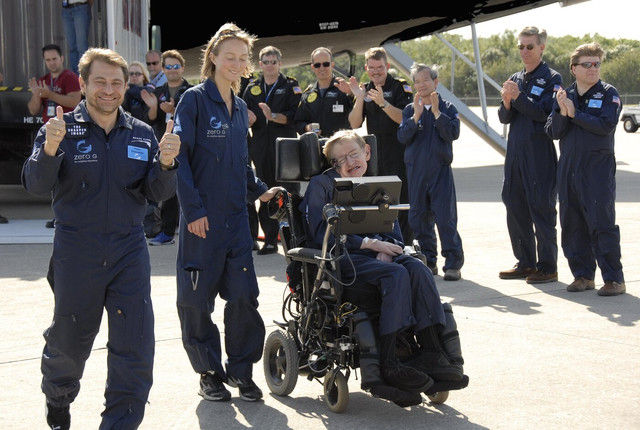
In 1985, Stephen Hawking caught pneumonia on a visit to CERN and had a tracheotomy in Cambridge that took away his ability to speak for good. For a while he communicated with a spelling card: someone pointed at letters, and he raised his eyebrows to pick one.217 Walt Woltosz of Words Plus in California had written a program called Equalizer for his mother-in-law, who had ALS. "I said I would donate whatever was needed." It first ran on an Apple II connected to a Speech Plus synthesizer, and Hawking chose words with a hand clicker, at about 15 words a minute.217
The voice the whole world recognized was made in the early 1980s by MIT engineer Dennis Klatt and was called "Perfect Paul." In 1988 Speech Plus gave Hawking a CallText 5010, and when its voice came out different, he asked them to put the original back.217 Hawking called it the best he had heard, "although it gives me an accent that has been described variously as Scandinavian, American or Scottish."218
By 2008 his hand was too weak for the clicker. An assistant mounted an infrared "cheek switch" on his glasses that detected when he tensed his cheek muscle.217 A cursor scanned across an on-screen keyboard by row and column, and when it reached the letter he wanted, he moved his cheek. "This switch is my only interface with the computer," he wrote.218 By 2011 he managed only one or two words a minute. When an Intel team first met him in 2012, it took him 20 minutes to write a greeting of about 30 words.217
Intel worked with him for three years on ACAT, the Assistive Context-Aware Toolkit, which brought in SwiftKey's word prediction, trained on Hawking's own writing: select "the" and it guesses "black," then "hole." His typing became twice as fast, common tasks ten times faster, and he had to type fewer than 20% of the characters himself.219217 In 2015 Intel open-sourced ACAT, free for anyone to use.220
Turning thoughts straight into words
Hawking's approach was to find one muscle somewhere in the body that still worked. For people with late-stage ALS or a brainstem stroke, even that one may be gone. Eye trackers can take over for a while, but they get harder to use as muscle control fades.221 The American Speech-Language-Hearing Association cites an estimate that about 97 million people worldwide may benefit from augmentative and alternative communication.222
On August 23, 2023, Nature published two papers on the same day. A Stanford team implanted four microelectrode arrays in the cortex of Pat Bennett, 68, who has ALS. When she tried to speak, the computer decoded the 39 phonemes of English from her neural signals and assembled them into sentences, at 62 words a minute, 3.4 times the previous record; natural conversation runs at about 160. With a 125,000-word vocabulary the error rate was 23.8%, which the researchers admit isn't yet low enough for everyday use.223224 The other paper came from UC San Francisco. Ann, who lost her speech to a brainstem stroke at 30, had been typing with head movements at 14 words a minute. Researchers placed a thin sheet of 253 electrodes on the surface of her brain, and the system turned what she was trying to say into text at a median of 78 words a minute, rebuilt her voice from a recording of her wedding speech, and gave her an animated avatar with facial expressions. Hearing the synthesized voice, she said, was "like hearing an old friend."225226
In August 2024, a UC Davis team published in the New England Journal of Medicine. Twenty-five days after his implant, and after only 30 minutes of calibration, Casey Harrell, 45, who has ALS, reached 99.6% accuracy on a 50-word vocabulary. Over the next eight months and more he used it for more than 248 hours of conversation, at 97.5% accuracy, in a voice synthesized from recordings made before his illness. The paper notes that the first live session "elicited tears of joy from the participant and his family."221227 "Not being able to communicate is so frustrating and demoralizing," Harrell said. "It is like you are trapped."227
From a spelling card to an infrared switch on a pair of glasses to electrodes under the skull took less than forty years.
Invisible disabilities: a sunflower lanyard
Not every disability shows. Autism, dementia, hearing loss, chronic pain: someone can look like everyone else and still need a bit more time or patience.
By 2016, the accessibility team at London's Gatwick Airport was helping more than 500,000 passengers a year, and wondered about the ones whose needs didn't show.228 Working with the Alzheimer's Society, the National Autistic Society and others, they designed a green lanyard printed with sunflowers. It launched at Gatwick in May 2016, during Dementia Awareness Week: wear it, and staff know you or someone with you may need help, without your having to explain.229 Ten years later, more than 95 countries recognize the symbol.230
9. Written into law and treaties
- UN Convention on the Rights of Persons with Disabilities: adopted by the General Assembly on December 13, 2006, in force since May 3, 2008.231 It drew 82 signatories on its opening day, the most for any UN convention.232 It now has 194 parties.233
- The Marrakesh Treaty: only about 1% to 7% of the world's published books exist in formats blind people can read, a shortage called the "book famine."234 Before the treaty, charities in five English-speaking countries, including the UK's RNIB and Vision Australia, each had to make their own braille master of the same Harry Potter book, because copyright law wouldn't let them share.235 The treaty, adopted June 27, 2013, created copyright exceptions so accessible copies can be made and shared across borders.236 China ratified it in 2022, and the China Braille Library has since joined the global accessible book exchange.237
- China, from a design code to the Paralympics: on April 1, 1989, China's first accessibility design standard, the Code for Design of Urban Roads and Buildings Accessible to the Disabled (JGJ 50-88), took effect on a trial basis. It focused on people with lower-limb and visual disabilities and applied to new roads and major public buildings in big cities, open coastal cities and key tourist cities.238 In 2004, Beijing passed the country's first local regulation on accessibility.239 For the 2008 Paralympics, Beijing upgraded more than 6,000 facilities, as much accessibility work as the previous 20 years combined,240 set up China's first accessible taxi fleet, and made the Great Wall and the Forbidden City passable for wheelchair users.241
- China's Barrier-Free Environment Construction Law: passed June 28, 2023, effective September 1, 2023, with 8 chapters and 72 articles; China's first dedicated national law on accessibility.242243 Some provisions are refreshingly concrete: drug makers must provide labels and package inserts in accessible formats such as audio, large print, braille or electronic versions, and the state supports adding elevators to older walk-up apartment buildings (82,000 were added from 2018 to 2022).244 One line is worth remembering: people other than the disabled and elderly who have accessibility needs may also enjoy the benefits of an accessible environment.245
10. There's no such thing as a "normal user"
Around 1985, the American architect Ronald Mace coined the term "universal design." Polio at age nine had put him in a wheelchair for the rest of his life.246 In 1997, a group he led published the seven Principles of Universal Design. The first is "Equitable Use: the design is useful and marketable to people with diverse abilities."247
His point was simple: there is no standard user. Holding a baby, you're a one-handed user. In a loud bar, you're hard of hearing. For two months with a broken leg, you have limited mobility. And in old age, most of us will be a bit of everything. By the UN's count, more than 1.3 billion people worldwide live with some form of disability.248
So the next time you roll a suitcase down a curb cut, watch a video with captions on the subway, or have your phone read a message aloud, it's worth knowing that these conveniences were first built for someone else, and then became yours.
Those 230 blocks in Okayama started out as a favor for one friend who was losing his sight.
Footnotes
-
Japan Up Close, "Japan's 'tenji blocks' pave the way for greater accessibility", 2021. https://japanupclose.web-japan.org/tech/t20211008_1.html ↩ ↩2
-
JAPAN Forward, "How Japanese Inventor of Tenji Blocks Changed the Lives of Millions Around the World", 2019. https://japan-forward.com/how-japanese-inventor-of-tenji-blocks-changed-the-lives-of-millions-around-the-world/ ↩ ↩2 ↩3
-
WIPO Magazine, "Bicentenary of Louis Braille – The world at our fingertips". https://www.wipo.int/en/web/wipo-magazine/articles/bicentenary-of-louis-braille-the-world-at-our-fingertips-36832 ↩
-
"The Invention of Braille", PMC. https://pmc.ncbi.nlm.nih.gov/articles/PMC3036681/ ↩
-
Wikipedia, "Louis Braille". https://en.wikipedia.org/wiki/Louis_Braille ↩ ↩2
-
Library of Congress, "Louis Braille: His Legacy and Influence". https://www.loc.gov/exhibits/louis-braille/overview.html ↩ ↩2
-
Louis Braille, Procedure for Writing Words, Music and Plain-song Using Dots (1829), English translation. https://www.duxburysystems.org/downloads/library/history/lb_1829/english.htm ↩
-
Bruns P. et al., tactile acuity across the lifespan, PLOS ONE, 2014. https://journals.plos.org/plosone/article?id=10.1371%2Fjournal.pone.0087384 ↩
-
National Library Service for the Blind (Library of Congress), "About Braille" reference guide (archived). https://permanent.fdlp.gov/gpo57822/www.loc.gov/nls/reference/guides/braille.html ↩ ↩2
-
Frances Koestler, The Unseen Minority, Chapter 8, American Foundation for the Blind. https://afb.org/about-afb/history/online-library/unseen-minority/chapter-8 ↩
-
Braille Authority of North America, "Size and Spacing of Braille Characters" (quoting NLS Specification 800). https://www.brailleauthority.org/size-and-spacing-braille-characters ↩
-
Braille Authority of North America, "Braille Basics: Alphabet and Numbers". https://www.brailleauthority.org/alphabet/alphabet.pdf ↩ ↩2
-
Legge, Madison & Mansfield, "Measuring Braille reading speed with the MNREAD test", 1999. https://legge.psych.umn.edu/sites/legge.psych.umn.edu/files/files/media/legge99_measuring_braille_reading_speed_with_the_mnread_test.pdf ↩ ↩2
-
Braille Authority of North America, position statement on the use of the braille slate and stylus. https://www.brailleauthority.org/use-braille-slate-and-stylus ↩
-
American Foundation for the Blind, "Braille Writing Devices". https://www.afb.org/blindness-and-low-vision/using-technology/assistive-technology-videos/braille-writing-devices-0 ↩
-
Perkins School for the Blind, "Howe Press & the Perkins Brailler". https://www.perkins.org/howe-press-the-perkins-brailler/ ↩
-
Wikipedia, "Refreshable braille display". https://en.wikipedia.org/wiki/Refreshable_braille_display ↩
-
American Printing House for the Blind, "Blindness History Basics: A Brief History of the Refreshable Braille Display", 2024. https://www.aph.org/blog/blindness-history-basics-a-brief-history-of-the-refreshable-braille-display/ ↩
-
教育部,《国家通用盲文方案》《国家通用手语常用词表》答记者问,2018. https://www.moe.gov.cn/jyb_xwfb/s271/201805/t20180521_336624.html ↩ ↩2
-
GB/T 15720-2008《中国盲文》(全文转载). https://www.bzchaxun.com/view/6130050003000000.html ↩
-
Wikipedia, "Pellegrino Turri". https://en.wikipedia.org/wiki/Pellegrino_Turri ↩ ↩2
-
The Epoch Times, "TIMELINES: … April 30, 1808", 2012. https://www.theepochtimes.com/article/timelines-what-predecessor-to-the-computer-was-built-by-an-italian-inventor-april-30-1808-1485915 ↩
-
The Economist, "Fade to black", 2013-01-26. https://www.economist.com/international/2013/01/26/fade-to-black ↩
-
Library of Congress NLS, "History". https://www.loc.gov/nls/who-we-are/history ↩
-
Library of Congress Information Bulletin, "NLS at 75", 2006-11. https://www.loc.gov/loc/lcib/0611/nls.html ↩
-
Library of Congress NLS, "Overview". https://www.loc.gov/nls/who-we-are/overview/ ↩
-
Wikipedia, "Charles-Michel de l'Épée". https://en.wikipedia.org/wiki/Charles_Michel_de_l'%C3%89p%C3%A9e ↩
-
Yale University Library, "Beginnings: The American School for the Deaf". https://onlineexhibits.library.yale.edu/s/deaf-culture/page/asd ↩ ↩2
-
Connecticut State Register & Manual 2017 dedication. https://portal.ct.gov/-/media/sots/register-manual-_-bluebook/dedication/2017dedicationweb.pdf ↩
-
Ministry of Education of China, announcement of the National Common Sign Language Vocabulary and National Common Braille Scheme (in Chinese), 2018-05-21. https://www.moe.gov.cn/jyb_xwfb/gzdt_gzdt/s5987/201805/t20180521_336625.html ↩
-
Guangming Daily, "National standards for sign language and braille released" (in Chinese), 2018-05-24; Ministry of Education, "Sign language gets its 'Mandarin', braille gets its 'standard script'" (in Chinese), 2018-08-16. https://news.gmw.cn/2018-05/24/content_28941474.htm ;http://www.moe.gov.cn/jyb_xwfb/s5147/201808/t20180816_345381.html ↩
-
Perkins School for the Blind, "Helen Keller". https://www.perkins.org/helen-keller/ ↩
-
American Foundation for the Blind, "Teaching Helen" (includes Sullivan's 1887 letter). https://www.afb.org/about-afb/history/online-museums/anne-sullivan-miracle-worker/anne-teacher/teaching-helen ↩
-
Perkins School for the Blind, "Helen Keller timeline". https://www.perkins.org/resource/helen-keller-timeline/ ↩
-
Gallaudet University, "I. King Jordan Bio". https://gallaudet.edu/museum/history/i-king-jordan-bio ↩
-
Gallaudet University, "Events leading up to DPN". https://gallaudet.edu/museum/history/the-deaf-president-now-dpn-protest/events-leading-up-to-dpn/ ↩
-
Wikipedia, "Deaf President Now". https://en.wikipedia.org/wiki/Deaf_President_Now ↩
-
The Washington Post, "Gallaudet U. Selects First Deaf President", 1988-03-14. https://www.washingtonpost.com/archive/politics/1988/03/14/gallaudet-u-selects-first-deaf-president/846fd592-9638-4c53-86d6-2dea3931034e/ ↩
-
Wellcome Collection, "The unimprovable white cane", 2021. https://wellcomecollection.org/stories/the-unimprovable-white-cane ↩ ↩2
-
Wikipedia, "White cane". https://en.wikipedia.org/wiki/White_cane ↩
-
The Seeing Eye, "The Seeing Eye's Early Beginnings: Morris Frank". https://seeingeye.org/the-seeing-eyes-early-beginnings-morris-frank ↩
-
The Seeing Eye, "The Seeing Eye's Early Beginnings: Buddy". https://seeingeye.org/the-seeing-eyes-early-beginnings-buddy/ ↩
-
The Seeing Eye, "Our History" / "About Us". http://seeingeye.org/about-us/our-history ↩
-
Mental Floss, "How Seiichi Miyake and Tactile Paving Changed the World", 2019. https://www.mentalfloss.com/culture/design/seiichi-miyake-and-tactile-paving-google-doodle ↩
-
Wikipedia, "Tactile paving". https://en.wikipedia.org/wiki/Tactile_paving ↩
-
Anniversary DB, "Tactile Paving Day (March 18)". https://kinenbi-db.com/en/anniversaries/67/ ↩
-
日本視覚障害者団体連合, "視覚障害者誘導用ブロック". http://nichimou.org/impaired-vision/barrier-free/induction-block ↩ ↩2
-
Bentzen B.L. et al., review of research on tactile walking surface indicators (NIDILRR), 2021. https://www.pedbikeinfo.org/downloads/TWSI%20review-Bentzen-NIDILRR.pdf ↩ ↩2 ↩3 ↩4 ↩5
-
JIS T 9251:2014, guidelines for tactile walking surface indicators (full text, in Japanese). https://kikakurui.com/t9/T9251-2014-01.html ↩
-
国土交通省, JIS T 9251:2014 dimensions table. https://www.mlit.go.jp/common/001392062.pdf ↩
-
ISO 23599:2019, Assistive products for blind and vision-impaired persons — Tactile walking surface indicators (preview). https://cdn.standards.iteh.ai/samples/76106/b2b91d36fab84a3e9e9de44a2fa03631/ISO-23599-2019.pdf ↩ ↩2
-
Study comparing two-point-touch and constant-contact long cane techniques, PMC3013510. https://pmc.ncbi.nlm.nih.gov/articles/PMC3013510 ↩
-
Minami et al., Human Studies, 2023. https://link.springer.com/article/10.1007/s10746-023-09690-6 ↩
-
GB 50763-2012《无障碍设计规范》(转载). https://gf.cabr-fire.com/article-47368.htm ↩
-
日本財団・交通エコロジー・モビリティ財団, 2002 report on platform-edge tactile blocks with an inner line. https://nippon.zaidan.info/seikabutsu/2002/01234/contents/001.htm ↩
-
内閣府『交通安全白書』令和元年版, topic 15 (platform safety). https://www8.cao.go.jp/koutu//taisaku/r01kou_haku/zenbun/genkyo/topics/topic_15.html ↩
-
央视网,2021-05-17. https://jingji.cctv.com/2021/05/17/ARTIGYf7U21AA90mmqHKfXx2210517.shtml ↩
-
人民网,2025-11-24. http://cpc.people.com.cn/n1/2025/1124/c64387-40609935.html ↩
-
GB 55019-2021《建筑与市政工程无障碍通用规范》(转载). https://gf.cabr-fire.com/article-41102.htm ↩
-
Smithsonian National Museum of American History, "Wheelchair" (Everest & Jennings). https://americanhistory.si.edu/collections/object/nmah_723750 ↩
-
Wikipedia, "Everest and Jennings". https://en.wikipedia.org/wiki/Everest_and_Jennings ↩ ↩2
-
Science Museum, "The History of the wheelchair". https://www.sciencemuseum.org.uk/objects-and-stories/history-wheelchair ↩
-
Kalamazoo Public Library, "Curb Cuts Come to Kalamazoo". https://www.kpl.gov/local-history/kalamazoo-history/general/curb-cuts-come-to-kalamazoo/ ↩
-
Smithsonian National Museum of American History, "Smashing barriers to access", 2015. https://americanhistory.si.edu/explore/stories/smashing-barriers-access-disability-activism-and-curb-cuts ↩
-
HISTORY, "The Activist Who Helped Bring Curb Cuts to America's Streets", 2026. https://www.history.com/articles/hale-zukas-disability-rights-activist-curb-cuts ↩
-
Angela Glover Blackwell, "The Curb-Cut Effect", Stanford Social Innovation Review, 2016. https://ssir.org/articles/entry/the_curb_cut_effect ↩ ↩2 ↩3
-
99% Invisible, "Curb Cuts". https://99percentinvisible.org/episode/308-curb-cuts/ ↩
-
The Berkeley Revolution, "Resolution 45,605". https://revolution.berkeley.edu/resolution-45605 ↩
-
Rehabilitation International, "Symbol of Accessibility" fact sheet. https://www.riglobal.org/wp-content/uploads/2016/03/RI-Fact-Sheet-Symbol-of-Accessibility.pdf ↩
-
U.S. Access Board, "Guidance on the International Symbol of Accessibility". https://www.access-board.gov/aba/guides/guidance-on-the-isa ↩
-
Scientific American, "Editing the City", 2011. https://www.scientificamerican.com/blog/oscillator/editing-the-city/ ↩
-
NPR, "504 Sit-In: Winning Rights for the Disabled", 2002. https://www-s1.npr.org/2002/04/28/1142484/504-sit-in-winning-rights-for-the-disabled ↩
-
U.S. National Park Service, "504 Protest: Disability, Community, and Civil Rights". https://www.nps.gov/articles/000/504-protest-disability-community-and-civil-rights.htm ↩
-
Smithsonian, "Sitting in for disability rights: The Section 504 protests of the 1970s". https://americanhistory.si.edu/explore/stories/sitting-disability-rights-section-504-protests-1970s ↩
-
KCUR, 2025-08-04. https://www.kcur.org/history/2025-08-04/section-504-judy-heumann-rebekah-taussig-disability-rights ↩
-
Wikipedia, "504 Sit-in". https://en.wikipedia.org/wiki/504_Sit-in ↩
-
Disability Social History Project, "The 504 Protests and the Black Panther Party". https://disabilityhistory.org/2021/12/19/the-504-protests-and-the-black-panther-party/ ↩
-
Global Nonviolent Action Database, Swarthmore College. https://nvdatabase.swarthmore.edu/node/5092 ↩ ↩2
-
RTD Denver, "'We Will Ride': Historic events of 45 years ago recognized", 2023-07-06. https://www.rtd-denver.com/community/news/2023/we-will-ride-historic-events-of-45-years-ago-recognized ↩
-
NPR, "In 1978, they stopped buses — and helped launch a disability rights movement", 2026-03-19. https://www.npr.org/2026/03/19/nx-s1-5675264/how-an-act-of-civil-disobedience-in-1978-denver-helped-propel-disability-rights ↩
-
RTD Denver, "RTD employee shares story of grandmother's experience with first wheelchair-accessible RTD bus". https://www.rtd-denver.com/community/news/rtd-employee-shares-story-of-grandmother-s-experience-with-first-wheelchair-accessible-rtd-bus ↩
-
Colorado Public Radio, "In 1978, Denver buses and the disability rights movement", 2026-04-06. https://www.cpr.org/2026/04/06/1978-denver-buses-disability-rights-movement/ ↩
-
HISTORY, "When the 'Capitol Crawl' Dramatized the Need for the ADA", 2020. https://www.history.com/articles/americans-with-disabilities-act-1990-capitol-crawl ↩
-
Mother Jones, 2015-07-25. https://www.motherjones.com/politics/2015/07/americans-disabilities-act-capitol-crawl-anniversary ↩
-
International Paralympic Committee, "Paralympics History". https://www.paralympic.org/ipc/history ↩ ↩2
-
IPC, "Stoke Mandeville 70: Recreating the Games". https://www.paralympic.org/news/stoke-mandeville-70-recreating-games ↩
-
Gallaudet University Museum, "How TTYs made telephones accessible to the Deaf". https://gallaudet.edu/museum/exhibits/history-through-deaf-eyes/awareness-access-and-change/how-ttys-made-telephones-accessible-to-the-deaf ↩ ↩2
-
RIT Distinctive Collections, "Robert H. Weitbrecht and James C. Marsters TTY modem". https://archivesspace.rit.edu/repositories/2/resources/863 ↩
-
Wikipedia, "Robert Weitbrecht". https://en.wikipedia.org/wiki/Robert_Weitbrecht ↩
-
ATIS Telecom Glossary, "voice frequency (VF)". https://glossary.atis.org/glossary/voice-frequency-vf ↩
-
U.S. Office of Technology Assessment, 1982 case study on the development of TTY networks for deaf people. https://www.princeton.edu/~ota/disk3/1982/8225/822505.PDF ↩ ↩2 ↩3 ↩4
-
TIA/EIA-825 draft, 45.45 baud FSK modem for TTY. https://www.3gpp.org/ftp/workshop/Archive/0104GTT/Docs/PDF/GTT-010031.pdf ↩ ↩2
-
Gallaudet University Technology Access Program, "TTY Basics for Engineers/Product Designers". https://tap.gallaudet.edu/Text/TTYBasics.html ↩ ↩2 ↩3 ↩4
-
TDI, Teletypewriters Made Easy (1974), via SMECC. https://www.smecc.org/teletypewriters_made_easy.htm ↩ ↩2 ↩3
-
Wikipedia, "Telecommunications device for the deaf". https://en.wikipedia.org/wiki/Telecommunications_device_for_the_deaf ↩
-
FCC, "Telecommunications Relay Service (TRS)". https://www.fcc.gov/consumers/guides/telecommunications-relay-service-trs ↩ ↩2 ↩3
-
Federal Register, "Require 711 Dialing for Nationwide Access to Telecommunications Relay Services", 2000. https://www.federalregister.gov/documents/2000/09/11/00-23156/require-711-dialing-for-nationwide-access-to-telecommunications-relay-services ↩
-
FCC, "Real-Time Text". https://www.fcc.gov/real-time-text ↩
-
NIDCD (NIH), "Captions For Deaf and Hard-of-Hearing Viewers". https://www.nidcd.nih.gov/health/captions-deaf-and-hard-hearing-viewers ↩
-
National Captioning Institute, "History of Closed Captioning". https://www.ncicap.org/history-of-cc ↩ ↩2 ↩3 ↩4
-
FCC 95-484. https://docs.fcc.gov/public/attachments/FCC-95-484A1.pdf ↩
-
Malcolm J. Norwood, "Captioning for Deaf People: An Historical Overview", 1988, DCMP. https://dcmp.org/learn/80-captioning-for-deaf-people-an-historical-overview ↩ ↩2 ↩3
-
ANSI/CTA-608-E, Line 21 Data Services (transcription). https://decode-orc.github.io/analogue-video-specifications/video_metadata/ANSI-CTA-608-E-S-2019/ANSI-CTA-608-E-S-2019/ ↩
-
47 CFR 15.119, Closed caption decoder requirements for television receivers. https://www.govinfo.gov/content/pkg/CFR-2011-title47-vol1/xml/CFR-2011-title47-vol1-sec15-119.xml ↩ ↩2 ↩3
-
NCRA, "The Evolution of Captioning". https://www.ncra.org/home/the-profession/Captioning/Captioning-Resources-Networking/Captioning-Business-Resources/The-Evolution-of-Captioning ↩
-
PEPNet tipsheet, "Real-time captioning (CART)". https://www.csi.cuny.edu/sites/default/files/pdf/csa/rcd/CART.pdf ↩
-
Wikipedia, "Stenotype". https://en.wikipedia.org/wiki/Stenotype ↩
-
NCRA, "Certified Realtime Captioner (CRC)". https://www.ncra.org/certification/NCRA-Certifications/certified-realtime-captioner ↩
-
Universal Access in the Information Society, 2022, on live captioning and respeaking. https://link.springer.com/article/10.1007/s10209-022-00926-3 ↩
-
Google Research Blog, "Automatic captioning in YouTube", 2009-12-04. https://www.research.google/blog/automatic-captioning-in-youtube ↩
-
YouGov, "American adults under 30 are more likely to watch TV with subtitles", 2023. https://yougov.com/en-us/articles/45987-american-adults-under-30-watching-tv-subtitles ↩
-
Stagetext, "YouGov survey supports Stagetext's findings". https://www.stagetext.org/news/yougov-survey-supports-stagetexts-findings ↩
-
American Foundation for the Blind, Ray Kurzweil interview, Part 4. https://afb.org/blindness-and-low-vision/using-technology/interviews-technology-pioneers/ray-kurzweil/part-4-4 ↩ ↩2
-
AccessWorld, "The Man and the Machine: An Interview with Ray Kurzweil". https://afb.org/aw/5/5/14692 ↩
-
Kurzweil Technologies, "Kurzweil Computer Products". https://www.kurzweiltech.com/kcp.html ↩
-
AccessWorld, "A History of Accessibility at IBM". https://afb.org/aw/5/2/14760 ↩
-
Jim Thatcher, "About the authors". https://jimthatcher.com/book2/about-authors.html ↩
-
Wikipedia, "James W. Thatcher". https://en.wikipedia.org/wiki/James_W._Thatcher ↩
-
Wikipedia, "VGA text mode". https://en.wikipedia.org/wiki/VGA_text_mode ↩
-
Neill Hadder, "Accessibility APIs, part 2", Knowbility, 2023. https://knowbility.org/blog/2023/accessibility-apis-part-2 ↩ ↩2 ↩3 ↩4
-
Curtis Chong, Braille Monitor, January 1986. https://nfb.org/sites/nfb.org/files/images/nfb/publications/bm/bm86/bm8601/bm860112.htm ↩
-
Wikipedia, "Screen reader". https://en.wikipedia.org/wiki/Screen_reader ↩
-
Wikipedia, "Microsoft Active Accessibility". https://en.wikipedia.org/wiki/Microsoft_Active_Accessibility ↩
-
Wikipedia, "VoiceOver". https://en.wikipedia.org/wiki/VoiceOver ↩
-
Wikipedia, "Assistive Technology Service Provider Interface". https://en.wikipedia.org/wiki/Assistive_Technology_Service_Provider_Interface ↩
-
MDN Web Docs, "Accessibility tree". https://developer.mozilla.org/en-US/docs/Glossary/Accessibility_tree ↩
-
W3C, "Accessible Rich Internet Applications (WAI-ARIA) 1.0", 2014. https://www.w3.org/TR/2014/REC-wai-aria-20140320/ ↩
-
WebAIM, "Alternative Text". https://webaim.org/techniques/alttext/ ↩
-
Bragg, Reinecke & Ladner, ACM Transactions on Accessible Computing, 2021. https://dl.acm.org/doi/fullHtml/10.1145/3461700 ↩
-
WebAIM, "Screen Reader User Survey #11 Results", 2026. https://webaim.org/projects/screenreadersurvey11/ ↩
-
IEEE Spectrum, "The Long Road to Today's Cochlear Implant", 2022-01-27. https://spectrum.ieee.org/cochlear-implant-history ↩
-
Encyclopedia of Australian Science and Innovation, "Saunders, Rod". https://eoas.info/biogs/P005544b.htm ↩
-
University of Sydney Faculty of Medicine Online Museum, "Clark, Graeme M". https://www.sydney.edu.au/medicine/museum/mwmuseum/index.php/Clark,_Graeme_M ↩
-
University of Melbourne, "Turning silence into sound", 2026-04-16. https://mdhs.unimelb.edu.au/150/impact/cochlear ↩
-
U.S. Army Aeromedical Research Laboratory, "Basic Anatomy of the Hearing System". https://usaarl.health.mil/assets/docs/hmds/Section-15-Chapter-8-Ear-Anatomy.pdf ↩ ↩2
-
Lasker Foundation, 2013 Clinical Medical Research Award: Modern cochlear implant. https://laskerfoundation.org/winners/modern-cochlear-implant/ ↩ ↩2 ↩3 ↩4 ↩5 ↩6 ↩7
-
国家医疗保障局转载《人民日报》,人工耳蜗专访,2025-04-17. https://www.nhsa.gov.cn/art/2025/4/17/art_52_16292.html ↩ ↩2
-
NIDCD (NIH), "Cochlear Implants". https://www.nidcd.nih.gov/health/cochlear-implants ↩ ↩2
-
Hainarosie M. et al., history of cochlear implants, Journal of Medicine and Life, 2014. https://europepmc.org/article/PMC/PMC4391344 ↩ ↩2
-
Fan-Gang Zeng, "Celebrating the one millionth cochlear implant", JASA Express Letters, 2022. https://pubs.aip.org/asa/jel/article/2/7/077201/2844572/ ↩ ↩2 ↩3
-
Wilson B.S. et al., Progress in Brain Research, 2011. https://sites.duke.edu/woldorfflab/files/2024/02/Wilson_ProgBrRes_2011.pdf ↩ ↩2
-
Saba et al., formant priority channel selection, JASA, 2018. https://crss.utdallas.edu/CILab/Publications/Saba%20(2018)%20-%20Formant%20priority%20channel%20selection.pdf ↩
-
NIDCD, "Quick Statistics About Hearing". https://www.nidcd.nih.gov/health/statistics/quick-statistics-hearing ↩
-
Xinhua via english.gov.cn, 2024-12-20. https://english.www.gov.cn/news/202412/20/content_WS6764c234c6d0868f4e8ee23e.html ↩
-
Wellcome Collection, "The joys and failures of audio description", 2021-12-02. https://wellcomecollection.org/articles/YaTnkRAAACEAAm-7 ↩
-
Metropolitan Washington Ear, "In Memorial". https://www.washear.org/in-memorial/ ↩
-
American Council of the Blind, "In Memoriam: Margaret R. Pfanstiehl". https://www.acb.org/memoriam-margaret-pfanstiehl ↩
-
People's Daily Overseas Edition, "Building a cultural 'tactile path' straight to the heart" (in Chinese), 2023-05-24. http://paper.people.com.cn/rmrbhwb/html/2023-05/24/content_25987817.htm ↩ ↩2
-
Beijing News, "The man who built a cinema for the blind" (in Chinese), 2022. https://www.bjnews.com.cn/detail/165128768214897.html ↩
-
W3C press release, 1999-05-05. https://www.w3.org/press-releases/1999/wcag/ ↩
-
W3C, WCAG 2.0. https://www.w3.org/TR/WCAG20/ ↩
-
W3C WAI, "WCAG 2.2 is a Web Standard", 2023-10-05. https://www.w3.org/WAI/news/2023-10-05/wcag22rec ↩
-
Wikipedia, "Web Content Accessibility Guidelines". https://en.wikipedia.org/wiki/WCAG ↩
-
AccessibleEU, "WCAG 2.2 is officially a W3C recommendation", 2023. https://accessible-eu-centre.ec.europa.eu/content-corner/news/wcag-22-officially-w3c-recommendation-2023-10-06_en ↩
-
W3C WAI, "Understanding Success Criterion 1.4.3: Contrast (Minimum)". https://www.w3.org/WAI/WCAG22/Understanding/contrast-minimum.html ↩ ↩2 ↩3
-
WebAIM, "The WebAIM Million: The 2026 report on the accessibility of the top 1,000,000 home pages", 2026-03-30. https://webaim.org/projects/million/ ↩ ↩2 ↩3
-
National Federation of the Blind, "National Federation of the Blind and Target Agree to Class Action Settlement", 2008-08-27. https://nfb.org/about-us/press-room/national-federation-blind-and-target-agree-class-action-settlement ↩
-
CNBC, "Supreme Court hands victory to blind man who sued Domino's over site accessibility", 2019-10-07. https://www.cnbc.com/2019/10/07/dominos-supreme-court.html ↩
-
Federal Trade Commission, "FTC Order Requires Online Marketer to Pay $1 Million for Deceptive Claims that its AI Product Could Make Websites Compliant with Accessibility Guidelines", 2025-01-03. https://www.ftc.gov/news-events/news/press-releases/2025/01/ftc-order-requires-online-marketer-pay-1-million-deceptive-claims-its-ai-product-could-make-websites ↩
-
EUR-Lex, "Accessibility of products and services" (summary of Directive (EU) 2019/882). https://eur-lex.europa.eu/EN/legal-content/summary/accessibility-of-products-and-services.html ↩
-
gov.cn, MIIT notice issuing the Special Action Plan for Age-Friendly and Accessible Internet Applications (Gongxinbu Xinguan [2020] No. 200) (in Chinese), 2020-12-26. https://www.gov.cn/zhengce/zhengceku/2020-12/26/content_5573472.htm ↩
-
China News Service, "MIIT to prioritize age-friendly upgrades of 115 websites and 43 apps" (in Chinese), 2020-12-28. https://www.chinanews.com/cj/2020/12-28/9372802.shtml ↩
-
gov.cn, MIIT General Office notice on implementing the age-friendly and accessibility special action, with design specifications (in Chinese), 2021-04-13. https://www.gov.cn/zhengce/zhengceku/2021-04/13/content_5599225.htm ↩
-
gov.cn (Xinhua), "2,577 websites and apps complete age-friendly and accessibility upgrades" (in Chinese), 2024-01-19. https://www.gov.cn/lianbo/bumen/202401/content_6927154.htm ↩
-
China News Service, "MIIT: more than 3,000 websites and apps completed age-friendly and accessibility upgrades in 2024" (in Chinese), 2025-01-21. https://www.chinanews.com.cn/cj/2025/01-21/10357424.shtml ↩
-
AppleVis, "5 Years of VoiceOver: Look How Far We've Come", 2014-06-19. https://www.applevis.com/blog/5-years-voiceover-look-how-far-weve-come ↩
-
Apple, iPhone 3GS accessibility page, 2009 (Internet Archive). https://web.archive.org/web/20090612042148/http://www.apple.com/iphone/iphone-3g-s/accessibility.html ↩
-
AFB AccessWorld, "Happy 40th Birthday to Apple: A Look Back at Apple's Progress". https://www.afb.org/aw/17/6/15322 ↩
-
AFB AccessWorld, "The Revolutionary New iPhone", 2009. https://afb.org/aw/10/5/16096 ↩
-
TechCrunch, "VoiceOver on the iPhone was a miracle for people who can't see", 2022-12-07. https://techcrunch.com/2022/12/07/voiceover-on-the-iphone-was-a-miracle-for-people-who-cant-see-and-it-keeps-getting-better-learn-how-at-sight-tech-global ↩
-
Wikipedia, "T. V. Raman". https://en.wikipedia.org/wiki/T._V._Raman ↩
-
Miguel Helft, "Google's Phone Apps for the Blind, and Everyone Else", The New York Times Bits blog, 2009-04-02. https://archive.nytimes.com/bits.blogs.nytimes.com/2009/04/02/googles-phone-apps-for-the-blind-and-everyone-else/ ↩
-
Charles Chen, Svetoslav Ganov & T.V. Raman, "TalkBack: An Open Source Screenreader For Android", Google Open Source Blog, 2009-10-20. https://opensource.googleblog.com/2009/10/talkback-open-source-screenreader-for.html ↩
-
Android Developers, "Ice Cream Sandwich" (Android 4.0 platform highlights), 2011. https://developer.android.com/about/versions/android-4.0-highlights ↩
-
Android Developers, "AccessibilityNodeInfo" API reference. https://developer.android.com/reference/android/view/accessibility/AccessibilityNodeInfo ↩
-
Apple Developer Documentation, "UIAccessibilityTraits". https://developer.apple.com/documentation/uikit/uiaccessibilitytraits ↩
-
PowerMapper, "button containing img with no alt – Screen reader compatibility", 2025-12-14. https://www.powermapper.com/tests/screen-readers/labelling/button-img-no-alt/ ↩
-
Android Developers, "Make apps more accessible". https://developer.android.com/guide/topics/ui/accessibility/apps ↩
-
Android Accessibility Help, "Navigate your device with TalkBack". https://support.google.com/accessibility/android/answer/6006598 ↩
-
American Foundation for the Blind, "Operating Your iPhone or iPad with Gestures". https://afb.org/blindness-and-low-vision/using-technology/cell-phones-tablets-mobile/apple-ios-iphone-and-ipad-1 ↩
-
David Pogue, "Apple's AssistiveTouch Helps the Disabled Use a Smartphone", The New York Times, 2011-11-10. https://archive.nytimes.com/pogue.blogs.nytimes.com/2011/11/10/apples-assistivetouch-helps-the-disabled-use-a-smartphone/ ↩
-
Charlie Warzel, "How A Simple Apple Feature Called Switch Control Is Changing Lives", BuzzFeed News, 2015-07-28. https://www.buzzfeednews.com/article/charliewarzel/how-a-simple-apple-feature-called-switch-control-is-changing ↩ ↩2
-
Apple Newsroom, "Apple announces new accessibility features, including Eye Tracking, Music Haptics, and Vocal Shortcuts", 2024-05-15. https://www.apple.com/newsroom/2024/05/apple-announces-new-accessibility-features-including-eye-tracking/ ↩
-
Apple Newsroom, "iOS 18 is available today", 2024-09-16. https://www.apple.com/newsroom/2024/09/ios-18-is-available-today-making-iphone-more-personal-and-capable-than-ever/ ↩
-
MacRumors, "ReSound LiNX Launches as World's First 'Made for iPhone' Hearing Aid", 2014-02-24. https://www.macrumors.com/2014/02/24/first-made-for-iphone-hearing-aid ↩
-
Android Developers Blog, "Streaming support spec for hearing aids on Android", 2018-08-16. https://android-developers.googleblog.com/2018/08/streaming-support-spec-for-hearing-aids_16.html ↩
-
U.S. FDA, "FDA Authorizes First Over-the-Counter Hearing Aid Software", 2024-09-12. https://www.fda.gov/news-events/press-announcements/fda-authorizes-first-over-counter-hearing-aid-software ↩
-
Apple Newsroom, "Apple introduces groundbreaking health features to support conditions impacting billions of people", 2024-09-09. https://www.apple.com/newsroom/2024/09/apple-introduces-groundbreaking-health-features/ ↩ ↩2
-
World Health Organization, "Deafness and hearing loss" fact sheet, 2026-03-03. https://www.who.int/news-room/fact-sheets/detail/deafness-and-hearing-loss ↩
-
Google, "If it has audio, now it can have captions", The Keyword, 2019-10-16. https://blog.google/products-and-platforms/platforms/android/live-caption ↩
-
Apple Newsroom, "iOS 14 is available today", 2020-09-16. https://www.apple.com/newsroom/2020/09/ios-14-is-available-today/ ↩
-
Apple App Store, Be My Eyes story. https://apps.apple.com/au/iphone/story/id1561187669 ↩
-
Made For Us podcast, Hans Jørgen Wiberg, 2025. https://made-for-us.captivate.fm/episode/how-be-my-eyes-built-a-global-volunteer-movement-for-accessibility ↩
-
Be My Eyes, "Be My Eyes Reaches 1 Million Blind and Low-Vision Users and 10 Million Volunteers", 2026-03-12. https://www.bemyeyes.com/news/be-my-eyes-reaches-1-million-blind-and-low-vision-users-and-10-million-volunteers ↩
-
The Guardian, "I tried Be My Eyes". https://www.theguardian.com/lifeandstyle/2019/jul/12/be-my-eyes-app-blind-people-helpers ↩
-
Be My Eyes, "Introducing Be My AI (formerly Virtual Volunteer)", 2023-03-14. https://www.bemyeyes.com/blog/introducing-be-my-eyes-virtual-volunteer ↩
-
Be My Eyes, "Announcing 'Be My AI,' Soon Available for Hundreds of Thousands of Be My Eyes Users", 2023-09-25. https://www.bemyeyes.com/news/announcing-be-my-ai-soon-available-for-hundreds-of-thousands-of-be-my-eyes-users ↩ ↩2
-
The Verge, "Microsoft announces Xbox Adaptive Controller", 2018-05-17. https://www.theverge.com/2018/5/17/17363964/microsoft-xbox-adaptive-controller-announced-price-release-date ↩
-
Microsoft Accessibility Blog, "Xbox Adaptive Controller available today", 2018-09-04. https://blogs.microsoft.com/accessibility/xbox-adaptive-controller-available-today-at-microsoft-stores/ ↩ ↩2
-
GeekWire, "The story behind Microsoft's gargantuan new Xbox controller", 2018. https://www.geekwire.com/2018/story-behind-microsofts-gargantuan-new-xbox-controller/ ↩
-
PlayStation.Blog, "The Access controller for PS5 starter's guide", 2023-12-04. https://blog.playstation.com/2023/12/04/the-access-controller-for-ps5-starters-guide ↩ ↩2
-
Sony Interactive Entertainment, "Access Controller for PlayStation 5 Launches Globally", 2023-12-06. https://sonyinteractive.com/en/press-releases/2023/access-controller-launch/ ↩
-
AbleGamers, "Mark Barlet, Founder". https://www.ablegamers.org/mark-barlet ↩
-
Matthew Gallant, "The Last of Us Part II: Accessibility features detailed", PlayStation.Blog, 2020-06-09. https://blog.playstation.com/2020/06/09/the-last-of-us-part-ii-accessibility-features-detailed/ ↩ ↩2
-
CNN, "A blind video gamer got emotional after seeing The Last of Us Part II's extensive accessibility options", 2020-06-19. https://www.cnn.com/2020/06/19/us/the-last-of-us-part-ii-accessibility-options-blind-gamer-trnd/index.html ↩
-
One More Game, "Blind gamer beats The Last of Us 2, owing it all to accessibility options", 2020-06-29. https://onemoregame.ph/2020/06/blind-gamer-beats-the-last-of-us-2-owing-it-all-to-accessibility-options/ ↩
-
Wikipedia, "The Game Awards 2020". https://en.wikipedia.org/wiki/The_Game_Awards_2020 ↩
-
BlindWarriorSven, "About". https://blindwarriorsven.com/html/about.html ↩
-
AUTOMATON WEST, "Street Fighter 6 got help from fully blind players to enhance accessibility", 2023-05-02. https://automaton-media.com/en/news/20230502-18743/ ↩ ↩2
-
Capcom, Street Fighter 6, "Fighting Ground Mode – Sound Accessibility". https://www.streetfighter.com/6/mode/fightingground ↩
-
Kotaku, "Blind Street Fighter 6 Player Steals Fighting Game Tournament's Hearts", 2023-08-07. https://kotaku.com/capcom-street-fighter-6-evo-blindwarriorsven-e-honda-1850714292 ↩
-
Honor of Kings official site (Tencent), announcement of TiMi Studios' charity games for visually impaired players (in Chinese), 2019-04-25. https://pvp.qq.com/webplat/info/news_version3/15592/24091/24092/24094/m15241/201904/805828.shtml ↩
-
MedlinePlus Genetics (U.S. National Library of Medicine), "Color vision deficiency". https://medlineplus.gov/genetics/condition/color-vision-deficiency/ ↩
-
Game Accessibility Guidelines, "Ensure no essential information is conveyed by a fixed colour alone". https://gameaccessibilityguidelines.com/ensure-no-essential-information-is-conveyed-by-a-fixed-colour-alone/ ↩
-
BBC News, "Disability video gaming guidelines website launched", 2012-09-04. https://www.bbc.com/news/technology-19467181 ↩
-
João Medeiros, "How Intel Gave Stephen Hawking a Voice", WIRED, 2015-01-13. https://www.wired.com/2015/01/intel-gave-stephen-hawking-voice/ ↩ ↩2 ↩3 ↩4 ↩5 ↩6
-
Stephen Hawking, "The Computer", hawking.org.uk (Internet Archive, 2014-10-16). https://web.archive.org/web/20141016003232/http://www.hawking.org.uk/the-computer.html ↩ ↩2
-
Intel, "New Intel-Created System Offers Professor Stephen Hawking Ability to Better Communicate with the World", 2014-12-02. https://www.intc.com/news-events/press-releases/detail/380/new-intel-created-system-offers-professor-stephen-hawking ↩
-
James Temperton, "Stephen Hawking's speech software is now open source", WIRED, 2015-08-19. https://www.wired.com/story/stephen-hawking-software-open-source-intel ↩
-
Card N.S. et al., "An Accurate and Rapidly Calibrating Speech Neuroprosthesis", New England Journal of Medicine 391:609–618, 2024. https://www.nejm.org/doi/full/10.1056/NEJMoa2314132 ↩ ↩2
-
American Speech-Language-Hearing Association, Practice Portal, "Augmentative and Alternative Communication". https://www.asha.org/practice-portal/professional-issues/augmentative-and-alternative-communication/ ↩
-
Willett F.R. et al., "A high-performance speech neuroprosthesis", Nature 620:1031–1036, 2023-08-23. https://www.nature.com/articles/s41586-023-06377-x ↩
-
Stanford Medicine News, "Brain implants, software guide speech-disabled person's intended words to computer screen", 2023-08-23. https://med.stanford.edu/news/all-news/2023/08/brain-implant-speech-als.html ↩
-
Metzger S.L. et al., "A high-performance neuroprosthesis for speech decoding and avatar control", Nature 620:1037–1046, 2023-08-23. https://www.nature.com/articles/s41586-023-06443-4 ↩
-
UCSF News, "How Artificial Intelligence Gave a Paralyzed Woman Her Voice Back", 2023-08-23. https://www.ucsf.edu/news/2023/08/425986/how-artificial-intelligence-gave-paralyzed-woman-her-voice-back ↩
-
UC Davis Health, "New brain-computer interface allows man with ALS to 'speak' again", 2024-08-14. https://health.ucdavis.edu/news/headlines/new-brain-computer-interface-allows-man-with-als-to-speak-again/2024/08 ↩ ↩2
-
Hidden Disabilities Sunflower, "Our history". https://hdsunflower.com/uk/our-history ↩
-
OCS, "Sunflower Lanyard Scheme: OCS and Gatwick's Story", 2026-02-18. https://ocs.com/uk/news/sunflower-lanyard-scheme/ ↩
-
Hidden Disabilities Sunflower, "10 years of the Sunflower", 2026-03-03. https://hdsunflower.com/uk/insights/post/10th-anniversary ↩
-
UN Office of Legal Affairs, CRPD. https://legal.un.org/avl/ha/crpd/crpd.html ↩
-
UN DESA, "Convention on the Rights of Persons with Disabilities". https://www.un.org/development/desa/disabilities/convention-on-the-rights-of-persons-with-Disabilities.html ↩
-
UN Treaty Collection, Chapter IV-15. https://treaties.un.org/pages/viewdetails.aspx?chapter=4&clang=_en&mtdsg_no=iv-15&src=treaty ↩
-
WIPO, "The Marrakesh Treaty – Helping to end the global book famine", 2016. https://www.wipo.int/edocs/pubdocs/en/wipo_pub_marrakesh_overview.pdf ↩
-
WIPO, "Limitations and Exceptions: Access to Books for the Visually Impaired – Background Brief". https://www.wipo.int/pressroom/en/briefs/limitations.html ↩
-
WIPO, Marrakesh Treaty. https://www.wipo.int/en/web/treaties/ip/marrakesh/index ↩
-
WIPO Marrakesh Treaty Assembly, MVT/A/11/2 Prov. https://www.wipo.int/edocs/mdocs/govbody/en/mvt_a_11/mvt_a_11_2_prov.pdf ↩
-
Ministry of Construction, Ministry of Civil Affairs and China Disabled Persons' Federation, full text of JGJ 50-88 and implementing notice (in Chinese, reposted by Tongzhou District DPF). https://quwei.bjtzh.gov.cn/cl/zcfg/wza/2026052914063315358/index.shtml ↩
-
Beijing Municipal People's Congress, on improving Beijing's accessible environment (in Chinese), 2021-09. https://www.bjrd.gov.cn/fwhd/bjrdzz/2021n/2021djq/yjyts/202109/t20210923_2499895.html ↩
-
NPC website, "Beijing becomes a national model city for accessibility through the Paralympics" (in Chinese), 2008-09-16. http://www.npc.gov.cn/zgrdw/npc/olmpic/2008-09/16/content_1449891.htm ↩
-
CCTV.com, press conference on Beijing Paralympic preparations (in Chinese), 2008-08-24. http://news.cctv.com/china/20080824/103505.shtml ↩
-
Ministry of Justice of China, "Barrier-Free Environment Construction Law passed, effective September 1" (in Chinese), 2023-06-28. https://www.moj.gov.cn/pub/sfbgw/jgsz/jgszjgtj/jgtjlfsj/lfsjtjxw/202306/t20230628_481587.html ↩
-
Qstheory.cn, "The main contents of the Barrier-Free Environment Construction Law" (in Chinese), 2023-09-20. https://www.qstheory.cn/laigao/ycjx/2023-09/20/c_1129872775.htm ↩
-
gov.cn (Xinhua), interpretation of the Barrier-Free Environment Construction Law (in Chinese), 2023-08-23. https://www.gov.cn/zhengce/202308/content_6899649.htm ↩
-
Full text of the Barrier-Free Environment Construction Law of the PRC (in Chinese). https://gxca.miit.gov.cn/zwgk/zcwj/flfg/art/2024/art_340a68cb6a8e45ae81c121630dd37346.html ↩
-
Wikipedia, "Ronald Mace", https://en.wikipedia.org/wiki/Ronald_Mace ; NC State University Libraries, "Ronald L. Mace Papers"; Brick Layers (NC State), "Universal Design". https://www.lib.ncsu.edu/findingaids/mc00260/summary ;https://bricklayers.history.ncsu.edu/items/show/15 ↩
-
The Center for Universal Design (1997). The Principles of Universal Design, Version 2.0. NC State University. https://design.ncsu.edu/research/center-for-universal-design ↩
-
United Nations, "International Day of Persons with Disabilities – Background". https://www.un.org/en/observances/day-of-persons-with-disabilities/background ↩