Why Does a Film Take Years to Reach Another Country?
November 1, 2026
The queue outside the Yūrakuza in Tokyo's Hibiya district on 4 September 1952 was for a film that had opened in Atlanta on 15 December 1939. Gone with the Wind had needed almost thirteen years to cover the distance. The Yūrakuza charged ¥600 a seat, at a time when the average ticket at a first-run cinema cost ¥120, and the house still sold out. The Asahi Shimbun summed up the opening in a headline that read like a weather report: Tokyo full, Osaka eighty percent.1

Natsuko Toda, still in her teens and decades away from becoming the best-known film subtitler in Japan, hurried to Hibiya to be one of them. Seventy years later she still remembered how long the wait had been. "Foreign films were banned back then, and even after the war ended in 1945 it just wouldn't come to Japan," she said. "Some film fans couldn't wait and went all the way to Hong Kong to see it."2
Some Japanese had in fact already seen it, ten years before the Yūrakuza screening. In early 1942, with Singapore taken, a print of Gone with the Wind and a print of Snow White and the Seven Dwarfs, both seized there, were run for an audience of Japanese officers and filmmakers in Tokyo. What stayed with some of them was a question: how could Japan possibly defeat a country that had produced such films?3
In Berlin, the minister who controlled every German screen had already had his private viewing. On 30 July 1940 Joseph Goebbels wrote in his diary: "The great American film Gone with the Wind. Unfortunately only in English … Magnificent in its colour and moving in its effect. One becomes quite sentimental … A great achievement by the Americans. One must see it more often. We want to take it as an example." Ordinary Germans got their first look on 15 January 1953, at a premiere in Munich, "with a 14-year delay." For the first part of that delay the cause was Nazi film policy, which had banned both the novel and the film. For the rest of it, MGM was holding out for better terms.4
In Moscow the film arrived on Friday 19 October 1990, with Ted Turner and Jane Fonda in the audience for the Soviet premiere. A viewer named Nelli Bersineva left the cinema convinced of one thing: "Scarlett definitely has a Russian character."5
So the same film waited out a Pacific war and an occupation in Japan, a propaganda ministry and then a sales negotiation in Germany, and five decades in Moscow. Before it reached the Yūrakuza, the Tokyo fans who could no longer wait had made the trip to Hong Kong.
1. Cans in the Freight Car
Before a film was data it was a weight. A feature on 35mm came in reels, each reel in a metal can, the cans packed into heavy shipping cases, and every cinema that showed the film needed a physical copy of its own. In the silent era, an American picture would open in the big downtown houses and then "gradually move to minor neighborhood and rural ones over the course of two years," passing from screen to screen as the prints wore out.6 For most of its audience, a film was something that had already been shown somewhere else.
Small towns stretched each copy even further. In Tryon, North Carolina, the owner of the Tryon Theater shared his reels with the town's Black cinema, and a projectionist who worked there remembered how: "As one reel ended, a boy on a bicycle would pick it up and take it to the other theater." Projectionists called the practice "bicycling." In Milwaukee, where the distances were longer, it was called "railroading."7

The cost of each copy set the pace for everything else. A print cost $750 to $1,200 to make.8 In 2008, striking a print and getting it to a cinema came to between $1,100 and $2,100.9 In 2010, a print cost $1,500 to $2,500, while the hard drive that would replace it cost about $150.10 At roughly $1,500 a print, a wide release on 5,000 screens meant $7.5 million in film stock and lab work before a single ticket was sold. The prints didn't last, either. Copies of Titanic reportedly "fell apart in the projectors" during its long run.11
One studio's own accounts show what this meant for the rest of the world. Disney's 2003 participation statement for Gone in 60 Seconds lists $5.7 million for foreign prints, $823,000 for dubbing and subtitling, and $455,000 for shipping.12 Every new country meant new prints, so studios took the cheaper route and staggered their releases. They finished a film's run in one territory, collected the cans and sent them on to the next, recovering "the savings represented by redeploying film prints from one territory to another." Until well into the 1990s, a Hollywood film could reach overseas cinemas "up to four months" after it opened at home.13 A studio that tried to open everywhere at once paid for it. A saturation launch cost 10 to 20 percent more, Disney's Mark Zoradi said in 2001, "because used prints can't be unspooled" and sent on to the next market.14
Star Wars shows how these waits looked in practice. It opened in the United States on 25 May 1977. In Britain, where audiences "had to often wait months for American films," it premiered on 27 December 1977, and people were queuing from seven in the morning outside the Dominion and in Leicester Square.15 Japan held advance screenings from 24 June 1978 and opened the film nationally on 1 July 1978, more than thirteen months after American audiences first saw it.16
The gaps shrank slowly, one country at a time. In Australia, the top 150 films of 1989 arrived an average of 163 days after their American opening. By 1999 the average was 133 days, and by 2009 it was 72. The medians fell faster, from 132 to 97 to 41 days. Between 2002 and 2005 the average gap between American and British releases dropped from 47.6 days to 30.8.13 In 1995, the average Hollywood film reached British cinemas 134 days after it opened in the United States. Around 2014 the gap for the biggest films was nine days, and 38 percent of that year's Hollywood releases opened in Britain on the same day as in America, or earlier.17
2. Sold Before It Was Finished
Bong Joon-ho had not finished Parasite when its American distributor bought it. Neon acquired the North American rights at the American Film Market on 31 October 2018.18 At the same market, the film's sales agent pre-sold other territories one by one: Germany to Koch Films, France to The Jokers, Japan to Bitters End.19 Each buyer would then decide when Parasite opened in its own country, and none of them chose the same date.
The film premiered at Cannes on 21 May 2019 and went on to win the Palme d'Or. It opened in Korea on 30 May and in France on 5 June. The United States got it on 11 October, Japan on 10 January 2020, and Britain on 7 February 2020.20 The British release came more than eight months after the Korean one, and nothing had held it up. Each country's distributor had picked the date that suited its own campaign.
Festival films travel the same way, one sale at a time. Hirokazu Kore-eda's Shoplifters was sold at Cannes in 2018, where Magnolia bought the North American rights from the French sales company Wild Bunch.21 It opened in Japan on 8 June 2018, in the United States and Britain on 23 November, and in France on 12 December.22 Ryūsuke Hamaguchi's Drive My Car opened in France on 18 August 2021, two days before it reached Japan. Britain had it on 19 November, the United States on 24 November and South Korea on 23 December.23 Amélie opened in France on 25 April 2001, in Germany on 16 August, in Britain on 5 October, and in the United States on 2 November.24 None of these films was censored or banned anywhere on that list. Each was bought separately in each country, by companies working to their own calendars.
Before there were markets like this, a film from outside Europe and America often needed a sponsor. Satyajit Ray's Pather Panchali had its world premiere at the Museum of Modern Art in New York in May 1955. It went to Cannes in 1956.25 Ray couldn't afford the trip and stayed at home. He learned afterwards that the official screening had taken place "around midnight," and that the jury, having already sat through four long features that day, decided to skip the Indian entry. A handful of critics stayed. They liked the film enough to insist on a second screening for the jurors, and Pather Panchali left Cannes with a special prize as the "best human document."26 Even so, it "did not begin its record-breaking run at the Fifth Avenue Playhouse in New York until 1958," three years after it had first been shown in that city.25
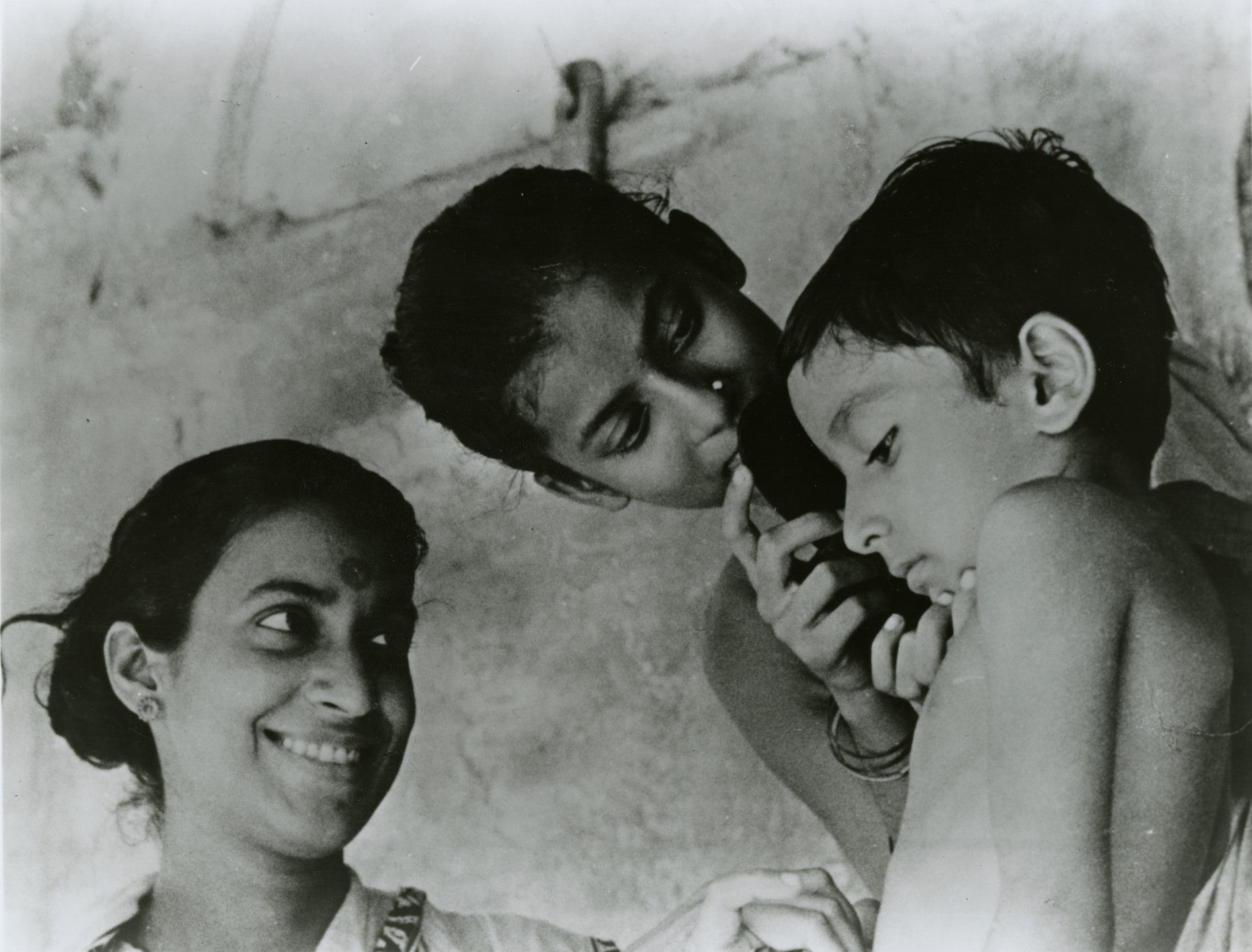
The following year Ray's second film, Aparajito, went to Venice and won the Golden Lion, and this time he was there. Two evenings before the prizes were announced he was sitting at a pavement café when a stout, middle-aged man, presumably a journalist, came up to him, bent down, whispered "I can hear the lion's roar!" and walked off into the dark. Festival juries, Ray noted, are sworn to secrecy so that the awards come as a surprise. "They never do."26
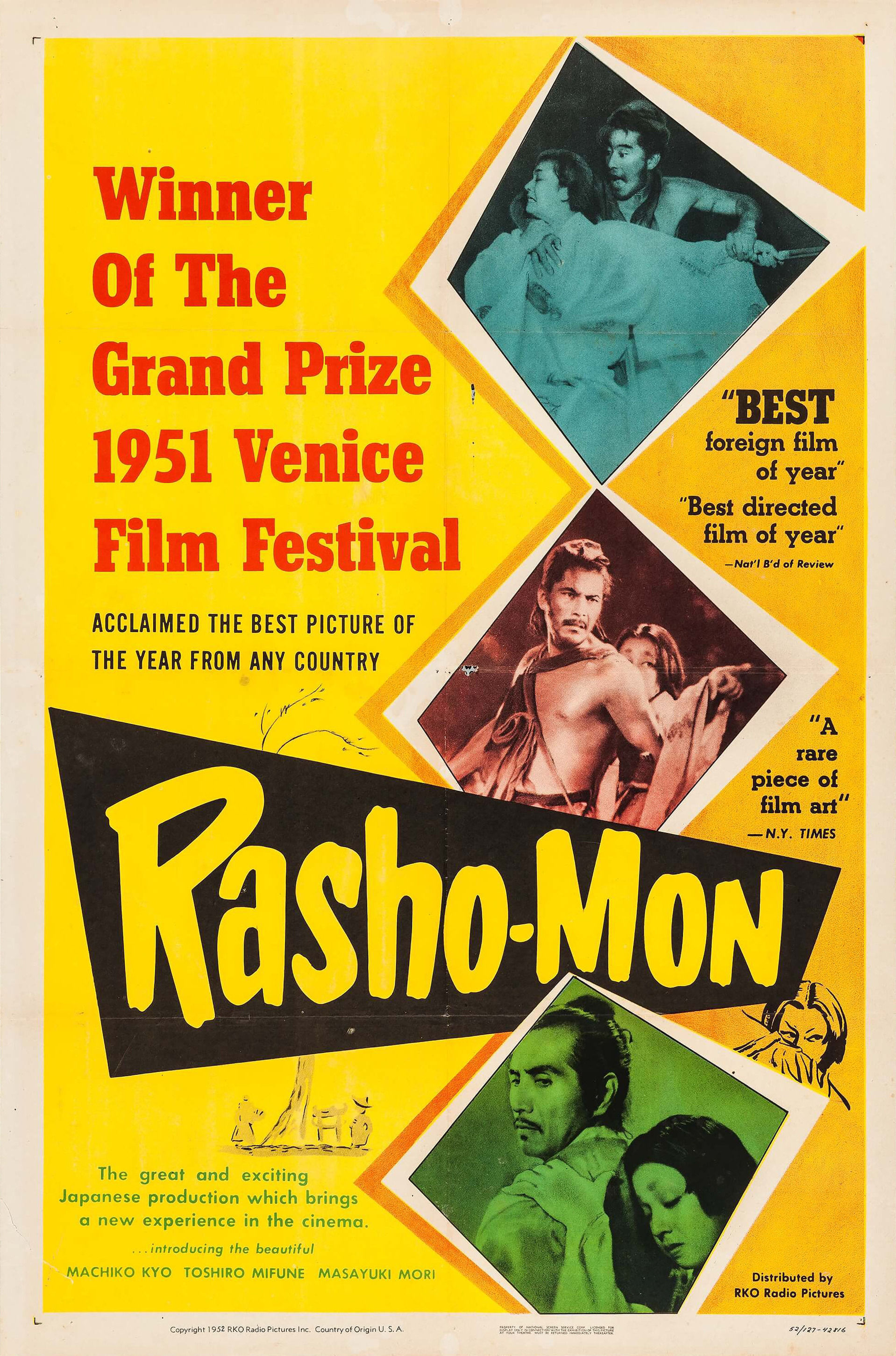
Akira Kurosawa found out about his own international breakthrough after it had happened. Rashomon opened in Japan on 26 August 1950. It did only modest business, though the critics of Kinema Junpo voted it fifth-best film of the year. Giuliana Stramigioli, who represented the Italian company Italiafilm in Japan, saw it there and recommended it for the next Venice Film Festival. Its studio, Daiei, entered the film without telling Kurosawa. When it won, Daiei didn't tell him that either.27 The Golden Lion was awarded on 10 September 1951, a little over a year after the domestic release, and Rashomon became the first Japanese film to win it.28 The jury had watched it in Japanese with Italian subtitles, the only way it was shown at the festival. Catherine De La Roche, reporting from Venice for Sight & Sound, admitted that she understood "no Japanese and little of the Italian subtitles," and printed the director's name as "Achira Curosawa," a misspelling carried over from the festival's own publicity.27 The confusion didn't hurt the film in English. In the same issue of Sight & Sound, the magazine's reviewer, Harcourt-Smith, called Rashomon "one of the most stimulating and extraordinary pictures made anywhere in the world since the end of the war," while admitting that its social conventions and psychological reactions were "alien to us."27 The prize got the film sold. Rashomon became the first Japanese film released in North America by a major studio.27
A film with no prize, sold to a small buyer, could go almost unseen. Bong's Memories of Murder opened in South Korea on 25 April 2003 and sold about five million tickets there.29 Palm Pictures released it in the United States on 15 July 2005, more than two years later, on no more than one screen at a time. The opening weekend took $4,487, nearly a third of a total American gross of about $14,000. The DVD followed on 9 August 2005, less than four weeks after the cinema release.30 In 2019, after Parasite, Neon picked up the older film to give it what it called "a proper theatrical release in America."29 It went back into American cinemas on 19 October 2020, seventeen years after Korean audiences first saw it.30
3. Waiting for the Oscars
Everything Everywhere All at Once opened in the United States on 25 March 2022 and in Britain on 13 May 2022. It opened in Japan on 3 March 2023, almost a year after its American release and nine days before the Academy Awards ceremony at which it won Best Picture.31 The pattern has repeated since. Anora opened in the United States on 18 October 2024, in Britain on 1 November, and in Japan on 28 February 2025, two days before the Oscars.32 The Brutalist opened in the United States on 20 December 2024, in Britain on 24 January 2025, and in Japan on 21 February.33 Sometimes the order changed. Nomadland opened in the United States on 19 February 2021 and in Japan on 26 March, but British audiences did not get it until 17 May 2021.34
How long did the wait last?
Release dates can be incomplete, especially for older films. A missing date does not mean there was no release.
 This application uses TMDB and the TMDB APIs but is not endorsed, certified, or otherwise approved by TMDB.
For a smaller film, awards season works as a release calendar. By the time Everything Everywhere All at Once opened in Japan it had collected a shelf of prizes, and they became the campaign.35 Nominations, prizes and reviews from abroad give a distributor in another country something to put on the poster. Japanese distributors in particular often wait to see how a film performs overseas before committing to it, because success abroad becomes part of the campaign at home. There are other reasons for the wait in Japan. Subtitling and dubbing for Japanese audiences go beyond translation, and the cultural adjustments take time. Releases are timed to the big cinema seasons of Golden Week, Obon and New Year, and a film that misses one of those windows may be pushed back to the next. Japanese films dominate the box office: in 2024, nine of the ten biggest films in Japan were local productions. Japan also has fewer cinema screens per person than most rich countries, so foreign titles queue for space. Spoilers matter less than they do in America or Britain. Many Japanese viewers are willing to wait for a film even when they already know how it ends, and as long as interest holds, the delay costs the distributor little.35
Even Hollywood's biggest releases tend to arrive in Japan last. Marketing there is highly structured, and the American studios "have influence but not the final say" over when their own films open. Release dates are worked out with the Japanese distributor and exhibitor Toho-Towa.36 Frozen opened in the United States on 22 November 2013 and in Japan on 14 March 2014, almost four months later.37 Even a summer blockbuster with a worldwide marketing push could be three weeks late: Barbie opened in the United States on 21 July 2023 and in Japan on 11 August.38 In 2001 Disney opened Pearl Harbor around the world within 30 days, except in Japan, where it opened on 14 July.14 In 2005 Fox opened Star Wars: Episode III – Revenge of the Sith worldwide on 19 May, "except Japan." Fox's Paul Hanneman explained the change in policy: "Waiting for three or four months … is not something we do anymore." Three years earlier, Episode II had needed 8,800 prints.39
Some of the delay goes into dubbing. In 2010, Paramount's Japanese arm dubbed 188 of the 452 prints of Shutter Island, at a time when local productions had taken 57 percent of the Japanese box office the year before.40 Foreign films were losing ground in Japan. They had taken 55.6 percent of the Japanese market in 1975 and peaked at 72.9 percent in 2002.41 A Hollywood film arriving in Japan was competing with a strong local industry, and its distributor took its time choosing when to open.
4. "Volete leggermi?"
When films began to talk, Hollywood's first answer to foreign languages was to shoot each film several times over. In early 1930 Paramount built a studio complex at Joinville, outside Paris, which in 1930 and 1931 turned out 150 films in as many as fourteen languages.42 The sets and costumes were reused, so the different language versions were shot in shifts around the clock, often in less than two weeks per feature. The economics didn't hold up, and Hollywood stopped making multiple-language versions altogether in 1933.43
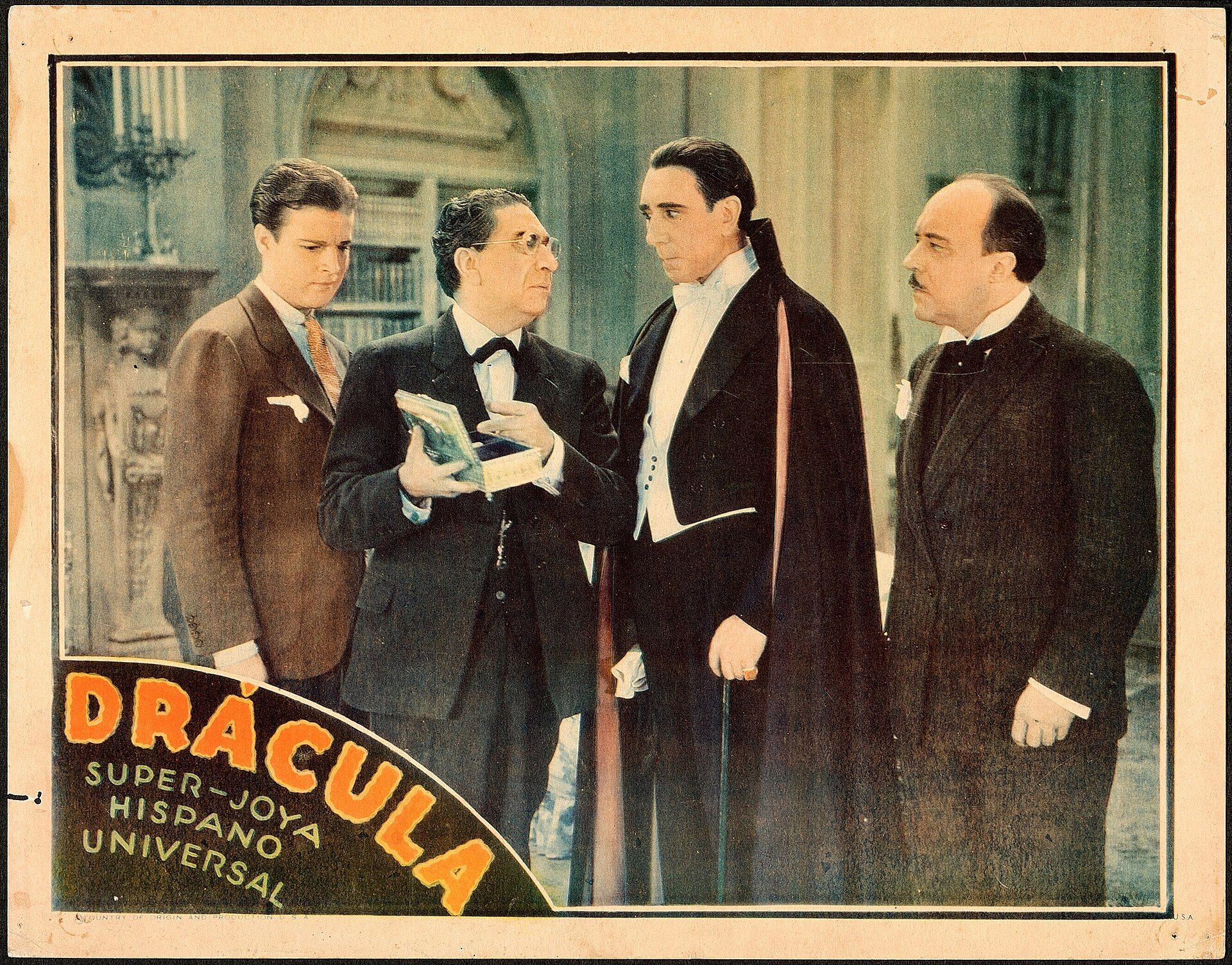
The best-known of these versions was made in Los Angeles. In 1931, Universal shot Dracula with Bela Lugosi by day. When that crew went home, a second cast and crew came in at night and shot the same script in Spanish. Lupita Tovar, who played the heroine, Eva, described the schedule: "We shot all night long till next morning because we used exactly the same sets. As matter of fact, we had the same marks the English cast got, we stepped in the same place."44 The Spanish unit was given half the shooting time, on a much smaller budget. Its crew could watch the day unit's footage when they arrived each night and adjust the lighting and camera angles, and their Drácula ended up 29 minutes longer than the English version.45 Tovar said the director, George Melford, did not actually speak Spanish and directed through an interpreter. She noticed the other differences only when she finally saw the English version. "The dresses that Helen Chandler wore were all covered up," she recalled. "What they gave me were big décolletées, what you'd call sexy. I wasn't even aware of it!"45 The two Draculas looked almost alike, she said. "The main difference was their hands. Lugosi had long, long fingers, you know, and Carlos Villarías has got shorter fingers."44
Fascist Italy took a more direct approach to foreign speech: it removed it. On 22 October 1930 a circular went out from Rome, on the instruction of the Ministry of the Interior, that no film would be cleared for screening if it contained foreign speech "even in some part and in minimal measure." Censors' reports were marked with the order: "Remove every scene of dialogue, or anything spoken, in a foreign language." Between November 1929 and August 1933, according to the surviving censorship files, 486 foreign sound productions were released in Italy with their dialogue stripped out, music and effects laid back in, and the missing lines replaced by Italian intertitles.46 Fifteen days before the circular, on 7 October 1930, one of the first Italian talking pictures, La canzone dell'amore, had premiered at the Supercinema in Rome.46 Few Italian cinemas could have played foreign soundtracks anyway. Only 4 percent were wired for sound in 1930, 15 percent in 1931, 32 percent in 1932 and 43 percent in 1933.46 (One reference work dates the first Italian requirement for an Italian-language soundtrack to 1929.43)
The satirical weekly Marc'Aurelio called these films "letti al cento per cento," one hundred percent read. In December 1940 the magazine Cinema looked back at what that had been like in the cinema. With so much text on screen, people started reading it aloud. A child would get someone to read to him "out loud" and then ask awkward questions ("And now why is he kissing her?"), and an elderly woman would sit down next to a stranger and ask: "Per favore, io ci vedo poco. Volete leggermi?" Please, I can't see very well. Would you read it to me?46
Hollywood had already tried dubbing for Italy in Los Angeles. Fox had its films translated by a studio editor married to an Italian woman, with help from Alberto Valentino, the brother of Rudolph. The casts came from Italian-American theatre companies, many of them speaking Sicilian or Neapolitan, and when there weren't enough of them the studios went into downtown Los Angeles and hired, for bit parts, men whom one director later called "good gangsters with records that weren't too dirty." That director, Goffredo Alessandrini, whom MGM brought over in 1932 to run its Italian dubbing, remembered that it worked for comedies. The worse the Italian, the funnier the film. Melodramas with Garbo and John Gilbert were another matter. He kept telling the Americans that io lavo and I love did not go together, and that they should do the dubbing in Italy. A few months later they did. An Italian vice-consul in Los Angeles had already complained to Rome that some of the translators were "not even of Italian nationality."46
The regime had a further reason to prefer dubbing to subtitles. Most Italians still spoke dialect rather than the official Tuscan-based language, and in 1931 up to half the population of regions such as Calabria, Basilicata and Sardinia could not read. Dubbed in Rome by trained actors, every foreign star now spoke the same standard Italian, which made dubbing a lesson in the national language for a whole country of cinemagoers.4643
Dubbing replaced the intertitles, and the law soon decided where the dubbing had to be done. Law No. 918 of 18 June 1931 required at least one Italian film to be shown for every three foreign imports and charged a dubbing tax of 25,000 lire on every foreign film dubbed and screened in Italy. During the 1930s the tax rose to 30,000 lire, then to 50,000 and 75,000, and in 1938 it brought the state 9.8 million lire, money that could be put back into Italian production. Royal Decree No. 1414 of 5 October 1933 banned foreign sound features dubbed abroad. From then on, dubbing had to be done in studios on Italian soil, by an entirely Italian cast and crew. Germany had already required films to be dubbed on German territory from 1 July 1932, and France had banned dubbed versions made abroad from 29 July 1932.46 In Spain, an order of 23 April 1941 banned the screening of films in any language other than Spanish and required dubbing to be done in Spanish studios by Spanish staff.47
These rules made each film slower and more expensive to bring into the country. Dubbing costs ten times as much as subtitling, and often more, and dubbing a feature film usually takes six to twelve weeks.48 Some estimates put the cost at fifteen times that of subtitles.49 Paying that money, in the right studio, with the right cast, became one more step a film had to complete before it could open in Rome, Berlin or Madrid.
5. Four Characters a Second
Japan chose subtitles. They were called sūpā jimaku, superimposed titles, because they were printed straight onto the picture. The first film shown there with Japanese titles printed over the image was Josef von Sternberg's Morocco, in 1931, subtitled by Yoshihiko Tamura.50 The rule that still governs Japanese subtitles dates from the same year: four characters per second of speech, in no more than two lines of twelve or thirteen characters each. According to one account, the limit was fixed by recruiting geisha from Tokyo's Shinbashi district as test readers, to see how much text an ordinary audience could take in without strain.51 Whatever its origin, the rule means the translator has to cut. A line of dialogue that runs for two seconds gets eight characters of Japanese. Subtitling in any language can cut as much as half of the original dialogue, because the average viewer reads only 150 to 180 words a minute.43 When ten graduate students were tested with eye-tracking in 2017, most of them preferred subtitles at six characters a second.51 The industry standard is still four.
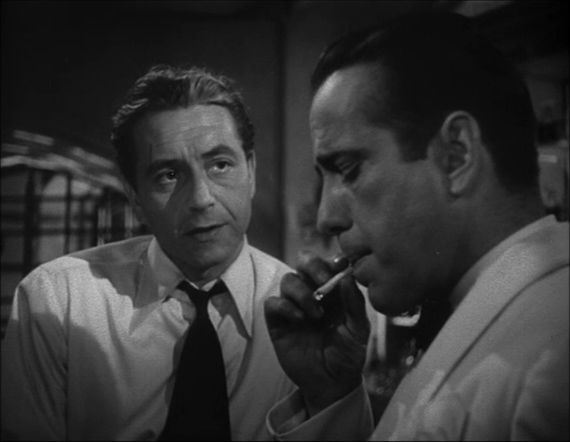
Tamura handed the job on to Shunji Shimizu, who became Japan's first full-time subtitler. Later came Shizuo Takase, who found the Japanese for "Here's looking at you, kid" in Casablanca.50
For decades, many of those characters in Hollywood films were written by Natsuko Toda, the teenager in the queue at the Yūrakuza. She did not start subtitling in earnest until after she turned forty. She went on to subtitle more than 1,500 films over more than four decades.52 At her busiest she finished one film a week, about fifty a year, with none of the online reference tools a translator relies on now.53 When a television interviewer asked whether she had assistants, she laughed. "I'm doing one a week. If I borrowed other people's hands it would eat up time. It's faster to do it myself." At 87 she was still subtitling, and her recent credits included Indiana Jones and the Dial of Destiny and Mission: Impossible – Dead Reckoning.52 At that volume mistakes crept in, and online she has been called the "queen of mistranslation." In 2025, aged 88, she subtitled the 169-minute Mission: Impossible – The Final Reckoning, released in Japan almost simultaneously with the United States, which left little time between the finished cut and the opening.53

Translators have less time now than Toda did. Mara Campbell, who founded a subtitling company that works for the vendors serving Disney+, Netflix and Amazon Prime, recalled that when she started in 1999 she had a week to translate a film. Now she has two days, and some streaming subtitlers are paid as little as $1 per minute of programme.54 "There is no lower limit," said Max Deryagin, who chairs the British Subtitlers' Association. "It goes all the way to almost zero."54 AVTE, the European federation of audiovisual translators, considers two to three weeks the proper time for a hundred-minute film.55
After the war, only one man received permission from the occupying powers to dub English and American films for German audiences. "From 1949 into the sixties there was only Wenzel Lüdecke for the dubbing of foreign films," a production manager at his old studio, Berlin Synchron, said later. In the 1950s, when Hitchcock's films reached German cinemas, people would come out and ask, quite seriously, how the American actors had learned to speak such good German.56 The work has to be invisible. "You need to really follow the performance of the actor on the screen to remain believable," said Dietmar Wunder, who dubs Daniel Craig as James Bond. "The goal is that the audience thinks that Daniel Craig actually speaks German."57 Dubbing for German cinemas still works to tight deadlines. To dub a cinema film, everyone involved usually has no more than two weeks. In that time the script has to be translated and reshaped so the German lines fit the actors' lip movements, every role cast with a German voice and recorded, and the sound mixed.56 Manfred Lehmann, who by 2013 had been Bruce Willis's German voice for twenty-five years, was candid about why he does it: "I enjoy the money. It pays the bills." He had met Willis once, around 2003, and asked whether he had ever heard the German version of himself. "No." Robin Williams was more grateful. After he won his Oscar for Good Will Hunting, he sent his German voice, Peer Augustinski, a note: "Thank you for making me famous in Germany."57
Streaming has made all this work much bigger, but it hasn't made it much faster. Dubbing the Korean zombie series All of Us Are Dead into English, including casting and editing, took about three and a half months and 55 voice actors. In 2021 Netflix dubbed five million minutes of programming and subtitled seven million, and viewing of dubbed programmes on the service rose 120 percent between 2020 and 2021.58 When Squid Game became a worldwide hit in the autumn of 2021, it was available with subtitles in 31 languages and dubbed in 13.59 Edward Hong, who voiced Player 244, the pastor, in the English dub, found the work harder than animation, because he had to honour the Korean actor's performance and match the movement of his mouth at the same time. Being Korean American helped. "The way Korean religious people, especially pastors, talk is a very specific way of talking," he said. "That's something I knew all too well from being stuck in those Korean church services as a kid." Subtitles had their own limits. "In general, subtitles can't be longer than two lines," said Denise Kripper, a television subtitler. "That's even fewer characters than a tweet."59 Korean speakers soon complained about the English subtitles. The comedian Youngmi Mayer pointed out that where one character says, in effect, "I am very smart. I just never got a chance to study," the subtitle read "I'm not a genius, but I still got it work out."59 Italian was not one of the 13 dubbed languages. "We realized we didn't dub in Italian," said Catherine Retat, Netflix's Paris-based director of international dubbing. "We had a suite of languages but not Italian." The content team begged her to hurry. "We took our time and we did it right."60 On Netflix, more people watched Squid Game dubbed than in the original Korean.58
The English-speaking market has been the hardest to persuade. Accepting the Golden Globe for best foreign-language film on 5 January 2020, Bong Joon-ho said: "Once you overcome the one-inch-tall barrier of subtitles, you will be introduced to so many more amazing films."61 Between 2003 and 2017, non-English-language films made up 18.8 percent of the films released in North American cinemas and took 1.1 percent of the box office.62 Before Parasite, the last foreign-language film to play in more than a thousand American cinemas had been Jet Li's Fearless, in 2006.63 Parasite, the film Neon had bought before it was finished, opened in America on three screens and finished its domestic run with $53,847,897.64
6. Closed for the Duration
For the first seven years of the Third Reich, Hollywood never left Berlin. About 250 American features played in German cinemas between 1933 and 1940, and MGM, Paramount and 20th Century-Fox kept their distribution offices in the capital until the summer of 1940. American stars were reportedly more popular with German audiences than German ones.65 The man who ended this arrangement was the same man who, on 30 July 1940, sat in a private screening room, watched Scarlett O'Hara, and wrote in his diary that Americans had shown how it was done. Admiration for the product did not soften the policy. That summer, in the words of the German Foreign Office's own note to the US Embassy, "the Reich Minister for Public Enlightenment and Propaganda felt compelled … to order the cessation of the distribution of the products of the Fox-Film AG., the Metro-Goldwyn-Mayer Film AG. and the Paramount AG. in the territory of the Reich." The note blamed films "whose anti-German character was unmistakable" and claimed the studios had ignored "more than a dozen" warnings.66
The door that closed in Berlin closed wherever the Wehrmacht went. In occupied France, films from non-Axis countries were banned from 1940; American and British imports simply stopped.67 For four years Parisians watched French films, German films and whatever the occupiers approved. Then the Allies arrived, and so did the backlog. "Après une privation de quatre ans, chacun court voir son premier film américain," one history of the period records: after four years of deprivation, everyone ran to see their first American film.68
Hollywood had four years of pictures Europe had never seen, and it wanted open doors rather than a trickle. The moment came with a loan. On 28 May 1946, in Washington, Léon Blum and the US Secretary of State James Byrnes signed a package of agreements that wrote off French war debts and opened new credit of roughly 650 million dollars. Folded inside was a clause about cinema. France gave up its numerical limit on American imports. In exchange, French cinemas were guaranteed a screen quota: French films had to be shown at least four weeks in every quarter, on every screen, for two years.6970
Nine weeks of every thirteen, in other words, were left to whoever could fill them. "Tous les fleurons de la production hollywoodienne envahissent les salles françaises," runs the account of the French national audiovisual archive: all the jewels of Hollywood production invaded French cinemas, and in 1947 some 420 million spectators rushed to see them. French production fell to 71 films, fewer than in 1942, under the occupation.69 The agreements were "perçus comme la condamnation à mort du cinéma français," perceived as the death sentence of French cinema; opponents called them «une tentative d'assassinat du cinéma français», an attempted assassination.7069 The actor Louis Jouvet, in June 1946, put it in terms a French audience would feel in the stomach: «Faits aux vins de Bourgogne et de Bordeaux, nos estomacs devront s'accoutumer au Coca-Cola.» Raised on Burgundy and Bordeaux, our stomachs will have to get used to Coca-Cola.68
The French government renegotiated in September 1948. The import quota came back, set at 121 American films a year, and the first law of state aid to French cinema was introduced, paid for with a 7 per cent tax on ticket receipts.70 The pattern of 1944 to 1948 would repeat itself in other places and decades. A political barrier holds films back for years; when it falls, the stored-up pictures arrive all at once, and the local industry, which had grown used to an empty field, asks for a wall of a different kind.
In Japan the wall went up with the war in the Pacific. After December 1941 Hollywood vanished from commercial screens, and, as the subtitler Natsuko Toda remembered, even after the surrender in 1945 the most famous American picture of all "just wouldn't come".2 Other American films came sooner, under the supervision of the occupation. "February 28, 1946: Tokyo," one history of the period begins. "On a late winter afternoon, crowds of Tokyoites packed the movie houses… The rumor had spread widely: Hollywood was returning to town!" The two films on offer were His Butler's Sister and Madame Curie. The weather was bad and tickets cost three times as much as for an ordinary Japanese film. In the first ten days, 350,000 people saw them and paid some 1.2 million yen. The films came through the Central Motion Picture Exchange, a distributor backed by the occupation authority.71 Gone with the Wind was not among them, and would wait six more years, until the September afternoon in 1952 with which this story began.
In Germany the same film waited a little longer still. Its German premiere took place in Munich on 15 January 1953, "mit 14-jähriger Verspätung", fourteen years late, and the delay had two layers. First Nazi film policy banned both the novel and the film. Then, once the Nazis were gone, MGM "pokerte um bessere Konditionen": it held out for better terms.4 The film Goebbels had wanted Germans to learn from was kept from them first by his ministry and then by a sales department in New York.
The war left another kind of delay, harder to see from the outside: films that arrived on time but arrived as something else. Casablanca premiered in New York in November 1942. It reached West German cinemas in August 1952, in a version prepared by Warner Bros.' own German branch. Through dubbing and 21 minutes of cuts, that version removed every scene with Major Strasser (Conrad Veidt) and his German officers, and it turned Victor Laszlo, the hunted resistance leader, into an inventor of mysterious "delta rays" named Viktor Larsen, wanted for sabotage.72 The scene in which Rick's café sings the Marseillaise to drown out the German officers was gone.73 The critic Karena Niehoff wrote in Der Tagesspiegel: "Das Wort 'Nazi' fällt nie… statt der Gestapo-Agenten fürchten alle Menschen nur Gespenster." The word "Nazi" is never spoken; instead of Gestapo agents, everyone is afraid only of ghosts.72
That was the Casablanca West Germans knew for twenty-three years. A newly dubbed, uncut version had its premiere on the ARD television network on 5 October 1975, and only then, in one account's phrasing, did the film become a classic in Germany too.7374 From New York to the full story in German had taken thirty-three years.
Charlie Chaplin's The Great Dictator opened in New York on 15 October 1940, with Chaplin as the dictator Adenoid Hynkel. It was banned throughout occupied Europe, in parts of South America and in the Irish Free State. A defector from the Nazi film division later told Chaplin that Hitler had screened the film alone, two nights running. "I'd give anything to know what he thought of it," Chaplin said.75
In Italy, where Mussolini appeared on screen as Benzino Napaloni, the Ministry of Popular Culture issued a curt instruction: "Ignorare la pellicola propagandistica dell'ebreo Chaplin," ignore the propaganda film of the Jew Chaplin.76 What happened next depends on the account. One places the first public screening in Rome at the end of October 1944, with the city already in Allied hands.77 Another dates the film's first Italian showing to United Artists' 1958 reissue.75 What is clear is that the dictator's family still mattered long after the dictator. When the film was re-released in 1961 it sat for a long time with the censors; there was a proposal to cut every scene with Napaloni, and in the end only the scenes with Napaloni's wife were removed, to avoid any reaction from Mussolini's widow, the one living person the film alluded to.76
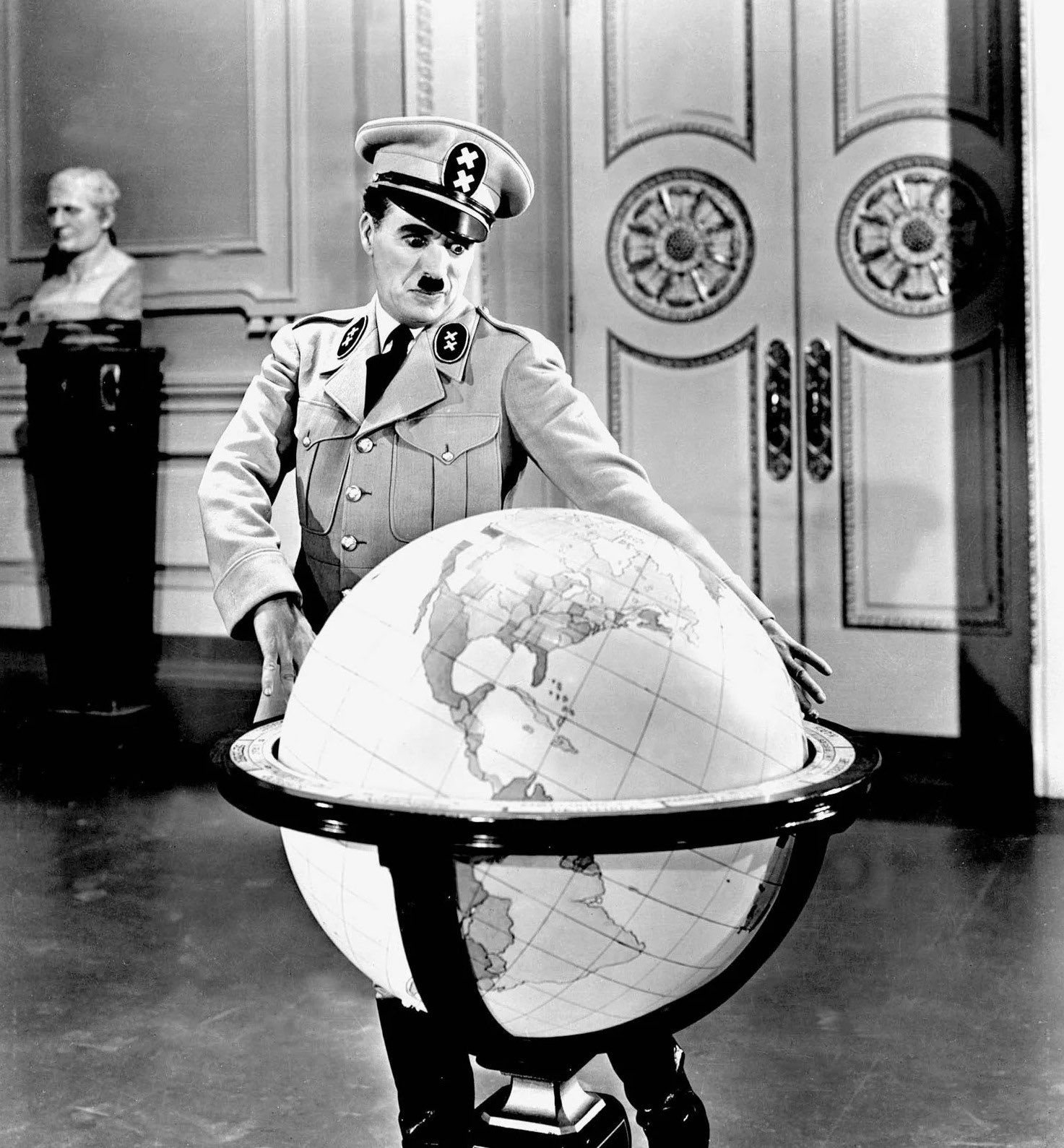
West Germany got the film in the summer of 1958, and United Artists sold it as contraband. The front page of the press book announced "Charles Chaplin's masterpiece, which up to now was not permitted in German movie theatres," and exhibitors were encouraged to use the line "A film that Germans have been forbidden to see for years." The forbidden fruit did not sell. In 1958 the film "did not find a large audience"; it became a massive success only on its re-release in 1973. Nobody could agree on who had held it back for eighteen years: the American government, the West German government, United Artists, the German film industry or Chaplin himself.78
Spain waited longest. Francisco Franco died on 21 November 1975. Six months later, in May 1976, Spaniards were "flocking to movie houses" to see the film, "finally allowed in Spain nearly four decades after it delighted much of the rest of the world"; it opened in four packed theatres in Madrid.79 Franco-era rules had required every foreign film to be dubbed into Spanish, and the film's first Spanish dub reportedly dates from that same year, 1976.
7. The Shelf
In the Soviet film industry there was a word for a film that had been made, paid for and then refused: it went na polku, onto the shelf. The shelf was not a metaphor for a slow release. It was a release that did not happen, sometimes for twenty years, and its most famous resident was a three-hour film about a fifteenth-century icon painter.
Andrei Tarkovsky began shooting Andrei Rublev in September 1964. When it was completed in July 1966, the state film agency demanded extensive cuts. After a single screening in Moscow, at the Dom Kino, a cinema that was supposedly ringed with mounted police for the occasion, the film, then titled The Passion According to Andrei, was shelved. It was scheduled for Cannes in 1967 and pulled by the Soviets at the last minute.80 Two years later it reached Cannes anyway, out of competition. One account says the reason was that Sovexportfilm, caught between contradictory orders, had already sold distribution rights to a French company, which entered the film with encouragement from the culture minister André Malraux.81 The festival showed it at four o'clock in the morning on its last day. It won the International Critics' Prize anyway. Soviet officials were furious, and Leonid Brezhnev reportedly demanded a private screening and walked out halfway through.80
The film opened in Paris late in 1969, with questionable legality and over the strenuous objections of the Soviet embassy, before Soviet audiences had been allowed to see it. It reached Soviet cinemas in 1971. American audiences first saw it at the New York Film Festival in 1973, in a version further cut by its American distributor, Columbia Pictures.80 In the space of seven years the film was trimmed in Moscow and trimmed again in New York, and in neither city could audiences see the film Tarkovsky had finished in 1966.
Aleksandr Askoldov made only one feature. Commissar, shot at the Gorky Studio in 1967, was banned on charges of "slandering the revolution" and of being "Zionist propaganda".82 Early in 1968 the political police seized it from an editing room. "They tried to destroy the film," Askoldov said, years later. "They sealed the editing room where all the shot and edited material was, but piece by piece it was rescued and survived."83
How it survived has more than one version. One account has the reel that was supposed to have been destroyed carried out of the studio by Askoldov's assistant under her skirt, after which it sat under Askoldov's bed for twenty years. Askoldov himself told it differently. He said he found the film in the archive, in a "heap of rotting cans". "A woman said that she had been ordered to burn the film, but she said she decided it might be useful some day," he recalled. "I knelt and kissed her feet."84
For two decades, everyone in the Soviet film world knew Commissar existed and nobody had seen it.83 It had its premiere in July 1987 at the Moscow International Film Festival, under glasnost. In February 1988 it went to Berlin, where it won the Silver Bear, the Special Jury Prize. Askoldov later called that Berlinale "probably the most important event of my life".82 He never directed another film.
He was not alone on the shelf; the question was how many others were there. In May 1986, right after its Fifth Congress, the Union of Cinematographers set up a Conflict Commission to review banned films. Its chairman, Andrei Plakhov, later wrote that at first "it seemed we would be dealing with two or three dozen 'shelf' films". Instead, those turned out to be "only the visible part of the iceberg", with whole layers of banned documentaries, television films and animation beneath them. In the four years the commission existed, it rehabilitated more than 250 films.85 Its loudest act was clearing Tengiz Abuladze's Repentance, made in 1984.86 The director Elem Klimov gave a larger number: in 1986, he said, "they discovered in these archives there were 300 finished films that were banned. One of my films, 'Rasputin,' was shelved for 10 years."87
The shelf held back Soviet films from Soviet viewers. A parallel restriction held back foreign films. Asked in 1991 whether American and other foreign films had been shown before 1986, Klimov answered: "Not very many. The good films almost never before 1986." Five years later the situation had flipped: "Now there are too many American movies shown." He offered an example. "The greatest success at the moment is enjoyed by 'Gone With the Wind.' For more than six months it was shown at one of the biggest movie theaters in Moscow. It was crowded all the time, sold out."87 That was the film whose Moscow premiere, on 19 October 1990, closes the opening of this story: Scarlett, fifty-one years after Atlanta, recognised by a Muscovite as someone with "a Russian character".5 The Soviet shelf and Hollywood's absence ended at the same time, and Moscow audiences were watching Andrei Rublev and Gone with the Wind in the same few years, each of them decades late.
8. Neighbours
Some delays have nothing to do with distance. Seoul is a two-hour flight from Tokyo, and for half a century after 1945 not a single Japanese film was legally shown in a South Korean cinema.
Korea had been a Japanese colony for thirty-five years from 1910. Diplomatic relations were normalised in 1965, and Japan then tried to export its films to Korea. The government of Park Chung-hee "refused the offer out of consideration for public sentiment."88 No single statute banned Japanese culture. The prohibition was administrative and never quite admitted. Broadcasting Japanese dramas, films and songs on terrestrial television was forbidden, but Japanese animation was quietly allowed on air in the 1970s and 1980s, provided its waesaek, its "Japanese colour", was erased. Characters were given Korean names and settings were localised, and a generation of Korean children grew up believing Astro Boy, Galaxy Express 999 and Mazinger Z were Korean shows. Japanese pop culture, in the words of the National Archives of Korea, was "unofficially open" after 1965, "but nobody could say so openly."89
What the state kept out, VHS brought in. After overseas travel was fully liberalised in 1989, illegally obtained Japanese comics, anime videos and J-pop albums "secretly spread like wildfire", and Japanese films and TV followed as more Korean households acquired video players. A Seoul office worker, Oh Jang-ho, remembered renting Dragon Ball Z and Neon Genesis Evangelion from local video shops: "Looking back, they were all illegally burnt videos or CDs."88 Around the universities, so-called film cafés and comic cafés screened Japanese films and anime without permission; by late 1998 a business newspaper concluded that Japanese film "has already penetrated deeply".90
In October 1998 the director Shunji Iwai was at the Busan International Film Festival with his film April Story. He asked the audience a question. "I asked, 'Have you seen Love Letter?' and almost the entire audience raised their hands. It hadn't been released in Korea, but it seemed to be circulating on video."91 Love Letter had opened in Japan in 1995. It had no Korean distributor, no Korean release and no legal way into the country, and the room was full of people who had seen it.
Policy changed the same month. On 8 October 1998, President Kim Dae-jung and Prime Minister Keizō Obuchi signed a joint declaration on a "future-oriented partnership", and that day Kim told his government to "open up (to Japanese culture) without fear."88 On 20 October, the culture minister, Shin Nak-kyun, announced the first stage: Korea–Japan co-productions, Korean films with Japanese actors, and Japanese films that had won at the "four big" festivals (Cannes, Venice, Berlin or the Academy Awards) could now be shown, and released on video. Films went first because officials judged their "Japanese colour" to be relatively faint.89 The schedule was one film a week: the co-production Family Cinema first, then Takeshi Kitano's Hana-bi on 5 December, then Akira Kurosawa's Kagemusha, Palme d'Or winner of 1980, on 12 December.90
Hana-bi had won the Golden Lion at Venice on 3 September 1997 and opened in Japan in January 1998.89 On 5 December 1998, at the Core Art Hall in Seoul, its billboard became the first for a Japanese film to hang over a Korean cinema. KBS's evening news reported: "the audience was smaller than expected, in contrast to the keen interest of the Japanese press who came to cover Korean viewers' reaction." The manager, Hwang Young-ho, looked at the advance bookings: "Judging by advance bookings, it's considerably fewer than expected." A viewer from Suwon, Park Il-jun, said, "I think it will help Korean film develop." Hyun Nam-suk, from Huam-dong in Seoul, worried that "Japan's low culture" would slip in behind it.92 Both Hana-bi and Kagemusha did unexpectedly poorly.89 The audience that had been waiting for Japanese films did not seem to be waiting for these ones.
The second stage, in September 1999, extended the opening to winners of any recognised international festival and to films rated for all ages. That made room for Iwai's films. A third stage followed in June 2000, covering video, performances, games and broadcasting.89 Then history interrupted again. On 3 April 2001 Japan approved a right-wing history textbook, and on 12 July Seoul "indefinitely suspended" further opening. Full opening for film, records and games came only in January 2004, the fourth stage, and even then some television entertainment and adult theatrical animation were held back.89
Love Letter opened legally in South Korea in 1999, four years after Japan.89 Admissions figures from the period differ: one count puts them above 1.15 million, which still made it the highest-grossing non-animated Japanese film in Korea, and another puts them at 1.4 million, the first time a Japanese film reached that mark.9394 Korea had no integrated national ticketing system in 1999, so neither number can be checked. What lasted was a line of dialogue. In the film Miho Nakayama shouts to her dead lover, "O-genki desu ka? Watashi wa genki desu" (How are you? I'm fine), and Koreans have quoted it ever since. "It's already been 25 years since 'Love Letter' was released," Nakayama said in 2017, "and I'm still so happy and grateful that people say 'Ogenki desu ka.'"94 After her death in December 2024, the film was re-released yet again, its ninth release in Korea, and drew 240,000 people by 3 February 2025, most of them in their twenties.95 One statistic, of uncertain origin, claims that 300,000 pirate videos of the film had circulated before it was ever legal.95 A Korean writer remembered buying a ticket to a university club screening in Sinchon before 1999: an auditorium darkened with thick curtains, hard chairs, "a makeshift cinema".95
Between India and Pakistan the films share a language, a music, and sometimes a setting. Mughal-e-Azam, made in Bombay in 1960, takes place in Mughal Lahore. For most of the decades since the September 1965 war, Indian films have been officially banned in Pakistan, available "only illegally, through pirated videotapes and discs," and on late-night cable.9697 The ban had exceptions. In 1980 General Zia ul-Haq allowed Kashish and Noorjehan, and some 450 Indian prints from the 1940s to the 1960s had been kept in Pakistan all along.98
In April 2006, with special permission from President Pervez Musharraf, Mughal-e-Azam, colourised and re-released in India two years earlier, came to Lahore's Gulistan Cinema. Accounts disagree about the day. One says it opened on Friday 21 April; another describes a premiere for officials and socialites on Saturday 22 April, with public screenings from Sunday 23 April.99100 Newspapers called it the first Indian film in Pakistani cinemas in forty-one years. Because of the earlier exceptions, the slogan was not strictly true.98 Abdul Waheed, a long-haired, bearded pensioner of seventy-five, bought a ticket for the first screening. "I've seen it a dozen times on video," he said, "but watching Mughal-e-Azam on the big screen was special." The distributor, Nadeem Mandviwala, stood at the Gulistan and predicted the film would "not only help revive Pakistani cinema, but it will also strengthen the peace process between Pakistan and India."97
The haste had a reason. The release had been brought forward from 2 June so that Mughal-e-Azam, rather than Taj Mahal: An Eternal Love Story, opening days later, could claim to be first. In the rush, advertising was thin, and the 1960s classic drew, "perhaps surprisingly", a lukewarm box office. A veteran actor, Yusuf Khan, had petitioned the Lahore High Court to keep the total ban, and lost. Around Lahore, cinemas were being turned into "plazas, showrooms and service stations". One exhibitor, Jahanzaib Baig, had built a petrol station on his cinema premises "in order to keep the ball rolling". His argument for Indian films was simple: "Our language and culture are quite similar. Besides, people are very fond of Indian movies. Period."96 Pakistan had about 700 cinemas in 1977. By 2008 it had about 200.98
The real opening came two years later. After a Senate committee recommended allowing Indian films "under a proper censorship policy", Welcome opened on 8 February 2008 to packed theatres and reportedly netted 70 million rupees.98 On 11 April 2008, Taare Zameen Par opened in 19 halls, the first film after the government "gave in to the long standing demand of cinema owners"; from then on any Indian film could be shown once the censor board cleared it.101 That April, on a busy night at the Prince cinema in Karachi, the film was Race. Ticket prices had gone up from 100 to 150 rupees. "Before the release of Indian films, a good Lollywood film would make about Rs700,000 in an average week," a cinema manager said. "Now the best week for Race in a Lahore cinema made more than Rs2 million." The head of the producers' association, Saeed Rizvi, saw the same numbers from the other side: "Do you want to make Lollywood a part of the history books?"102
The opening lasted as long as relations did. On 18 September 2016 militants killed nineteen Indian soldiers at Uri; Indian producers barred Pakistani artists, and from 30 September Pakistani cinema owners stopped showing Indian films. They resumed on 19 December. "The Bollywood films were anyway being watched illegitimately through DVDs and internet," Mandviwala said.103 In February 2019, after the Balakot air strikes, the information minister, Fawad Chaudhry, announced: "No Indian movies will be released in Pakistan."104 On 8 August 2019, after India revoked Article 370 in Kashmir, the prime minister's adviser Firdous Ashiq Awan went further: "No Indian cinema will be screened in any Pakistani cinema." The same day Pakistan suspended the Samjhauta Express, the train that crossed the border.105 Whether that ban has been formally lifted since is not clear. Abdul Waheed's dozen viewings on video turned out to be the normal situation, and the screenings at the Gulistan the exception.
9. Counting Days
Some delays are written into law as numbers, and the numbers usually come from a dispute over who gets the country's screens.
In 1938, American films took 73.5 per cent of the Italian box office. On 4 September of that year a royal decree, the legge Alfieri, gave a state body, ENIC, a monopoly on "the purchase, import and distribution of films". The American majors would not sell their films to a single state buyer. Fox, MGM, Paramount and Warner withdrew from Italy from 1 January 1939, closing their offices on New Year's Eve. Italy imported 162 American films in 1938, 64 in 1939 and 36 in 1940. Many American films made in 1939 and after never received Italian distribution at all.106
Franco's Spain built the barrier differently, using the dubbing studio as its tollgate. From April 1941 every foreign film paid an import fee of 25,000, 50,000 or 75,000 pesetas depending on its category, and had to be shown in a Spanish version, for which a separate "dubbing licence" cost 20,000 pesetas. The money went to subsidise Spanish production. Import permits went only to people and companies that produced Spanish films. Rules issued on 28 October 1941 required anyone who wanted to import foreign films to make a new film in Spanish studios first, or to commit to doing so with a bank guarantee; from May 1943, licences were granted only once the state board had approved and graded the importer's own films.107 Under that system, a Hollywood picture reached Spanish audiences only after a Spanish film had been made to pay for it.
South Korea's version was a calendar. By law, every cinema had to show Korean films for 146 days a year, a requirement that exemptions could bring down to 106.108 In 1999, when the government considered cutting it, the film industry treated the quota as a matter of survival. "The quota system is the only reason we survive," said the producer Moon Sung-keun. The director Kang Je-gyu said: "No country has won the battle against the U.S."108 On 16 June 1999, Kang and eight others shaved their heads.109 Two days later about 700 film people rallied at Gwanghwamun, and 101 of them, including the directors Park Kwang-su and Jang Sun-woo, held a collective head-shaving; another count put the number at 111.110109
On 24 June, at three in the afternoon, at a rally on Sejong-ro attended by about a thousand people, the director Im Kwon-taek sat down and had his head shaved. "We are not simply trying to protect films," he said. "We are trying to defend our cultural sovereignty." He could not hide, he said, his "boundless sadness" at a government ready to give up cultural sovereignty on economic logic. The actors Kim Ji-mi, Han Suk-kyu and Kang Soo-yeon wept.111 Protesters burned American cigarettes, Coca-Cola and symbols of American films, declared 1 July a "day of not watching American films", and began a sit-in at Myeongdong Cathedral.112 The quota survived.
It survived for seven more years. On 26 January 2006, the government announced that from 1 July the quota would be halved, from the existing 106–146 days a year to 73. To soften the blow it promised 400 billion won of support for the film industry over five years, half from the government and half from a 5 per cent levy on tickets.113 In Washington, the US Trade Representative, Rob Portman, welcomed the move the same day: "The long-standing Korean requirement that domestic films be shown on local theater screens 146 days out of the year placed US movies at a significant disadvantage. Today's move to reduce the requirement by half to 73 days will help level the playing field." He added: "Now is the right time."114
The film industry answered with a relay of one-person protests. On Saturday 4 February the actor Ahn Sung-ki stood alone at Gwanghwamun with a placard. Park Joong-hoon took Sunday. On Monday it was Jang Dong-gun's turn, and the crowd that gathered around him was so large that he could not continue for more than five minutes and moved to the National Assembly. "One Hollywood film can cost as much as a whole year's worth of Korean movies," he said.115
On Tuesday 7 February, the fourth day of the relay, Choi Min-sik walked into the Ministry of Culture on Sejong-ro at 1.20 p.m. and handed the information desk on the ground floor a certificate and a medal. It was the Okgwan Order of Cultural Merit, awarded to him in July 2004 after Oldboy, in which he played the lead, won the Grand Prix at Cannes. "I decided to return the medal because a cultural medal from a country that tramples its own cultural sovereignty has no value," he said.116 He called it "a sign of disgrace", and called the quota cut "a death sentence for Korean film".115 The ministry said it had no procedure for returning an order and would keep the medal for now and give it back later. Choi went outside and stood with his placard in front of the Kyobo Building at Gwanghwamun until five o'clock. Sixty-two civic groups backed the protest.116 A mass rally followed the next day.115
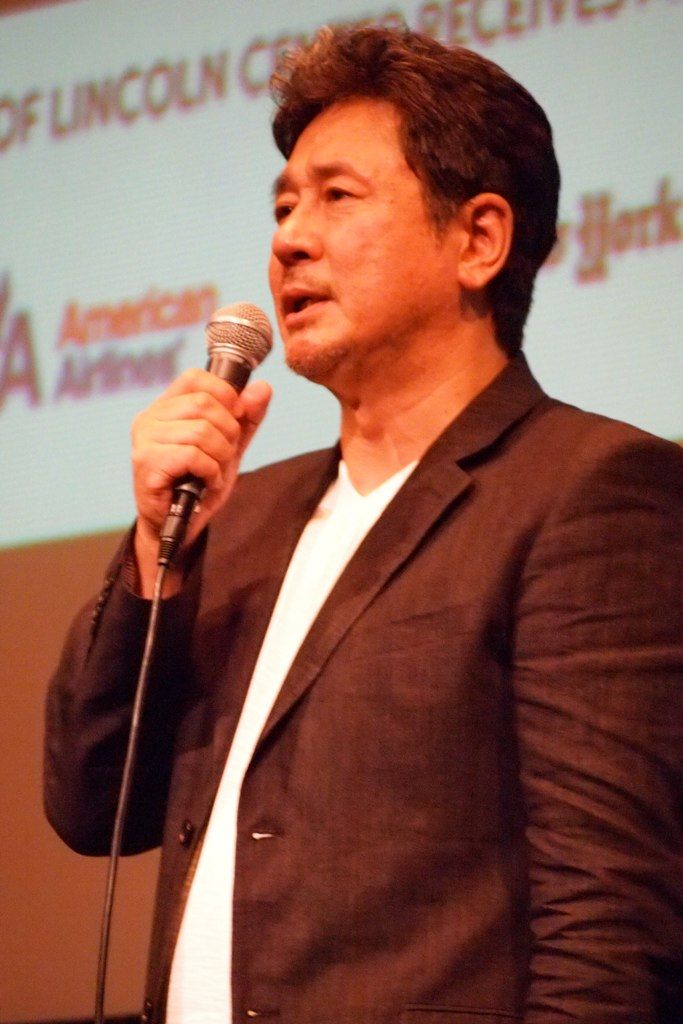
The relay went on for months, and it travelled. Park Chan-wook held his placard at the Berlin festival, Choi at Cannes.117 On 28 June Bong Joon-ho, the 141st person to stand, said: "There are many good Korean movies waiting to be released, including Fly, Daddy, Fly, Dasepo Naughty Girls and Hanbando."117 The same day, Superman Returns opened on 350 screens and sold more than a million tickets.118 "Hollywood blockbusters have been dominating the local market for almost three months now," said Jonathan Kim, a producer.118
The new quota took effect on Saturday 1 July 2006. That day an estimated 10,000 protesters marched. They burned effigies of the "Five Enemies" they held responsible, and police wrestled away an effigy of the president. Film production across the country stopped from 1 to 3 July. Im Kwon-taek, who had shaved his head seven years earlier, stood as the symbolic 146th member of the relay, one for each day of the old quota, and gave the final protest on 3 July.118117 Because the cut came halfway through the year, Korean cinemas owed Korean films 109 days in 2006: the new 73, plus 36 left over from the first half.117
Bong's list of films "waiting to be released" was the whole quarrel in one sentence: a screen given to one film is a screen another film waits for. Seen from Seoul, a quota means Korean films wait less often behind Hollywood. Seen from Los Angeles, it means American films wait for screen days. Where a country is large enough, the bargaining can be done in public. On 17 February 2012, after the United States had won a World Trade Organization dispute that it had begun in April 2007, Beijing and Washington announced a deal over dinner in Los Angeles: China would admit 14 more foreign films a year on revenue-sharing terms, provided they were in IMAX or 3D, on top of the existing 20, and the foreign studios' share of the box office would rise from 13 per cent to 25 per cent.119120 "The industry has been living with the numbers in terms of percentages and quotas for 20 years," said Chris Dodd, head of the Motion Picture Association of America. "It begged for a conclusion."120
The conclusion did not last. On 10 April 2025, after the United States raised its tariffs on Chinese goods to 125 per cent, the China Film Administration announced that "the wrong action of the U.S. government to abuse tariffs on China will inevitably further reduce the domestic audience's favorability towards American films," and that China would "follow the market rules, respect the audience's choice, and moderately reduce the number of American films imported."121
10. The Scissors and the Stamp
In September 1926 the British Board of Film Censors watched Sergei Eisenstein's Battleship Potemkin and turned it down. The board's annual report gave the reason in a single line, misspelling and all: "inflammatory subtitles and Bolshevist Proaganda". The country had come out of a nine-day general strike that May, and the board held that films should not touch matters of "political controversy". The London County Council and Middlesex County Council refused the film too, officially because of its violence. When the distributors tried other local authorities, officers of the Metropolitan Police came to see them, and the attempts stopped.122
In 1929 the Film Society, Ivor Montagu's private club for people who took cinema seriously, screened it to its members. Through the 1930s it turned up again and again at private shows, often for workers' educational groups.123 The board did not look at it again until 1954. By then silent films no longer made money and Stalin had been dead for a year, and on 11 January 1954 Battleship Potemkin was passed X, uncut, nobody under sixteen admitted. In 1987 it was reclassified PG, again uncut.122 From the first refusal to the first certificate took twenty-eight years. Not one frame had been changed.
Monty Python's Life of Brian opened in America in 1979, and the Pythons' own country passed it uncut with an AA, the certificate for fourteen and over. Norway's State Film Control met on 11 January 1980 to look at film number 66793. The vote was unanimous: a "white" rating, meaning a total ban, on grounds of blasphemy.124
Swedish cinemas sold the film with the line "so funny that it has been banned in Norway", and there were stories of busloads of Norwegians heading over the border to see what the fuss was about.124 The ban lasted ten months. When it went, the film came back with conditions. It carried an 18 age limit, against 15 in Sweden, 12 in the Netherlands and 5 in France. A caption at the start explained that crucifixion had been an ordinary Roman punishment. The Norwegian subtitles left out the words "messias", "vårherre" and "Jesus". Else Germeten, head of the censorship board, explained the stricter limit by saying Norwegians were "more sensitive in religious questions". The Norwegian premiere was on 1 October 1980, at the Saga cinema in Oslo, and the Swedes had to take their posters down. The age limit fell to 15 in 1990 and to 11 in 2004.125
In Ireland the film censor, Frank Hall, banned it almost the moment it arrived. One account dates the ban to 29 April 1980.126 Hall's own verdict was that the film was "offensive to Christians and to Jews as well, because it made them appear a terrible load of gobshites". The soundtrack album was withdrawn as well, voluntarily, after the Irish Independent pointed out that the constitution prohibited blasphemy. Life of Brian did not get an Irish certificate until 1987.127
In Britain, local councils could overrule the national board, and some did. Around a dozen banned the film outright. Sources give eleven or ten, and say that another twenty-eight, or twenty-seven, raised the certificate to X. Torbay Council only allowed a screening in 2008, after the film won an online vote for a comedy festival on the English Riviera.128
In July 2008 Sue Jones-Davies, the Plaid Cymru mayor of Aberystwyth, began a campaign to end what everyone believed was a near-thirty-year local ban. She had played Judith Iscariot in the film. On 28 March 2009 the Aberystwyth Arts Centre held a charity screening, with Terry Jones and Michael Palin in the audience.129 Then a student called Rory Hogan went through the old newspapers. A Ceredigion Council sub-committee had in fact watched the film privately on Monday 2 March 1981 and let it through, and the Commodore cinema had listed it for six days from 16 March 1981. "As far as we were aware," Jones-Davies said, "the film had been banned since 1979."130 The town had spent almost three decades waiting for a film it had already been shown.
In the Irish censor's office, another film sat even longer. Ken Russell's The Devils opened in Britain in 1971: the story of Urbain Grandier, a priest in 17th-century Loudun accused of bewitching a convent of nuns. According to the logbook checked by the Irish Film Classification Office (IFCO), it was banned in 1972 by the film censor Dermot Breen, only the second film he banned; Warner Bros did not appeal, and the book records no reason.131 Another account holds that the distributor never formally submitted it, assuming it would be rejected anyway; Kevin Coyne, a programmer at the Irish Film Institute, called it "a film not even submitted to the Irish censor for an inevitable ban."132133 Either way, the outcome was the same: for more than half a century it never had an Irish cinema release. In October 2026 IFCO gave the new 4K restoration an 18 certificate, warning of "strong sex and nudity… strong violence, scenes of torture and disturbing images."132 On 30 October, BFI Distribution and Warner Bros. Clockwork released it in cinemas across the UK and Ireland. The restoration draws on a cut reconstructed in 2004 under Russell's supervision and is billed as the first publicly released version of the film as he intended.134131 Fifty-four years separated the ban from the screening. As IFCO's assistant classifier David Power put it: "Today we don't censor. We classify."131
In 1981 Warner put The Exorcist out on cassette in Britain on the strength of its old X certificate, at a time when videos needed no certificate of their own. Then the Video Recordings Act of 1984 made classification compulsory and gave the board four years to work through the back catalogue, with 1988 as the deadline. Among the board's worries was that the possessed girl at the centre of the film was twelve years old. In the board's own account, "at the beginning of 1988, the video was removed from the shelves (after nearly seven years of free availability) and remained unavailable for 11 years". Other accounts say the tape disappeared in 1986.135 The film got an 18 for cinemas in 1991. On 25 February 1999 the video was classified 18, uncut, a quarter of a century after the first British cinema run, which had been dogged by reports of people having fits, fainting and vomiting. The board now said there was little evidence of "actual harm".136
In West Germany, Sam Raimi's The Evil Dead was put on the index of media harmful to young people in 1984, and the first seizure order followed three months later. A version cut by forty-four seconds was rated 18 and then seized as well. The total ban lasted until July 2016, when decisions of a Berlin district court, the Amtsgericht Tiergarten, dated 20, 22 and 25 July, lifted the seizure orders. That August Sony announced the uncut film for German cinemas and, at the same time, on VHS, ending a ban that had begun thirty-two years earlier.137
Pier Paolo Pasolini's Salò, or the 120 Days of Sodom had played Australian cinemas from 1993 to 1998. In July 2008 a DVD version was refused classification. The Minister for Home Affairs, Brendan O'Connor, asked for a review. On 4 and 5 May 2010 the Classification Review Board looked at a two-disc set running 292 minutes, the film plus documentaries, and decided by a majority to classify it R18+ for "scenes of torture and degradation, sexual violence and nudity". The majority said the extras helped "facilitate wider consideration of the historical, political and cultural context". The minority would have refused it again.138
In June 2022 Malaysia's Film Censorship Board approved Pixar's Lightyear at P13, provided that certain scenes "be cut and muted". The film shows a same-sex couple who share a brief kiss. "The film distributors did not agree to comply with the instructions," the board said, and the release was cancelled.139 Fourteen countries in the Middle East and Asia would not show the film at all. China had asked for cuts too. Its producer, Galyn Susman, put the studio's position simply: "We're not going to cut out anything."140
Barbie was due to open in Vietnam on 21 July 2023, the same day as in the United States. On Monday 3 July the state newspaper Tuoi Tre published a statement from Vi Kien Thanh, head of the Department of Cinema: "We do not grant license for the American movie 'Barbie' to release in Vietnam because it contains the offending image of the nine-dash line." In the film a map in Barbie Land carries a row of dashes in the sea off Asia, and to Hanoi they looked like Beijing's claim to the South China Sea. Vietnam had acted on the same grounds before. It pulled DreamWorks' Abominable in 2019 and banned Sony's Uncharted in 2022, and Netflix took the Australian spy series Pine Gap off its Vietnamese service in 2021.141
The Philippines, which had brought that case to The Hague, watched the same scene twice. Its Movie and Television Review and Classification Board consulted foreign-affairs officials and legal experts and let the film open on 19 July, asking Warner Bros to blur the lines. In a letter dated 11 July the board said that the map showed "only eight dashes around the landmass labelled 'Asia'", and that "the Philippines, Malaysia, and Indonesia are not visible on the map", which set it apart from the maps in Abominable and Uncharted. Warner called the drawing a "childlike crayon drawing" that was "not intended to make any type of statement".
11. Bought, Then Buried
In January 2001 DreamWorks paid $1 million, outbidding Disney, for the rights to remake Hideo Nakata's Ringu. It was understood to control all worldwide rights to the property except in Japan.142 The American remake, The Ring, made more than $129 million in North America.143 The Japanese original had already found its way into American hands without any help from a studio, as bootleg tapes passed between fans. When DreamWorks finally released Ringu on video, it came out the same week as The Ring, and its packaging was designed "to look like one of the bootlegs snapped up by U.S. fans obsessed with the original".144 The studio was selling the original as if it were a pirated copy, and selling it after its own remake.
The man who put many of these deals together, Roy Lee, made no secret of how the pitch went. To Asian distributors he would explain that their films "would probably never sell in America, because Americans hate movies with subtitles", and that selling the remake rights would earn them more anyway. To the studios his advice was to treat each film as "a script that someone had taken the trouble to film".143 In October 2001 Miramax bought the Korean comedy My Wife Is a Gangster, for $1.1 million, from a tape with no subtitles: "Miramax bought it without even knowing what the characters were talking about."143145
At the American Film Market in 2002 DreamWorks paid $750,000 plus 4 percent of global revenues for the remake rights to My Sassy Girl. MGM paid $300,000 plus 5 percent for Hi, Dharma, and that April Sony had taken Il Mare for $500,000 plus 2.5 percent.145 What the studios were buying in each case was a story to make again, and the original film did not need to come with it. My Sassy Girl's first theatrical showing in North America was planned for July 2026, as a 4K restoration at the New York Asian Film Festival, released by Film Movement Classics and "brought to North American audiences for the first time in theaters".146 That was twenty-five years after it opened in Seoul.
Infernal Affairs opened in Hong Kong on 12 December 2002. Within two months Warner Bros, with Brad Grey and Brad Pitt, had beaten at least four other studios to the remake rights, paying $1.75 million.147 The original's American release dragged on until 24 September 2004. It opened to $25,680 and ended with $169,659, about 1.9 percent of its worldwide total.148 The remake was The Departed.
Harvey Weinstein bought the American rights to Snowpiercer at the American Film Market in 2012, from a script and some sample footage, with a wide release written into the contract.149 The Weinstein Company also pre-bought Britain, South Africa, Australia and New Zealand, and then wanted twenty-five minutes cut from the 125-minute film and a voiceover added, reportedly to be written by Neil Gaiman. The film opened in Korea in August 2013. A French Blu-ray was on sale two months before the film reached American screens.150 The truce let Bong keep his length in exchange for a platform release instead of a wide one, and the film opened in Los Angeles at the end of June 2014. By that April it had already taken about $80 million around the world.149150
In 1985 New World Pictures released Nausicaä of the Valley of the Wind in America as Warriors of the Wind, ninety-five minutes long, with its heroine renamed Princess Zandra. The voice actors were not told what the story was about. This version went to cinemas and then to VHS, and New World held the rights until they expired in 1995.151 Studio Ghibli's producer, Toshio Suzuki, called it "the worst kind of shortened version". Ghibli's releases in Taiwan and Hong Kong had all been cut as well.152
On 23 July 1996, at the Hotel Okura in Tokyo, Tokuma Shoten announced that Disney would distribute Ghibli's films around the world. Suzuki explained the choice: "We had offers of overseas distribution from several companies, but Disney was the only one that accepted our conditions of respect for the original, no cuts, and no tampering with the story or the music."152 Tokuma even gave up home-video rights in Japan. Disney's studio chief Joe Roth put it this way: "In the U.S., when people think of animation, they think of Disney; in Japan . . . they think of Miyazaki."153 One film was left out of the deal: Grave of the Fireflies, whose rights sat with the publisher Shinchosha.152

When Miramax, then Disney's art-house arm under Harvey Weinstein, was preparing Princess Mononoke, the demands for cuts came, and the story has been told two ways ever since. Miyazaki told it in 2005: "Actually, my producer did that. Although I did go to New York to meet this man, this Harvey Weinstein, and I was bombarded with this aggressive attack, all these demands for cuts." Then: "I defeated him."154 "That" was a Japanese sword with a message attached, "No cuts!" In the usual telling, the sword was sent to Weinstein. Steve Alpert, the American who worked at Ghibli at the time, gives a different account: Suzuki carried the sword to New York and handed it to Weinstein in person, shouting the message. "I was present for all of the original story," Alpert said, "from its conception, to the purchase of the sword, to its delivery to Mr. Weinstein."155 Miyazaki had no illusions about what translation would do anyway. "Film crosses so many borders these days," he said. "Of course it is going to be distorted."154
My Neighbor Totoro was dubbed into English by Streamline Pictures in 1989, a year after its Japanese release. That dub could only be seen on Japan Airlines flights, "for four long years", until Fox bought it and released it on video in 1993.156 Isao Takahata's Only Yesterday (1991), a story about a woman in her twenties remembering herself at ten, was included in the Disney deal. In America it was broadcast once, on Turner Classic Movies in 2006, and otherwise left on the shelf. The theory that a frank scene about menstruation kept it there has never been more than a guess.157 In 2015 the distributor GKIDS acquired the film and announced that it "has not previously been released in North America".158 It opened at the IFC Center in New York on 1 January 2016 with a new English dub starring Daisy Ridley and Dev Patel, and went nationwide on 26 February. It was twenty-five years old.159
12. Ashes in a Can
Playtime bankrupted Jacques Tati. After it, his films were seized by creditors, from 1970 to 1976 in the account of the man who later rescued them. Tati had to give up most of his rights and cut Playtime to under two hours, against his will. "Those cuts were very mutilating," the theatre director Jérôme Deschamps said years later; "Tati didn't even want to see that version." The rights passed to the heirs of his former partners, and in time the whole body of work came close to being sold to an opaque Swiss trust. Tati's daughter, Sophie Tatischeff, telephoned Deschamps. Between them they bought the rights back, and the first film they restored was Playtime.160 Another account says the rights had been sold to an Italian banker with no interest in cinema, and the dates of the seizure and the later liquidation are reported differently. Either way, for years Tati's films were out of his hands.
In 1992 the Academy gave Satyajit Ray an honorary Oscar. The producers of the telecast were dismayed at how bad the available prints of his films looked, and so in 1993 the original negatives of the Apu trilogy were shipped to Henderson's Film Laboratories in London for work. That July a nitrate fire broke out in the laboratory and spread into the vaults. It destroyed more than twenty-five original negatives of British classics, and Ray's negatives were badly burned.161
Michael Friend, director of the Academy Film Archive, had the remains sent to Los Angeles anyway.162 The ashes and fragments sat in the archive for twenty years. In 2013 the Criterion Collection began a restoration with the laboratory L'Immagine Ritrovata in Bologna. The technicians rehydrated the brittle film and rebuilt broken perforations by hand, which took about a thousand hours. In the end about 40 percent of Pather Panchali and more than 60 percent of Aparajito came from the original burned negatives. Apur Sansar's two surviving reels were too badly damaged, and that film was rebuilt from a fine-grain master and a duplicate negative. The digital work took about six months.161
Criterion's president, Peter Becker, called it "the hardest thing we've ever done", the end of a twenty-year wait for the right technology. They had worked, he said, "piece of dirt by piece of dirt, tear by tear, splice by splice, warp by warp".162 The restored trilogy opened at Film Forum in New York in May 2015.163 Its per-screen average in New York was second only to Avengers: Age of Ultron. It opened at the Nuart in Los Angeles on 29 May and went on to more than thirty art houses.162 Pather Panchali had first been shown at the Museum of Modern Art in 1955 and had waited until 1958 for its New York run. Sixty years later it opened in New York again, rebuilt from what was left after the fire.
13. The Voice in the Basement
The Soviet Union's first video salon opened legally in 1985, on Arbat Street in Moscow, in a former cinema. It had a thirty-seat room and "individual booths" for three or four people, and it showed only Soviet films that anyone could already see on television.164 Nobody much wanted to go. Then in 1987 private enterprise was partly legalised, and the video salon turned out to be the ideal small business. All it needed was a room, a few dozen chairs, a television and the costly part, a video recorder. Salons appeared in basements, school gyms, flats, railway and bus stations, and even on trains and ships. A ticket cost about one ruble whether you were in Moscow or Vladivostok, when a cinema seat cost 10 to 50 kopecks. The cinemas did not have Schwarzenegger.164
By June 1991 there were perhaps a million video recorders in Moscow alone, about one for every nine residents. When they reached the shops at all they cost 6,000 to 10,000 rubles. Moscow had about 270 legally registered outlets renting, selling or screening bootleg tapes, down from about 400 the year before, after the city imposed a 70 percent tax on their profits. A manager who gave his name only as Yura ran an eighty-seat salon with five screenings a day, every day, at one ruble a ticket, mostly for customers aged twenty and under. It made 12,000 rubles a month. Of the 500 titles on his shelves the favourites were Tango & Cash, Total Recall and the Police Academy films. Behind the salons were some 1,500 freelance copiers running four to ten machines each around the clock, and behind them were the master tapes, recorded from laser discs bought abroad with a Russian voice laid over the top.165
That voice was usually one man doing every part, sometimes in a nasal monotone, a beat behind the actors. Leonid Volodarsky may have dubbed a quarter of all bootleg American videos before 1988.165 His count is put at around 5,000 films, recorded in simultaneous translation, sometimes five to seven in a day. Andrei Gavrilov, who gave many Soviet viewers their first Pulp Fiction, Basic Instinct, Jaws and Terminator, did around 2,000.166 An urban legend grew up to explain the strange sound of their voices: the translators clamped clothespins on their noses so the KGB could not identify them. Volodarsky had a plainer explanation. He had broken his nose twice as a young man, once in a fight and once in a car accident. Gavrilov dismissed the legend completely: "I can hardly imagine a person who could sit for an hour and a half with a clothespin on his nose. Think about it yourself. After fifteen minutes you'd howl." His own guess was that the equipment was just poor.166

Once, Gavrilov recalled, a wedding party went past under the window with an accordion, and he had to wait for them to leave and then translate the whole film again. Another time it was summer and very hot. The windows were shut against the noise and only the door to the room was open for a draught, and everyone sat there in their underpants. The doorbell rang. The host, also in his underpants, opened it to two militiamen, and through the open door they could see the translator in his headphones. When they left, each had a video recorder under his arm. One leaned towards the host and said, confidentially: "Old man, that's not what we came for. I'm just helping the local officer check the electoral roll."167
In 1980, straight out of university, Irina Margareta Nistor joined Romanian Television as a translator for its censorship committee. She translated foreign films for the people who decided what could go on air. Their rules were strict. The feasts that Tom and Jerry wrecked on dinner tables were cut, and so were Lamborghinis and Ferraris, swimming pools, luxurious villas and any sign of religion. In 1985 a colleague asked whether she would like to translate and voice smuggled Western films. She went to a large house a short walk from the television building, went down into its basement, and met a serious middle-aged man who introduced himself as Teodor Zamfir. Her test was Doctor Zhivago, which she had luckily seen before.168
After that she worked her day job from 8.30 a.m. to 3.30 p.m., then walked two blocks to the basement and dubbed until midnight.169 She had headphones, a mixer, a microphone and a small television. The tapes ran without stopping, so she translated each film in real time the first time she saw it, six to eight films in a shift, men's and women's parts alike. "I was part of two worlds — a censored world and an uncensored world," she said. With Zamfir things were "cold and transactional": "We both suspected each other of working for the secret police."168 Her family knew. "I was 28, so there was no question of them saying no," she said. "My mum was proud, I think — she wouldn't have liked to have a coward daughter — but she was afraid."169 How many films she dubbed depends on who is counting. She told one interviewer more than 1,000 between 1985 and the revolution.169 In other interviews, and in the documentary Chuck Norris vs Communism, the number is about 3,000.168170

Her tapes were watched in living rooms with thick blankets nailed over the windows. Few households had a video player, so the owner of one would team up with someone who had a television and sell tickets to the neighbours.168 One day her boss at the television station called her in. He had heard her voice on a bootleg copy of Zeffirelli's Jesus of Nazareth. She went on working anyway. "That was their system," she said. "They wanted you to be afraid, and it drove them mad if they couldn't."168
In May 1977 a group of Los Angeles science-fiction fans, tired of being outvoted whenever they suggested a Japanese cartoon at a party, set up the Cartoon/Fantasy Organization and began meeting on the third Saturday of every month. They swapped Star Trek tapes with pen friends in Japan for recordings of giant-robot series that American television did not show. By the early 1980s some tapes going round were fifteenth- to twentieth-generation copies, so blurred that fans compared copies to find the least bad one.171 In 1989 the Commodore Amiga and a genlock made it possible to lay subtitles over a video signal at home, and the fansub was born. Fansubbers put a line on their tapes that was half joke and half rule: "CEASE DISTRIBUTION WHEN LICENSED."171 The fans would keep copying until a distributor showed up, and then they would stop.
In Uganda, video halls, called bibandas, cost about 1,000 shillings to get in, against about 20,000 for a cinema seat, and by some estimates there are as many as 3,000 of them. In the 1980s the video joker, or VJ, appeared. He sits at the front with a microphone and a sound mixer and talks over the film in Luganda or whichever local language the hall's audience speaks. He paraphrases the dialogue, renames characters, adds jokes and adds moral lessons.172 "When you are translating the movie you have to feel like you are in the movie," says VJ Emmie, whose hall can draw two hundred people. "We normally do not change the meaning of the film, but we spice it up."173 One VJ working over Christopher Nolan's Oppenheimer kept telling his audience: "This bomb is big enough to destroy the whole of Africa!"172
In South Korea, before 1999, Shunji Iwai's Love Letter was shown at university film clubs in rooms darkened with heavy curtains. By one unsourced statistic 300,000 pirate videotapes of it were in circulation before the legal release.174 In Asia the pirates moved within days. Star Wars: Episode I opened in America on 19 May 1999, and by 22 May three different pirated video-CD versions were on sale in Malaysia.175 In China more than 3.5 million pirated VCDs of Titanic were sold in 1998, before Fox had issued one of its own.176 There, the subtitle group YYeTs was founded in 2003 and grew to about eight million members. On 22 November 2021 a Shanghai court sentenced its founder, Liang Yongping, to three and a half years in prison.177
On Monday 28 February 2022, four days after Russia invaded Ukraine, Disney said it was "pausing the release of theatrical films in Russia, including the upcoming 'Turning Red'". Warner Bros paused The Batman hours later, and Sony paused everything, Morbius included. Russia had taken $601 million at the box office in 2021, about 2.8 percent of the world total.178 Paramount and Universal followed the next day, and every major studio had stopped distributing in Russia.179
Avatar: The Way of Water opened around the world in mid-December 2022. From 22 December it was playing in cinemas in St Petersburg, Yekaterinburg and Krasnoyarsk, from digital cinema packages brought in from "friendly" countries such as Kazakhstan, with Russian dubbing. Some cinemas presented it as a free "warm-up" before the paid feature, a seventeen-minute Russian short called Vizhu ("I See") by Vera Vodynski, a graduate of Nikita Mikhalkov's academy. That short consequently earned an "unthinkable" box office for a film of its kind.180 The trade called this "pre-session service". At the Kinomax in Moscow's Riga Mall in April 2023, customers bought tickets to a Russian film and got a three-hour Avatar as its "preview". "It's like you buy a ticket to one movie, and you're getting another," said a viewer named Nikita. "We live in Russia. Nothing ever bothers us," said Maria. "So, we have to look for some loopholes, tricks." Dmitry Medvedev had already given his advice that March: "Find the right pirates and download them."181
By May 2026 such unofficial releases had taken about 7.7 billion roubles. The top earner was Three Good Deeds, a six-minute short by Marta Kotova, with about 2 billion. It had served as the legal ticket for screenings of Avatar: The Way of Water, Barbie and Oppenheimer.182 In Russia, then, Oppenheimer was shown as the unofficial bonus feature to a six-minute short.
14. Zero Hour
On Wednesday 5 November 2003 The Matrix Revolutions opened at the same moment everywhere: 14:00 GMT. In London that was two in the afternoon, in Los Angeles six in the morning, nine in New York, five in the afternoon in Moscow, ten at night in Beijing and eleven at night in Tokyo.183184 Warner Bros called the moment "zero hour". The film opened in 107 territories with more than 8,000 prints in North America and more than 10,000 abroad, in 43 languages, 14 of them dubbed. Thanks to a sped-up delivery and censorship process, it also opened in China on the same day, a first there. At 6 a.m. a countdown clock stood in front of Grauman's Chinese Theatre in Hollywood. Keanu Reeves and the Wachowskis were in Tokyo, where the premiere ran at the same hour as the film opened across Japan, and the neon-lit Kabuki-cho Cine City complex was closed to the public for the occasion.184 At Beijing's Oriental Plaza, 600 people, 200 of them journalists, filled six screens, and many others were turned away. Warner said it wanted to make the most of the trilogy's popularity and to deter pirates.183
Warner's own head of international distribution, Veronika Kwan-Rubinek, was cautious: "I don't know whether day and date, hour by hour is right for every movie."184 Fox had opened X2 in 58 countries on 1 May that year. The Matrix Reloaded had reached 95 percent of its territories within three weeks.184185 The average international window for American films was 10.5 weeks in 2004, 7.5 in 2006, six in 2007 and four in 2010. Piracy in the gap was estimated to have cut international box office by at least 7 percent.8
On 27 July 2005 Digital Cinema Initiatives, a body set up by the studios, published its final technical specification for projecting films from files.186 By the end of 2012, 68.7 percent of the world's screens were digital.187 By the end of 2014 the figure was 89.8 percent, or 127,688 screens.188 In January 2014 Paramount became the first studio to stop sending film prints to American cinemas; The Wolf of Wall Street was the first major release distributed only in digital form. By then 92 percent of the country's 40,045 screens had converted, and delivering a film by satellite cost under $100 a screen, compared with up to $2,000 for a print.189 Once a print no longer had to be made and shipped and then sent on to the next territory, sending a film around the world became cheap. On 24 April 2019 Avengers: Endgame opened in China, France, Germany and Australia, two days before it opened in the United States.190
On 20 January 2020 Netflix announced from Singapore that from 1 February it would stream twenty-one Studio Ghibli films around the world, through the sales company Wild Bunch International, with subtitles in 28 languages and dubbing in up to 20. Only Yesterday was in the first batch. "In this day and age, there are various great ways a film can reach audiences," Toshio Suzuki said. "We've listened to our fans and have made the definitive decision to stream our film catalogue." The announcement excluded the United States, Canada and Japan.191 Ghibli's American streaming rights had reportedly gone to HBO Max, and in Japan the films were not streamed at all.
Grave of the Fireflies, the film left out of the Disney deal in 1996, took its own route. On 16 September 2024 it began streaming on Netflix "in over 190 countries, excluding Japan".192 In its first week it reached seventh place on Netflix's global top ten for non-English films. Then Netflix announced that from 15 July 2025 it would stream in Japan as well, the first Ghibli film Netflix had streamed in the country where it was made.193 Shin'ichirō Yashiro of Shinchosha, which holds the copyright and publishes Akiyuki Nosaka's original story, said: "People want to watch it every time summer comes, and to recommend it to someone dear to them. That seems to be how it is regarded around the world now. Eighty years have passed since that day, and yet in an age when the fires of war still have not ceased, I am glad it is quietly reaching the hearts of so many people, whatever their nationality, race or ethnicity."193 So for ten months a Japanese film about two children starving after the firebombing of Kobe could be streamed in more than 190 countries but not in Japan.
The European Union's geo-blocking regulation of 28 February 2018, which has applied since 3 December 2018, bans most forms of discrimination by nationality or residence in online sales across the single market. Its recitals exclude audiovisual services "provided on the basis of exclusive territorial licenses", and its Article 4 leaves out services whose main feature is access to copyright-protected works.194 When the Commission reviewed the rule again in 2025, 571 of the 598 responses to its call for evidence were about audiovisual services, and 555 of those were against extending the regulation to them.195
Oppenheimer took eight months to reach Japan. Universal released it in most countries in July 2023; in the United States it opened on 21 July. Toho-Towa, which usually handled Universal's films in Japan as sub-distributor, chose not to release it.196 That summer the internet paired it with Barbie, which opened on the same American weekend, and fans made "Barbenheimer" memes, some of them showing the doll against atomic fireballs. Warner Bros Japan publicly rebuked its own American parent over the pairing, and the hashtag #NoBarbenheimer trended in Japan.197 Barbie opened in Japan on 11 August, a few days after the anniversaries of 6 and 9 August. Oppenheimer still had no Japanese distributor.
In December 2023 the independent company Bitters End took it on, "following months of thoughtful dialogue associated with the subject matter and acknowledging the particular sensitivity for we Japanese". Bitters End had also released Parasite in Japan. In January 2024, after the film had received thirteen Oscar nominations and taken $952 million worldwide, the company set its opening for 29 March, two and a half weeks after the Oscars.196 The distributors never explained why they had waited.198
29 March 2024
The film opened on a rainy Friday morning in Shinjuku, Tokyo. People lined up just before nine for the first screening, and it was not a grand occasion.199 Some Tokyo cinemas reportedly put up signs warning that the film contained images of nuclear tests.200
In Hiroshima the film had already been shown once. On the evening of 12 March, at the Hatchoza cinema in Naka Ward, about 110 people came to a preview, among them invited high-school and university students. Takashi Hiraoka, a former mayor of the city, was ninety-six. "From Hiroshima's standpoint, the horror of nuclear weapons was not sufficiently depicted," he said afterwards.201 He still told people to go: "I would encourage people to go and see it."202 A seventeen-year-old from Sotoku High School, Noa Yamanishi, said: "The images and sounds depicting the atomic bomb tests made me feel the terror of the weapons."201
Toshiyuki Mimaki was three years old when the bomb fell on Hiroshima. Accounts differ on whether he saw the film at a preview or on opening day. "During the whole movie," he said, "I was waiting and waiting for the Hiroshima bombing scene to come on, but it never did."203 Masao Tomonaga was two in Nagasaki. He became a physician and is now honorary director of the Japanese Red Cross Nagasaki Atomic Bomb Hospital. He saw an advance screening and put it more simply: "Under that explosion, I was there. I was there, in Nagasaki."198 He thought Oppenheimer's shock in dozens of scenes was enough for him. "The hibakusha are all very old," he added, "so this is a film for young people."202
In Nagasaki on opening morning, a housewife named Tsuyuko Iwanai came out after the first showing. "The film was only about the side that dropped the A-bomb," she said. "I wish they had included the side it was dropped on." She had come, she said, because of Ukraine and other places; she felt nuclear weapons were more likely to be used these days. Another Nagasaki resident, Koichi Takeshita, remembered the hero's face at the end: "The last look of Oppenheimer in the film was that of pain."198
The Hatchoza was showing the film again that Friday, for paying customers. Mei Kawashima had come because she liked Nolan, and because of where the cinema was. "When Hiroshima was mentioned in the film," she said, "it triggered something in me." A university student, Shogo Tachiyama, had learned about the bombing in primary school: "but I knew nothing about Oppenheimer."202 On the screen men in a New Mexico desert counted down to a flash. The seats they were watching from were less than a kilometre from the spot on the ground above which, on 6 August 1945, the real bomb had exploded.202 When the lights came up, they went out into the streets of Hiroshima, where the dome still stands with its steel ribs open to the sky.
References
Footnotes
-
Kitakyushu City Library, reference record on the 1952 Japanese release of Gone with the Wind (citing 20世紀全記録 and the Asahi Shimbun), NDL Collaborative Reference Database. https://crd.ndl.go.jp/reference/entry/index.php?id=1000300187&page=ref_view ↩
-
Shueisha Online, interview with Natsuko Toda, 10 September 2022. https://shueisha.online/articles/-/51060 ↩ ↩2
-
Michael Schaller, "Gone with the Wind viewed in 1939 Brooklyn, Berlin, Tokyo," Arizona Daily Star (tucson.com). https://tucson.com/opinion/local/ua-prof-michael-schaller-gone-with-the-wind-viewed-in-1939-brooklyn-berlin-tokyo/article_f6dd3a0d-8bc6-54c7-bbe6-3fd53014e4aa.html ↩
-
Deutschlandfunk, Kalenderblatt, "Erstaufführung vor 65 Jahren: 'Vom Winde verweht' kam in die … Kinos," 15 January 2018. https://www.deutschlandfunk.de/erstauffuehrung-vor-65-jahren-vom-winde-verweht-kam-in-die-100.html ↩ ↩2
-
Los Angeles Times, report on the Soviet premiere of Gone with the Wind in Moscow, 22 October 1990. https://www.latimes.com/archives/la-xpm-1990-10-22-ca-2313-story.html ↩ ↩2
-
National Film Preservation Foundation, "The Roaring Road (1919)," Screening Room. https://www.filmpreservation.org/preserved-films/screening-room/the-roaring-road-1919 ↩
-
Cinema Treasures, "Seeking stories from projectionists," 12 March 2004. https://www.cinematreasures.org/blog/2004/3/12/seeking-stories-from-projectionists ↩
-
Brett Danaher and Joel Waldfogel, "Reel Piracy: The Effect of Online Film Piracy on International Box Office Sales," working paper, 2012. https://deadline.com/wp-content/uploads/2012/02/piracy_study__120217222412.pdf ↩ ↩2
-
Los Angeles Times, report on studios' digital cinema conversion plan, 2 October 2008. https://www.latimes.com/archives/la-xpm-2008-oct-02-fi-studios2-story.html ↩
-
Variety, "All hands on digital deck," 2010. https://variety.com/2010/film/features/all-hands-on-digital-deck-1118020925/ ↩
-
The New Republic, "How Digital Cinema Took Over 35mm Film," 2014. https://newrepublic.com/article/119431/how-digital-cinema-took-over-35mm-film ↩
-
Slate, "Send in the Aliens," August 2005. https://slate.com/culture/2005/08/send-in-the-aliens.html ↩
-
Verhoeven et al., study of Australian release lags ("Coming Soon"), Media International Australia no. 136, 2010. https://kinomatics.com/wp-content/uploads/2013/10/MIAComingSoon.pdf ↩ ↩2
-
Variety, report on Hollywood's plans for overseas day-and-date releases, 2001. https://variety.com/2001/film/news/h-w-d-plans-o-seas-d-day-date-1117797088/ ↩ ↩2
-
StarWars.com, "Star Wars in the UK 1977: The First Star Wars Christmas." https://www.starwars.com/news/star-wars-in-ihe-uk-1977-the-first-star-wars-christmas ↩
-
Star Wars official Japanese site (Disney Japan), history page, archived 7 May 2017. https://web.archive.org/web/20170507010446/http://starwars.disney.co.jp/history.html ↩
-
Stephen Follows, "How long between UK and US movie release dates?" https://stephenfollows.com/p/how-long-between-uk-us-movie-release-dates ↩
-
Variety, report on Neon's acquisition of Bong Joon-ho's Parasite at AFM, 31 October 2018. https://variety.com/2018/film/news/bong-joon-ho-parasite-neon-1203015944/ ↩
-
Screen Daily, "Bong Joon-ho thriller 'Parasite' sells to US, Japan, France," 2018. https://www.screendaily.com/news/bong-joon-ho-thriller-parasite-sells-to-us-japan-france/5134106.article ↩
-
Box Office Mojo, Parasite release group. https://www.boxofficemojo.com/releasegroup/gr2497925637/ ↩
-
Variety, report on Magnolia's acquisition of Shoplifters at Cannes, 2018. https://variety.com/2018/film/news/shoplifters-cannes-hirokazu-koreeda-1202815442/ ↩
-
Box Office Mojo, Shoplifters release group. https://www.boxofficemojo.com/releasegroup/gr758731269/ ↩
-
Box Office Mojo, Drive My Car release group. https://www.boxofficemojo.com/releasegroup/gr3400684037/ ↩
-
Box Office Mojo, Amélie release group. https://www.boxofficemojo.com/releasegroup/gr2002801157/ ↩
-
Museum of Modern Art, Inside/Out, "Satyajit Ray's Pather Panchali," 13 November 2012. https://www.moma.org/explore/inside_out/2012/11/13/satyajit-rays-pather-panchali ↩ ↩2
-
Satyajit Ray, "The Feel of Festivals" (IFFI 1975), Indian Film Institute. https://www.indianfilminstitute.org/post/1975/01/03/satyajit-ray-the-feel-of-festivals-iffi-1975 ↩ ↩2
-
BFI, "The Rashomon effect: Akira Kurosawa." https://www.bfi.org.uk/features/rashomon-effect-akira-kurosawa ↩ ↩2 ↩3 ↩4
-
AkiraKurosawa.info, "Biography, part 5." https://akirakurosawa.info/biography-part-5 ↩
-
Korean Film Council (KOFIC), "NEON to Bring MEMORIES OF MURDER to America," 4 December 2019. https://www.koreanfilm.or.kr/eng/news/news.jsp?mode=VIEW&seq=5282 ↩ ↩2
-
The Numbers, Salinsui Chooeok (Memories of Murder, 2003), box office and release data. https://www.the-numbers.com/movie/Salinsui-Chooeok-(S-korea)(2003) ↩ ↩2
-
Box Office Mojo, Everything Everywhere All at Once release group. https://www.boxofficemojo.com/releasegroup/gr448156165/ ↩
-
Box Office Mojo, Anora release group. https://www.boxofficemojo.com/releasegroup/gr3396162309/ ↩
-
Box Office Mojo, The Brutalist release group. https://www.boxofficemojo.com/releasegroup/gr979587845/ ↩
-
Box Office Mojo, Nomadland release group. https://www.boxofficemojo.com/releasegroup/gr815813125/ ↩
-
Stephen Follows, "Why is Japan's theatrical schedule so different?" 2025. https://stephenfollows.com/p/why-is-japans-theatrical-schedule-so-different ↩ ↩2
-
Variety, report on Oppenheimer's release in Japan, 29 June 2023. https://variety.com/2023/film/box-office/oppenheimer-christopher-nolan-theatrical-release-japan-1235645752/ ↩
-
Box Office Mojo, Frozen original release. https://www.boxofficemojo.com/releasegroup/gr1177113093/ ↩
-
Box Office Mojo, Barbie release group. https://www.boxofficemojo.com/releasegroup/gr629756421/ ↩
-
Variety, "Summer takeoffs stack up o'seas," 2005. https://variety.com/2005/film/news/summer-takeoffs-stack-up-o-seas-1117917833/ ↩
-
Variety, "Hollywood pics move to dubbing in Japan," 2010. https://variety.com/2010/film/features/hollywood-pics-move-to-dubbing-in-japan-1118017884/ ↩
-
The Japan Times, on the decline of Hollywood films in Japan, 23 June 2023. https://www.japantimes.co.jp/culture/2023/06/23/films/hollywood-films-decline-japan/ ↩
-
Encyclopedia.com, "Co-productions." https://www.encyclopedia.com/arts/encyclopedias-almanacs-transcripts-and-maps/co-productions ↩
-
Encyclopedia.com, "Dubbing and Subtitling." https://www.encyclopedia.com/arts/encyclopedias-almanacs-transcripts-and-maps/dubbing-and-subtitling ↩ ↩2 ↩3 ↩4
-
NPR, Mandalit del Barco, "Spanish 'Dracula' finds new blood, more than 90 years after its release," 19 September 2022. https://www.npr.org/2022/09/19/1122120454/spanish-dracula-finds-new-blood-more-than-90-years-after-its-release ↩ ↩2
-
The Guardian, "They came at night: how a Spanish crew shot an alternative Dracula after Bela Lugosi had gone to bed," 3 February 2021. https://www.theguardian.com/film/2021/feb/03/they-came-at-night-how-a-spanish-crew-shot-an-alternative-dracula-after-bela-lugosi-had-gone-to-bed ↩ ↩2
-
Carla Mereu Keating, "'100% Italian': The Coming of Hollywood Sound Films in 1930s Italy and State Regulation on Dubbing," California Italian Studies 4(1), 2013. https://escholarship.org/content/qt7f86023v/qt7f86023v.pdf ↩ ↩2 ↩3 ↩4 ↩5 ↩6 ↩7
-
Avanca | Cinema, article on the history of dubbing into Spanish in Spain. https://publication.avanca.org/index.php/avancacinema/article/download/155/298?inline=1 ↩
-
IndieWire, "Subtitles vs. Dubbing: What You Need to Know," 2020. https://www.indiewire.com/features/general/subtitles-vs-dubbing-what-you-need-to-know-1202212800/ ↩
-
Universitat de València, notes on dubbing and subtitling. https://www.uv.es/tronch/Tra/Dub_subt_notes.html ↩
-
Kamakura Kawakita Film Museum, "The Art of Film Subtitle Translation: Infusing Magic into 4 Characters per Second." https://kamakura-kawakita.org/en/exhibition/the-art-of-film-subtitle-translation-%e2%80%95-infusing-magic-into-4-characters-per-second/ ↩ ↩2
-
Runa Sasaki, "Is the Four-Character-per-Second Word Limitation Outdated? An Empirical Study of Japanese Film Subtitling," Interpreting and Translation Studies no. 17, 2017 (citing Toda 1994). http://jaits.jpn.org/home/kaishi2017/17_08_sasaki.pdf ↩ ↩2
-
RBB Today, "戸田奈津子、40年で字幕翻訳1500本以上!週1ペースでやっていたことも," 17 August 2023. https://www.rbbtoday.com/article/2023/08/17/211752.html ↩ ↩2
-
Bunshun Online, article on Natsuko Toda and Mission: Impossible – The Final Reckoning, 2025. https://bunshun.jp/articles/-/79459 ↩ ↩2
-
The Guardian, "Where have all the translators gone?" 14 November 2021. https://www.theguardian.com/tv-and-radio/2021/nov/14/where-have-all-the-translators-gone ↩ ↩2
-
AVTE (Audiovisual Translators Europe), guidance for aspiring audiovisual translators. https://avteurope.org/wannabee ↩
-
Welt am Sonntag, "Wo Mr. Bond auf Roger Rabbit trifft," 2005. https://www.welt.de/print-wams/article102383786/Wo-Mr-Bond-auf-Roger-Rabbit-trifft.html ↩ ↩2
-
BBC News Magazine, on Germany's dubbing industry, 2013. https://www.bbc.com/news/magazine-21523643 ↩ ↩2
-
Los Angeles Times, "Why dubbing has become more crucial to Netflix's business," 28 February 2022. https://www.latimes.com/entertainment-arts/business/story/2022-02-28/why-dubbing-has-become-more-crucial-to-netflixs-business ↩ ↩2
-
NBC News, "Translators, experts weigh in on 'Squid Game' subtitle debate," 2021. https://www.nbcnews.com/news/asian-america/translators-experts-weigh-squid-game-subtitle-debate-rcna2568 ↩ ↩2 ↩3
-
Variety, on subtitling and dubbing in the streaming boom (Series Mania), March 2022. https://variety.com/2022/tv/global/squid-game-subtitles-dubbing-streaming-boom-1235211234/ ↩
-
CJ ENM, "Director Bong Joon-ho's Parasite wins the Best Foreign Language Film at the 77th Golden Globe Awards," January 2020. https://www.cjenm.com/en/news/director-bong-joonhos-parasite-wins-the-best-foreign-language-film-at-the-77th-golden-globe-awards/ ↩
-
Stephen Follows, "How many non-English language films get a US theatrical release?" https://stephenfollows.com/p/how-many-non-english-language-films-get-us-theatrical-release ↩
-
BBC News, on Parasite's US box office and foreign-language films in America, February 2020. https://www.bbc.co.uk/news/world-us-canada-51567425 ↩
-
Box Office Mojo, Parasite (2019) title page. https://www.boxofficemojo.com/title/tt6751668/ ↩
-
Deutsches Historisches Museum, Zeughauskino, "Was Volk und Führer liebten…" (film series), 2015. https://www.dhm.de/zeughauskino/filmreihe/was-volk-und-fuehrer-liebten/ ↩
-
Office of the Historian, US Department of State, Foreign Relations of the United States, 1941, Vol. II, Document 585 (German Foreign Office note verbale to the US Embassy), 1941. https://history.state.gov/historicaldocuments/frus1941v02/d585 ↩
-
Library of Congress, "French and Francophone Film: Realism and War Years" (research guide). https://guides.loc.gov/french-and-francophone-film/movements-and-genres/realism-and-war-years ↩
-
Revue d'histoire moderne et contemporaine 33-2, "L'accueil des films américains en France pendant la guerre froide (1946-1953)", 1986. https://www.persee.fr/doc/rhmc_0048-8003_1986_num_33_2_1362 ↩ ↩2
-
Lumni (INA), "La signature des accords Blum-Byrnes (1946)". https://enseignants.lumni.fr/fiche-media/00000000549/la-signature-des-accords-blum-byrnes-1946.html ↩ ↩2 ↩3
-
Geneviève Sellier, Le Monde diplomatique (Manière de voir 166), August 2019. https://www.monde-diplomatique.fr/mav/166/SELLIER/60107 ↩ ↩2 ↩3
-
Hiroshi Kitamura, Screening Enlightenment: Hollywood and the Cultural Reconstruction of Defeated Japan, Cornell University Press, 2010, ch. 2. https://warwick.ac.uk/fac/arts/history/students/modules/hi3h6/seminars/13/Kitamura.pdf ↩
-
Deutsches Historisches Museum, Zeughauskino, "Casablanca" (screening note). https://www.dhm.de/zeughauskino/vorfuehrung/casablanca-575/ ↩ ↩2
-
SWR Kultur, Archivradio, "ARD zeigt unzensierte Casablanca-Version mit Nazis". https://www.swr.de/swrkultur/wissen/archivradio/ard-zeigt-unzensierte-casablanca-version-mit-nazis-100.html ↩ ↩2
-
NPR, "What's 'Casablanca' Without Nazis? After WWII, German Audiences Found Out", 17 December 2017. https://www.npr.org/2017/12/17/565777766/whats-casablanca-without-nazis-after-wwii-german-audiences-found-out ↩
-
Jeffrey Vance, "The Great Dictator", Library of Congress National Film Registry essay. https://www.loc.gov/static/programs/national-film-preservation-board/documents/great_dictator.pdf ↩ ↩2
-
Treccani, Enciclopedia del Cinema, "The Great Dictator". https://www.treccani.it/enciclopedia/the-great-dictator_%28Enciclopedia-del-Cinema%29/ ↩ ↩2
-
Treccani Atlante, "Il grande dittatore, genesi di un capolavoro", 17 October 2017. https://www.treccani.it/magazine/atlante/cultura/Il_grande_dittatore_genesi_di_un_capolavoro.html ↩
-
Peter Krämer, "The (Un)Timeliness of Satire: The Reception of The Great Dictator in West Germany, 1952–1973", BFI Chaplin conference paper (Web Archive copy). https://web.archive.org/web/2012/http://chaplin.bfi.org.uk/programme/conference/pdf/peter-kramer.pdf ↩
-
The New York Times (UPI), "Spaniards at Last See Chaplin's 'Great Dictator'", 13 May 1976. https://www.nytimes.com/1976/05/13/archives/spaniards-at-last-see-chaplins-great-dictator.html ↩
-
J. Hoberman, "Andrei Rublev: An Icon Emerges", The Criterion Collection, 1999. https://www.criterion.com/current/posts/43-andrei-rublev-an-icon-emerges ↩ ↩2 ↩3
-
Gosfilmofond, Tarkovsky site, "22 May 1969: Andrei Rublev at Cannes". https://tarkovskiy.gosfilmofond.ru/1969-may-22-andrey-rublev-v-kannakh/ ↩
-
Berlinale, Yearbook 1988. https://www.berlinale.de/en/archive/yearbooks/1988.html ↩ ↩2
-
El País, report from the Berlin Film Festival on Komissar, 15 February 1988. https://elpais.com/diario/1988/02/15/cultura/571878001_850215.html ↩ ↩2
-
Richard Sandomir, The New York Times, obituary of Aleksandr Askoldov, 2018 (syndicated by WRAL). https://www.wral.com/archive/17610163 ↩
-
Andrei Plakhov, «Растопленный айсберг», Screenstage, 2013. https://screenstage.ru/?p=657 ↩
-
Seventeen Moments in Soviet History, "Banned Soviet Films Released from the Shelf". https://soviethistory.msu.edu/1985/lost-movies/lost-movies-texts/banned-soviet-films-released-from-the-shelf ↩
-
Los Angeles Times, interview with Elem Klimov, 22 September 1991. https://www.latimes.com/archives/la-xpm-1991-09-22-tv-3756-story.html ↩ ↩2
-
Jung Min-kyung, The Korea Herald, "In 1998, Korea lifts ban on Japanese pop culture", 6 September 2023. https://www.koreaherald.com/article/3205047 ↩ ↩2 ↩3
-
National Archives of Korea (국가기록원), "일본대중문화개방". https://theme.archives.go.kr/next/koreaOfRecord/cultureofJapan.do ↩ ↩2 ↩3 ↩4 ↩5 ↩6 ↩7
-
매일경제 (Maeil Business), "빗장푼 일본영화 1주 1편씩 개봉", 26 November 1998. https://www.mk.co.kr/news/economy/1961853 ↩ ↩2
-
大部俊哉, Asahi Shimbun, 「韓国は第二の故郷、岩井俊二さん『ラヴレター』からの縁」, 30 October 2020. https://www.asahi.com/articles/ASNBY3DFNN9YUHBI017.html ↩
-
KBS 뉴스, "일본영화 국내 극장가 첫 개봉", 5 December 1998. https://news.kbs.co.kr/news/view.do?ncd=3794739 ↩
-
The Korea Times, "'Love Letter' reclaims Korean hearts after lead actor Miho Nakayama's passing", 11 January 2025. https://www.koreatimes.co.kr/entertainment/films/20250111/love-letter-reclaims-korean-hearts-after-lead-actor-miho-nakayamas-passing ↩
-
ChosunBiz, report on Love Letter, 6 December 2025. https://biz.chosun.com/en/en-entertainment/2025/12/06/UBM2CPM2ZBB3TLJWQSPMDQPLB4/ ↩ ↩2
-
Kim Kyung-chul, 週刊現代 / gendai.media, on Love Letter in Korea, 2 July 2025. https://gendai.media/articles/-/146351 ↩ ↩2 ↩3
-
Usman Ghafoor, BBC News, Lahore, on the release of Mughal-e-Azam in Pakistan, 28 April 2006. http://news.bbc.co.uk/1/hi/world/south_asia/4952288.stm ↩ ↩2
-
Reuters via Gulf News, "Mughal-e-Azam screened in Lahore", 23 April 2006. https://gulfnews.com/world/asia/pakistan/mughal-e-azam-screened-in-lahore-1.234175 ↩ ↩2
-
IPS, "South Asia: Indian Films Back on Pakistan's Big Screens", 26 March 2008. https://www.ipsnews.net/2008/03/south-asia-indian-films-back-on-pakistans-big-screens/ ↩ ↩2 ↩3 ↩4
-
Shilpa Bharatan Iyer, Variety, "Pakistan lifts ban", 24 April 2006. https://variety.com/2006/film/news/pakistani-lifts-ban-1200335117/ ↩
-
Hindustan Times, "Love epic breaches border", April 2006. https://www.hindustantimes.com/india/love-epic-breaches-border/story-IZGjRtQpK4nceYeyZ5T0GI.html ↩
-
IANS / Hindustan Times, "Taare Zameen Par crosses a Rubicon in Pakistan", April 2008. https://www.hindustantimes.com/entertainment/taare-zameen-par-crosses-a-rubicon-in-pakistan/story-8Rj4ctxL22ToawLOwgpPKP.html ↩
-
Aftab Borka, Reuters via Mint, "Bollywood fare a big hit across the border", April 2008. https://www.livemint.com/Consumer/JfWsdUNOaEtDcXFSvXvrhI/Bollywood-fare-a-big-hit-across-the-border.html ↩
-
Al Jazeera, "Pakistani cinemas end ban on Bollywood films", 18 December 2016. https://www.aljazeera.com/news/2016/12/18/pakistani-cinemas-end-ban-on-bollywood-films ↩
-
Al Jazeera, "Pakistan bans Bollywood films amid India tensions", 27 February 2019. https://www.aljazeera.com/features/2019/2/27/pakistan-bans-bollywood-films-amid-india-tensions ↩
-
Mint, "Pakistan bans Indian films from being screened in country over Kashmir issue", 8 August 2019. https://www.livemint.com/news/india/pakistan-bans-indian-films-from-being-screened-in-country-over-kashmir-issue-1565268283825.html ↩
-
Italia Taglia (Cineteca / MiC censorship database), "1939: l'autarchia". https://www.italiataglia.it/indice_sonoro_fascismo/autarchia ↩
-
Fernández Ibero, "Comentarios a la protección de nuestra industria cinematográfica", Cine experimental no. 1, December 1944, pp. 43–46. https://riunet.upv.es/bitstreams/fad9d5b6-0ff8-4c12-9387-f7ea2f51a760/download ↩
-
Variety, "Quest for survival", 25 June 1999. https://variety.com/1999/film/news/quest-for-survival-1117503462/ ↩ ↩2
-
매일경제 (Maeil Business), screen quota protest timeline, 1999. https://www.mk.co.kr/news/economy/2096919 ↩ ↩2
-
JoongAng Ilbo, photo report on the Gwanghwamun rally and collective head-shaving, 18 June 1999. https://www.joongang.co.kr/article/3791654 ↩
-
JoongAng Ilbo, report on Im Kwon-taek's head-shaving at the Sejong-ro rally, 24 June 1999. https://www.joongang.co.kr/article/3793706 ↩
-
Yonhap News, screen quota rally report, 24 June 1999. https://www.yna.co.kr/view/AKR19990624002900005 ↩
-
Yi Ch'ang-ho, Korean Film Council (KOFIC) news, 3 February 2006. http://www.koreanfilm.or.kr/eng/news/news.jsp?blbdComCd=601008&mode=VIEW&seq=344 ↩
-
Office of the US Trade Representative, "USTR Portman Welcomes Korea's Action to Reduce Movie Restrictions; Benefits US Film Industry", 26 January 2006. https://ustr.gov/archive/Document_Library/Press_Releases/2006/January/USTR_Portman_Welcomes_Koreas_Action_to_Reduce_Movie_Restrictions;_Benefits_US_Film_Industry.html ↩
-
Korean Film Council (KOFIC) news, 13 February 2006. https://www.koreanfilm.or.kr/eng/news/news.jsp?mode=VIEW&seq=348 ↩ ↩2 ↩3
-
JoongAng Ilbo, report on Choi Min-sik returning his Order of Cultural Merit, 7 February 2006. https://www.joongang.co.kr/article/2139227 ↩ ↩2
-
Nigel D'Sa, Korean Film Council (KOFIC) news, 3 July 2006. https://www.koreanfilm.or.kr/eng/news/news.jsp?blbdComCd=601008&mode=VIEW&seq=413 ↩ ↩2 ↩3 ↩4
-
Jean Noh, Screen Daily, "Korean filmmakers protest as new quota becomes reality", 3 July 2006. https://www.screendaily.com/korean-filmmakers-protest-as-new-quota-becomes-reality/4027865.article ↩ ↩2 ↩3
-
The White House, Office of the Vice President, "United States Achieves Breakthrough on Movies in Dispute with China", 17 February 2012. https://obamawhitehouse.archives.gov/the-press-office/2012/02/17/united-states-achieves-breakthrough-movies-dispute-china ↩
-
Mary Hennock, The Guardian, "China eases import quota for Hollywood films", 20 February 2012. https://www.theguardian.com/world/2012/feb/20/china-eases-import-quota-hollywood-films ↩ ↩2
-
Naman Ramachandran, Variety, "China to 'Moderately Reduce' U.S. Film Imports After Latest Round of Trump Tariffs", 10 April 2025. https://variety.com/2025/film/news/trump-tarrifs-china-bans-hollywood-1236362660/ ↩
-
BBFC, "Case study: Battleship Potemkin" (archived 12 April 2023). https://web.archive.org/web/20230412145311/www.bbfc.co.uk/education/case-studies/battleship-potemkin ↩ ↩2
-
Michael Brooke, BFI, "10 great censored films", 8 August 2024. https://www.bfi.org.uk/lists/10-great-censored-films ↩
-
Fritt Ord, "Norway banned Monty Python's Life of Brian – now a book about film censorship is in the pipeline", 23 February 2024. https://frittord.no/en/pages/1259-norway-banned-monty-python-s-life-of-brian-now-a-book-about-film-censorship-is-in-the-pipeline ↩ ↩2
-
Wikipedia (Norwegian), "Profeten Brians liv og historie". https://no.wikipedia.org/wiki/Profeten_Brians_liv_og_historie ↩
-
The Irish Times, "The movie quiz: Who has never had a film banned in Ireland?", 29 May 2020. https://www.irishtimes.com/culture/film/the-movie-quiz-who-has-never-had-a-film-banned-in-ireland-1.4261799 ↩
-
Donald Clarke, The Irish Times, "'An awful dump': the Ireland that banned Monty Python's Life of Brian", 26 February 2019. https://www.irishtimes.com/culture/film/an-awful-dump-the-ireland-that-banned-monty-python-s-life-of-brian-1.3807270 ↩
-
Wikipedia, "Monty Python's Life of Brian". https://en.wikipedia.org/wiki/Monty_Python's_Life_of_Brian ↩
-
BBC News, "Life of Brian ban ends in Aberystwyth" (Mid Wales), 27 February 2009. http://news.bbc.co.uk/2/hi/uk_news/wales/mid_/7915623.stm ↩
-
BBC Mid Wales, "Monty Myth-on: Aberystwyth's Life of Brian 'ban'", updated 1 April 2009. http://downloads.bbc.co.uk/wales/archive/bbc-mid-wales-aberystwyth-monty-python-myth.pdf ↩
-
Andrew Walsh, TheJournal.ie, "A film banned in 1972 is finally reaching Irish cinemas. Does it still have the power to shock?", 31 October 2026. https://www.thejournal.ie/the-devils-film-cinema-ireland-banned-ifco-7210017-Oct2026/ ↩ ↩2 ↩3
-
Gerard Donaghy, The Irish Post, "Controversial 1971 horror film The Devils to be shown in Irish cinemas for first time", 28 October 2026. https://www.irishpost.com/news/controversial-1971-horror-film-the-devils-to-be-shown-in-irish-cinemas-for-first-time-315130 ↩ ↩2
-
GCN, "Cult classic The Devils releases in Irish cinemas 55 years after being banned", 30 October 2026. https://gcn.ie/the-devils-releases-irish-cinemas/ ↩
-
BFI, "Spooky season programme at BFI Southbank and BFI IMAX includes Roger Corman centenary celebration", 16 September 2026. https://www.bfi.org.uk/news/spooky-season-programme-bfi-southbank-bfi-imax-includes-roger-corman-centenary-celebration ↩
-
BBFC, "Case study: The Exorcist (1973)". https://www.bbfc.co.uk/case-studies/the-exorcist-1973 ↩
-
BBC News, "Exorcist released on video", 9 February 1999. http://news.bbc.co.uk/2/hi/entertainment/275867.stm ↩
-
Schnittberichte.com, "Tanz der Teufel: Beschlagnahmen aufgehoben" (Sony press release), 8 August 2016. https://www.schnittberichte.com/news.php?ID=10914 ↩
-
Classification Review Board (Australia), "Decision: Salò o le 120 giornate di Sodoma", 4–5 May 2010. https://www.classification.gov.au/sites/default/files/2019-09/crb-decision-45may2010-salo.pdf ↩
-
Associated Press / Los Angeles Times, "Disney refused to cut gay scenes in 'Lightyear,' Malaysia's censors say", 17 June 2022. https://www.latimes.com/entertainment-arts/movies/story/2022-06-17/disney-refused-to-cut-gay-scenes-in-lightyear-malaysias-censors-say ↩
-
Lisa Richwine and Dawn Chmielewski, Reuters, "Exclusive: Disney/Pixar's 'Lightyear,' with same-sex couple, will not play in 14 countries; China in question", 13 June 2022. https://www.reuters.com/business/media-telecom/exclusive-pixar-movie-lightyear-with-same-sex-couple-will-not-play-14-countries-2022-06-13/ ↩
-
Reuters / NBC News, "Vietnam bans 'Barbie' movie over South China Sea map", 3 July 2023. https://www.nbcnews.com/news/world/barbie-movie-banned-vietnam-map-south-china-sea-rcna92314 ↩
-
Variety, "'Ring' fits D'Works digits", 31 January 2001. https://variety.com/2001/film/news/ring-fits-d-works-digits-1117793066 ↩
-
Tad Friend, The New Yorker, "Remake Man", 2 June 2003. https://www.newyorker.com/magazine/2003/06/02/remake-man ↩ ↩2 ↩3
-
Variety, "Inside Move: Tale of the 'Ring' tape", 2 March 2003. https://variety.com/2003/digital/features/inside-move-tale-of-the-ring-tape-1117881454/ ↩
-
Screen Daily, "Foreign films get Hollywood on the re-make", 8 May 2002. https://www.screendaily.com/foreign-films-get-hollywood-on-the-re-make/409135.article ↩ ↩2
-
Naman Ramachandran, Variety, "'My Sassy Girl' 4K restoration set for North American theatrical premiere", 20 May 2026. https://variety.com/2026/film/markets-festivals/my-sassy-girl-4k-restoration-film-movement-classics-1236754982 ↩
-
Variety, "Warners hot for 'Infernal Affairs'", 3 February 2003. https://variety.com/2003/film/markets-festivals/warners-hot-for-infernal-affairs-1117879861/ ↩
-
Box Office Mojo, "Infernal Affairs (2002)". https://www.boxofficemojo.com/title/tt0338564 ↩
-
Mike Fleming Jr, Deadline, "Bong Joon-ho and Harvey Weinstein reach truce on 'Snowpiercer'", 7 February 2014. https://deadline.com/2014/02/bong-joon-ho-and-harvey-weinstein-reach-truce-on-snowpiercer-678743/ ↩ ↩2
-
Variety, "'Snowpiercer' arrives on video in France two months ahead of delayed U.S. release", 24 April 2014. https://variety.com/2014/film/news/snowpiercer-arrives-on-video-in-france-two-months-ahead-of-delayed-u-s-release-1201163311/ ↩ ↩2
-
UW Cinematheque, "When Nausicaä became Warriors of the Wind", 6 September 2016. https://cinema.wisc.edu/2016/09/06/when-nausicaa-became-warriors-wind/ ↩
-
二馬力・畑研究 (fan newsletter), report on the Tokuma–Disney announcement of 23 July 1996, 4 August 1996. http://www.yk.rim.or.jp/~rst/rabo/news/niba001.html ↩ ↩2 ↩3
-
Sonni Efron, Los Angeles Times, "Disney acquires rights to Japanese animated films", 24 July 1996. https://www.latimes.com/archives/la-xpm-1996-07-24-fi-27371-story.html ↩
-
Xan Brooks, The Guardian, "A god among animators", 14 September 2005. https://www.theguardian.com/film/2005/sep/14/japan.awardsandprizes ↩ ↩2
-
Andrew Osmond, Anime News Network, "Steve Alpert: The Westerner at Ghibli", 17 June 2020. https://www.animenewsnetwork.com/interview/2020-06-17/steve-alpert-the-westerner-at-ghibli/.160678 ↩
-
Kotaku, "A Tale of Two Totoro". https://kotaku.com/a-tale-of-two-totoro-1795625161 ↩
-
Vox, "Only Yesterday review", 27 February 2016. https://www.vox.com/2016/2/27/11125512/only-yesterday-review-ghibli ↩
-
Anime News Network, "GKIDS to release Ghibli's Only Yesterday in theaters in N. America", 24 August 2015. https://www.animenewsnetwork.com/news/2015-08-24/gkids-to-release-ghibli-only-yesterday-in-theaters-in-n-america/.92083 ↩
-
Animation World Network, "GKIDS sets 25th anniversary release of Studio Ghibli's 'Only Yesterday'", 11 December 2015. https://www.awn.com/news/gkids-sets-25th-anniversary-release-studio-ghibli-s-only-yesterday ↩
-
La Libre Belgique, "Jacques Tati, mon oncle" (interview with Jérôme Deschamps), 25 October 2002. https://www.lalibre.be/culture/cinema/2002/10/25/jacques-tati-mon-oncle-5OIOGXEZGJFGLFDWDQKKQS3ZQQ/ ↩
-
Janus Films, "The Apu Trilogy: The Restoration". http://www.janusfilms.com.s3-website-us-east-1.amazonaws.com/aputrilogy/restoration.html ↩ ↩2
-
Los Angeles Times, "Satyajit Ray's 'Apu Trilogy' restored from fire-damaged negatives", May 2015. https://www.latimes.com/entertainment/movies/la-et-mn-apu-trilogy-20150527-html-htmlstory.html ↩ ↩2 ↩3
-
The Criterion Collection, "Restoring the Apu Trilogy", 8 May 2015. https://www.criterion.com/current/posts/3550-restoring-the-apu-trilogy ↩
-
GW2RU, "What were 'video salons' & why were they so popular in the USSR?", 9 October 2023. https://www.gw2ru.com/arts/935-soviet-video-salons ↩ ↩2
-
Greg Gransden, Los Angeles Times, "VCRs Help Russians Be Video Pirates", 15 June 1991. https://www.latimes.com/archives/la-xpm-1991-06-15-ca-528-story.html ↩ ↩2
-
Provereno.media, "Правда ли, что переводчики 80–90-х работали с прищепкой на носу?", 17 February 2021. https://provereno.media/blog/2021/02/17/pravda-li-chto-perevodchiki-80-90-x-rabotali-s-prishepkoy-na-nosu/ ↩ ↩2
-
Colta.ru, "Полтора часа с прищепкой на носу" (interview with Andrei Gavrilov), 2014. https://www.colta.ru/articles/90s/3188-poltora-chasa-s-prischepkoy-na-nosu ↩
-
Andrei Popoviciu, The Calvert Journal / New East Digital Archive, "Inside the hidden network that smuggled Western culture to Ceaușescu's Romania", 22 December 2020. https://www.new-east-archive.org/articles/show/12408/romanian-culture-smuggling-western-films-iron-curtain-communism-censorship-ceauescu ↩ ↩2 ↩3 ↩4 ↩5
-
Kit Gillet, The Guardian, "The voice that brought Hollywood films to communist Romania's TV screens", 25 December 2014. https://www.theguardian.com/world/2014/dec/25/hollywood-film-communist-romania-video-dub-irina-margareta-nistor ↩ ↩2 ↩3
-
Bryan Bishop, The Verge, "Chuck Norris vs. Communism: how VHS piracy started a political revolution", 24 January 2015. https://www.theverge.com/2015/1/24/7882533/sundance-film-festival-2015-chuck-norris-vs-communism-review ↩
-
Sean Leonard, MIT 6.805 student paper, "Progress Against the Law: Fan Distribution, Copyright, and the Explosive Growth of Japanese Animation", 2003. https://groups.csail.mit.edu/mac/classes/6.805/student-papers/fall03-papers/Progress_Against_the_Law.html ↩ ↩2
-
The Conversation, "Inside Uganda's video halls: video jokers transform Hollywood blockbusters into local entertainment", December 2025. https://theconversation.com/inside-ugandas-video-halls-video-jokers-transform-hollywood-blockbusters-into-local-entertainment-270126 ↩ ↩2
-
BBC News Magazine, "Wakaliwood: the Ugandan film studio" (VJ Emmie on Outlook), 2015. https://www.bbc.com/news/magazine-32531558 ↩
-
Kim Kyung-chul, 現代ビジネス / Shūkan Gendai, on Love Letter in South Korea, 2 July 2025. https://gendai.media/articles/-/146351 ↩
-
Variety, "MPAA pledges to keep heat on piracy in Asia", 1999. https://variety.com/1999/film/news/mpaa-pledges-to-keep-heat-on-piracy-in-asia-1117758562/ ↩
-
Los Angeles Times, "Fox launches 'Titanic' VCD in China", 17 February 1999. https://www.latimes.com/archives/la-xpm-1999-feb-17-fi-8786-story.html ↩
-
Supreme People's Court of China (English), on the sentencing of YYeTs founder Liang Yongping, 24 November 2021. https://english.court.gov.cn/2021-11/24/c_761914.htm ↩
-
The Guardian, "Disney and Warner Bros pause film releases in Russia over Ukraine invasion", 1 March 2022. https://www.theguardian.com/film/2022/mar/01/disney-and-warner-bros-pause-film-releases-in-russia-over-ukraine-invasion ↩
-
Screen Daily, "Hollywood pauses theatrical distribution in Russia as Paramount, Universal join response to Ukraine crisis", 1 March 2022. https://www.screendaily.com/news/hollywood-pauses-theatrical-distribution-in-russia-as-paramount-universal-join-response-to-ukraine-crisis/5168217.article ↩
-
Meduza, "В России начинают показывать «Аватар: Путь воды», но правообладатели согласия не давали", 22 December 2022. https://meduza.io/feature/2022/12/22/v-rossii-nachinayut-pokazyvat-avatar-put-vody-no-pravoobladateli-soglasiya-ne-davali ↩
-
ABC News, "Russian cinemas show Disney movies despite boycott over Ukraine", 26 April 2023. https://abcnews.com/International/russian-cinemas-show-disney-movies-despite-boycott-ukraine/story?id=98759370 ↩
-
Mediabaza, "Shadow distribution tops Russian box office", 22 May 2026. https://mediabaza.ru/en/public-news/1274_-shadow-distribution-tops-russian-box-office ↩
-
BBC News, "Matrix global release begins", 5 November 2003. http://news.bbc.co.uk/1/hi/entertainment/film/3241671.stm ↩ ↩2
-
Variety, "'Matrix' muscle", November 2003. https://variety.com/2003/film/markets-festivals/matrix-muscle-1117895056/ ↩ ↩2 ↩3 ↩4
-
Screen Daily, "Revolutions to open day-and-date in 60 territories", 2003. https://www.screendaily.com/revolutions-to-open-day-and-date-in-60-territories/4015270.article ↩
-
Digital Cinema Initiatives, "DCI releases final digital cinema system specification", press release, 27 July 2005. https://www.dcimovies.com/assets/DCI_Press_Release_Final_Spec.8GqDXbOd.pdf ↩
-
Variety, "Digital cinema conversion nears end game", 2013. https://variety.com/2013/film/global/digital-cinema-conversion-nears-end-game-1200500975/ ↩
-
Variety, "Report: Almost 90 percent of the planet's movie screens are now digital", 2015. https://variety.com/2015/film/global/report-almost-90-percent-of-the-planets-movie-screens-are-now-digital-exclusive-1201426239/ ↩
-
Los Angeles Times, "Paramount stops releasing major movies on film", 17 January 2014. https://www.latimes.com/entertainment/envelope/cotown/la-et-ct-paramount-digital-20140117-story.html ↩
-
Box Office Mojo, "Avengers: Endgame" release group. https://www.boxofficemojo.com/releasegroup/gr3511898629/ ↩
-
Netflix, "Netflix releases 21 Studio Ghibli masterpieces around the world", 20 January 2020. https://about.netflix.com/en/news/netflix-releases-21-studio-ghibli-masterpieces-around-the-world ↩
-
Netflix, "Grave of the Fireflies streams September 16", 19 August 2024. https://about.netflix.com/en/news/grave-of-the-fireflies-streams-september-16 ↩
-
Netflix Japan, "スタジオジブリによる名作アニメーション映画『火垂るの墓』 7月15日(火)からNetflixで日本初の配信が決定", 14 May 2025. https://about.netflix.com/ja/news/grave-of-the-fireflies ↩ ↩2
-
European Union, Regulation (EU) 2018/302 of 28 February 2018 on unjustified geo-blocking. https://eur-lex.europa.eu/legal-content/EN/TXT/HTML/?uri=CELEX:32018R0302 ↩
-
Bundesnetzagentur, "Position paper on the 2025 review of the Geo-blocking Regulation", December 2025. https://www.bundesnetzagentur.de/DE/Fachthemen/Digitales/Schutz/Geoblocking/_DL/2025Review_Stellungnahme_EN.pdf?__blob=publicationFile&v=2 ↩
-
Variety, "'Oppenheimer' sets post-Oscars release date in Japanese cinemas", January 2024. https://variety.com/2024/global/news/oppenheimer-japan-release-date-oscars-1235887516/ ↩ ↩2
-
The Guardian, "Not big in Japan: country rejects co-marketing of Barbie and Oppenheimer as trivialising nuclear war", 1 August 2023. https://www.theguardian.com/film/2023/aug/01/not-big-in-japan-country-rejects-co-marketing-of-barbie-and-oppenheimer-as-trivialising-nuclear-war ↩
-
Anthony Kuhn, NPR (via KPBS), "'Oppenheimer' finally premieres in Japan to mixed reactions and high emotions", 28 March 2024. https://www.kpbs.org/news/international/2024/03/28/oppenheimer-finally-premieres-in-japan-to-mixed-reactions-and-high-emotions ↩ ↩2 ↩3
-
Kathleen Benoza, The Japan Times, "'Oppenheimer' opens in Japan", 29 March 2024. https://www.japantimes.co.jp/culture/2024/03/29/film/japan-oppenheimer-release/ ↩
-
Irene Wang, Reuters, "Japan finally screens 'Oppenheimer' with trigger warnings, unease in Hiroshima", 29 March 2024. https://www.reuters.com/lifestyle/japan-finally-screens-oppenheimer-with-trigger-warnings-unease-hiroshima-2024-03-29/ ↩
-
The Mainichi, report on the 12 March preview of Oppenheimer in Hiroshima, 13 March 2024. https://mainichi.jp/english/articles/20240313/p2a/00m/0na/031000c ↩ ↩2
-
Justin McCurry, The Guardian, "Oppenheimer finally opens in Japan to mixed reviews", 29 March 2024. https://www.theguardian.com/world/2024/mar/29/oppenheimer-finally-opens-japan-mixed-reviews ↩ ↩2 ↩3 ↩4
-
Associated Press / VOA, "'Oppenheimer' finally premieres in Japan to mixed reactions, high emotions", 29 March 2024. https://www.voanews.com/a/oppenheimer-finally-premieres-in-japan-to-mixed-reactions-high-emotions-/7548430.html ↩