Why Does Technological Progress Sometimes Make the World More Dangerous First?
October 24, 2026
On 26 August 1830, Fanny Kemble, a 21-year-old English actress, climbed onto the footplate of a locomotive outside Liverpool. At the controls was George Stephenson, chief engineer of the Liverpool and Manchester Railway. In a letter afterwards, Kemble called the engine a "snorting little animal, which I felt rather inclined to pat." On the way back Stephenson ran it at full speed, thirty-five miles an hour, "swifter than a bird flies (for they tried the experiment with a snipe)." "You cannot conceive what that sensation of cutting the air was," she wrote. "I stood up, and with my bonnet off 'drank the air before me.'"1
Three weeks later, on 15 September, the world's first intercity passenger railway opened, and Kemble rode in the inaugural procession. Crowds lined the track, shouting and waving hats and handkerchiefs; her spirits, she said, rose "to the true champagne height." The trains stopped to take on water at Parkside, halfway along the line, and several passengers stepped down to stretch their legs. One of them was William Huskisson, Member of Parliament for Liverpool. On the other track, an engine was running up and down to show off its speed. People began shouting "Stop the engine! Clear the track!" Huskisson, older and in poor health, "completely lost his head, looked helplessly to the right and left, and was instantaneously prostrated by the fatal machine," which passed over his leg. Lady Wilton, standing within three yards, told Kemble she "distinctly heard the crushing of the bone." Apart from that, and Mrs Huskisson's "piercing shriek," not a word was uttered among those nearby.1
Lord Wilton tied up the severed artery on the spot. Stephenson himself drove the injured man to Eccles. Huskisson died that night; on his deathbed, hearing the guns announce the Duke of Wellington's arrival in Manchester, he said, "I hope to God the Duke may get safe through the day."2 He is often called the first railway fatality, which is not quite right. In 1815 an experimental walking locomotive exploded during a demonstration at Newbottle Colliery in north-east England, killing 13 people; on 1 July 1828 the Stockton and Darlington's famous Locomotion No. 1 exploded while taking on water, killing its driver, John Cree, and "its bits were collected from the fields around and it was patched back together."34 Huskisson was simply the first to die in front of the whole country.
On 20 September Kemble wrote a remarkably cool sentence. "Great as was the horror excited by it," she said, "I could not help feeling how evanescent the effect of it was after all." The next day the accident became "a subject of earnest, it is true, but free discussion; and after that, was alluded to with almost as little apparent feeling as if it had not passed under our eyes."1
What happened in those few days, and the many ways it has happened again in the two centuries since, is the subject of this article. The benefits of a new technology tend to arrive at once: faster, brighter, cheaper, less painful. Its dangers often appear only once it is used at scale, and by the time they appear, people can no longer do without it. A good share of technological progress has first pushed some people into greater danger, then pulled the danger back down through autopsy reports, accident inquiries, courts, legislation and engineering codes. None of this is inevitable, and not every technology follows the pattern. But it recurs too often to ignore.

1. Boilers
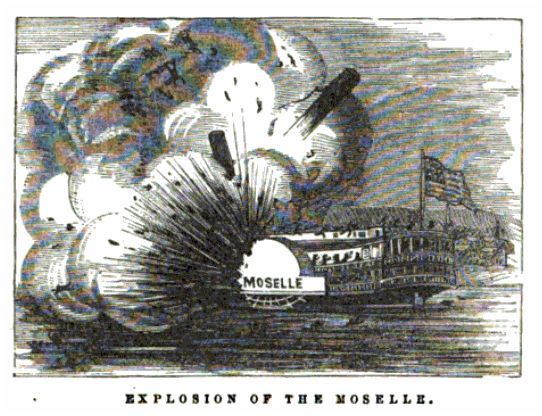
On the evening of 25 April 1838, the brand-new sidewheel steamboat Moselle stopped at Fulton, just upriver from Cincinnati, to take on a family of passengers. According to a Cincinnati Whig extra printed at 8 o'clock that night, "during the whole time of the detention, the Captain was holding on to all the steam he could create, with an intention of showing off to the best advantage the great speed of the boat." At the very moment her wheels made their first revolution, the boilers burst "with a most awful and astounding noise, equal to the most violent clap of thunder." "Heads, limbs, bodies and blood, were seen flying through the air in every direction." The captain was thrown into the street and picked up dead; another man was hurled through the roof of a neighbouring house. A small boy on shore watched his father, mother and three sisters drown "one by one almost within his reach." An infant from the same family was found alive, "floating down the river on one of the fragments of the hurricane deck." The paper's verdict: "sheer imprudence and carelessness."5
No one agrees on how many died. The extra estimated "about one hundred and twenty five" that night; later accounts mostly say around 150; one county compilation lists 81 known dead and 55 missing.56 What is certain is that the Moselle was one explosion in a long series. In December 1848 the US Commissioner of Patents reported to Congress that between 1816 and 1848 there had been 233 steamboat explosions in the United States, killing 2,563 people and injuring 2,097. In 1838 alone, 14 explosions took 496 lives. In England over 1817–1839, 23 explosions killed 77.6
The boilers on American river steamers burst so often partly because of what the technology offered. High-pressure engines were lighter, cheaper and more powerful than low-pressure ones, ideal for pushing upstream on the shallow, fast Mississippi. Competition was fierce, and arriving first meant prestige and trade. During a race, "the usual practice... was to overload or tie down the safety valve, so that excessive steam pressure would not be relieved."6
In 1817 Philadelphia's city council asked engineers to look into steamboat boilers. Their advice was unremarkable by modern standards: a hydraulic proof test at twice the working pressure before a new boiler went into service, monthly tests after that, and the safety valve placed in a locked box so crews could not tamper with it. The council decided that regulating boilers was beyond a city's powers and passed the matter to the state legislature, "and there it rested."6 Across the Atlantic, in 1843, the engineer Sir John Rennie told a parliamentary select committee that there should be "no impediments in the application of steam power," that coroners' juries already deterred bad builders, that constant inspection "would cause serious inconvenience," and that "there were really few accidents."6
Congress first legislated on 7 July 1838, ten weeks after the Moselle. The law had federal judges appoint boiler inspectors, required inspections twice a year, and had the owner pay the inspector $5 per visit, "his sole remuneration." It specified no inspection criteria.6 The result was predictable: from 1841 to 1848, some seventy explosions killed about 625 people. Congress heard that "the inspection methods were a mockery"; inspectors were appointed through well-placed friends, and few "even looked at the boilers but merely collected their fees." Explosion deaths were 277 in 1850 and 407 in 1851.6
What worked was the law of 30 August 1852. The old act had 13 sections on three pages; the new one had 43 sections on fourteen. It set a maximum working pressure of 110 pounds per square inch, required an annual hydrostatic test at one and a half times the working pressure, had plates stamped with the maker's name, demanded two safety valves with one locked in a grating, licensed every engineer, and punished overloading a safety valve with "a two hundred dollar fine and eighteen months imprisonment."6 In the eight years that followed, deaths on steamboats from all causes fell to 65 per cent of the figure for the preceding eight. An engineering editor wrote in the early 1860s that explosions on the Atlantic had "become almost unknown, and have greatly decreased in the west."6
In the small hours of 27 April 1865, the Sultana's boilers exploded on the Mississippi above Memphis. Her legal capacity was 376; she was carrying more than 2,300 people, most of them Union soldiers just released from Confederate prison camps and desperate to get home. The day before, a boiler had been repaired at Vicksburg.7 Estimates of the dead vary widely: the National Park Service gives about 1,169, while the Library of Congress notes that estimates rose "steadily to 1,700 or 1,800."87 On any count it is the deadliest maritime disaster in American history.
At 7.50 on the morning of 20 March 1905, a firetube boiler exploded at the Grover Shoe Factory in Brockton, Massachusetts, killing 58 and injuring 117. A newspaper that day reported that "in an hour the four story factory was a blazing ruin," and "the cries of persons pinned under the timbers in the ruins were heard nearly half a mile."910 The boiler was flung more than 200 feet into a house. The following December another shoe-factory boiler blew up in Lynn. Massachusetts passed a steam boiler law in 1907; the American Society of Mechanical Engineers began drafting a boiler code in 1911, and the first edition (the 1914 Edition) appeared in 1915.911 In ASME's own history, there were "literally thousands of boiler explosions in the United States and Europe" in the nineteenth century.11
Thirty-five years separated the Philadelphia engineers' advice from an effective federal law. The technology did not wait. Steamboats multiplied and grew faster the whole time.
2. The safety lamp
At about 11.30 in the morning of 25 May 1812, firedamp exploded in Felling Colliery near Gateshead. The local clergyman, John Hodgson, wrote the following year of "two heavy discharges from the John Pit," followed almost instantly by one from the William Pit. People half a mile away felt a trembling "as from an earthquake," and the blast was heard three or four miles off. Coal dust fell on the village of Heworth, bringing "a darkness like that of early twilight," and passers-by left footprints "strongly imprinted in it." Of the 121 men and boys underground, 92 died.12
Bodies were not brought up until 8 July. Families identified them by "clothes, tobacco-boxes, shoes." On 15 July, 21 bodies came up, "some like mummies, scorched as dry as if they had been baked." The pit reopened on 19 September. Hodgson recorded: "The body of number ninety-two has never yet been found."12
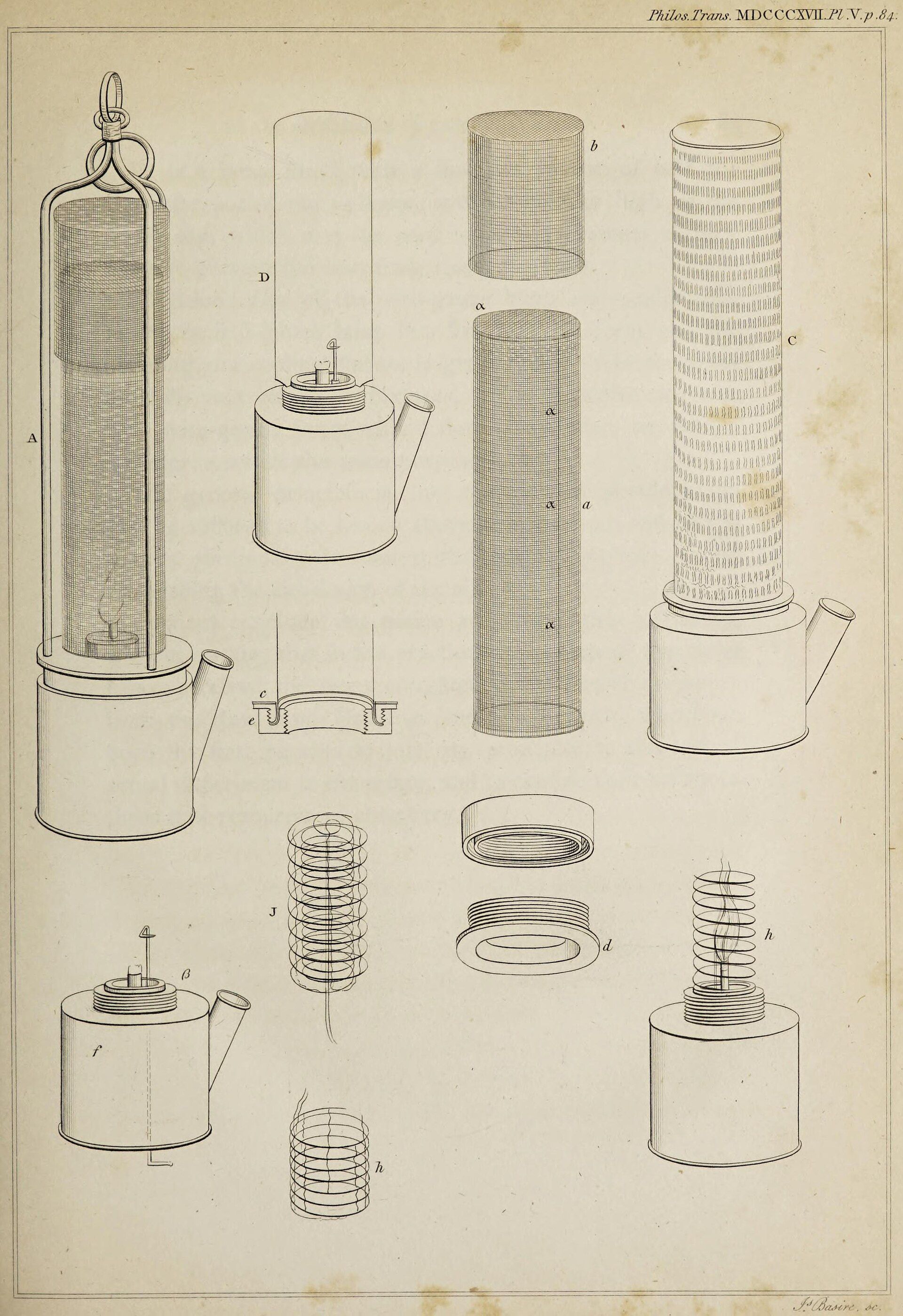
The disaster led directly to a society for preventing mine accidents, whose 1814 report declared that "it is to scientific men only that we must look up."13 In 1815 Humphry Davy and his assistant Michael Faraday took on the problem. Their answer was to enclose the flame in fine metal gauze, which let air in and light out but drew away the flame's heat, so the gas outside never reached ignition. Davy's phrase was to "confine this destructive element flame like a bird in a cage." The lamp was tested at Hebburn Colliery on 9 January 1816. Joseph Banks, President of the Royal Society, congratulated Davy "on defending Society from a Tremendous Scourge of humanity."13 Davy took out no patent.
Twenty years later, a House of Commons select committee on mine accidents produced an unsettling set of figures. In Durham and Northumberland, 447 people had died in mine accidents in the 18 years before the safety lamp, and 538 in the 18 years after: "an evident increase... of 91."14
The committee's explanation was blunt. The lamp had allowed owners to work "seams of coal, so fiery as to have laid unwrought." Reporting the findings, The Times wrote of a "delusion arising from the mere name of 'safety lamp,' which has generated a false degree of confidence in workmen... and an almost blameable degree of enterprise in the owners." The report itself said that "ignorance, and a false reliance upon its merits, in cases attended with most unwarrantable risk, have led to most disastrous consequences." The committee also regretted that Davy's private cautions about the lamp "were not made more public."14
Over the same period, British coal output soared, from 5.2 million tons in 1750 to 62.5 million in 1850.12 Per ton of coal, the lamp very likely made mining safer; in total deaths, miners were worse off. Both calculations are correct. They answer different questions. A lamp that made each descent safer also sent more men down more dangerous pits, and miners rarely chose which pit they went down. In June 1835, Wallsend Colliery on the Tyne exploded, killing 101 (or 102). A survivor testified that three times as many died from afterdamp, the poisonous gas left after an explosion, as from burning.14
3. Hellish machines
In early September 1864, at the Heleneborg estate on Stockholm's south shore, the smith's wife, Mrs Andersson, watched bottles of acid being carried upstairs and muttered: "Now Nobel is carrying up more of those hellish machines. God knows what will become of us one fine day." The landlord had been assured there was no danger.15
At 10.30 on the morning of 3 September, the Nobel family's nitroglycerin laboratory blew up. A newspaper described "a strong pillar of fire with a bright red glow." The dead included Alfred Nobel's 21-year-old brother Emil, an Uppsala student, a 13-year-old boy, a 19-year-old woman, a 45-year-old man who died on the way to hospital, and Mrs Andersson herself, who had "over 200 deeply gaping wounds" from mirror and window glass.15 Sources give the toll as five or six.15 Afterwards Stockholm banned nitroglycerin manufacture inside the city, and Nobel moved his works to a barge on Lake Mälaren.
Nitroglycerin was far more powerful than black powder; its problem was that a jolt could set it off. At 1.15 in the afternoon of 16 April 1866, in the Wells Fargo building on California Street in San Francisco, an employee opened a crate shipped from New York via Panama with a mallet and chisel. The crate was about two and a half feet square and weighed 329 pounds; it had been dropped on a New York wharf a month earlier and had been leaking an oil "like sweet oil." No one knew it held nitroglycerin. The explosion was "instantly killing all the parties present."16 The ground shook for a quarter of a mile, every window on California Street between Montgomery and Kearny broke, an arm struck a third-storey window, and a human brain was found in the auction room next door. A local paper's editorial: "This must be stopped at once... Public safety demands it."17 The death toll is given variously as 10 to 15.18 That same month, on 8 April, the steamer European exploded at Aspinwall in Panama; when the case reached the US Supreme Court, it held that a carrier was not liable for contents it knew nothing about.16
California then banned transporting nitroglycerin. But the Central Pacific Railroad was driving tunnels through the Sierra Nevada on a punishing schedule, so it shipped the ingredients and mixed the explosive on site. One premature blast killed six men. Meanwhile, progress at the Summit Tunnel rose from 1.18 to 1.82 feet a day. One of the railroad's owners summed it up in a letter: "Nitroglycerine tells."18
In 1867 Alfred Nobel absorbed nitroglycerin into a porous diatomaceous earth, creating a "dynamite" that could be handled safely. He received Swedish patent no. 102 and demonstrated it publicly that July at Merstham quarry in England.19 His own factory at Krümmel in Germany had exploded the year before.19
4. The web overhead
In the 1880s the sky over New York's streets was thick with wires: telegraph, telephone, fire alarm and, newest of all, electric light. Arc lamps ran on high voltage, their lines strung on the same wooden poles as everything else, many of the older wires dead and never removed.
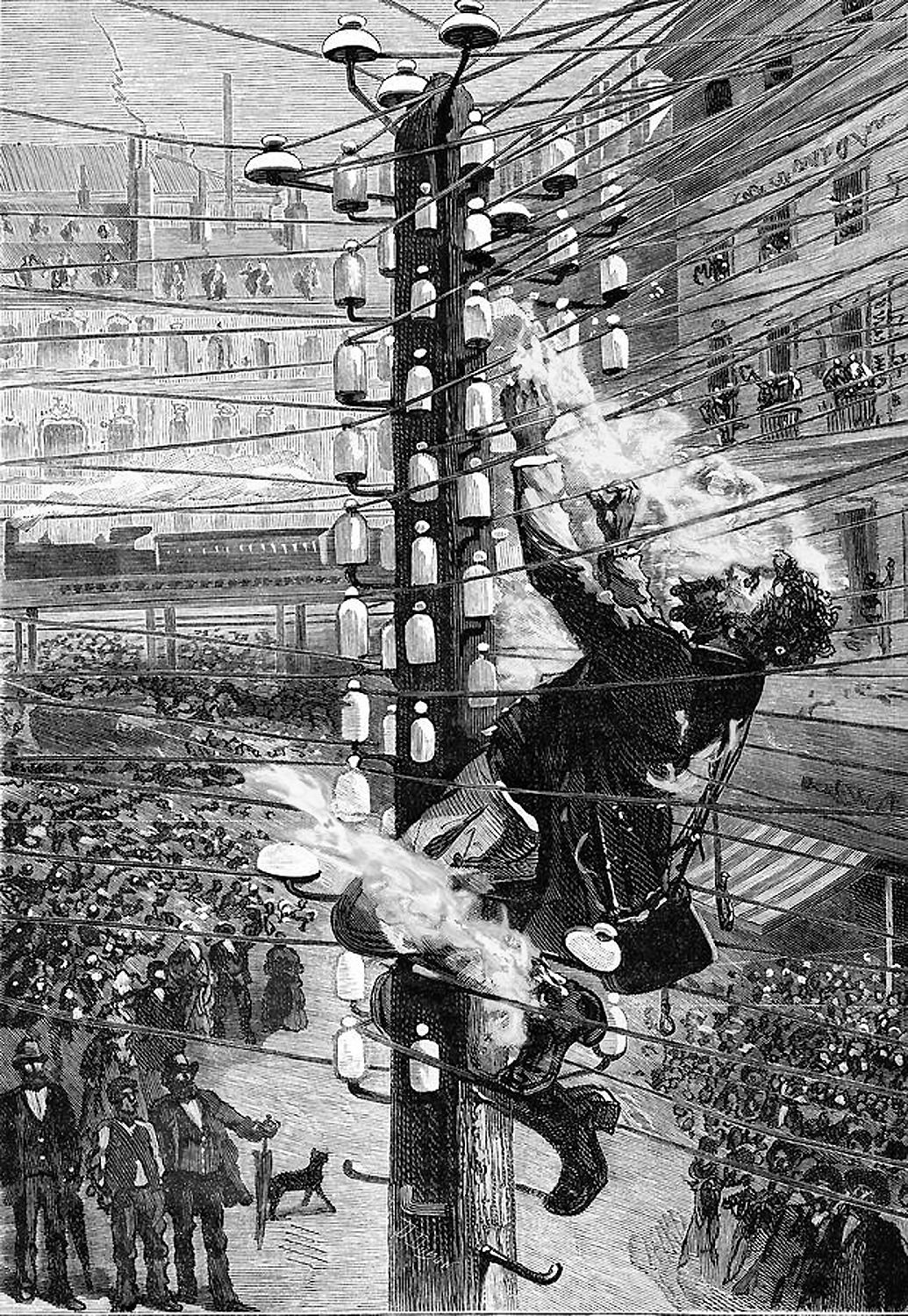
At about 1.15 in the afternoon of 11 October 1889, Western Union lineman John Feeks climbed a 50-foot pole at the south-west corner of Chambers and Centre Streets to cut six dead telegraph wires. The pole also carried nine electric-light wires. He had not taken his rubber gloves. He lurched against a light wire and, according to a wire report the next day, "in an instant the body stiffened... the whole form seemed to have been cast in an iron mold." Blood spattered on the people below. His partner climbed down and ran.20 The deputy coroner said it was the most ghastly sight of his career: the burn in the throat had severed the windpipe, and "if the man had remained suspended in the air much longer the head would have been completely severed from the body." His fingers had been burned off and had fallen into the street.20
Thousands watched from below. The body hung in the wires for the better part of an hour, by some accounts more than an hour. Another lineman had been electrocuted three days earlier. Headlines read "Met Death in the Wires" and "Roasted On a Wire Gridiron." Mayor Hugh Grant said the "death dealing wires must be made safe."21 The electric companies had held off removal with court injunctions; after Feeks's death the courts stopped granting them, the poles came down one by one, and the wires went underground.21 On 30 October the coroner's jury found that the current had come from an electric-light wire and called overhead wires "a constant menace to the lives and property of citizens."22 The current was the same current; what changed was New York's attitude to the wires: they were no longer something to string up first and worry about later.
5. The lying-in ward
The maternity department of the Vienna General Hospital had two clinics. Under an imperial decree of October 1840, all male medical students trained in the First Clinic and all female midwifery students in the Second. The clinics admitted women in alternating 24-hour blocks, the First four days a week, the Second three.23 Without meaning to, the arrangement set up a controlled experiment that ran for years.
These are the figures the Hungarian physician Ignaz Semmelweis later published for deaths from puerperal (childbed) fever in the two clinics:24
| Year | First Clinic births | Deaths | Rate | Second Clinic births | Deaths | Rate |
|---|---|---|---|---|---|---|
| 1841 | 3,036 | 237 | 7.7% | 2,442 | 86 | 3.5% |
| 1842 | 3,287 | 518 | 15.8% | 2,659 | 202 | 7.5% |
| 1843 | 3,060 | 274 | 8.9% | 2,739 | 164 | 5.9% |
| 1844 | 3,157 | 260 | 8.2% | 2,956 | 68 | 2.3% |
| 1845 | 3,492 | 241 | 6.8% | 3,241 | 66 | 2.0% |
| 1846 | 4,010 | 459 | 11.4% | 3,754 | 105 | 2.7% |
| Total | 20,042 | 1,989 | 9.9% | 17,791 | 691 | 3.4% |
Semmelweis wrote that women who found they had been admitted to the First Clinic would, "kneeling and wringing their hands, beg to be released in order to seek admission to the second clinic."25 There was another oddity. Every year around a thousand Viennese women failed to reach the hospital in time, gave birth in the street, and then registered at the hospital so their babies could go to the free foundling home. These "street births" rarely developed childbed fever.26
In the first 39 years of the Vienna maternity clinic, from its opening in 1784 to 1822, deaths from puerperal fever were low: a median of 0.8 per cent, above 3 per cent in only two years. In 1823 the hospital introduced teaching in pathological anatomy. Students and doctors began dissecting corpses every day and then going straight to examine women in labour. Mortality climbed, reaching 12.1 per cent (both clinics combined) in 1842.26 What made the ward lethal was the most advanced medicine of its day: autopsy-based pathology, which for the first time let doctors systematically match symptoms to diseased organs, and which also let them carry something from the corpses to the mothers. No one yet knew about bacteria.
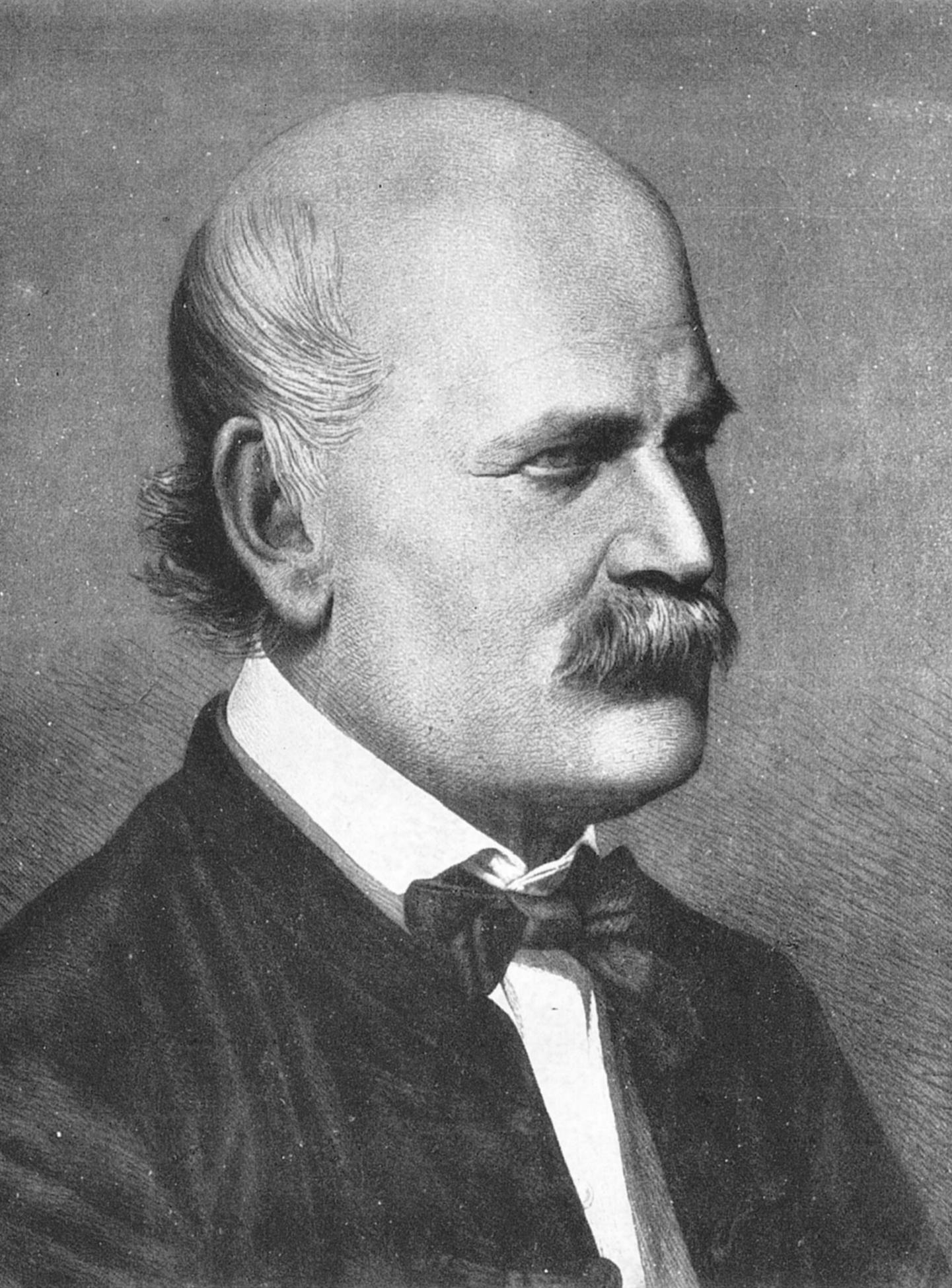
In March 1847 Semmelweis returned from a holiday in Venice to learn that Jakob Kolletschka, a professor of forensic medicine he admired, had died after a student nicked his finger with an autopsy knife. Reading the post-mortem, Semmelweis wrote, "I could see clearly that the disease from which Kolletschka died was identical to that from which so many hundred maternity patients had also died... Day and night I was haunted by the image of Kolletschka's disease."27 He concluded that "cadaverous particles" on doctors' hands were to blame.
The monthly figures, as later reconstructed, are stark. From late 1846 to March 1847, while a non-autopsying assistant was in charge of the First Clinic, mortality fell to 4.9 per cent; Semmelweis resumed his post on 20 March, and in April mortality jumped to 18.3 per cent (57 of 312). In mid-May he ordered everyone to wash their hands in a solution of chlorinated lime before entering the ward. He chose it because it removed the smell of the dissecting room, and because it was cheap; it was used at the time to whiten paper and clean stables. From June 1847 to February 1849, First Clinic mortality was 2.0 per cent (122 of 6,189).2628 In 1848, with washing all year, 45 of 3,556 women died: 1.3 per cent.27
Semmelweis was dismissed in March 1849, partly for political reasons; he had backed the Hungarian revolution of 1848. He went back to Pest, published his book on the cause of childbed fever in 1861, and wrote furious open letters: "It weighs on my conscience that thousands upon thousands of mothers and infants have perished—lives that could have been saved... The killing must end."28 In 1865 he was committed to an asylum outside Vienna, where he died of sepsis on 13 August, aged 47.27
In 1871 Florence Nightingale published Introductory Notes on Lying-in Institutions, drawing on European data compiled by a French surgeon: 888,312 hospital deliveries with 30,394 deaths, or 34 per 1,000; 934,781 home deliveries with 4,405 deaths, or 4.7 per 1,000. As she put it, "for every two women who would die if delivered at home, fifteen must die if delivered in lying-in hospitals."29 Her own fund's maternity ward at King's College Hospital in London, opened in 1862, fared no better: 26 deaths in 780 deliveries over six years, or 33.3 per 1,000, several times the national average at the time, and the ward was closed.29 An 1876 committee report to the governors of the New York Hospital cited the same European data: at home, one death in 212; in hospital, one in 32. "Puerperal fever has become the terror of obstetrics."30
Hospitals were built to make childbirth safer. They gathered mothers, the best doctors and the newest science in one place, and infection gathered there with them.
6. The painless knife
In 1843 George Wilson, a chemistry professor in Edinburgh, had his foot amputated without anaesthesia. He later recalled "the horror of great darkness, and the sense of desertion by God and man, bordering close on despair... the twisting of the tourniquet: the first incision: the fingering of the sawed bone... the bloody dismembered limb lying on the floor."31
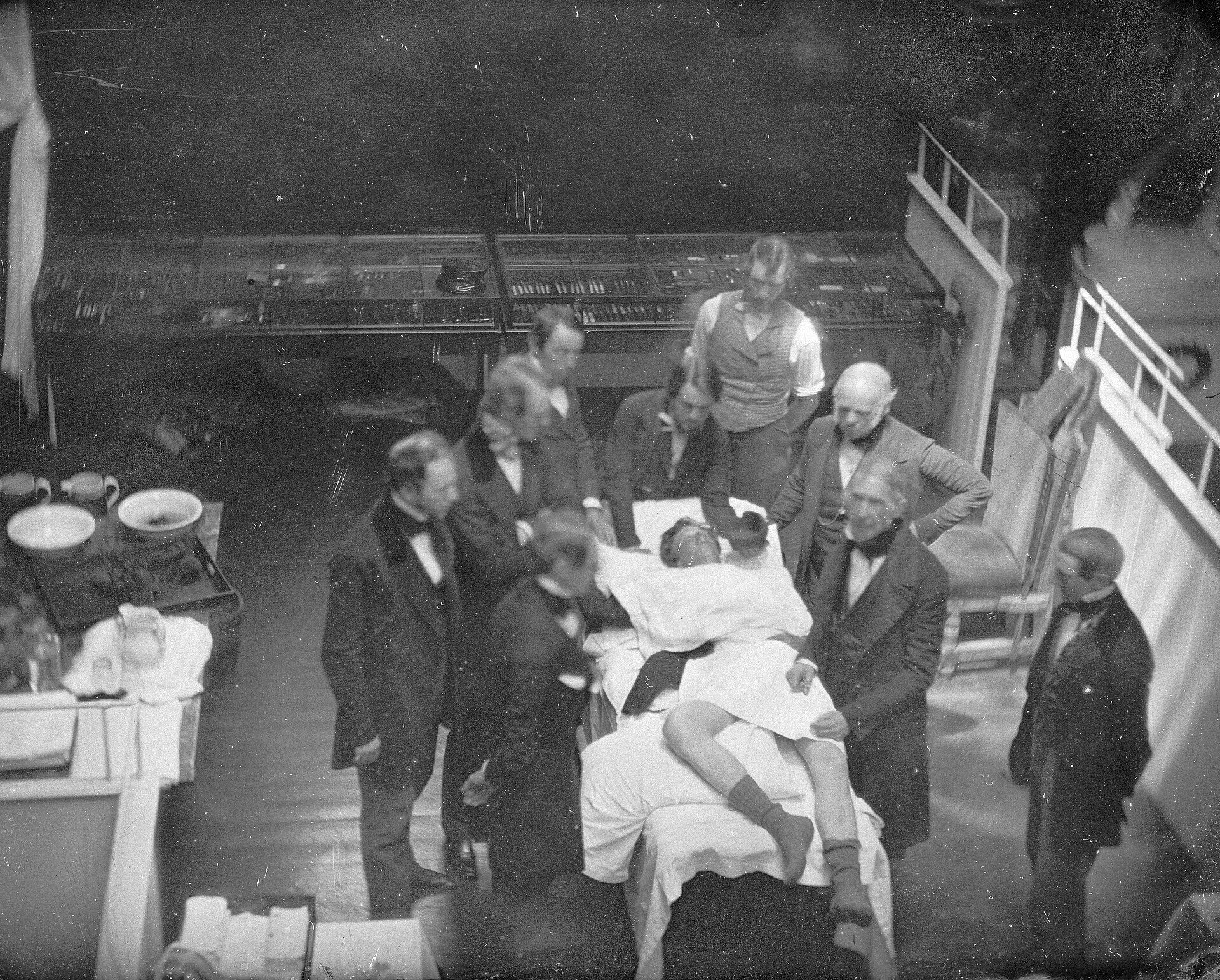
On 16 October 1846, at Massachusetts General Hospital in Boston, the dentist William Morton had 20-year-old Edward Gilbert Abbott inhale ether while the surgeon John Collins Warren removed a tumour from his neck. Warren reportedly told the packed room, "Gentlemen, this is no humbug." The following November, in Edinburgh, James Young Simpson and two assistants inhaled chloroform in his dining room; eleven days later he published a paper reporting about 50 successful cases and recommending no apparatus at all, "just a little chloroform on a cloth."3132
Massachusetts General's records show about 1.6 operations a month before Ether Day and 5.6 a month in the five months after; the share of female patients doubled, and amputations and orthopaedic cases rose. The sample is small, just 40 records, but the direction is clear.31 Patients no longer had to endure the saw awake, surgeons no longer had to count in seconds, and many operations once too dreadful or too marginal to attempt began to be performed.
On 28 January 1848, in Winlaton near Newcastle, Hannah Greener, a healthy 15-year-old, was to have an ingrowing toenail removed. Months earlier she had had another toenail removed under ether without trouble. This time the surgeon, Thomas Meggison, poured about a fluid drachm of chloroform onto a tablecloth and held it to her nose. At the inquest he testified: "Her eyes were closed and I opened them, and they remained open. Her mouth was open, and the lips and face blanched. I called for water and dashed some of it in her face. I then gave her some brandy, a little of which she swallowed with difficulty." She was dead within two minutes of beginning to inhale.33 Simpson promptly argued that she had choked on the brandy given to revive her.32 By 1852 the London anaesthetist John Snow had listed more than 21 chloroform deaths, mostly in healthy people undergoing minor operations.33 England began switching back to ether from 1873; Scotland kept using chloroform until 1914.32
As operations multiplied and lengthened, wounds stayed open longer, and the infection in hospital wards did not diminish at all. In 1869 Simpson surveyed 374 country surgeons and a set of large hospitals. In British hospitals with 300 to 600 beds, 855 of 2,089 limb amputations ended in death: 41 per cent. In country practice, where patients were operated on in isolated rooms, about 226 of 2,098 died: roughly 11 per cent. The bigger the hospital, the higher the death rate; in the great hospitals of Paris it reached 62 per cent.30 Simpson named the phenomenon "hospitalism."
The 1876 New York Hospital report did not mince words: "No progress has been made in English hospitals for forty years, notwithstanding the vast advantages conferred upon modern surgeons by the use of chloroform and ether... surgeons continue to lose almost half their amputations." It quoted the London surgeon John Erichsen's question of 1874, "must hospital surgeons ever remain content with losing from one-third to one-half of all their amputation cases, and nine-tenths of some?" and the grim joke of the day: "the operation has succeeded admirably but the patient is dead."30 Lincoln County Hospital was so saturated with pyaemia that its governors pulled it down. Erichsen's view was that in such cases "there is... only one remedy left, viz., the demolition of the infected fabric and the destruction of its materials."30
In Glasgow, the new surgical block of the Royal Infirmary where Joseph Lister worked looked ideal, but "this noble structure proved extremely unhealthy. Pyaemia, erysipelas, and hospital gangrene soon showed themselves," worst on the ground floor. Beneath the ground-floor wards Lister later found "the uppermost tier of a multitude of coffins" from the cholera epidemic of 1849, the bodies so little changed "that the clothes they had on at the time of their hurried burial were plainly distinguishable."34
Having read Pasteur's work on microbes, Lister began treating wounds and dressings with carbolic acid in 1867. His wards, he reported, had been among the unhealthiest in Glasgow, yet "during the last nine months not a single instance of pyaemia, hospital gangrene, or erysipelas has occurred in them."35 In 1870 he published his amputation figures: 16 deaths in 35 cases before antisepsis, 6 in 40 after. He conceded that "these numbers are, no doubt, too small for a satisfactory statistical comparison."34 Simpson himself scorned carbolic acid.
Anaesthesia made surgery possible; antisepsis made it safe. Twenty years lay between them, and in those twenty years far more people were put on the operating table.
7. Invisible light
In November 1895 the German physicist Wilhelm Röntgen noticed that a discharge tube wrapped in black paper made a fluorescent screen glow across the room. A week later he X-rayed his wife's hand, "revealing finger bones and a bulbous wedding ring."36 Within months X-rays were a worldwide sensation.
In May 1896, at the National Electric Light Association exhibition in New York, Thomas Edison showed his fluoroscope and hundreds lined up to see their own bones. Edison's glassblower Clarence Dally tested the tubes. A doctor later told the New York World that Dally "put his head up in front of the light in order that people might look through it. The result was that his hair and mustache fell out." He tested tubes by "placing his hand between the fluoroscope and the light... day after day, until he simply burned up the blood vessels in his hand."3736 He slept with his hands in water to ease the burning. By 1903 his left arm had been amputated three inches below the shoulder and four fingers removed from his right hand, leaving "but one thumb on one hand." His surgeon said: "I regard him a martyr to science."37
In August 1903 Edison told a World reporter: "Don't talk to me about X-rays... I am afraid of them. I stopped experimenting with them two years ago, when I came near to losing my eyesight and Dally, my assistant practically lost the use of both of his arms. I am afraid of radium and polonium too, and I don't want to monkey with them." He could have made an X-ray lamp, he said, "but... it would kill everybody who would use it continuously."37 Dally died in October 1904, aged 39.
From the 1910s through the 1920s, more than 3,000 girls and young women in the United States painted luminous dials on watches and instruments with radium paint. At the US Radium Corporation in Orange, New Jersey, supervisors "instructed the women to lick their camel-hair brushes to a point" so they could trace the tiny numerals. When the women asked whether this was safe, they were told it was.38 Within a few years some began losing teeth and suffering rotting jaws. During one examination Mollie Maggia's "jawbone shattered against the light touch of her dentist's hand." Others had collapsed hips and spines and wore braces "from the neck to the waist."38
In April 1928 Elizabeth Hughes, a physicist formerly of the National Bureau of Standards, had each of five women suing the company breathe through bottles into an electroscope. For all five, the gold leaf moved "at least twice as fast as the normal drift rate": their breath was radioactive.38 That June the company settled, paying each woman $10,000 plus medical bills and a $600 yearly pension, without ever admitting liability.3839 Sources differ slightly on the exact date and amount. One of the five, Grace Fryer, died in October 1933, aged 35.40
Radithor was a tonic sold to the well-off: half-ounce bottles of water "guaranteed to contain at least 1 microcurie each of Ra-226 and Ra-228," at $1 apiece. More than 400,000 bottles were sold.41 Eben Byers, a Pittsburgh steel magnate and former US amateur golf champion, began drinking it after injuring his arm in 1927, about three bottles a day, some 1,400 in all, and fed it to his racehorses too. A Federal Trade Commission investigator who visited him reported that "his whole upper jaw, excepting two front teeth, and most of his lower jaw had been removed. All the remaining bone tissue of his body was slowly disintegrating, and holes were actually forming in his skull... A more gruesome experience in a more gorgeous setting would be hard to imagine." Byers died on 31 March 1932.41 The often-quoted headline "The Radium Water Worked Fine Until His Jaw Came Off" comes from a 1990 Wall Street Journal retrospective, not from the news of 1932.42
From the 1920s to the 1950s, many shoe shops installed X-ray fluoroscopes for fitting; customers put their feet into the machine and looked through an eyepiece at their bones inside the new shoes. The customer stood "on top of the X-ray tube," with only a 1 mm aluminium filter in between; the most common timer setting was 20 seconds. In the early 1950s there were about 10,000 in the United States, 3,000 in Britain and 1,000 in Canada. Measured doses to the feet were 7 to 14 roentgens per 20-second exposure, and more than 60 per cent of machines inspected exceeded the 1946 standard.43 No customer injuries were recorded. The harm fell on staff, who spent their days putting their hands into the beam to press on shoes; one shoe model suffered such a serious radiation burn that her leg had to be amputated. Pennsylvania became the first jurisdiction to ban the machines, in 1957; by about 1960 they had largely vanished from the US, though a few were still in use in Canada and Britain around 1970.43
Marie Curie's laboratory notebooks are now held by the Bibliothèque nationale de France. The library confirms that they carry "traces de contamination" and can be consulted only "selon un protocole de suivi très strict"; but when it had an expert from the French Atomic Energy Commission measure the display, ten minutes in front of the case gave about 2 nanosieverts, "5,000 times less than a day's natural background radiation."44 Radium-226 has a half-life of about 1,600 years.

8. Slow poisons
On 9 December 1921, at General Motors' research laboratory in Dayton, Ohio, Thomas Midgley Jr.'s team found that tetraethyl lead stopped engine knock. A concentration of one part in 1,360, "less than an ounce in 10 gallons," was enough. "It was eureka," a colleague recalled. The first leaded gasoline went on sale in Dayton in February 1923.45 Tetraethyl lead had in fact been synthesised in 1854 and never used commercially because of "its known deadliness."46
In January 1923 Midgley cancelled three American Chemical Society talks, writing: "After about a year's work in organic lead, I find that my lungs have been affected and that it is necessary to drop all work and get a large supply of fresh air." He went to Miami. A colleague recalled: "We all had lead poisoning... You could see the lines of lead in the bones... Midgley had it, too."4645
In October 1924, at Standard Oil's tetraethyl lead unit at Bayway in Elizabeth, New Jersey, workers went mad one after another. A medical report described how "the patient becomes violently maniacal, shouting, leaping from the bed, smashing furniture... In two fatal cases, the body temperature rose to 110 degrees just before death." By the end of the month five were dead and 35 more had tremors and hallucinations. The workers called the stuff "loony gas."4546 At DuPont's tetraethyl lead plant in Deepwater, New Jersey, workers called the building "the House of Butterflies, for the hallucinations"; men died there too.4645 As early as 1922 a Public Health Service laboratory director had warned that tetraethyl lead was a "serious menace to public health."46
In 1925 the Surgeon General convened a conference. Standard Oil's representative called tetraethyl lead "a gift of God"; a labour advocate replied that it had been no gift of God for the workers. Midgley called it "not so much a dangerous poison as it is a treacherous one." Sales were suspended in May 1925; a committee found no grounds for a ban, and they resumed in May 1926.45
Over the following decades lead drifted from exhaust pipes into air, soil and children's blood. The United States did not ban lead in motor fuel until 1986; a 1985 Environmental Protection Agency study estimated that up to 5,000 Americans had died each year of lead-related heart disease before the phase-out. In 1996, 93 per cent of the petrol sold in Africa was still leaded.46
Midgley's other famous invention solved a different safety problem. In 1929 a refrigerant leak of methyl chloride at a Cleveland hospital killed more than 100 people. Refrigerators needed a coolant that would neither burn nor poison. Midgley's team found dichlorodifluoromethane, Freon-12, in about three days. At the 1930 ACS meeting he "breathed in a lungful of the vapors, and gently exhaled them toward the flame. It went out."45 It really was non-toxic and non-flammable, almost perfectly safe. Fifty-five years later, in May 1985, scientists of the British Antarctic Survey reported in Nature that October ozone over the Halley station had fallen to about two-thirds of its thickness in earlier decades. NASA's satellite processing software had been flagging the low readings as probable bad data.47 The culprits were chlorofluorocarbons, Freon's chemical family.
Midgley was paralysed by polio in 1940 and built himself a harness of ropes and pulleys to get out of bed. On 2 November 1944 his wife found him strangled in it. The public was told it was an accident; another account says it was privately ruled a suicide.4548
In 1898 a British factory inspector noted the "sharp glass-like jagged nature" of asbestos particles. In 1899 a carding-room worker told the London doctor Montague Murray that of the ten men in his room he was the only survivor: "They all died somewhere about thirty years of age." By 1918 American insurers were refusing to cover asbestos workers.49 In 1924 Nellie Kershaw of Rochdale became the first asbestos worker to receive an inquest and pathological examination; her doctor said he saw ten to twelve such cases a year. Thomas Legge, formerly Britain's senior medical inspector of factories, wrote in 1934 that "opportunities for discovery and prevention of asbestos disease were badly missed."49 The World Health Organization estimates that occupational asbestos exposure still causes more than 200,000 deaths worldwide each year, over 70 per cent of all deaths from work-related cancers.50 A European Environment Agency report put the difficulty of proving such harm in one line: "it was the workers who did not make it to the party who provided the proof of harm."49
A boiler explosion leaves bodies on the spot, and so does a firedamp blast. Lead, asbestos and CFCs did their damage over years and decades, and by the time the evidence was in, they had been built into cars, houses, refrigerators and entire industries.
9. The medicine bottle
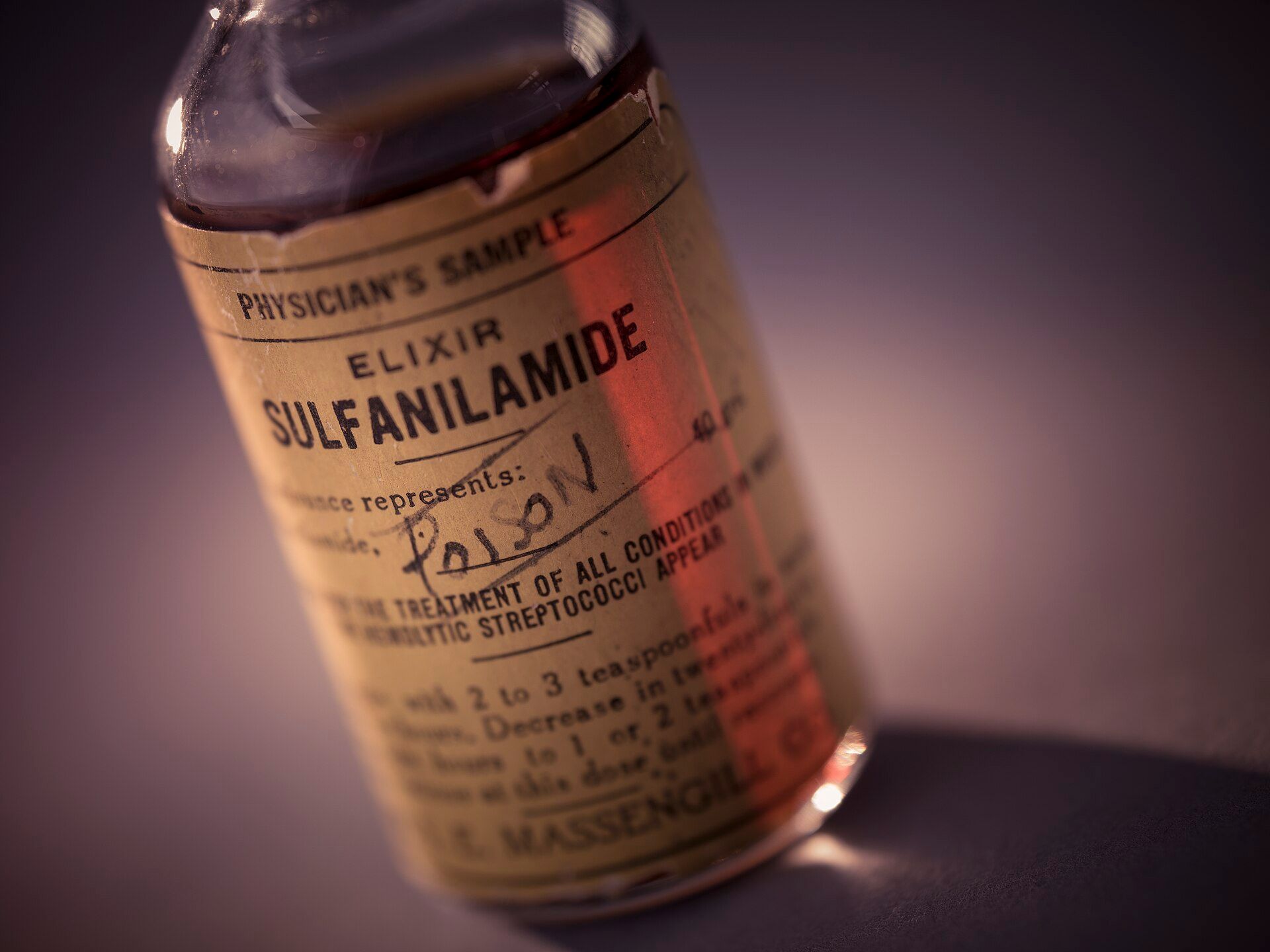
In June 1937 a salesman for the S.E. Massengill Company of Bristol, Tennessee, reported demand in the South for a liquid form of sulfanilamide, a genuine wonder drug already used safely as tablets and powder. The company's chief chemist, Harold Cole Watkins, found that it dissolved in diethylene glycol. The raspberry-flavoured product was called Elixir Sulfanilamide. The company's control laboratory tested it only "for flavor, appearance, and fragrance." American law required no toxicity testing of new drugs. In early September, 633 shipments went out across the country.51
In September and October 1937 more than 100 people in 15 states, "as far east as Virginia and as far west as California," died; many were children with sore throats. They lingered for seven to twenty-one days with kidney failure and "intense and unrelenting pain," and there was no antidote.51 The FDA later put the toll at 107.52 A doctor wrote on 22 October: "...to realize that six human beings, all of them my patients, one of them my best friend, are dead because they took medicine that I prescribed for them innocently... I have known hours when death for me would be a welcome relief from this agony."51 A mother wrote to President Roosevelt: "The first time I ever had occasion to call in a doctor for [Joan] and she was given Elixir of Sulfanilamide. All that is left to us is the caring for her little grave. Even the memory of her is mixed with sorrow for we can see her little body tossing to and fro and hear that little voice screaming with pain and it seems as though it would drive me insane... It is my plea that you will take steps to prevent such sales of drugs that will take little lives and leave such suffering behind."51
Practically all of the FDA's 239 inspectors and chemists were put on the case, hunting down every bottle. At one firm 20,000 sales slips were checked; a Texas salesman gave up his distribution records only after being jailed; prescriptions in East St Louis read simply "Betty Jane, 9 months old" or "Mrs. Jackson (no address)." In South Carolina an inspector found a dead mill-worker's four-ounce bottle, with about an ounce left, among the medicines placed on his grave, "about one and a half miles back in the fields." Of 240 gallons manufactured, 234 gallons and one pint were recovered.51 The company's owner, Samuel Evans Massengill, said: "My chemists and I deeply regret the fatal results, but there was no error in the manufacture of the product... I do not feel that there was any responsibility on our part." Watkins, the chemist, killed himself after learning what had happened.51
The FDA could seize the drug only for "misbranding": an "elixir" implied alcohol, and this one contained none. Had it been called a "solution," there would have been no charge at all. Commissioner Walter Campbell said the agency had been forced to proceed "on a technical and trivial charge of misbranding."51 The company was fined $26,100, the maximum the law allowed.52 The following year Congress passed the Federal Food, Drug, and Cosmetic Act of 1938, requiring proof of safety before a drug could be marketed.51 Among the University of Chicago graduate students whose animal tests helped pin the toxicity on the solvent was a young Canadian named Frances Kelsey.52
Twenty-three years later, in September 1960, Kelsey was a medical reviewer at the FDA, a month into the job. Her first assignment was an application from Richardson-Merrell of Cincinnati for "Kevadon," the sedative thalidomide, already widely used in Europe. "They gave it to me because they thought it would be an easy one." She judged the clinical reports "more on the nature of testimonials." The company pressed: "We want to get this drug on the market before Christmas, because that is when our best sales are." After a letter in the British Medical Journal in December 1960 reported peripheral neuritis in users, she asked for more data, suspecting the drug might harm a fetus.52 In November 1961 the German physician Widukind Lenz linked thalidomide to phocomelia, a rare malformation of the limbs, and Germany withdrew it about ten days after his warning. More than 10,000 children in 46 countries are estimated to have been born with deformities. In the US there were 17, because while the application was pending, the company had distributed more than 2.5 million tablets "on an investigational basis" to over 1,000 doctors, who gave them to about 20,000 patients, several hundred of them pregnant.52 On 7 August 1962 President Kennedy presented Kelsey with the President's Award for Distinguished Federal Civilian Service; on 10 October he signed the Kefauver-Harris Amendments, which required new drugs to prove not only safety but efficacy, through "adequate and well-controlled studies."5253
On 12 April 1955 a trial involving 1.8 million children declared Jonas Salk's polio vaccine safe and effective. That afternoon five companies were licensed to make it; the licensing took about two and a half hours.54 One was Cutter Laboratories in California. Within weeks, children who had received Cutter vaccine began to be paralysed, and the first paralysis often appeared in the arm or leg where they had been injected. The CDC's count in November 1955 was 204 cases of polio associated with Cutter vaccine, with 11 deaths: 79 among vaccinated children, 105 among their family members and 20 among community contacts.55 Later work, including mild cases, estimated about 40,000 infections, roughly 164 people permanently paralysed and 10 dead.56 Some Cutter lots contained live virus. All polio vaccination in the US was suspended on 7 May. The CDC later called the episode "a defining moment in the history of vaccine manufacturing and government oversight of vaccines," which "led to the creation of a better system of regulating vaccines."57
In the early 1970s, clotting-factor concentrates purified from plasma transformed life for people with haemophilia. They could inject themselves at home instead of being admitted to hospital with every bleed. Life expectancy for American haemophiliacs rose from about 40 in 1941–60 to 60 in 1971–80.58 But each batch of concentrate was made from plasma pooled from thousands of donors, and the manufacturing process "can also inadvertently concentrate certain viruses." American factor concentrates were not virally inactivated until 1983–84.58 In the early 1980s about half of the roughly 16,000 haemophiliacs in the United States were infected with HIV.58 In Britain, the final report of the Infected Blood Inquiry, published on 20 May 2024, found that about 1,250 people with bleeding disorders had been infected with HIV, including about 380 children, three-quarters of whom have died; about 26,800 more had been infected with hepatitis C through transfusion; and more than 3,000 deaths were attributable to infected blood and blood products.59 Its chair, Sir Brian Langstaff, said on publication: "This disaster was not an accident."60
On 12 December 1995 the US Food and Drug Administration approved Purdue Pharma's OxyContin, an extended-release form of oxycodone.61 Those who later promoted opioid painkillers often cited a 1980 letter to the New England Journal of Medicine: of 39,946 hospitalised patients followed by a drug-surveillance programme, 11,882 had received at least one narcotic, and there were "only four cases of reasonably well documented addiction."62 The letter was about patients given drugs in hospital. By 2017 it had been cited 608 times, 439 of them (72.2 per cent) as evidence that addiction was rare.63 Purdue's own market research, begun in January 1996, recorded that "[t]he biggest negative of [OxyContin] was the abuse potential," and the company's own study found that crushing a 10 mg tablet let an abuser extract about 68 per cent of the oxycodone. In 2007 a Purdue affiliate and three executives pleaded guilty to misbranding OxyContin and paid a total of $634,515,475. The US Attorney on the case, John Brownlee, said: "In the process, scores died as a result of OxyContin abuse and an even greater number of people became addicted to OxyContin."64 In 2020 Purdue Pharma pleaded guilty again, this time to three federal felonies, with a criminal fine of $3.544 billion and a further $2 billion in forfeiture.65 The New England Journal of Medicine now prints an editor's note beside the 1980 letter, warning that it was "heavily and uncritically cited."62
In December 1945, Alexander Fleming closed his Nobel lecture with an imaginary case. Mr X has a sore throat. He buys some penicillin and takes "not enough to kill the streptococci but enough to educate them to resist penicillin." He infects his wife. Mrs X gets pneumonia and is treated with penicillin; the streptococci are now resistant, and the treatment fails. "Mrs. X dies." Fleming ended: "Moral: If you use penicillin, use enough."66
10. The road
On 31 August 1869, in Birr (then Parsonstown), Ireland, the naturalist and microscopist Mary Ward was riding on an experimental steam carriage built by her young cousins, sons of the Earl of Rosse. Raising steam had taken over an hour, and the car was now travelling down the Mall "at an easy pace," about three and a half miles an hour. Mary, perched on a stool at the front, slipped off and fell into the road; a second or two later one of the heavy iron wheels ran over her head. The doctor told the inquest: "She was merely breathing... Her neck was broken and her jaw bone greatly fractured, she was bleeding a great deal from the ears... she died about one minute after I saw her."67 She is regarded as the first recorded motor-vehicle fatality.
On 17 August 1896 Bridget Driscoll, a 44-year-old labourer's wife, was visiting the Crystal Palace in London with her 16-year-old daughter when she was struck and killed by a petrol car. There were fewer than 20 petrol cars in Britain. A witness said the car came at "a 'tremendous pace', like a fire engine — 'as fast as a good horse could gallop'"; the driver, Arthur Edsall, said he had been doing 4 mph and had rung his bell and shouted. He had been driving for three weeks; no licence was required, and no one had told him which side of the road to keep to. Her daughter testified that the driver "did not seem to understand what he was doing," and broke down as she described the car going over her mother.68 A few weeks earlier a new Act had raised the speed limit to 14 mph and abolished the requirement for a man to walk ahead of motor vehicles with a red flag. The coroner said he hoped this would be the last death of its kind. By 2010, more than 550,000 people were estimated to have been killed on Britain's roads.68
The US National Highway Traffic Safety Administration keeps a table that begins in 1899, when 26 Americans died in motor vehicles. In 1921, 13,253 died, a rate of 24.08 per 100 million vehicle-miles; in 2024, 39,254 died, a rate of 1.19.69 Mile for mile, driving in America is about 20 times safer than in 1921; yet the death toll has nearly tripled, because the miles driven have grown about sixty-fold.69 The gap between those two ways of counting was described statistically long ago. In 1949 the British statistician R. J. Smeed fitted data from many countries to a formula showing that as car ownership rises, deaths per vehicle fall, while deaths per head of population, and the total, rise for a long time.7071 Only from the 1960s did total deaths in some countries begin to turn down.71
In November 1965 Ralph Nader, a 31-year-old lawyer, published Unsafe at Any Speed. As early as 1959 he had written that "Detroit today is designing automobiles for style, cost, performance and calculated obsolescence, but not — despite the 5,000,000 reported accidents, nearly 40,000 fatalities, 110,000 permanent disabilities and 1,500,000 injuries yearly — for safety."72 In February 1966 he told a Senate subcommittee: "A civilized society should want to protect even the nut behind the wheel from paying the ultimate penalty for a moment's carelessness, not to mention protecting the innocent people who get in his way." General Motors had hired private investigators to dig into his private life; when this came out, GM's president apologised at a televised hearing, and the company later settled Nader's privacy suit for $425,000.72 On 9 September 1966 President Johnson signed the National Traffic and Motor Vehicle Safety Act. In the Rose Garden he said: "Over the Labor Day weekend, 29 American servicemen died in Vietnam. During the same Labor Day weekend, 614 Americans died on our highways in automobile accidents... In this century, more than 1,500,000 of our fellow citizens have died on our streets and highways: nearly three times as many Americans as we have lost in all our wars."73 Nader sat inconspicuously near the back. NHTSA estimated in 2015 that government-mandated vehicle safety improvements saved 613,501 lives between 1960 and 2012.72
In 1975 an economics paper examined the seat belts, energy-absorbing steering columns, penetration-resistant windshields, dual braking systems and padded instrument panels required from 1968, and concluded that "safety regulation has had no effect on the highway death toll," because drivers offset the gains by driving more riskily; lives saved among occupants were made up by more pedestrian deaths.74 The study was quickly criticised, and the mainstream view that emerged over the following decades is that people often spend part of a safety margin, but nowhere near all of it.7576 A Munich taxi study of the 1980s is often cited as evidence. In one fleet, cabs with anti-lock brakes had no fewer accidents than cabs without; they had slightly more, though not significantly so in a statistical sense. Accelerometers hidden in the cars showed that "extremely hard braking occurred more often in the vehicles with ABS," and undercover passengers found that ABS drivers "made sharper turns in curves" and followed more closely. But in the study's fourth year, after the company made drivers pay part of their repair costs and threatened dismissal, accidents fell sharply in all the cabs.7778 What moved the risk in the end was the incentive, not the brakes.
In 2009, 4,109 pedestrians were killed in the United States, the lowest in decades. By 2023 pedestrian deaths had risen 80 per cent, against a 13 per cent rise in all other traffic deaths, and 2022 set a 40-year high.79 These were the years smartphones spread: active smartphones in the US grew by more than 400 per cent between 2009 and 2018. But the Governors Highway Safety Association, which compiles the pedestrian figures, says itself that although the two coincide, "there is a lack of evidence to establish a definitive link," partly because investigators cannot capture "momentary distraction."80 The vehicles changed too: pickups, SUVs and vans with a hood higher than 40 inches are about 45 per cent more likely to kill a pedestrian they hit than cars with lower, sloping fronts.81 In 2024, 21.7 per cent of pedestrian deaths involved a distracted driver, up from 15.6 per cent in 2019.82
11. Clever machines
On 3 June 1985, at Kennestone Regional Oncology Center in Marietta, Georgia, a 61-year-old woman lay under a medical linear accelerator called the Therac-25. She felt "a tremendous force of heat... this red-hot sensation," and told the technician, "You burned me." The technician replied that this was not possible. It was later estimated that she had received one or two doses in the 15,000 to 20,000 rad range; a typical treatment is about 200 rads.83
The Therac-25 was made by Atomic Energy of Canada Limited (AECL). Its predecessors used hardware interlocks to prevent accidents; this model relied more on software. AECL decided not to duplicate all the existing hardware safety mechanisms and interlocks, and its 1983 fault-tree safety analysis apparently excluded the software. Eleven machines were installed, five in the US and six in Canada.83
On 21 March 1986, at the East Texas Cancer Center in Tyler, an experienced operator was giving Voyne Ray Cox his ninth treatment. Entering the parameters, she typed "x" for X-ray mode instead of "e" for electron mode, corrected it with the up-arrow key, hit return, and pressed "B" to start the beam. The screen showed "Malfunction 54" and "treatment pause," with the dose display reading 6 of 202 prescribed units. The machine paused for no reason so often that she pressed "P" to proceed. That day the room's intercom and video monitor happened to be broken. Cox felt as if he had received an electric shock or "someone had poured hot coffee on his back"; on the second shot he felt "like his arm was being shocked by electricity and that his hand was leaving his body," and got up and pounded on the door.8384 Simulations later put his dose at 16,500 to 25,000 rads "in less than 1 second over an area of about 1 cm."83 He died later that year.
On 11 April, the same operator, using the same editing sequence, caused another accident. The patient reported "fire" on the side of his face, a flash of light and "a sizzling sound reminiscent of frying eggs." He asked: "What happened to me, what happened to me?" He died on 1 May of a high-dose radiation injury to the brain.83 The hospital physicist Fritz Hager worked with the operator until they could reproduce the fault: "data-entry speed during editing was the key factor... If the prescription data was edited at a fast pace (as is natural for someone who has repeated the procedure a large number of times), the overdose occurred."83 The software contained a race condition. Setting the bending magnets took about eight seconds, and edits made during those eight seconds appeared on the screen but never reached the logic that controlled the beam. Only a fast, practised operator could finish an edit inside the window.83
In January 1987, in Yakima, Washington, another accident came from a different flaw: a one-byte variable that overflowed to zero on every 256th pass, so that if the operator pressed "set" at that instant, "the software turned on the full 25 MeV without the target in place."83 Between June 1985 and January 1987 the Therac-25 caused six known massive overdoses; three people are generally counted as having died.8384 In February 1986, after the first Yakima accident, AECL's technical support supervisor wrote: "After careful consideration, we are of the opinion that this damage could not have been produced by any malfunction of the Therac-25 or by any operator error."83 At the time US hospitals were not required to report medical-device incidents; according to a government study, "the FDA knows of less than 1 percent of deaths, serious injuries, or equipment malfunctions that occur in hospitals."83
Seven years earlier, at about 4 a.m. on 28 March 1979, Unit 2 of the Three Mile Island nuclear plant in Pennsylvania suffered a partial core meltdown. A relief valve stuck open, while instruments in the control room told the staff it was closed.85 Valves in two emergency feedwater pipes had been left closed after maintenance two days before, and one of the two control-panel indicators showing this "was obscured by a repair tag hanging on the switch above it."86 It was the most serious accident in US commercial nuclear power, though its small radioactive releases had no detectable health effects on workers or the public. Afterwards the industry overhauled operator training, control-room design and human-factors engineering, and two resident inspectors were placed at every plant.85
The repair tag and the lying relief valve later appeared in the first chapter of a book about high-risk technologies. The more complex a system and the more tightly its parts are coupled, the more likely it is to fail in combinations its designers never anticipated, and the safety devices added to it may themselves be "deceived or avoided or defeated by hidden paths in the systems."86 And the more advanced a control system, the more crucial the human operator may become. Automation takes over the easy parts and leaves people "to do the tasks which the designer cannot think how to automate"; an operator who has long only monitored loses skill, so that "a formerly experienced operator who has been monitoring an automated process may now be an inexperienced one." It may be "the most successful automated systems, with rare need for manual intervention, which may need the greatest investment in human operator training."87
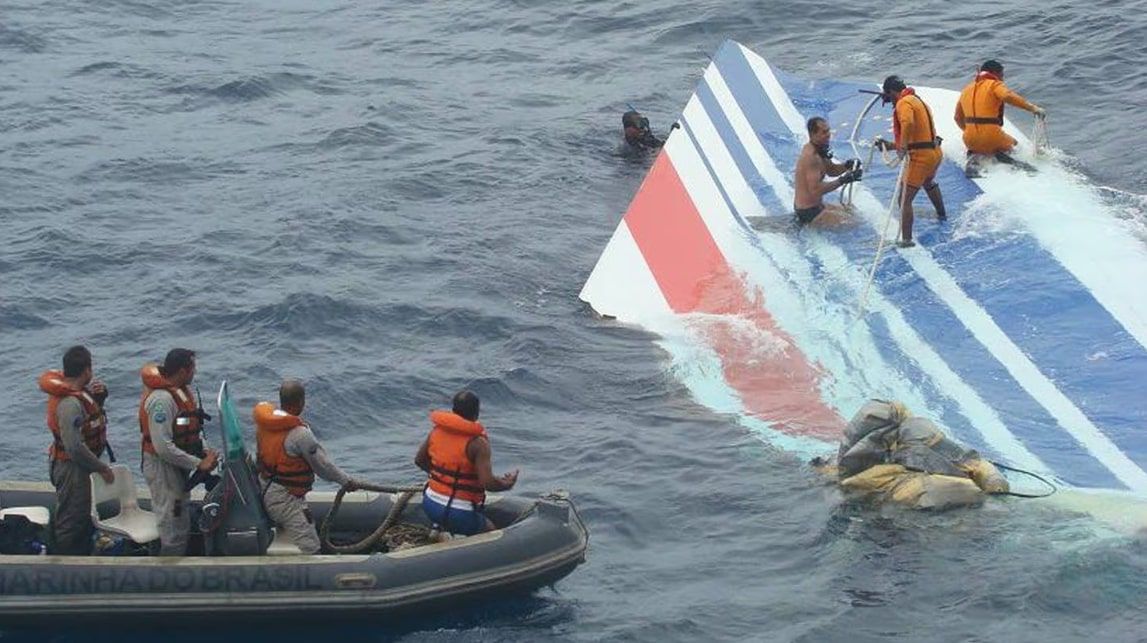
On 1 June 2009, Air France flight 447, an Airbus A330 from Rio de Janeiro to Paris, was carrying 216 passengers and 12 crew. At 2:10:05, in cruise over the Atlantic, the pitot probes were likely obstructed by ice crystals; the airspeed indications went wrong and the autopilot disconnected. The co-pilot flying said, "I have the controls." The other said, "We've lost the speeds." The aircraft climbed to about 38,000 feet, and the stall warning sounded continuously for 54 seconds. When the captain returned from his rest, the angle of attack was above 40 degrees and the aircraft was descending at about 10,000 feet per minute. "I have no more displays." "We have no valid indications." At 2:14:28 the aircraft struck the sea, about four minutes and twenty-three seconds after the autopilot disconnected. The airspeed on the left display had in fact been wrong for only 29 seconds.88
In its 2012 final report, France's BEA wrote that pitot icing in cruise was a phenomenon "known but misunderstood by the aviation community," and that the crew never formally identified the stall. Among the causes it listed was the absence of any training in manual aircraft handling at high altitude: "Manual aeroplane handling cannot be improvised and requires precision and measured inputs on the flight controls." Between May 2008 and March 2009, Air France's A330/A340 fleet had reported nine incidents of unreliable airspeed, seven of which triggered the stall warning.88
On 29 October 2018, Lion Air flight 610, a Boeing 737 MAX 8, crashed into the Java Sea 13 minutes after takeoff, killing all 189 on board. On 10 March 2019, Ethiopian Airlines flight 302 crashed six minutes after takeoff, killing 157.89 The MAX was "the 12th derivative model of the 737," first certified in 1967. Boeing had added software called MCAS that pushed the nose down automatically in certain conditions; it acted on input from a single angle-of-attack sensor, and most pilots did not know it existed. On the Lion Air flight MCAS pushed the nose down more than 20 times as the pilots fought it.89 The House Transportation and Infrastructure Committee found that Boeing's own data showed "it took a Boeing test pilot more than 10 seconds to diagnose and respond to uncommanded MCAS activation in a flight simulator, a condition the pilot found to be 'catastrophic'," and that Boeing had withheld this from regulators. Under a 2011 contract with Southwest Airlines, Boeing would have had to discount each MAX "by at least $1 million" if the FAA required simulator training. In December 2017 Boeing's 737 chief technical pilot wrote: "I save this company a sick amount of $$$$."89 The report concluded that the crashes "were not the result of a singular failure, technical mistake, or mismanaged event" but "the horrific culmination of a series of faulty technical assumptions by Boeing's engineers, a lack of transparency on the part of Boeing's management, and grossly insufficient oversight by the FAA."89 By Boeing's own figures, the MAX's fatal hull-loss rate is 0.27 per million departures, against 0.08 for the previous 737 generation.90
At about 9.58 p.m. on 18 March 2018, in Tempe, Arizona, a Volvo test vehicle controlled by Uber's automated driving system struck Elaine Herzberg, 49, at 39 mph as she walked a bicycle across the road away from a crosswalk. She is generally regarded as the first pedestrian killed by a self-driving test vehicle. The National Transportation Safety Board found that the system "detected the pedestrian 5.6 seconds before impact. Although the ADS continued to track the pedestrian until the crash, it never accurately classified her as a pedestrian or predicted her path": it classified her in turn as a vehicle, a bicycle and "other." The "system design did not include consideration for jaywalking pedestrians." At 1.2 seconds before impact the system recognised that emergency braking was needed, and then entered a one-second "action suppression," neither braking nor alerting the operator, a design adopted because of concerns about false alarms. The Volvo's factory forward-collision warning and automatic emergency braking were switched off whenever Uber's system was running. In the 31.5 minutes the car was moving, the safety operator spent 34 per cent of her time looking down toward the bottom of the centre console; her phone was streaming a television show.91 The NTSB's chairman, Robert Sumwalt, called the collision "the last link of a long chain of actions and decisions made by an organization that unfortunately did not make safety the top priority."92
At about 8.30 p.m. on 2 November 1988, a program was released onto the Internet from a computer at MIT. Exploiting bugs in the sendmail and finger programs, it copied itself across the network and bogged down machines at Harvard, Princeton, Stanford, NASA and Lawrence Livermore. A Berkeley student emailed: "We are currently under attack." Its author was Robert Tappan Morris, a 23-year-old Cornell graduate student.93 The Internet was small then: about 200 hosts in 1982, more than 60,000 by early 1989. There was never an official count of infected machines; the often-quoted 6,000 was extrapolated from an MIT estimate that 10 per cent of its own machines had been hit, and other estimates ran from 1,000 to 3,000 or 3,000 to 4,000.94 Two weeks later DARPA set up the Computer Emergency Response Team (CERT) at Carnegie Mellon University, with a core of five people.94
Thirty-six years later, on 19 July 2024, the security company CrowdStrike pushed a routine content update to its Falcon sensor. A new template type defined 21 input fields, but the code that invoked it supplied only 20 values; when the program tried to read the 21st, it read beyond the end of the array, and the system crashed.95 The sensor ran on Windows computers in companies around the world, and its job was to stop attacks. Microsoft estimated that 8.5 million Windows devices were affected, "less than one percent of all Windows machines."96 Delta Air Lines cancelled about 7,000 flights over five days and put its losses at no less than $500 million.97 Nobody had attacked anyone, and nobody had broken a procedure. A security update with one number wrong went out to millions of machines on the same morning.


12. Tickling the dragon's tail
On the night of 21 August 1945, at Omega Site in Los Alamos, New Mexico, the physicist Harry Daghlian was working alone. He was stacking 4.4-kilogram tungsten-carbide bricks around a plutonium core to reflect neutrons and measure how close it came to criticality. The last brick slipped from his hand into the stack, and the core went critical. He had to pull the bricks away by hand. He died 25 days later, on 15 September, "the first known death due to exposure to radiation in a laboratory setting."98
Nine months later, on 21 May 1946, the Canadian physicist Louis Slotin used the same core for another experiment. He held two beryllium half-shells apart with the blade of a screwdriver instead of the shims meant for the job, a practice colleagues called "tickling the dragon's tail." Enrico Fermi is said to have warned him he would be "dead within a year." With six others looking on, the screwdriver slipped, and there was a flash of blue light. Slotin felt "an immediate sour taste in his mouth and a burning sensation in his left hand." He died nine days later. After that, Los Alamos "ceased all hands-on experiments with critical assemblies."99
Early on 1 March 1954, the United States tested a thermonuclear device code-named Castle Bravo at Bikini Atoll in the Marshall Islands. Its designers expected about six megatons (other sources say four to eight, or five); it yielded fifteen, "1,000 times that of the weapon that destroyed Hiroshima," vaporising "some ten million tons of sand, coral and water."100 The designers had assumed that the lithium-7 in the fuel was inert. "Instead, when ignited, it produced tritium."100 On Rongelap, more than a hundred miles away, the fallout "looked like snow; children played with the irradiated flakes."100
The Japanese tuna boat Daigo Fukuryū Maru (Lucky Dragon No. 5), out of Yaizu, was 14 miles outside the declared danger area, with 23 crew whose average age was 25. At 6.45 a.m. the western sky lit up. Crewman Matashichi Oishi later recalled: "It was just like sleet. As it accumulated on deck, our feet left footprints... I took a lick; it was gritty but had no taste."101100 The chief radio operator, Aikichi Kuboyama, died on 23 September, aged 40, leaving a wife and three daughters. His last wish was: "I pray that I am the last victim of an atomic or hydrogen bomb."101 The United States later paid his widow one million yen and, in January 1955, paid Japan $2 million.100 The danger zone was afterwards enlarged from 57,000 to 570,000 square miles.100
In 1967 the weapons physicist Theodore Taylor told a conference: "obviously we didn't irradiate the natives on purpose. Obviously, we didn't know what the hell we were doing."100

13. Dual use
On 2 July 1909, in the laboratory of the chemist Fritz Haber at the Technische Hochschule in Karlsruhe, a machine circulated a 3 : 1 mixture of hydrogen and nitrogen over an osmium catalyst at 180 to 200 atmospheres and 500 to 600°C. It had been built by Haber's English assistant, Robert Le Rossignol. After a few repairs it began forming liquid ammonia at about six or seven in the evening, and that night it made 500 to 600 grams. The men from BASF who watched it were utterly convinced.102 The next day Haber wrote to BASF's directors: "The steady yield was 2 cm³/minute and it was possible to raise it to 2.5 cm³."103 BASF gave the scale-up to Carl Bosch. Within four years the 75-centimetre converter on Haber's bench, making about 100 grams of ammonia an hour, had become an 8-metre converter at the Oppau plant turning out up to 200 kilograms an hour. Oppau produced its first ammonia on 9 September 1913.103
The nitrogen in the air could now be turned into fertiliser on an industrial scale. "Without ammonia, there would be no inorganic fertilizers, and nearly half the world would go hungry," Vaclav Smil wrote in Nature in 1999.104 In his book on the subject he calculated that the synthesis "now provides the very means of survival" for about 40 per cent of humanity, while warning that this does not mean half the world's population would not be alive without it.103 The same ammonia could be made into nitric acid, and nitric acid into explosives. When war came in 1914, Germany's imported supplies of nitrates for explosives failed; the Oppau and Leuna works, in the words of Haber's Nobel biography, "enabled Germany to prolong the First World War."105
Haber himself went further. At 5 p.m. on 22 April 1915 (6 p.m. by German time), north of Ypres in Belgium, German troops opened the valves of 5,730 cylinders dug in along about six kilometres of front. Within ten minutes the cylinders were empty, and roughly 150 to 180 tonnes of chlorine drifted on the wind toward the lines opposite, held by the French 45th (Algerian) and 87th Territorial divisions.106107 A German lieutenant remembered: "A hissing sound began, as though a hundred pipes were letting off steam. As the cloud rolled forward it was yellowish-green, a hellish, sulphurous haze."107 A British soldier saw "a living wall of green fog, about four feet in height" move toward the French line: "Soon we heard strange shouts coming from the green fog. The cries became weaker and more incoherent. Then masses of soldiers tumbled upon us from out of the fog and collapsed. … Now they were staggering along like drunks."108 How many died that day is still not reliably known. French Army reports gave about 600 gassed and no longer fit to fight and about 1,800 taken prisoner, some 200 of them badly gassed; the often-quoted figure of 5,000 dead cannot be traced to a primary record.109 Haber supervised the release at the front in person, and was promoted to captain afterwards.110111
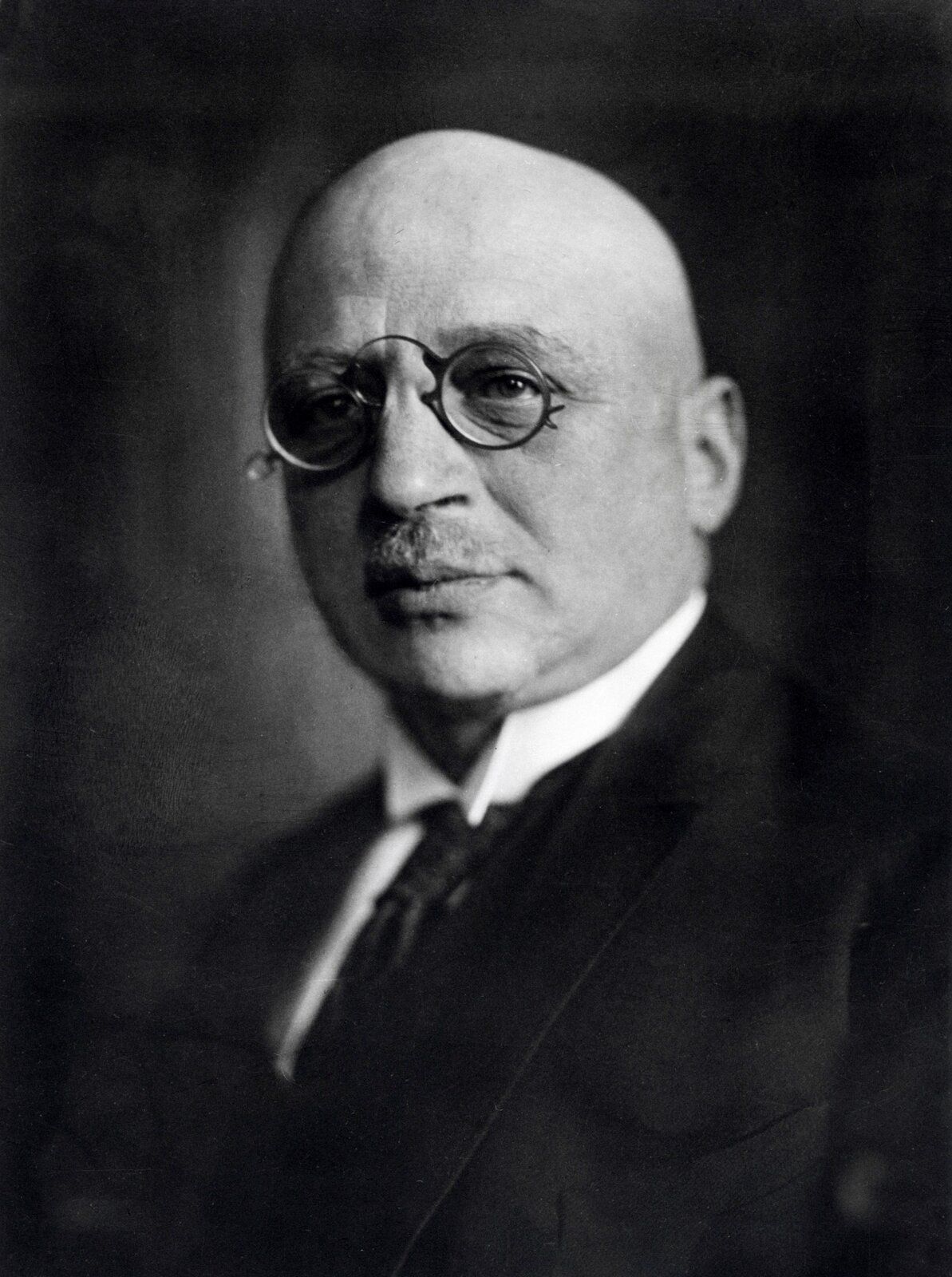
On the evening of 1 May Haber held a gathering at his house in Dahlem, Berlin, to celebrate the "success" at Ypres and his promotion. That night his wife, Clara Immerwahr, shot herself in the garden with his army pistol; their thirteen-year-old son Hermann found her dying. In 1900 she had become the first woman to earn a doctorate in chemistry at the University of Breslau. On 2 May Haber left for the Eastern Front. She left no letter that explains why, and the much-quoted line in which she called gas warfare "a perversion of science" turns out to come from a 1967 biography that gives no source for it.112
Haber received the Nobel Prize in Chemistry for 1918 (awarded in 1919) for synthesising ammonia from its elements. The Allies had labelled him a war criminal, and the award drew international protests.105113 An often-quoted maxim of his was: "In peace for mankind, in war for the fatherland."111 In 1917 he set up a Technical Committee for Pest Control at his institute to study hydrogen cyanide as an insecticide; the company Degesch, founded in 1919, patented a product called Zyklon B in 1924.114 On 30 April 1933 Haber resigned as director rather than dismiss his Jewish staff as the Nazis demanded; his own dismissal had not been required, because of his war service. He died in Basel on 29 January 1934, on his way to Palestine.113 A few years later the SS used Zyklon B in gas chambers to kill far more than a million people.114
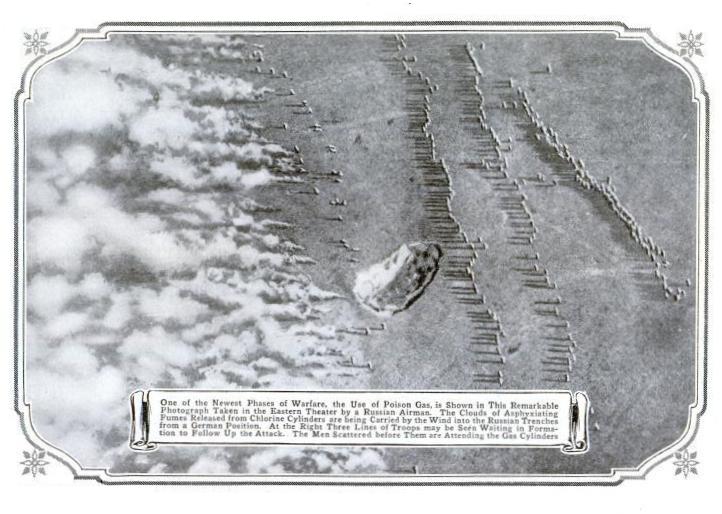
By the end of the First World War "some 124,200 tonnes of chlorine, mustard and other chemical agents had been released, and more than 90,000 soldiers had suffered painful deaths."115 The Chemical Weapons Convention, which bans chemical weapons outright, opened for signature in Paris on 13 January 1993 and entered into force on 29 April 1997.115 On 7 July 2023 the United States destroyed the last munition in its declared chemical stockpile at the Blue Grass Chemical Agent-Destruction Pilot Plant in Kentucky. That day the Organisation for the Prohibition of Chemical Weapons announced that it had verified the destruction of 72,304.34 metric tonnes of stockpiled chemical weapons since the convention came into force, and that all declared stockpiles had been irreversibly destroyed.116 It was 108 years after that afternoon at Ypres.
In 2021 Collaborations Pharmaceuticals, a small North Carolina company that uses artificial intelligence to design drugs, was invited to prepare a talk for a conference held by the Swiss government's Spiez Laboratory on how new technologies might be misused. Its generative model, MegaSyn, normally penalised predicted toxicity and rewarded predicted activity against a target. "We simply proposed to invert this logic." In less than six hours on the company's in-house server, the model generated 40,000 molecules that scored within the desired threshold. Among them was VX, one of the most toxic chemical warfare agents developed in the twentieth century, of which "a few salt-sized grains" (6 to 10 mg) is enough to kill a person; there were also many other known chemical warfare agents, and many new molecules predicted to be more toxic still. None of these nerve agents had been in the training data. The authors did not synthesise any of the molecules, nor assess whether they could be made. "We can easily erase the thousands of molecules we created," they wrote in Nature Machine Intelligence in March 2022, "but we cannot delete the knowledge of how to recreate them."117
At 8.15 a.m. on 6 August 1945 a uranium bomb of about 15,000 tons of TNT equivalent exploded over Hiroshima; on 9 August a plutonium bomb of about 21,000 tons fell on Nagasaki. By the end of December, about 140,000 people had died in Hiroshima and about 74,000 in Nagasaki, each figure uncertain by some 10,000 either way.118119 Over the next forty years the United States, the Soviet Union and the other nuclear powers built warheads one by one, until in 1986 the world's total peaked at about 70,300.120
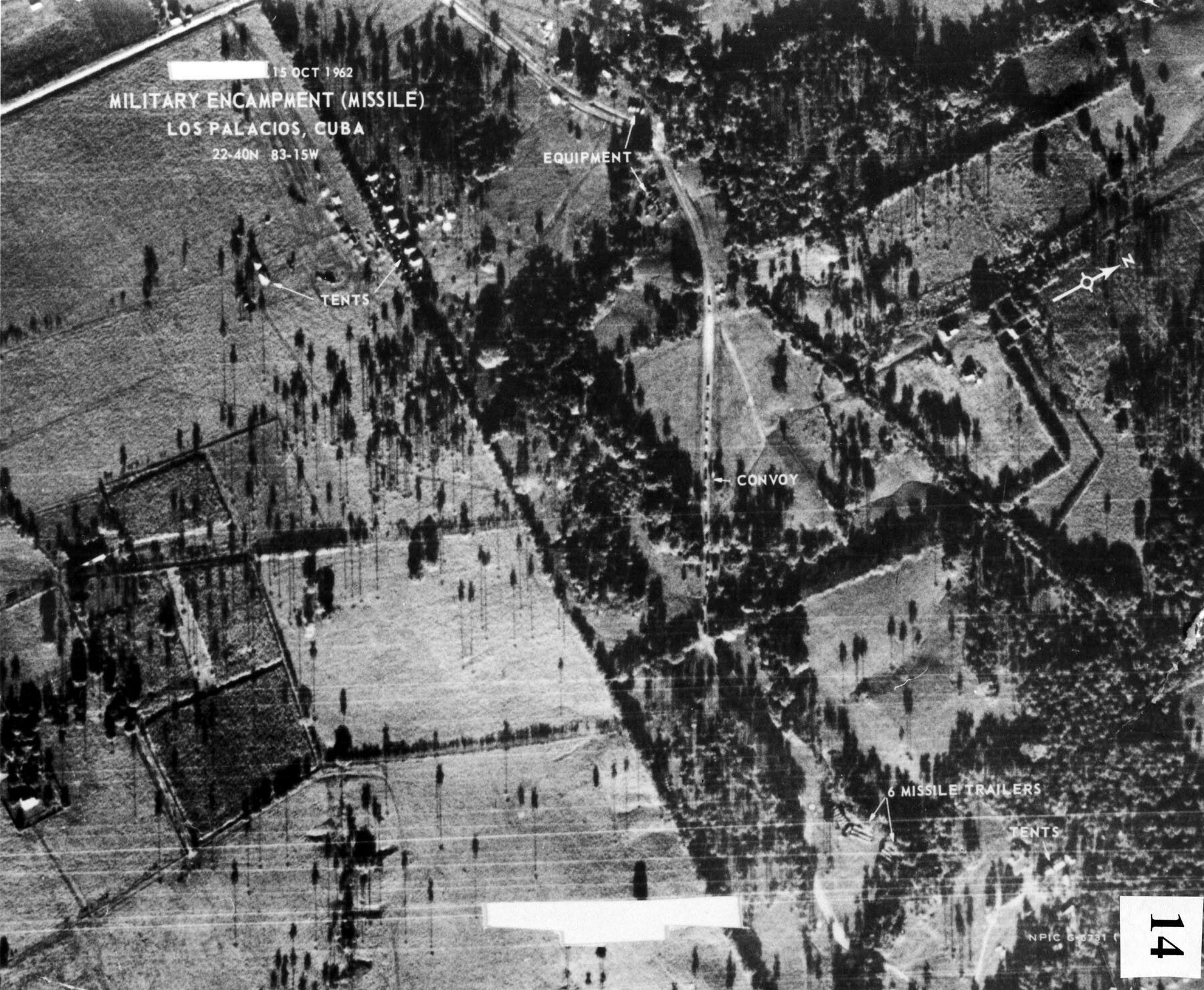
On 14 October 1962 an American U-2 photographed sites for Soviet medium- and intermediate-range ballistic missiles under construction in western Cuba; the pictures reached the White House the next day.121 On 26 October Khrushchev wrote Kennedy a long letter: "we and you ought not now to pull on the ends of the rope in which you have tied the knot of war, because the more the two of us pull, the tighter that knot will be tied." A messenger delivered it to the US Embassy in Moscow at 4.43 p.m. Moscow time; the embassy translated it and cabled it, and it was passed to the White House at 9.15 p.m. Washington time, about eleven and a half hours later.122 At 10.19 the next morning a U-2 was shot down over Cuba by a Soviet surface-to-air missile, killing its pilot, Major Rudolf Anderson. According to Air & Space Forces Magazine, the Soviet commander could not be found, and his deputy gave the order to fire, in violation of orders.123 The same day, near the quarantine line, US destroyers dropped practice depth charges "the size of hand grenades" on the Soviet submarine B-59 to signal it to surface. The State Department had sent the signalling procedure to Moscow; the Soviet submarine commanders later said they never received it. B-59 carried a nuclear torpedo with a yield of about 15 kilotons, close to that of the Hiroshima bomb. According to the recollection of a signals officer on board, the exhausted captain, Valentin Savitsky, ordered the nuclear torpedo made ready: "We're going to blast them now! We will die, but we will sink them all." The deputy brigade commander, Vasili Arkhipov, calmed him down, and they decided to surface. The National Security Archive notes that this account is controversial, and that the other submarine commanders do not believe Savitsky would have given such an order.124125 On 28 October Khrushchev's letter agreeing to remove the missiles was broadcast in English over Moscow radio at 5 p.m. Moscow time. Kennedy replied: "I am replying at once to your broadcast message of October twenty-eight even though the official text has not yet reached me."126127
Less than eight months later, on 20 June 1963, American and Soviet representatives in Geneva signed a memorandum setting up a direct communications link between the two heads of government. It was not the red telephone of the films but a pair of teletype terminals: a wire telegraph circuit routed Washington–London–Copenhagen–Stockholm–Helsinki–Moscow, with a backup radiotelegraph circuit through Tangier, and the American end in the Pentagon.128129 The link went live on 30 August. The first American test message was "The quick brown fox jumped over the lazy dog's back 1234567890," which checked that every letter and digit on the machine would print; Moscow replied with a test message in Russian that the American operators could not read at all.130 The time it took the two leaders to reach each other directly fell "from hours to minutes."129
On 5 August 1963 the United States, the Soviet Union and Britain signed the Limited Test Ban Treaty in Moscow, banning nuclear tests in the atmosphere, in outer space and under water. Underground tests were left out, because the two sides could agree only on the environments their existing means of verification could police.131 The Nuclear Non-Proliferation Treaty opened for signature on 1 July 1968 and entered into force on 5 March 1970.132 On 8 December 1987 Reagan and Gorbachev signed the INF Treaty in Washington. At the ceremony Reagan brought up the Russian maxim once more: "trust, but verify." Gorbachev cut in: "You repeat that at every meeting."133 The treaty let each side station inspectors outside the other's missile plant for up to 13 years, the Americans at Votkinsk in the Soviet Union and the Soviets at Magna, Utah. By May 1991 the two countries had eliminated 2,692 missiles.134 At the beginning of 2026 the world held about 12,187 nuclear warheads, more than 80 per cent fewer than at the peak.120
These restraints can also be taken apart. On 2 August 2019 the United States withdrew from the INF Treaty, citing a Russian missile it said violated it.135 In February 2023 Russia suspended its participation in New START, the last nuclear arms control treaty between the two countries; on 5 February 2026 the treaty expired, with no extension and no replacement.136137 The Federation of American Scientists reports that the number of warheads in global military stockpiles "is increasing once again."120
14. The other end of the screen
In March 2019 the chief executive of a British energy company took a call from someone he believed was the head of his German parent company, and was told to send €220,000 to a Hungarian supplier within the hour. He did. The insurer that covered the loss said the voice had been imitated with software, down to the slight German accent and the "melody" of the real boss's speech.138 Five years later, in January 2024, a finance employee in the Hong Kong office of the British engineering firm Arup joined a video conference with the company's UK-based "chief financial officer" and several colleagues. Following instructions, he made 15 transfers totalling HK$200 million, about US$25.6 million. "(In the) multi-person video conference, it turns out that everyone [he saw] was fake," said Senior Superintendent Baron Chan Shun-ching of the Hong Kong police.139 In May Arup confirmed it was the victim and that "fake voices and images were used"; none of its internal systems had been compromised.140 Its global chief information officer, Rob Greig, later said it "wasn't even a cyberattack in the purest sense" but "technology-enhanced social engineering." Trying it for himself with open-source software, he made a real-time deepfake video of himself in about 45 minutes.141
On 3 June 2024 Synnovis, which ran pathology services for hospitals in south-east London, was hit by a ransomware attack. Unable to cross-match blood, the hospitals had to use O-type blood, which "contributed to a national shortage of O-type blood supplies"; at the two worst-affected trusts, King's College Hospital and Guy's and St Thomas', 10,152 acute outpatient appointments and 1,710 elective procedures were postponed.142 In June 2025 King's College Hospital confirmed that "one patient sadly died unexpectedly," and that the contributing factors included "a long wait for a blood test result due to the cyber-attack."143 Earlier, in September 2020, Düsseldorf University Hospital stopped taking emergencies after a ransomware attack; a 78-year-old woman with an aortic aneurysm was sent to Wuppertal, 32 kilometres away, her treatment was delayed by about an hour, and she died. The public prosecutor in Cologne concluded that "the delay was of no relevance to the final outcome."144 In February 2024 attackers broke into the US payments processor Change Healthcare through a remote-access portal that "did not have multi-factor authentication"; its parent, UnitedHealth Group, paid a $22 million ransom, and about 192.7 million people were affected.145146147 A study published in 2026 in the American Economic Journal: Economic Policy looked at ransomware attacks on American hospitals: among patients already admitted when an attack began, in-hospital mortality rose by 34 to 38 per cent.148
No machine broke in any of these cases. The video calls connected as usual and the hospital systems ran as usual, until someone decided to use them. What the forgers and the extortionists exploited was exactly what these technologies are good for: video makes people believe what they see, and networking makes every department of a hospital depend on the same system.
15. Counting
On 1 July 1837 civil registration began in England and Wales. Every birth and death had to be registered with the local registrar, and one purpose was that causes of death "could be collated and studied."149 William Farr, a physician who joined the General Register Office soon afterwards, drew up a classification of causes of death and asked doctors to give, "in every instance," an authentic name of the fatal disease; it grew into today's International Classification of Diseases. He tabulated deaths by disease, parish, age, sex and occupation.150151 In 1864 one of his reports showed that Cornish miners over 35 died at far higher rates than other men, and he inferred that the cause lay in the conditions of work underground.151 "Diseases are more easily prevented than cured," Farr wrote, "and the first step to their prevention is the discovery of their exciting causes."150
Women in Vienna were dying of puerperal fever before Semmelweis. The fever there really did become more common after autopsy teaching arrived in 1823, but we know that only because the hospital recorded births and deaths year after year, and because Semmelweis set the two clinics' figures side by side. Asbestos is a similar case. In 1960 three doctors in South Africa reported in the British Journal of Industrial Medicine 33 histologically proven cases of diffuse pleural mesothelioma, all but one with probable exposure to Cape blue asbestos. In the previous five years, they wrote, "no neoplasm of this nature has been diagnosed amongst 10,000 lungs examined at the Pneumoconiosis Bureau in Johannesburg." The patients included "housewives, domestic servants, cattle herders, farmers, a water bailiff, an insurance agent, and an accountant, none of whom were working on the asbestos mines," and the tumours appeared "20 to 40 years or more after exposure to dust."152 The lead author, Christopher Wagner, later recalled that only when they stopped asking where the patients had worked and asked instead whether they had lived near an asbestos mine did things fall into place: "the situation became clear"; the paper was at first rejected, "because eminent London pathologists stated that mesotheliomas did not exist."153
In December 1974 TWA flight 514 flew into a hill near Washington. A United Airlines crew had run into a similar danger weeks earlier, but the warning had been shared only within the company. In April 1976 NASA and the FAA set up the Aviation Safety Reporting System, on the principle of "voluntary, confidential, non-punitive" reports. At first it received about 400 reports a month; in 2025 it received about 10,094 a month, 121,128 in the year.154 Reports rose more than twentyfold while the death rate on commercial flights fell. More counted hazards can simply mean better sight.
Better sight can also make a danger look larger than it is. In 1999 South Korea launched a national cancer-screening programme. The thyroid was not part of it, but providers often offered thyroid ultrasound as an add-on for $30 to $50. In 2011 the rate of thyroid-cancer diagnoses in Korea was 15 times that of 1993, making it the most common cancer diagnosed in the country, with more than 40,000 new cases that year; deaths from thyroid cancer had stayed between 300 and 400 a year for a decade. Rising diagnoses with flat mortality, three researchers wrote in the New England Journal of Medicine, is "a combination that is pathognomonic for overdiagnosis."155
Not every new danger, though, is an old one finally seen. The chlorine at Ypres and the "snow" on Rongelap did not exist before anyone counted them. They were made.
16. The long ledger
The strongest objection to this article is that, over a long enough span, technology really has made people far safer.
By the estimates compiled by Our World in Data, life expectancy at birth worldwide was about 28.5 years in 1800, about 32 in 1900 and 73.2 in 2023.156 In 1800 around 43 per cent of children died before their fifth birthday; in 2024 the figure had fallen to 3.74 per cent.157158 In the United States, infectious-disease mortality fell from 797 per 100,000 in 1900 to 36 in 1980.159 Worldwide aviation deaths per million passengers fell from 4.77 in 1970 to 0.07 in 2022.160 In 1913, 61 of every 100,000 American workers died in industrial accidents; in 2024 the figure was 3.3 per 100,000 full-time-equivalent workers. The two series are not measured quite the same way, but the gap is still close to eighteenfold.161162 In 2018 the psychologist Steven Pinker also compressed a century of American safety into three figures: a 96 per cent lower chance of being killed in an auto accident, 99 per cent lower in a plane crash and 95 per cent lower on the job.163
None of this is an illusion produced by the statistics. Most of the hazards in this article were eventually brought under control. Boilers, mine lamps, lying-in wards, vaccines and jet airliners are all far safer now than when they first appeared, and several of them safer than the older technologies they replaced. Technology can indeed reduce danger, and can even change the scale of a danger beyond recognition.
But there is a problem here that is easy to miss: becoming safe in the end does not mean the danger was shrinking from the start, and it certainly does not mean that the people who paid for it lived to reach the safe era.
Between 1800 and 1900 child mortality worldwide hardly changed, falling from 42.8 to 40.9 per cent. The Industrial Revolution had already been running for a century, and the steep fall came mainly after 1900.158 Huskisson at Parkside, the French soldiers at Ypres, the men at Bayway, the women who painted the dials and the passengers on two 737 MAXs did not live to see the day the danger actually came down. No later rate, however small, can repay what they paid.
Nor does safety improve along a line that only descends. After falling to 36 per 100,000 in 1980, American infectious-disease mortality rose again to 63 in 1995, mainly because of AIDS.159 American pedestrian deaths rose 80 per cent after 2009, and the 737 MAX's fatal hull-loss rate reached more than three times that of the previous 737.
Averages have another limit: they can describe a long trend, but they cannot dissolve the consequences of a single accident. In 2025 world aviation's fatality risk rose to 0.17, about three times the 0.06 of 2024, mainly because of two accidents that year, one of them Air India flight 171, which killed 241 people.164 For those passengers the long trend offered no consolation. The same is true of the risk on 27 October 1962. To anyone inside it, the danger of that day was not a decimal that a long-run average could dilute; it was something that really happened and could not be undone.
The fall in these numbers means something, but it is not a result that technical progress delivers on its own. Pinker himself wrote that everyday hazards were blunted by “safety regulations and engineering.” He had one more line: “solutions create new problems, which must be solved in their turn.”163
This is exactly where the difficulty lies. Technology can create new capacities and supply the tools for dealing with a danger, but it does not tell anyone which risks are unacceptable, and it will not by itself carry out the inquiry into an accident, the assignment of responsibility or the revision of the rule. Long-run safety is a process of finding the fault, admitting the cost and correcting the mistake. Autopsy reports, accident inquiries, courts, legislation and engineering standards are all parts of that process.
17. The dilemma
In 1980 a technology-policy researcher at the University of Aston in England published a book called The Social Control of Technology. Its preface contains a passage that has been quoted ever since: "The social consequences of a technology cannot be predicted early in the life of the technology. By the time undesirable consequences are discovered, however, the technology is often so much part of the whole economic and social fabric that its control is extremely difficult. This is the dilemma of control. When change is easy, the need for it cannot be foreseen; when the need for change is apparent, change has become expensive, difficult and time consuming." Among the book's examples is lead in petrol.165
In 1817 the Philadelphia engineers already knew how boilers should be inspected. Steamboats were still few, and explosions not yet frequent enough for any level of government to feel compelled to act. By the time hundreds were dying every year, steamboats were the lifeblood of the western economy, and the first law Congress produced was so weak it was almost meaningless. Tetraethyl lead could have been banned in 1925, when it had been on sale for two years; by the time its harm was established, the world's cars and refineries had been built around it. Both horns of the dilemma are visible in those two stories.
A boiler that once killed a few men in a workshop killed hundreds on a steamboat. A bad prescription that once harmed one patient became, at Massengill, 633 shipments to 15 states. A virus from one blood donor that once reached one recipient was mixed, in a concentrate plant, into thousands of doses. New technology often enlarged exposure all at once, while the means of protection were still sized for the old scale.
The safety lamp sent owners into seams "so fiery as to have laid unwrought"; anaesthesia sent surgeons into operations they would never have attempted; the Munich cabs with ABS braked later. A technology often makes people feel safe faster than it makes them safe, and someone walks into the gap.
"Nitroglycerine tells," wrote a man who was not in the tunnel. Leaded petrol made engines run smoother, and the men who went mad worked at Bayway; luminous watches glowed in the dark, and the jaws that shattered belonged to the women who painted them; Boeing saved on training, and 346 people on two aircraft paid. As long as the benefit and the danger fall on different people, the first group always has a reason to ask the second to wait a little longer.
The Therac-25 had six accidents in a year and a half, while the FDA knew of fewer than one in a hundred device incidents in hospitals; the effects of asbestos, lead and CFCs were measured in decades. Even immediately lethal accidents have to pile up before anyone connects them into a pattern, and until then each one can be explained as individual carelessness: the driver was going too fast, the operator typed too fast, the pilots didn't react.
Cars had been getting safer for decades; then the shape of their fronts and the things in drivers' hands changed, and pedestrian deaths climbed back. The 737 had flown for half a century; new software made it, at certain moments, an unfamiliar aircraft again. Autopilots made cruise so reliable that pilots stopped practising high-altitude hand-flying, until the night the pitot probes iced. A test car's automatic emergency braking was switched off when a cleverer system took over; one routine update to a piece of security software stopped 8.5 million computers on the same morning. Change something underneath a mature technology, quietly, and it becomes a new technology again.
Everything above concerns dangers nobody wanted. Haber's chlorine, the bomb over Hiroshima, the fake colleagues on Arup's video call and the ransomware at Synnovis are different: the danger is the use itself, and those who make it and use it know it will hurt people. Here the dilemma of control takes another shape: every side can see the danger, and every side fears the other will have it first. Better engineering does little to help; the trouble in October 1962 was not that the missiles were unreliable. What brought the danger down after that crisis was a pair of teletype machines, a treaty that banned only the tests both sides could verify, and an inspection regime that let the other side post its people outside your factory gate. Such restraints can lapse too: the INF Treaty ended in 2019, and New START expired in February 2026.
What finally pushed the danger down was seldom a cleverer invention and more often something far duller: a rule requiring a hydraulic test at one and a half times working pressure every year, a basin of chlorinated lime, a law requiring a drug to prove it is safe before sale, a teletype line between two heads of government, a duty to report accidents upward, a procedure for testing a new aircraft to destruction before it carries passengers. Almost all of them came after a disaster.
18. The water tank
The US Post Office began flying the mail in 1918. In the early years its pilots were known as the "Suicide Club." In the nine years the Post Office ran the Air Mail Service there were more than 6,500 forced landings, and "airmail pilots had a life span of only about 900 flying hours."166 Of the roughly 200 pilots who flew the mail between August 1918 and September 1927, 34 died in crashes.167
On 2 May 1952 the de Havilland Comet entered scheduled service with the British Overseas Airways Corporation, the first jet airliner to carry fare-paying passengers on a regular route. It flew higher and faster than propeller airliners, so its cabin had to be pressurised. On 10 January 1954, Comet G-ALYP, known as "Yoke Peter," took off from Rome with six crew and 29 passengers. The captain was sending a message to another BOAC aircraft: "George How Jig from George Yoke Peter did you get my"—and the transmission ceased. Witnesses on Elba saw part of the aircraft fall into the sea in flames. All 35 on board died.168
The Comets were grounded, modified mainly against the risk of fire, and returned to service at the end of March. A little over two weeks later, on 8 April, another Comet, G-ALYY, flying from Rome to Cairo, fell into the sea near Naples "at approximately the same height and after approximately the same lapse of time after departure from Rome as in the case of Yoke Peter." On 12 April Britain withdrew the certificates of airworthiness of all Comets.168
The Royal Navy recovered wreckage from the seabed off Elba with grabs and underwater television, and it was reassembled piece by piece at the Royal Aircraft Establishment, Farnborough. The establishment's director, Sir Arnold Hall, ordered a full-scale repeated-loading test. The entire fuselage of another Comet, G-ALYU, was immersed in a huge tank, and the cabin was filled with water, pressurised, depressurised and pressurised again, simulating flight after flight. Water was used instead of air because with air, a failure "would be catastrophic (equivalent in the case of the Comet's cabin to the explosion of a 500 lb. bomb)."168
G-ALYU had made 1,230 pressurised flights before the test. After the equivalent of a further 1,830 in the tank, 3,060 in all, the cabin structure failed, "the starting point of the failure being the corner of one of the cabin windows." Yoke Peter had made 1,290 pressurised flights before it was lost, and the Naples aircraft 900. Strain gauges showed that peak skin stress near the window corners was "probably over 40,000 lb/sq. in." at normal cabin pressure, against de Havilland's design estimate of 28,000.168 In 1955 the Court of Inquiry found that the Elba accident had been caused by structural failure of the pressure cabin in the region of the roof window for the automatic direction-finding aerial, "brought about by fatigue."168169 The popular story of "square passenger windows" is not quite right: the failures began at the roof aerial window in service and at the corner of a cabin window in the tank.
Full-scale fatigue testing became a standard part of certifying new airliners. By Airbus's count, first-generation jets (including the Comet, the Boeing 707 and the DC-8) had a fatal accident rate of 4.0 per million flights; the fourth generation, with fly-by-wire and flight-envelope protection, has 0.1.170 In 2023 there was no fatal accident involving a large commercial jet anywhere in the world, the first such year since records began in 1959.171
In the tank at Farnborough, G-ALYU was filled, pressurised and emptied, over and over. After the 3,060th cycle, water seeped out of a crack at the corner of a window. There was no one in the cabin.
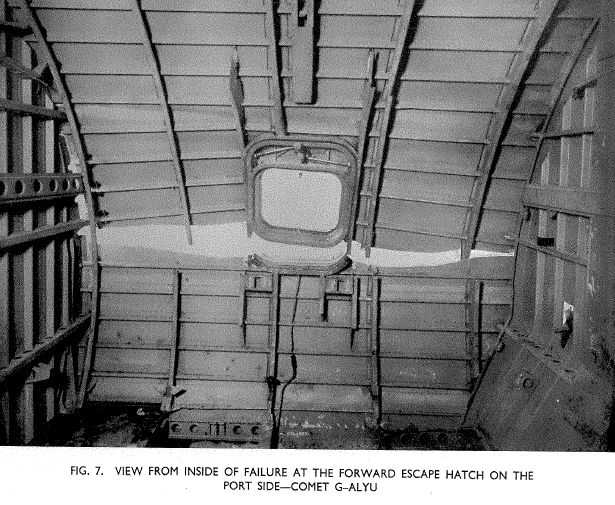
References
Footnotes
-
Frances Ann Kemble, Records of a Girlhood (1878), letters dated Liverpool, 26 August 1830, and Manchester, 20 September 1830. Project Gutenberg eBook #16478. https://www.gutenberg.org/cache/epub/16478/pg16478.txt ↩ ↩2 ↩3
-
"The Death of William Huskisson," The Peel Web (quoting the Creevey Papers and Charles Greville's diary). https://www.historyhome.co.uk/peel/railways/accident.htm ↩
-
National Railway Museum, "Eccentric Engineering: discoveries in railway technology," NRM blog, 2015. https://blog.railwaymuseum.org.uk/eccentric-engineering (date of the 1815 explosion given as 13 July here; other sources say 31 July 1815). ↩
-
National Transport Trust, "Heighington Station" heritage plaque. https://www.nationaltransporttrust.org.uk/heritage-sites/heritage-detail/heighington-station ↩
-
Cincinnati Whig — Extra, 25 April 1838 (8 p.m.). Library of Congress, Printed Ephemera Collection, rbpe 13602100. https://tile.loc.gov/storage-services/service/rbc/rbpe/rbpe13/rbpe136/13602100/13602100.pdf ↩ ↩2
-
John G. Burke, "Bursting Boilers and the Federal Power," Technology and Culture 7(1), Winter 1966, pp. 1–23. DOI 10.2307/3101598. https://commons.princeton.edu/motorcycledesign/wp-content/uploads/sites/70/2019/08/Burke_Bursting-Boilers.pdf ↩ ↩2 ↩3 ↩4 ↩5 ↩6 ↩7 ↩8 ↩9
-
Library of Congress, "Sinking of the SS Sultana: Topics in Chronicling America," research guide, 2020. https://guides.loc.gov/chronicling-america-sinking-sultana/introduction ↩ ↩2
-
National Park Service, Pea Ridge National Military Park, "Pea Ridge National Military Park Presents Program About the Sultana Disaster." https://www.nps.gov/peri/learn/news/pea-ridge-national-military-park-presents-program-about-the-sultana-disaster.htm ↩
-
Mike Burns, article on the Grover Shoe Factory explosion and the Massachusetts boiler law, National Board of Boiler and Pressure Vessel Inspectors. https://www.nationalboard.org/PrintPage.aspx?ID=1613&pageID=1603 ↩ ↩2
-
Library of Congress, "Grover Shoe Factory Disaster: Topics in Chronicling America" (quoting The Paducah Sun, 20 March 1905). https://guides.loc.gov/chronicling-america-grover-shoe-factory-disaster/introduction ↩
-
ASME, "The History of ASME's Boiler and Pressure Vessel Code," 2010, updated 2024. https://www.asme.org/topics-resources/content/the-history-of-asmes-boiler-and-pressure ↩ ↩2
-
"The Industrial Revolution, Coal Mining and the Felling Colliery Disaster," Letters and the Lamp, Lancaster University (quoting John Hodgson's 1813 account). https://wp.lancs.ac.uk/lettersandthelamp/sections/the-industrial-revolution-coal-mining-and-the-felling-colliery-disaster ↩ ↩2 ↩3
-
Frank James, "Safety Underground: Mining and the Miners' Lamp," Gresham College lecture, 1 June 2015. https://www.gresham.ac.uk/watch-now/safety-underground-mining-and-miners-lamp ↩ ↩2
-
"Accidents in Mines," The Times, 8 December 1835, reporting the Select Committee on Accidents in Mines (1835); transcribed by the Durham Mining Museum. http://www.dmm.org.uk/news18/8351208.htm ↩ ↩2 ↩3
-
"Heleneborg," Kulturarv Stockholm (from the Dyno Nobel Sweden AB archive), archived copy. https://web.archive.org/web/20150725073227/http:/www.kulturarvstockholm.se/site_media/industri/nobelsvinterviken/heleneborg.html (NobelPrize.org gives five dead, Tekniska museet and Kulturarv six.) ↩ ↩2 ↩3
-
The Nitro-Glycerine Case, 82 U.S. 524 (U.S. Supreme Court, December Term 1872). https://www.law.cornell.edu/supremecourt/text/82/524 ↩ ↩2
-
Placer Herald, 21 April 1866, transcribed by CPRR.org. https://www.cprr.org/Museum/Newspapers/Nitroglycerine.html ↩
-
PBS American Experience, "Nitroglycerin" (Transcontinental Railroad). https://www.pbs.org/wgbh/americanexperience/features/tcrr-nitroglycerin/ (death toll of the San Francisco explosion given as 15; other accounts give 10 or 14.) ↩ ↩2
-
NobelPrize.org, "List of Alfred Nobel's patents" and "Alfred Nobel in Scotland." https://www.nobelprize.org/alfred-nobel/list-of-alfred-nobels-patents ; https://www.nobelprize.org/alfred-nobel/alfred-nobel-in-scotland ↩ ↩2
-
"A Horrible Scene," Ann Arbor Register, 17 October 1889 (New York dispatch of 12 October), Ann Arbor District Library. https://aadl.org/node/507687 ↩ ↩2
-
"Building: wires," The Blizzard of 1888 virtual exhibit, American Social History Project, CUNY. https://virtualny.ashp.cuny.edu/blizzard/building/building_2.html ↩ ↩2
-
"Verdict in the Feeks' Inquest," Rockland County Journal, 2 November 1889, HRVH Historical Newspapers. https://news.hrvh.org/veridian/?a=d&d=rocklandctyjournal18891102.2.12 ↩
-
Ignaz Semmelweis, Die Aetiologie, der Begriff und die Prophylaxis des Kindbettfiebers (1861), key passage translated by Ulrich Tröhler, James Lind Library. https://www.jameslindlibrary.org/semmelweis-i-1861 ↩
-
"Pioneering Hand Hygiene: Ignaz Semmelweis and the Fight Against Puerperal Fever," Cureus, 2024 (Table 1, reproduced from Semmelweis 1861). https://pmc.ncbi.nlm.nih.gov/articles/PMC11568873/ ↩
-
Canadian Museum of Health Care, "Ignaz Semmelweis: The Saviour of Mothers," 20 August 2022 (quoting K. Codell Carter's translation of Semmelweis 1861). https://www.museumofhealthcare.ca/blog/ignaz-semmelweis-the-saviour-of-mothers ↩
-
Stang, Standl & Poole, "A twenty-first century perspective on concepts of modern epidemiology in Ignaz Philipp Semmelweis' work on puerperal sepsis," European Journal of Epidemiology, 2022. https://pmc.ncbi.nlm.nih.gov/articles/PMC9209376 ↩ ↩2 ↩3
-
Ravel, Pandiyan & Chandran, "Ignaz Philipp Semmelweis (1818–1865) – a public health visionary and champion of hand hygiene," GMS Hygiene and Infection Control. https://pmc.ncbi.nlm.nih.gov/articles/PMC12720402/ ↩ ↩2 ↩3
-
Róża Gombos, "Ignaz Semmelweis," Science History Institute, 15 September 2025. https://www.sciencehistory.org/education/scientific-biographies/ignaz-semmelweis (Note: the oft-quoted fall "from 18.27% to 1.27%" compares the single month of April 1847 with the year 1848.) ↩ ↩2
-
Florence Nightingale, Introductory Notes on Lying-in Institutions (Longmans, Green, 1871), Project Gutenberg #73878. https://www.gutenberg.org/cache/epub/73878/pg73878.txt ↩ ↩2
-
Report of the Committee on a Village of Cottage Hospitals to the Governors of the Society of the New York Hospital, 24 February 1876 (reproducing J. Y. Simpson's amputation tables and quoting J. E. Erichsen, 1874). NLM Digital Collections. https://collections.nlm.nih.gov/ocr/nlm:nlmuid-101234089-bk (Simpson's own 1869 letter gives 227 country deaths.) ↩ ↩2 ↩3 ↩4
-
Andrew, Gitlin & Desai, "Surgical operations at Massachusetts General Hospital in 1846 and 1847: Early impact of the discovery of anaesthesia," Anaesthesia and Intensive Care 50(2_suppl), 2022. https://journals.sagepub.com/doi/full/10.1177/0310057X221105296 ↩ ↩2 ↩3
-
A. G. McKenzie, "Anaesthetic practice and mortality in Scotland compared to England from 1847 to 1914," Anaesthesia and Intensive Care, 2025. https://pmc.ncbi.nlm.nih.gov/articles/PMC12405647 ↩ ↩2 ↩3
-
John Snow, on chloroform deaths, London Journal of Medicine, May 1852 (quoting Meggison's inquest testimony). John Snow Archive, Michigan State University. https://johnsnow.matrix.msu.edu/work.php/id=15-78-C8/ (A 1998 Lancet article dates Greener's death 29 January.) ↩ ↩2
-
Joseph Lister, "On the effects of the antiseptic system of treatment upon the salubrity of a surgical hospital," The Lancet, 1 and 8 January 1870. James Lind Library. https://www.jameslindlibrary.org/wp-data/uploads/2014/08/Lister_J_1870-pt1.pdf ; https://www.jameslindlibrary.org/wp-data/uploads/2014/07/Lister_J_1870.pdf ↩ ↩2
-
Joseph Lister, "On the antiseptic principle of the practice of surgery," address to the British Medical Association, Dublin, 1867. https://biotech.law.lsu.edu/cphl/history/articles/lister.htm ↩
-
Gilbert King, "Clarence Dally — The Man Who Gave Thomas Edison X-Ray Vision," Smithsonian Magazine, 14 March 2012. https://www.smithsonianmag.com/history/clarence-dally-the-man-who-gave-thomas-edison-x-ray-vision-123713565 ↩ ↩2
-
"Edison Fears Hidden Perils of the X-Rays," New York World, 3 August 1903, p. 1, archived transcription. https://web.archive.org/web/20110816170318/http://home.gwi.net/~dnb/read/edison/edison_xrays.htm ↩ ↩2 ↩3
-
Ron Cowen, "New Jersey's 'Radium Girls' and the NIST-Trained Scientist Who Came to Their Aid," NIST Taking Measure, 16 March 2022. https://www.nist.gov/blogs/taking-measure/new-jerseys-radium-girls-and-nist-trained-scientist-who-came-their-aid ↩ ↩2 ↩3 ↩4
-
U.S. National Archives, "The Radium Girls at the National Archives," The Text Message blog, 4 January 2018 (settlement dated 8 June 1928; some sources give $15,000). https://text-message.blogs.archives.gov/2018/01/04/the-radium-girls-at-the-national-archives ↩
-
"22D Worker Dies of Radium Poison," The New York Times, 28 October 1933. https://www.nytimes.com/1933/10/28/archives/22d-worker-dies-of-radium-poison-woman-became-iii-14-years-ago.html ↩
-
Paul Frame, "Radithor (ca. 1928)," Museum of Radiation and Radioactivity, Oak Ridge Associated Universities. https://www.orau.org/health-physics-museum/collection/radioactive-quack-cures/pills-potions-and-other-miscellany/radithor.html ↩ ↩2
-
Ron Winslow, "The Radium Water Worked Fine Until His Jaw Came Off," The Wall Street Journal, c. 1 August 1990, tied to R. Macklis, "Radithor and the Era of Mild Radium Therapy," JAMA 264(5):614–621 (1990). Scanned text: https://idoc.pub/documents/the-radium-water-worked-fine-until-his-jaw-fell-off-zpnx725k1glv ↩
-
"Shoe-Fitting Fluoroscope (ca. 1930–1940)," Museum of Radiation and Radioactivity, Oak Ridge Associated Universities. https://www.orau.org/health-physics-museum/collection/shoe-fitting-fluoroscope/index.html ↩ ↩2
-
Bibliothèque nationale de France, "Les cahiers de Marie Curie conservés à la BnF sont-ils radioactifs ?", 2025. https://www.bnf.fr/fr/les-cahiers-de-marie-curie-conserves-la-bnf-sont-ils-radioactifs ↩
-
Mark Bernstein, "Thomas Midgley and the Law of Unintended Consequences," Invention & Technology 17(4), Spring 2002. https://www.inventionandtech.com/content/thomas-midgley-and-law-unintended-consequences-0 ↩ ↩2 ↩3 ↩4 ↩5 ↩6 ↩7
-
Jamie Lincoln Kitman, "The Secret History of Lead," The Nation, 20 March 2000. https://www.thenation.com/article/archive/secret-history-lead/ ↩ ↩2 ↩3 ↩4 ↩5 ↩6
-
Susan Solomon, "The discovery of the Antarctic ozone hole," Nature 575, 46–47, 23 October 2019. https://www.nature.com/articles/d41586-019-02837-5 ↩
-
"The Brilliant Inventor Who Made Two of History's Biggest Mistakes," The New York Times Magazine, 15 March 2023. https://www.nytimes.com/2023/03/15/magazine/cfcs-inventor.html ↩
-
David Gee & Morris Greenberg, "Asbestos: from 'magic' to malevolent mineral," in Late lessons from early warnings: the precautionary principle 1896–2000, European Environment Agency, Environmental Issue Report 22, 2001. https://www.eea.europa.eu/en/analysis/publications/environmental_issue_report_2001_22/issue-22-part-05.pdf/@@download/file ↩ ↩2 ↩3
-
World Health Organization, "Asbestos" fact sheet, 11 August 2026. https://www.who.int/news-room/fact-sheets/detail/asbestos-elimination-of-asbestos-related-diseases ↩
-
Carol Ballentine, "Taste of Raspberries, Taste of Death: The 1937 Elixir Sulfanilamide Incident," FDA Consumer, June 1981. https://www.fda.gov/files/about%20fda/published/The-Sulfanilamide-Disaster.pdf ↩ ↩2 ↩3 ↩4 ↩5 ↩6 ↩7 ↩8
-
Linda Bren, "Frances Oldham Kelsey: FDA Medical Reviewer Leaves Her Mark on History," FDA Consumer, March–April 2001. https://permanent.access.gpo.gov/lps1609/www.fda.gov/fdac/features/2001/201_kelsey.html (Lower estimates of thalidomide births also exist.) ↩ ↩2 ↩3 ↩4 ↩5 ↩6
-
U.S. FDA, "Promoting Safe & Effective Drugs for 100 Years." https://www.fda.gov/about-fda/histories-product-regulation/promoting-safe-effective-drugs-100-years ↩
-
Paul A. Offit, "The Cutter Incident, 50 Years Later," New England Journal of Medicine 352:1411–1412, 7 April 2005. https://www.nejm.org/doi/full/10.1056/NEJMp048180 ↩
-
Langmuir, Nathanson & Hall, The Surveillance of Poliomyelitis in the United States in 1955, Communicable Disease Center, 15 November 1955. https://stacks.cdc.gov/view/cdc/48111/cdc_48111_DS1.pdf ↩
-
Miller, Moro, Cano & Shimabukuro, "Deaths following vaccination: What does the evidence show?" Vaccine 33 (2015), author manuscript. https://stacks.cdc.gov/view/cdc/34869/cdc_34869_DS1.pdf (Other official pages give 200 to 260 paralysed.) ↩
-
CDC, "Historical Vaccine Concerns," 31 July 2024. https://www.cdc.gov/vaccine-safety/historical-concerns/index.html ↩
-
Institute of Medicine, HIV and the Blood Supply: An Analysis of Crisis Decisionmaking (National Academies Press, 1995). https://www.nationalacademies.org/read/4989/chapter/3 ↩ ↩2 ↩3
-
Infected Blood Inquiry: The Report, Volume 1 (Overview and Recommendations), 20 May 2024. https://www.infectedbloodinquiry.org.uk/sites/default/files/Volume_1.pdf ↩
-
Infected Blood Inquiry, transcript of publication, 20 May 2024. https://www.infectedbloodinquiry.org.uk/sites/default/files/2024-10/2024-05-20%20Infected%20Blood%20Inquiry%20transcript.pdf ↩
-
U.S. Food and Drug Administration, Center for Drug Evaluation and Research, Summary Review, NDA 22272/S-027 (OxyContin), 13 August 2015. https://www.accessdata.fda.gov/drugsatfda_docs/nda/2015/022272Orig1s027SumR.pdf ↩
-
Jane Porter & Hershel Jick, "Addiction Rare in Patients Treated with Narcotics," New England Journal of Medicine 302:123, 10 January 1980 (with the journal's later editor's note). https://www.nejm.org/doi/full/10.1056/NEJM198001103020221 ↩ ↩2
-
Pamela T. M. Leung, Erin M. Macdonald, Matthew B. Stanbrook, Irfan A. Dhalla & David N. Juurlink, "A 1980 Letter on the Risk of Opioid Addiction," New England Journal of Medicine 376:2194–2195, 1 June 2017. https://www.nejm.org/doi/full/10.1056/NEJMc1700150 ↩
-
U.S. Attorney's Office, Western District of Virginia, "The Purdue Frederick Company, Inc. and Top Executives Plead Guilty to Misbranding OxyContin; Will Pay Over $600 Million," 10 May 2007 (archived copy). https://web.archive.org/web/20070712113217/http:/www.usdoj.gov/usao/vaw/press_releases/purdue_frederick_10may2007.html ↩
-
U.S. Department of Justice, Office of Public Affairs, "Opioid Manufacturer Purdue Pharma Pleads Guilty to Fraud and Kickback Conspiracies," 24 November 2020. https://www.justice.gov/opa/pr/opioid-manufacturer-purdue-pharma-pleads-guilty-fraud-and-kickback-conspiracies ↩
-
Alexander Fleming, "Penicillin," Nobel Lecture, 11 December 1945. https://www.nobelprize.org/uploads/2018/06/fleming-lecture.pdf ↩
-
"Did you know an Irishwoman was the world's first car accident fatality … in 1869," Irish Examiner, 25 August 2019. https://www.irishexaminer.com/lifestyle/arid-30946081.html ↩
-
Andrew McFarlane, "How the UK's first fatal car accident unfolded," BBC News Magazine, 17 August 2010. https://www.bbc.co.uk/news/magazine-10987606 ↩ ↩2
-
NHTSA / CDAN, "Motor Vehicle Traffic Fatalities and Fatality Rates, 1899–2024." https://cdan.dot.gov/tsftables/Fatalities%20and%20Fatality%20Rates.pdf (The National Safety Council uses a broader death count: 18.65 per 100 million miles in 1923, 1.30 in 2024.) ↩ ↩2
-
R. J. Smeed, "Some Statistical Aspects of Road Safety Research," Journal of the Royal Statistical Society, Series A 112(1), 1949, pp. 1–34. DOI 10.2307/2984177. ↩
-
Csaba Koren & Attila Borsos, "Is Smeed's Law Still Valid? A World-Wide Analysis of the Trends in Fatality Rates," Journal of Society for Transportation and Traffic Studies 1. https://real.mtak.hu/30558/7/is_smeeds_law_still_valid.pdf ↩ ↩2
-
Richard F. Weingroff, "A Moment in Time: Highway Safety Breakthrough," FHWA Highway History, 2021. https://www.fhwa.dot.gov/highwayhistory/moment/highway_safety_breakthrough.cfm ↩ ↩2 ↩3
-
Lyndon B. Johnson, "Remarks at the Signing of the National Traffic and Motor Vehicle Safety Act and the Highway Safety Act," 9 September 1966. The American Presidency Project, UCSB. https://www.presidency.ucsb.edu/documents/remarks-the-signing-the-national-traffic-and-motor-vehicle-safety-act-and-the-highway ↩
-
Sam Peltzman, "The Effects of Automobile Safety Regulation," Journal of Political Economy 83(4): 677–725, August 1975. https://www.journals.uchicago.edu/doi/10.1086/260352 ↩
-
H. C. Joksch, "Critique of Sam Peltzman's study," Accident Analysis & Prevention 8(2), 1976. https://www.sciencedirect.com/science/article/pii/000145757690004X ↩
-
G. J. S. Wilde; L. Robertson & B. Pless, "Does risk homoeostasis theory have implications for road safety?" (for and against), BMJ 324:1149, 11 May 2002. https://www.bmj.com/content/324/7346/1149 ↩
-
Gerald J. S. Wilde, Target Risk 3 (free edition, 2014), §7.1 "The Munich taxicab experiment," pp. 109–111. https://safetyrisk.net/wp-content/uploads/2016/09/Target-Risk-3-Free-Download.pdf ↩
-
K. M. Aschenbrenner & B. Biehl, "Improved safety through improved technical measures?" in Trimpop & Wilde (eds.), Challenges to Accident Prevention (Styx, 1994), pp. 81–89; TRID record. https://trid.trb.org/view/457353 (a book chapter, not a peer-reviewed journal article; full German report: BASt, 1992, https://trid.trb.org/view/347801) ↩
-
Governors Highway Safety Association, Pedestrian Traffic Fatalities by State: 2024 Preliminary Data, July 2025. https://www.ghsa.org/sites/default/files/2025-07/Pedestrian%20Traffic%20Fatalities%20by%20State%20-%202024%20Data%20-%207.10.25.pdf ↩
-
GHSA, Pedestrian Traffic Fatalities by State: 2019 Preliminary Data, February 2020. https://www.safehomealabama.gov/wp-content/uploads/2020/05/GHSA-Pedestrian-Spotlight-2020-FINAL-rev_0.pdf ↩
-
IIHS, "Vehicles with higher, more vertical front ends pose greater risk to pedestrians," 14 November 2023. https://www.iihs.org/news/detail/vehicles-with-higher-more-vertical-front-ends-pose-greater-risk-to-pedestrians ↩
-
GHSA, Pedestrian Traffic Fatalities by State: 2025 Preliminary Data, 14 July 2026. https://www.ghsa.org/resource-hub/pedestrian-traffic-fatalities-2025-data ↩
-
Nancy G. Leveson & Clark S. Turner, "An Investigation of the Therac-25 Accidents," IEEE Computer 26(7): 18–41, July 1993. https://web.mit.edu/6.033/2004/wwwdocs/papers/Therac_1.html ↩ ↩2 ↩3 ↩4 ↩5 ↩6 ↩7 ↩8 ↩9 ↩10 ↩11
-
Jonathan Jacky, "Safety-Critical Computing," University of Washington. https://staff.washington.edu/jon/pubs/safety-critical.html (Sources differ on whether Cox died in August or September 1986.) ↩ ↩2
-
U.S. Nuclear Regulatory Commission, "Backgrounder on the Three Mile Island Accident." https://www.nrc.gov/reading-rm/doc-collections/fact-sheets/3mile-isle.html ↩ ↩2
-
Charles Perrow, Normal Accidents: Living with High-Risk Technologies (Basic Books, 1984; Princeton University Press, 1999), pp. 5, 11, 18–19. https://press.princeton.edu/books/paperback/9780691004129/normal-accidents ↩ ↩2
-
Lisanne Bainbridge, "Ironies of Automation," Automatica 19(6): 775–779, 1983. https://ckrybus.com/static/papers/Bainbridge_1983_Automatica.pdf ↩
-
BEA, Final Report on the accident on 1st June 2009 to the Airbus A330-203 registered F-GZCP operated by Air France flight AF 447 Rio de Janeiro – Paris, 5 July 2012. https://bea.aero/fileadmin/documents/docspa/2009/f-cp090601.en/pdf/f-cp090601.en.pdf ↩ ↩2
-
House Committee on Transportation and Infrastructure (Majority Staff), Final Committee Report: The Design, Development & Certification of the Boeing 737 MAX, September 2020. https://democrats-transportation.house.gov/imo/media/doc/2020.09.15%20FINAL%20737%20MAX%20Report%20for%20Public%20Release.pdf ↩ ↩2 ↩3 ↩4
-
Boeing, Statistical Summary of Commercial Jet Airplane Accidents, Worldwide Operations 1959–2025, April 2026. https://www.boeing.com/content/dam/boeing/v2/safety/statsum.pdf ↩
-
National Transportation Safety Board, Collision Between Vehicle Controlled by Developmental Automated Driving System and Pedestrian, Tempe, Arizona, March 18, 2018, Highway Accident Report NTSB/HAR-19/03, adopted 19 November 2019. https://www.ntsb.gov/investigations/AccidentReports/Reports/HAR1903.pdf ↩
-
National Transportation Safety Board, news release on the Tempe collision board meeting, 19 November 2019 (archived copy). https://web.archive.org/web/20191220142504id_/https://www.ntsb.gov/news/press-releases/Pages/NR20191119c.aspx ↩
-
FBI, "Morris Worm," FBI History: Famous Cases. https://www.fbi.gov/history/famous-cases/morris-worm ↩
-
U.S. General Accounting Office, Computer Security: Virus Highlights Need for Improved Internet Management, GAO/IMTEC-89-57, June 1989. https://www.gao.gov/assets/imtec-89-57.pdf ↩ ↩2
-
CrowdStrike, "External Technical Root Cause Analysis — Channel File 291," 6 August 2024. https://www.crowdstrike.com/wp-content/uploads/2024/08/Channel-File-291-Incident-Root-Cause-Analysis-08.06.2024.pdf ↩
-
David Weston, "Helping our customers through the CrowdStrike outage," Official Microsoft Blog, 20 July 2024. https://blogs.microsoft.com/blog/2024/07/20/helping-our-customers-through-the-crowdstrike-outage/ ↩
-
Delta Air Lines, Inc., Form 8-K, filed with the U.S. Securities and Exchange Commission, 8 August 2024. https://www.sec.gov/Archives/edgar/data/27904/000168316824005369/delta_8k.htm ↩
-
National Park Service, "Manhattan Project Scientists: Harry Daghlian," updated 4 March 2025. https://www.nps.gov/articles/000/manhattan-project-scientists-harry-daghlian.htm ↩
-
"May 21, 1946: Louis Slotin Becomes Second Victim of 'Demon Core'," APS News, American Physical Society, May 2014. https://www.aps.org/apsnews/2014/05/slotin ↩
-
William Burr (ed.), "Castle BRAVO at 70: The Worst Nuclear Test in U.S. History," National Security Archive Briefing Book #853, 29 February 2024. https://nsarchive.gwu.edu/briefing-book/nuclear-vault/2024-02-29/castle-bravo-70-worst-nuclear-test-us-history ↩ ↩2 ↩3 ↩4 ↩5 ↩6 ↩7
-
Nic Maclellan, Grappling with the Bomb: Britain's Pacific H-bomb tests, ch. 3 "The fisherman—Matashichi Oishi," ANU Press, 2017. https://press-files.anu.edu.au/downloads/press/n2626/html/ch03.xhtml ↩ ↩2
-
Deri Sheppard, "Robert Le Rossignol, 1884–1976: Engineer of the 'Haber' process," Notes and Records: the Royal Society Journal of the History of Science 71(3), published online 25 January 2017. https://royalsocietypublishing.org/rsnr/article/71/3/263/48636/Robert-Le-Rossignol-1884-1976-Engineer-of-the ↩
-
Vaclav Smil, Enriching the Earth: Fritz Haber, Carl Bosch, and the Transformation of World Food Production (MIT Press, 2001), preface and chs. 4, 5 and 8 (Haber's letter to BASF of 3 July 1909 is quoted in ch. 4). ↩ ↩2 ↩3
-
Vaclav Smil, "Detonator of the population explosion," Nature 400, 415, 29 July 1999. https://www.nature.com/articles/22672 ↩
-
"Fritz Haber – Biographical," NobelPrize.org (from Nobel Lectures, Chemistry 1901–1921, Elsevier, 1966). https://www.nobelprize.org/prizes/chemistry/1918/haber/biographical/ ↩ ↩2
-
"Second Battle of Ypres," Encyclopaedia Britannica (Britannica Editors, revised by Michael Ray). https://www.britannica.com/event/Second-Battle-of-Ypres (gives "nearly 200 tons (180,000 kg)"; other sources give about 150 tonnes or 168 long tons.) ↩
-
"The gas valves are opened," The Second Battle of Ypres, 1915, greatwar.co.uk (quoting the regimental history of RIR 238). https://www.greatwar.co.uk/battles/second-ypres-1915/gravenstafel-ridge/gas-valves-open.htm (the number of cylinders is from the companion page "Installation of the gas cylinders completed," citing van Well, Gas! The Battle for Ypres 1915.) ↩ ↩2
-
"The gas cloud is observed," The Second Battle of Ypres, 1915, greatwar.co.uk (a British soldier's account published in The Times, as reproduced in Der Völkerkrieg, vol. V, p. 164; the English is a back-translation from the German compilation). https://www.greatwar.co.uk/battles/second-ypres-1915/gravenstafel-ridge/gas-cloud-observed.htm ↩
-
"Allied losses by the end of the day," The Second Battle of Ypres, 1915, greatwar.co.uk (citing French Army reports). http://www.greatwar.co.uk/battles/second-ypres-1915/gravenstafel-ridge/allied-losses.htm ↩
-
Science History Institute, "Fritz Haber," Scientific Biographies. https://www.sciencehistory.org/education/scientific-biographies/fritz-haber/ ↩
-
Gerhard Ertl, "Fritz Haber and His Institute," in Bretislav Friedrich et al. (eds.), One Hundred Years of Chemical Warfare: Research, Deployment, Consequences (Springer, 2017), open access. https://pure.mpg.de/rest/items/item_2471844_5/component/file_2518078/content ↩ ↩2
-
Bretislav Friedrich & Dieter Hoffmann, "Clara Immerwahr: A Life in the Shadow of Fritz Haber," in One Hundred Years of Chemical Warfare: Research, Deployment, Consequences (Springer, 2017), open access. https://pure.mpg.de/rest/items/item_2506873_5/component/file_3002643/content ↩
-
Fritz Haber Institute of the Max Planck Society, "Historical Review." https://www.fhi.mpg.de/history ↩ ↩2
-
Wollheim Memorial (Fritz Bauer Institute / Goethe University Frankfurt), "Zyklon B: An Insecticide Becomes a Means for Mass Murder." http://www.wollheim-memorial.de/en/zyklon_b_en_2 ↩ ↩2
-
Organisation for the Prohibition of Chemical Weapons, "History." https://www.opcw.org/about-us/history ↩ ↩2
-
Organisation for the Prohibition of Chemical Weapons, "OPCW confirms: All declared chemical weapons stockpiles verified as irreversibly destroyed," The Hague, 7 July 2023. https://www.opcw.org/media-centre/news/2023/07/opcw-confirms-all-declared-chemical-weapons-stockpiles-verified ↩
-
Fabio Urbina, Filippa Lentzos, Cédric Invernizzi & Sean Ekins, "Dual use of artificial-intelligence-powered drug discovery," Nature Machine Intelligence 4, 189–191, 7 March 2022. https://www.nature.com/articles/s42256-022-00465-9 ↩
-
Hiroshima Prefectural Office, "The Path from the Atomic Bombing to Reconstruction of Hiroshima," Hiroshima for Global Peace (citing the City of Hiroshima). https://www.pref.hiroshima.lg.jp/site/hiroshimaforpeace-en/reconstruction-atomic-bombing.html ↩
-
Atomic Heritage Foundation / National Museum of Nuclear Science & History, "Little Boy and Fat Man," 23 July 2014. https://ahf.nuclearmuseum.org/ahf/history/little-boy-and-fat-man ↩
-
Hans M. Kristensen, Matt Korda, Eliana Johns, Mackenzie Knight-Boyle & Kate Kohn, "Status of World Nuclear Forces," Federation of American Scientists (2026 estimates). https://fas.org/initiative/status-world-nuclear-forces/ ↩ ↩2 ↩3
-
Office of the Historian, U.S. Department of State, "The Cuban Missile Crisis, October 1962," Milestones in the History of U.S. Foreign Relations. https://history.state.gov/milestones/1961-1968/cuban-missile-crisis ↩
-
Foreign Relations of the United States, 1961–1963, vol. VI, Document 65, "Telegram From the Embassy in the Soviet Union to the Department of State," Moscow, 26 October 1962. https://history.state.gov/historicaldocuments/frus1961-63v06/d65 ↩
-
John T. Correll, "High Noon," Air & Space Forces Magazine, 1 October 2012. https://www.airandspaceforces.com/article/1012noon/ ↩
-
William Burr & Thomas S. Blanton (eds.), "The Submarines of October: U.S. and Soviet Naval Encounters During the Cuban Missile Crisis," National Security Archive Electronic Briefing Book No. 75, 31 October 2002. https://nsarchive2.gwu.edu/NSAEBB/NSAEBB75/ ↩
-
Thomas Blanton, William Burr & Svetlana Savranskaya (eds.), "The Underwater Cuban Missile Crisis: Soviet Submarines and the Risk of Nuclear War," National Security Archive Electronic Briefing Book No. 399, 24 October 2012. https://nsarchive2.gwu.edu/NSAEBB/NSAEBB399/ ↩
-
Foreign Relations of the United States, 1961–1963, vol. VI, Document 68, "Letter From Chairman Khrushchev to President Kennedy," Moscow, 28 October 1962. https://history.state.gov/historicaldocuments/frus1961-63v06/d68 ↩
-
Foreign Relations of the United States, 1961–1963, vol. XI, Document 104, "Telegram From the Department of State to the Embassy in the Soviet Union," 28 October 1962. https://history.state.gov/historicaldocuments/frus1961-63v11/d104 ↩
-
U.S. Department of State, "Memorandum of Understanding Between The United States of America and The Union of Soviet Socialist Republics Regarding the Establishment of a Direct Communications Link" (Hot Line Agreement), 2009–2017 archive. https://2009-2017.state.gov/t/isn/4785.htm ↩
-
Arms Control Association, "Hotline Agreements," fact sheet, last reviewed May 2020. https://www.armscontrol.org/factsheets/hotline-agreements ↩ ↩2
-
"'Hot Line' Opened by U.S. and Soviet to Cut Attack Risk," The New York Times, 30 August 1963 (NYT Learning Network archive). https://archive.nytimes.com/www.nytimes.com/learning/general/onthisday/big/0830.html ↩
-
U.S. Department of State, "Treaty Banning Nuclear Weapon Tests in the Atmosphere, in Outer Space and Under Water" (Limited Test Ban Treaty), 2009–2017 archive. https://2009-2017.state.gov/t/isn/4797.htm ↩
-
United Nations Office for Disarmament Affairs, "Treaty on the Non-Proliferation of Nuclear Weapons," UNODA Treaties Database. https://treaties.unoda.org/t/npt ↩
-
Ronald Reagan, "Remarks on Signing the Intermediate-Range Nuclear Forces Treaty," 8 December 1987, Ronald Reagan Presidential Library & Museum. https://www.reaganlibrary.gov/archives/speech/remarks-signing-intermediate-range-nuclear-forces-treaty (the transcript spells the maxim "Dovorey no provorey.") ↩
-
U.S. Department of State, "Treaty Between the United States of America and the Union of Soviet Socialist Republics on the Elimination of Their Intermediate-Range and Shorter-Range Missiles (INF Treaty)," 2009–2017 archive. https://2009-2017.state.gov/t/avc/trty/102360.htm ↩
-
Michael R. Pompeo, "U.S. Withdrawal from the INF Treaty on August 2, 2019," press statement, U.S. Department of State, 2 August 2019. https://2017-2021.state.gov/u-s-withdrawal-from-the-inf-treaty-on-august-2-2019 ↩
-
Christopher Yeaw, "Statement to the Conference on Disarmament," U.S. Department of State, Bureau of Arms Control and Nonproliferation, Geneva, 23 February 2026. https://www.state.gov/releases/bureau-of-arms-control-and-nonproliferation/2026/02/statement-to-the-conference-on-disarmament-2 ↩
-
Jonathan Beale, "Fears of new arms race as US-Russia nuclear weapons treaty expires," BBC News, 5 February 2026. https://www.bbc.com/news/articles/c4g31n4ey9go ↩
-
"Scammers deepfake CEO's voice to talk underling into $243,000 transfer," Sophos Naked Security, September 2019 (summarising Catherine Stupp, "Fraudsters Used AI to Mimic CEO's Voice in Unusual Cybercrime Case," The Wall Street Journal, 30 August 2019). https://www.sophos.com/en-us/blog/scammers-deepfake-ceos-voice-to-talk-underling-into-243000-transfer ↩
-
Heather Chen & Kathleen Magramo, "Finance worker pays out $25 million after video call with deepfake 'chief financial officer'," CNN, 4 February 2024. https://edition.cnn.com/2024/02/04/asia/deepfake-cfo-scam-hong-kong-intl-hnk/index.html ↩
-
Kathleen Magramo, "British engineering giant Arup revealed as $25 million deepfake scam victim," CNN, 16 May 2024. https://edition.cnn.com/2024/05/16/tech/arup-deepfake-scam-loss-hong-kong-intl-hnk/index.html ↩
-
David Elliott, "'This happens more frequently than people realize': Arup chief on the lessons learned from a $25m deepfake crime," World Economic Forum, 4 February 2025. https://www.weforum.org/stories/2025/02/deepfake-ai-cybercrime-arup/ ↩
-
NHS England — London, "Almost all services back on track after cyber attack hit south east London," 4 October 2024. https://www.england.nhs.uk/london/2024/10/04/almost-all-services-back-on-track-after-cyber-attack-hit-south-east-london ↩
-
Jess Warren, "Ransomware attack contributed to patient's death," BBC News, 25 June 2025. https://www.bbc.co.uk/news/articles/cp3ly4v2kp2o ↩
-
William Ralston, "The untold story of a cyberattack, a hospital and a dying woman," WIRED, 11 November 2020. https://www.wired.com/story/ransomware-hospital-death-germany/ ↩
-
Andrew Witty, written testimony before the House Energy and Commerce Subcommittee on Oversight and Investigations, 1 May 2024. https://www.congress.gov/118/meeting/house/117242/witnesses/HHRG-118-IF02-Wstate-WittyS-20240501-U5.pdf ↩
-
U.S. Senate Committee on Finance, "Responses to Questions for the Record for Andrew Witty" (hearing of 1 May 2024). https://www.finance.senate.gov/imo/media/doc/responses_for_questions_for_the_record_to_andrew_witty.pdf ↩
-
U.S. Department of Health and Human Services, Office for Civil Rights, "Change Healthcare Cybersecurity Incident Frequently Asked Questions," last reviewed 13 August 2025. https://www.hhs.gov/hipaa/for-professionals/special-topics/change-healthcare-cybersecurity-incident-frequently-asked-questions/index.html ↩
-
Hannah T. Neprash, Claire C. McGlave & Sayeh Nikpay, "Hacked to Pieces? The Effects of Ransomware Attacks on Hospitals and Patients," American Economic Journal: Economic Policy 18(1): 256–281, February 2026. https://www.aeaweb.org/articles?id=10.1257%2Fpol.20240594 ↩
-
Home Office, "The General Register Office celebrates 175 years of civil registration," GOV.UK, 29 June 2012. https://www.gov.uk/government/news/the-general-register-office-celebrates-175-years-of-civil-registration ↩
-
Stephen Halliday, "William Farr: Campaigning Statistician," Journal of Medical Biography 8: 220–227, 2000, reproduced by the UCLA Fielding School of Public Health. https://epi-snow.ph.ucla.edu/Stream5_additionalitems_h.html ↩ ↩2
-
José A. Tapia Granados, "William Farr," Encyclopaedia Britannica. https://www.britannica.com/biography/William-Farr ↩ ↩2
-
J. C. Wagner, C. A. Sleggs & Paul Marchand, "Diffuse Pleural Mesothelioma and Asbestos Exposure in the North Western Cape Province," British Journal of Industrial Medicine 17(4): 260–271, October 1960. https://pmc.ncbi.nlm.nih.gov/articles/PMC1038078/ ↩
-
J. C. Wagner, "This Week's Citation Classic," Current Contents no. 32, 6 August 1979. https://garfield.library.upenn.edu/classics1979/A1979HE36800001.pdf ↩
-
NASA Aviation Safety Reporting System, "ASRS Program Briefing," data through December 2025. https://asrs.arc.nasa.gov/docs/ASRS_ProgramBriefing.pdf ↩
-
Hyeong Sik Ahn, Hyun Jung Kim & H. Gilbert Welch, "Korea's Thyroid-Cancer 'Epidemic' — Screening and Overdiagnosis," New England Journal of Medicine 371: 1765–1767, 6 November 2014. https://www.nejm.org/doi/full/10.1056/NEJMp1409841 ↩
-
Saloni Dattani, Lucas Rodés-Guirao, Hannah Ritchie, Esteban Ortiz-Ospina & Max Roser, "Life Expectancy," Our World in Data (pre-1950 world estimates from Riley 2005). https://ourworldindata.org/life-expectancy ↩
-
Max Roser, "The short history of global living conditions and why it matters that we know it," Our World in Data, 2016, revised February 2024. https://ourworldindata.org/a-history-of-global-living-conditions ↩
-
"Global child mortality," Our World in Data chart (Gapminder and UN IGME). https://ourworldindata.org/grapher/global-child-mortality-timeseries ↩ ↩2
-
Gregory L. Armstrong, Laura A. Conn & Robert W. Pinner, "Trends in Infectious Disease Mortality in the United States During the 20th Century," JAMA 281(1): 61–66, 6 January 1999. https://jamanetwork.com/journals/jama/fullarticle/768249 ↩ ↩2
-
"Global aviation fatalities per million passengers," Our World in Data chart (Aviation Safety Network; ICAO via World Bank). https://ourworldindata.org/grapher/aviation-fatalities-per-million-passengers ↩
-
Centers for Disease Control and Prevention, "Achievements in Public Health, 1900–1999: Improvements in Workplace Safety — United States, 1900–1999," MMWR 48(22): 461–469, 11 June 1999. https://www.cdc.gov/mmwr/preview/mmwrhtml/mm4822a1.htm ↩
-
U.S. Bureau of Labor Statistics, "National Census of Fatal Occupational Injuries in 2024," USDL-26-0230, 19 February 2026. https://www.bls.gov/news.release/cfoi.nr0.htm ↩
-
Steven Pinker, "The Enlightenment Is Working," The Wall Street Journal, 9 February 2018 (adapted from Enlightenment Now, Viking, 2018). https://www.wsj.com/articles/the-enlightenment-is-working-1518191343 ↩ ↩2
-
IATA, "IATA Releases 2025 Safety Report," press release no. 11, 9 March 2026. https://www.iata.org/en/pressroom/2026-releases/2026-03-09-01 ↩
-
David Collingridge, The Social Control of Technology (Frances Pinter, 1980), Preface, p. 11. ↩
-
Smithsonian National Postal Museum, "Some Early Pilots," Airmail in America. https://postalmuseum.si.edu/exhibition/airmail-in-america/some-early-pilots (gives 32 pilots lost). ↩
-
USPS Historian, Airmail History in Pictures. https://about.usps.com/who/profile/history/pdf/airmail-history-in-pictures.pdf ↩
-
Ministry of Transport and Civil Aviation, Report of the Court of Inquiry into the Accidents to Comet G-ALYP on 10th January, 1954 and Comet G-ALYY on 8th April, 1954 (HMSO, 1955). https://asn.flightsafety.org/reports/1954/19540408_COMT_G-ALYY.pdf ↩ ↩2 ↩3 ↩4 ↩5
-
Hansard, HC Deb 16 February 1955, "Comet Aircraft Accidents (Report of Court of Inquiry)." https://api.parliament.uk/historic-hansard/commons/1955/feb/16/comet-aircraft-accidents-report-of ↩
-
Airbus, A Statistical Analysis of Commercial Aviation Accidents 1958–2019 (2020), via SKYbrary. https://skybrary.aero/sites/default/files/bookshelf/5920.pdf ↩
-
"Rate of large-aircraft accidents declined further in 2023," FlightGlobal, September 2024 (reporting Boeing's statistical summary). https://www.flightglobal.com/ops-safety/2024/09/rate-of-large-aircraft-accidents-declined-further-in-2023/ ↩